
Bài đọc Water Filter IELTS Reading: Từ vựng, đáp án & giải thích chi tiết



Tóm Tắt Nội Dung Bài Viết
Bài đọc Water Filter IELTS Reading: Từ vựng, đáp án & giải thích chi tiết


Tóm Tắt Nội Dung Bài Viết
Tiếp cận nước sạch luôn là một trong những thách thức lớn nhất của các quốc gia đang phát triển. Bài đọc IELTS “Water Filter” giới thiệu một phát minh đầy sáng tạo và thực tế, sử dụng những vật liệu vô cùng đơn giản để giải quyết vấn đề này. Đây là một bài đọc điển hình, kiểm tra nhiều kỹ năng cùng lúc như điền quy trình, T/F/NG và trắc nghiệm. Bài viết này của ECE English sẽ phân tích sâu toàn bộ bài đọc, cung cấp đáp án kèm giải thích cặn kẽ và tổng hợp từ vựng quan trọng, giúp bạn tự tin chinh phục các dạng bài tương tự.
Bài đọc và câu hỏi chi tiết: Water Filter
Nội dung bài đọc
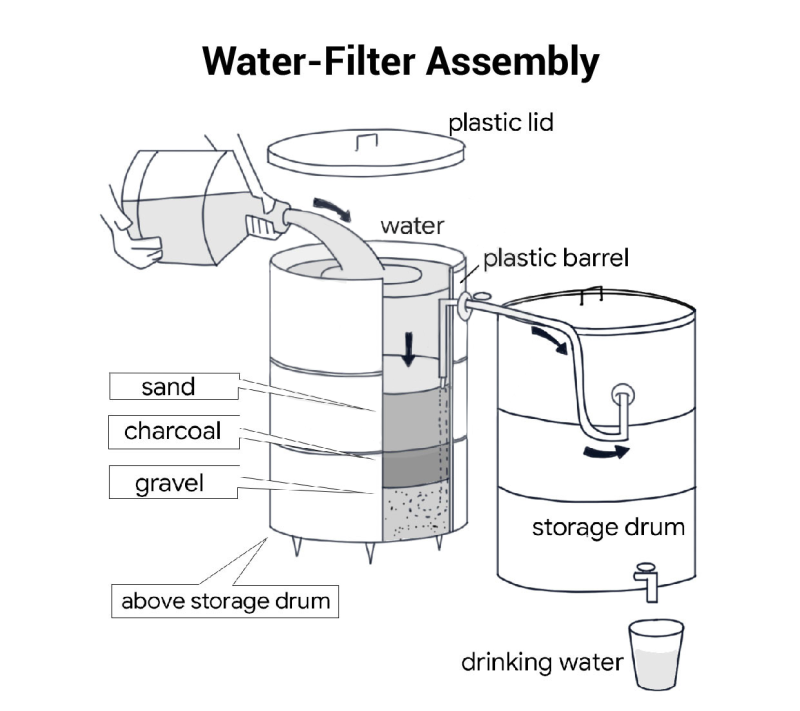
Water Filter – IELTS reading practice test
(A) An ingenious invention is set to bring clean water to the third world, and while the science may be cutting edge, the materials are extremely down to earth. A handful of clay, yesterday’s coffee grounds and some cow manure are the ingredients that could bring clean, safe drinking water to much of the third world.
(B) The simple new technology, developed by ANU materials scientist Mr. Tony Flynn, allows water filters to be made from commonly available materials and fired on the ground using cow manure as the source of heat, without the need for a kiln. The filters have been tested and shown to remove common pathogens (disease-producing organisms) including E-coli. Unlike other water filtering devices, the filters are simple and inexpensive to make.
(C) The production of the filters is extremely simple. Take a handful of dry, crushed clay, mix it with a handful of organic material, such as used tea leaves, coffee grounds or rice hulls, add enough water to make a stiff biscuit-like mixture and form a cylindrical pot… then dry it in the sun. … Next, surround the pots with straw; put them in a mound of cow manure, light the straw and then top up the burning manure as required. In less than 60 minutes the filters are finished. The walls of the finished pot should be about as thick as an adult’s index. The properties of cow manure are vital as the fuel can reach a temperature of 700 degrees in half an hour and will be up to 950 degrees after another 20 to 30 minutes.
(D) “A potter’s kiln is an expensive item and can could take up to four or five hours to get up to 800 degrees. It needs expensive or scarce fuel… With no technology, no insulation and nothing other than a pile of cow manure and a match, none of these restrictions apply,” Mr. Flynn says.
(E) It is also helpful that, like terracotta clay and organic material, cow dung is freely available across the developing world… the porosity of clay is something that potters have known about for years… The difference is that rather than viewing the porous nature of the material as a problem… his filters capitalize on this property.
(F) Other commercial ceramic filters do exist, but, even if available, with prices starting at US$5 each, they are often outside the budgets of most people in the developing world. The filtration process is simple, but effective. The basic principle is that there are passages through the filter that are wide enough for water droplets to pass through, but too narrow for pathogens. Tests with the deadly E-coli bacterium have seen the filters remove 96.4 to 99.8 per cent of the pathogen — well within safe levels.
(G) The invention was born out of a World Vision project involving the Manatuto community in East Timor. The charity wanted to help set up a small industry manufacturing water filters, but initial research found the local clay to be too fine — a problem solved by the addition of organic material. While the problems of producing a working ceramic filter in East Timor were overcome, the solution was kiln-based and particular to that community’s materials and couldn’t be applied elsewhere. Manure firing, with no requirement for a kiln, has made this zero technology approach available anywhere it is needed. With all the components being widely available, Mr. Flynn says there is no reason the technology couldn’t be applied throughout the developing world, and with no plans to patent his idea, there will be no legal obstacles to it being adopted in any community that needs it. “Everyone has a right to clean water…” says Mr. Flynn.
Câu hỏi
Questions 14-19 (Flow Chart Completion) Complete the flow chart, using NO MORE THAN TWO WORDS from the Reading Passage for each answer.
Guide to Making Water Filters
- Step one: combination of 14………..and organic material, with sufficient 15……….to create a thick mixture -> sun dried
- Step two: pack 16……….around the cylinders -> place them in 17………..which is used as burning fuel for firing (maximum temperature: 18………..) -> filter being baked in under 19……….
Questions 20-23 (True/False/Not Given)
20. It takes half an hour for the manure to reach 950 degrees.
21. Clay was initially found to be unsuitable for pot making.
22. Coffee grounds are twice as effective as other materials.
23. E-coli is the most difficult bacteria to combat.
Questions 24-26 (Multiple Choice)
24. When making the pot, the thickness of the wall
A. is large enough to let the pathogens to pass.
B. varied according to the temperature of the fuel.
C. should be the same as an adult’s forefinger.
D. is not mentioned by Mr. Flynn.
25. What is true about the charity, it
A. failed in searching the appropriate materials.
B. successfully manufactured a kiln based ceramic filter to be sold worldwide.
C. found that the local clay was good enough.
D. intended to help build a local filter production factory.
26. Mr. Flynn’s design is purposely not being patented
A. because he hopes it can be freely used around the world.
B. because he doesn’t think the technology is perfect enough.
C. because there are some legal obstacles.
D. because the design has already been applied thoroughly.
Tóm tắt nội dung bài đọc Water Filter
Bài đọc giới thiệu về một phát minh đột phá của nhà khoa học Tony Flynn: một bộ lọc nước đơn giản, giá rẻ có thể được sản xuất ở bất cứ đâu tại các nước đang phát triển. Phát minh này sử dụng các vật liệu dễ kiếm như đất sét, bã cà phê và đặc biệt là phân bò khô làm nhiên liệu. Quy trình sản xuất không cần đến lò nung đắt tiền, chỉ cần nung các bình lọc bằng đất sét trong một đống phân bò đang cháy, vốn có thể đạt nhiệt độ rất cao.
Bộ lọc hoạt động dựa trên nguyên lý độ xốp, cho phép nước đi qua nhưng giữ lại các mầm bệnh nguy hiểm như E-coli. Ý tưởng này ra đời từ một dự án ở Đông Timor và được phát triển để có thể áp dụng rộng rãi. Tác giả không có ý định đăng ký bằng sáng chế với mong muốn mọi người đều có quyền tiếp cận nước sạch.
Từ vựng và cấu trúc hay trong bài
- Ingenious (tính từ): Tinh xảo, khéo léo, tài tình.
- Down to earth (thành ngữ): Rất thực tế, giản dị.
- Pathogens (danh từ): Mầm bệnh, vi sinh vật gây bệnh.
- Porosity (danh từ): Độ xốp (khả năng có các lỗ nhỏ li ti cho chất lỏng/khí đi qua).
- Capitalize on (động từ): Tận dụng (một cách hiệu quả).
- Kiln (danh từ): Lò nung (gạch, gốm).
- Patent (động từ/danh từ): Đăng ký bằng sáng chế / Bằng sáng chế.
- Legal obstacles (cụm danh từ): Những trở ngại về mặt pháp lý.
Gợi ý đáp án bài đọc và giải thích chi tiết
Questions 14-19
14. clay
- Dẫn chứng (Đoạn C): “Take a handful of dry, crushed clay, mix it with a handful of organic material…”
- Giải thích: Bước đầu tiên là kết hợp (“combination”) “đất sét” (“clay”) và vật liệu hữu cơ.
15. water
- Dẫn chứng (Đoạn C): “…add enough water to make a stiff biscuit-like mixture…”
- Giải thích: Cần đủ “nước” (“water”) để tạo ra một hỗn hợp đặc.
16. straw
- Dẫn chứng (Đoạn C): “Next, surround the pots with straw…”
- Giải thích: Bước tiếp theo là bọc “rơm” (“straw”) xung quanh các bình gốm.
17. cow manure
- Dẫn chứng (Đoạn C): “…put them in a mound of cow manure…”
- Giải thích: Các bình gốm được đặt vào một đống “phân bò” (“cow manure”) để nung.
18. 950 degrees
- Dẫn chứng (Đoạn C): “…and will be up to 950 degrees after another 20 to 30 minutes.”
- Giải thích: Đây là nhiệt độ tối đa mà nhiên liệu có thể đạt tới.
19. 60 minutes
- Dẫn chứng (Đoạn C): “In less than 60 minutes the filters are finished.”
- Giải thích: Quá trình nung và hoàn thành bộ lọc diễn ra trong vòng dưới 60 phút.
Questions 20-23
20. FALSE
- Dẫn chứng (Đoạn C): “…can reach a temperature of 700 degrees in half an hour and will be up to 950 degrees after another 20 to 30 minutes.”
- Giải thích: Phân bò cần nửa giờ để đạt 700 độ, và thêm 20-30 phút nữa để đạt 950 độ (tổng cộng 50-60 phút). Do đó, việc nói nó chỉ cần nửa giờ để đạt 950 độ là sai.
21. TRUE
- Dẫn chứng (Đoạn G): “…initial research found the local clay to be too fine — a problem solved by the addition of organic material.”
- Giải thích: Ban đầu (“initially”), đất sét địa phương được cho là “quá mịn” (“too fine”), tức là không phù hợp (“unsuitable”).
22. NOT GIVEN
- Dẫn chứng (Đoạn C): “According to Mr. Flynn, used coffee grounds have given the best results to date.”
- Giải thích: Bài đọc nói bã cà phê cho kết quả tốt nhất, nhưng không hề so sánh định lượng nó hiệu quả “gấp đôi” (“twice as effective”) so với các vật liệu khác.
23. NOT GIVEN
- Dẫn chứng (Đoạn F): “Tests with the deadly E-coli bacterium have seen the filters remove 96.4 to 99.8 per cent of the pathogen…”
- Giải thích: Bài đọc lấy E-coli làm ví dụ về một loại vi khuẩn nguy hiểm mà bộ lọc có thể xử lý, chứ không hề nói nó là loại “khó tiêu diệt nhất” (“most difficult to combat”).
Questions 24-26
24. C. should be the same as an adult’s forefinger.
- Dẫn chứng (Đoạn C): “The walls of the finished pot should be about as thick as an adult’s index.”
- Giải thích: “Index” là một từ khác của “forefinger” (ngón trỏ).
25. D. intended to help build a local filter production factory.
- Dẫn chứng (Đoạn G): “The charity wanted to help set up a small industry manufacturing water filters…”
- Giải thích: “Industry manufacturing water filters” (nền công nghiệp sản xuất bộ lọc nước) đồng nghĩa với “a local filter production factory” (một nhà máy sản xuất bộ lọc tại địa phương).
26. A. because he hopes it can be freely used around the world.
- Dẫn chứng (Đoạn G): “…with no plans to patent his idea, there will be no legal obstacles to it being adopted in any community that needs it.”
- Giải thích: Việc không đăng ký bằng sáng chế là để không có rào cản pháp lý nào ngăn cản công nghệ này được áp dụng ở bất kỳ đâu, có nghĩa là ông muốn nó được sử dụng một cách tự do.
Kết bài
Bài đọc “Water Filter” là một ví dụ tuyệt vời về cách IELTS sử dụng các chủ đề thực tế về khoa học và đổi mới xã hội. Qua việc phân tích bài đọc, chúng ta đã thực hành nhuần nhuyễn ba dạng bài quan trọng: điền quy trình, True/False/Not Given và trắc nghiệm. Bài học rút ra là hãy luôn đọc kỹ yêu cầu về giới hạn từ và chú ý đến các chi tiết nhỏ trong bài để xác minh thông tin. Hy vọng rằng, với những phân tích chi tiết từ ECE, bạn sẽ tự tin hơn khi đối mặt với các bài đọc tương tự.
Mời bạn tham khảo thêm đáp án một số đề IELTS Reading khác:
Flying Tortoises IELTS Reading
Fatal Attraction IELTS Reading

Đoàn Nương
Tôi là Đoàn Nương - Giám đốc trung tâm ngoại ngữ ECE. Tôi hiện đang là giảng viên của khoa ngôn ngữ các nước nói tiếng Anh - Trường Đại Học Quốc Gia Hà Nội. Tôi đã có 19 năm kinh nghiệm giảng dạy IELTS và 15 năm là giảng viên Đại Học. Tôi mong muốn đưa ECE trở thành trung tâm ngoại ngữ cho tất cả mọi người, mang tới cho học viên môi trường học tập tiếng Anh chuyên nghiệp và hiệu quả.
Tìm hiểu các khóa học tại ECE
Tin Tức Cùng Danh Mục

The Concept of Childhood in Western Countries IELTS Reading: Dịch & giải chi tiết
The Magic of Kefir IELTS Reading: Dịch bài đọc & đáp án chuẩn
The Columbian Exchange IELTS Reading: Dịch & giải chi tiết A-Z
Giải mã bài đọc: Complementary & alternative medicine IELTS Reading

Stadium Australia IELTS Reading: Giải chi tiết & Dịch nghĩa
Các tin liên quan
The Concept of Childhood in Western Countries IELTS Reading: Dịch & giải chi tiết
The Magic of Kefir IELTS Reading: Dịch bài đọc & đáp án chuẩn
The Columbian Exchange IELTS Reading: Dịch & giải chi tiết A-Z
Giải mã bài đọc: Complementary & alternative medicine IELTS Reading
Stadium Australia IELTS Reading: Giải chi tiết & Dịch nghĩa

Television and Sport IELTS Reading: Dịch chuẩn & Giải đề chi tiết
The Invention of Television IELTS Reading: Từ vựng & đáp án chuẩn
Frogwatch IELTS Reading: Bài dịch & đáp án chuẩn nhất

Consecutive and Simultaneous Translation IELTS Reading: Dịch chuẩn & Giải chi tiết

Fears IELTS Reading: Bản dịch chuẩn & giải chi tiết từ A-Z
Memory and Age IELTS Reading: Dịch chuẩn & Giải chi tiết
Đáp án & từ vựng bài đọc Photovoltaics on the rooftop IELTS Reading




Lượt Đăng Ký

NHẬN TƯ VẤN NGAY
Vui lòng để lại thông tin để được tư vấn chi tiết lộ trình học và thi IELTS ở trên
