
IELTS Reading: The Cane Toad in Australia – Cóc mía ở Úc



Tóm Tắt Nội Dung Bài Viết
IELTS Reading: The Cane Toad in Australia – Cóc mía ở Úc


Tóm Tắt Nội Dung Bài Viết
Bài đọc “The Cane Toad in Australia” là một tài liệu hay trong IELTS Reading, mô tả câu chuyện về cóc mía – một loài động vật xâm lấn đã gây ra những hậu quả nghiêm trọng cho môi trường Úc. Bài viết này của trung tâm ngoại ngữ ECE sẽ phân tích chi tiết từ đặc điểm sinh học đến tác động môi trường của loài cóc này, đồng thời cung cấp hướng dẫn giải các dạng câu hỏi một cách hiệu quả. Mời các bạn cùng theo dõi!
IELTS Reading: The Cane Toad in Australia
The Cane Toad in Australia
Paragraph A
The cane toad was introduced into Australia in 1935 to control sugar cane pests in Queensland. One hundred and one cane toads arnved at Edmonton in June in 1935. Breeding occurred almost immediately. The cane toad is tough and adaptable, as well as being poisonous throughout Its life cycle, and has few predators in Australia.
Paragraph B
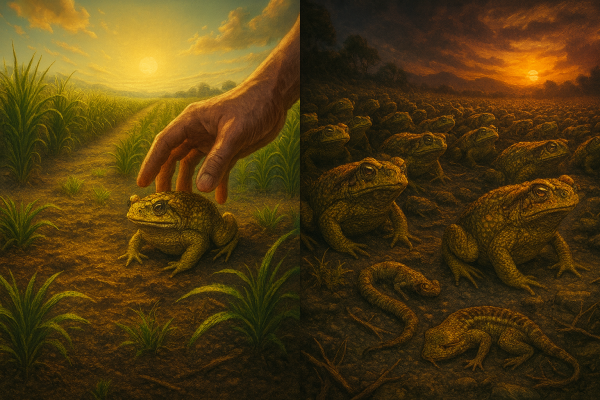
Cane toads are large heavily-built amphibians with dry, warty skin. They have a bony head and over their eyes are bony ndges that meet above the nose They sit upright and move in short rapid hops. Their hind feet have leathery webbing between the toes and their front feet are unwebbed. Adult cane toads have large swellings – the parotoid glands – on each shoulder behind the eardrum. Cane toads may be grey, yellowish, olive-brown or reddish-brown, and their bellies are pale with dark mottling. Average-sized adults are ten to fifteen centimetres long. The largest female measured in Queensland was twenty-four centimetres long and weighed one point three kilograms Male cane toads are smaller and wartier than females. Dunng the breeding season males develop dark lumps (nuptial pads) on their first two fingers; these help them cling to a female while mating. Their mating call is a long loud purnng tnll. Cane toad spawn is exclusive in Australia. It is laid in long strings of transparent jelly enclosing double rows of black eggs The spawn tangles in dense dark masses around water plants, and hangs in ropy strands if picked up.
Paragraph C
The natural range of cane toads extends from the southern United States to tropical South Amenca. In 2002, cane toads occurred throughout the eastern and northern half of Queensland and have extended their range to the river catchments surrounding Kakadu National Park in the Northern Temtory. In New South Wales, they occur as far south as Yamba and Port Macquarie.
Paragraph D
Cane toads tolerate a broad range of environmental and climatic conditions and appear to be able to adjust and survive in almost any environment system, including sea water for short penods of time. This to a large extent explains their success in their spreading in Australia. Cane toads are found in environments ranging from sand dunes and coastal heath to the margins of rainforest and mangroves. They are most abundant in open clearings in urban areas, and in grassland and woodland.
Paragraph E
Cane toads eat almost anything they can swallow, including pet food, carrion and household scraps, but most of their food consists of living insects Beetles, honey bees. ants, winged termites, cnckets and bugs are eaten in abundance Marine snails, smaller toads and native
frogs, small snakes, and small mammals are occasionally eaten by cane toads. The tadpoles of cane toads eat algae and other aquatic plants which they rasp off with five rows of tiny peg-like teeth. They also filter organic matter from the water. Large tadpoles sometimes eat cane toad eggs
Paragraph F
Cane toads were introduced to Australia to eat French s Cane Beetle and the Greyback Cane Beetle The whitegrub larvae of these beetles eat the roots of sugar cane and kill or stunt the plants. The Australian Bureau of Sugar Experimental Stations imported about a hundred toads from Hawaii to the Meringa Experimental Station near Cairns. The toads bred quickly and more than three thousand were released in the sugar cane plantations of north Queensland in July 1935. At that time, some naturalists and scientists warned of the dangers of liberating cane toads in Australia. Their protests resulted in a brief moratohum on the release of toads, but releases resumed in 1936. The protestors were right. Firstly, cane toads compete for the resources of native animals, like food, which affects native populations. Secondly, cane toads don’t have as many established predators as native animals and so their population grows quickly. Finally, some native animals who would normally feed on frogs try to eat toads and get poisoned.
Paragraph G
All stages of the cane toad’s life-cycle are poisonous. No humans have died in Australia from cane toad poison, but overseas, people have died after eating toads and even soup made from boiled toad eggs Cane toads are also poisonous to pets. In Hawaii, up to fifty dogs a year have died after having cane toads in their mouths Signs of dogs being poisoned through ingestion include profuse salivation, twitching, vomiting, shallow breathing, and collapse of the hind limbs. Death may occur by cardiac arrest within fifteen minutes. A cane toad responds to threat by turning side-on so Its parotoid glands are directed towards the attacker. The poison usually oozes out of the glands, but toads can squirt a fine spray for a short distance if they want. The poison is absorbed through mucous membranes such as eyes, mouth and nose, and in humans may cause intense pain, temporary blindness and inflammation
Questions 1 – 6
The reading passage The Cane Toad in Australia has paragraphs (A – G).
From the list of headings below (i – X) choose the most suitable headings for paragraphs B – G
Write the appropriate number (i – X) in boxes 1-6 on your answer sheet.
NB There are more headings than paragraphs, so you will not use them all
| Example | Answer |
| Paragraph A | v |
| i | Diet |
| ii | Habitat |
| iii | Pollution Effects |
| iv | Danger |
| V | Arrival In Australia |
| Vi | Food for Snakes |
| vii | Identification |
| viii | Captivity |
| ix | Distribution |
| x | Environmental Impacts |
| 1 | Paragraph B |
| 2 | Paragraph C |
| 3 | Paragraph D |
| 4 | Paragraph E |
| 5 | Paragraph F |
| 6 | Paragraph G |
Questions 7-10
Reading Passage The Cane Toad in Australia, has 7 paragraphs (A – G). Which paragraphs offer information on the following ideas? Write the appropriate letters (A – G) in boxes 7-10 on your answer sheet.
7 Male cane toads grow protuberances dunng mating penods.
8 The cane toad’s unique way of laying eggs in Australia.
9 Opposition to Vie introduction of cane toads in Australia.
10 The danger of eating cane toad eggs
Questions 11-13
Complete each of the following statements (Questions 11-13) with words taken from the box below.
Write your answers in boxes 38 – 40 on your answer sheet.
11. When suspended, the eggs of the cane toad resemble 11
12. Cane toads were introduced into Australia in order to stop beetle young eating sugar cane 12
13. The text says that dogs affected by cane toad poisoning may have problems with 13
| flowers | heanng | hair | walking |
| leaves | roots | smelling | tadpoles |
| stalks | rope | seeds | sleeping |
Tổng quan về nội dung bài đọc
Bài đọc “The Cane Toad in Australia” kể về một câu chuyện khoa học đầy phức tạp và đáng tiếc về việc con người can thiệp vào hệ sinh thái.
- Đoạn A giới thiệu lý do và thời điểm cóc mía được đưa vào Úc (năm 1935) để kiểm soát sâu hại mía, cùng với đặc điểm thích nghi và độc tố của chúng.
- Đoạn B mô tả chi tiết về ngoại hình và các đặc điểm nhận dạng của cóc mía, bao gồm kích thước, màu sắc, các tuyến độc và cách chúng sinh sản.
- Đoạn C nói về phạm vi phân bố tự nhiên của cóc mía (từ Mỹ đến Nam Mỹ) và sự lan rộng nhanh chóng của chúng ở Úc.
- Đoạn D giải thích khả năng thích nghi đáng kinh ngạc của cóc mía với nhiều môi trường và điều kiện khí hậu khác nhau, từ sa mạc đến rừng ngập mặn, lý giải cho sự thành công của chúng.
- Đoạn E trình bày chế độ ăn uống đa dạng của cóc mía, từ côn trùng, động vật nhỏ đến cả thức ăn thừa của con người.
- Đoạn F đi sâu vào lý do ban đầu của việc du nhập cóc mía, những cảnh báo từ các nhà khoa học, và những tác động tiêu cực mà chúng đã gây ra cho hệ sinh thái bản địa.
- Đoạn G tập trung vào độc tố của cóc mía, mức độ nguy hiểm đối với động vật và con người, cùng với các triệu chứng khi bị nhiễm độc.
Từ vựng & cấu trúc hay trong bài đọc The Cane Toad in Australia
Gợi ý đáp án kèm giải thích chi tiết
a. Dạng bài: Matching Headings (Nối tiêu đề với đoạn văn)
- Câu 1 (Đoạn B):
Phân tích: Đoạn B mô tả chi tiết về đặc điểm ngoại hình, màu sắc và cấu tạo cơ thể của cóc mía. Đây là những thông tin giúp nhận biết chúng.
Đáp án: vii. Identification.
- Câu 2 (Đoạn C):
Phân tích: Đoạn C nói về phạm vi phân bố tự nhiên và sự lan rộng của cóc mía ở Úc.
Đáp án: ix. Distribution.
- Câu 3 (Đoạn D):
Phân tích: Đoạn D giải thích khả năng thích nghi và sống sót của cóc mía trong nhiều môi trường khác nhau.
Đáp án: ii. Habitat.
- Câu 4 (Đoạn E):
Phân tích: Đoạn E liệt kê các loại thức ăn mà cóc mía tiêu thụ, từ côn trùng đến động vật nhỏ.
Đáp án: i. Diet.
- Câu 5 (Đoạn F):
Phân tích: Đoạn F trình bày mục đích ban đầu khi đưa cóc mía vào và những tác động tiêu cực mà chúng gây ra cho môi trường.
Đáp án: x. Environmental Impacts.
- Câu 6 (Đoạn G):
Phân tích: Đoạn G nói về độc tố của cóc mía, mức độ nguy hiểm đối với con người, thú cưng và các triệu chứng ngộ độc.
Đáp án: iv. Danger.
b. Dạng bài: Matching Paragraph (Nối ý với đoạn văn)
- Câu 7:
Male cane toads grow protuberances during mating periods.
Vị trí: Đoạn B nói “Dunng the breeding season males develop dark lumps (nuptial pads) on their first two fingers…”
Đáp án: B.
- Câu 8:
The cane toad's unique way of laying eggs in Australia.
Vị trí: Đoạn B nói “Cane toad spawn is exclusive in Australia. It is laid in long strings of transparent jelly…”
Đáp án: B.
- Câu 9:
Opposition to Vie introduction of cane toads in Australia.
Vị trí: Đoạn F nói “…some naturalists and scientists warned of the dangers of liberating cane toads in Australia. Their protests resulted in a brief moratorium…”
Đáp án: F.
- Câu 10:
The danger of eating cane toad eggs
Vị trí: Đoạn G nói “…overseas, people have died after eating toads and even soup made from boiled toad eggs.”
Đáp án: G.
c. Dạng bài: Sentence Completion (Hoàn thành câu)
- Câu 11:
When suspended, the eggs of the cane toad resemble 11
Vị trí: Đoạn B nói “The spawn tangles in dense dark masses around water plants, and hangs in ropy strands if picked up.” Từ “ropy strands” có nghĩa là “sợi dây thừng”.
Đáp án: ropes (từ ropy mang nghĩa “giống như sợi dây thừng” nên ropy strands là những sợi dây thừng).
- Câu 12:
Cane toads were introduced into Australia in order to stop beetle young eating sugar cane 12
Vị trí: Đoạn F nói “The whitegrub larvae of these beetles eat the roots of sugar cane and kill or stunt the plants.”
Đáp án: roots.
- Câu 13:
The text says that dogs affected by cane toad poisoning may have problems with 13
Vị trí: Đoạn G nói “Signs of dogs being poisoned through ingestion include profuse salivation, twitching, vomiting, shallow breathing, and collapse of the hind limbs.” Từ “collapse of the hind limbs” (sự sụp đổ của chi sau) ám chỉ vấn đề về khả năng đi lại.
Đáp án: walking.
Bài đọc “The Cane Toad in Australia” không chỉ là một bài luyện tập IELTS mà còn là một câu chuyện sinh học và môi trường đầy ý nghĩa. Nó minh họa một cách rõ nét những hậu quả không lường trước được của việc can thiệp vào hệ sinh thái một cách thiếu hiểu biết. Bằng cách nắm vững cấu trúc bài đọc, nhận diện từ vựng chuyên ngành và áp dụng kỹ năng làm bài, bạn không chỉ đạt được điểm số cao mà còn mở rộng tầm nhìn về các vấn đề môi trường toàn cầu.
Mời bạn tham khảo thêm một số bài mẫu IELTS Reading được ECE biên soạn và tổng hợp:
How stress affects your judgement

Đoàn Nương
Tôi là Đoàn Nương - Giám đốc trung tâm ngoại ngữ ECE. Tôi hiện đang là giảng viên của khoa ngôn ngữ các nước nói tiếng Anh - Trường Đại Học Quốc Gia Hà Nội. Tôi đã có 19 năm kinh nghiệm giảng dạy IELTS và 15 năm là giảng viên Đại Học. Tôi mong muốn đưa ECE trở thành trung tâm ngoại ngữ cho tất cả mọi người, mang tới cho học viên môi trường học tập tiếng Anh chuyên nghiệp và hiệu quả.
Tìm hiểu các khóa học tại ECE
Tin Tức Cùng Danh Mục

The Concept of Childhood in Western Countries IELTS Reading: Dịch & giải chi tiết

The Magic of Kefir IELTS Reading: Dịch bài đọc & đáp án chuẩn
The Columbian Exchange IELTS Reading: Dịch & giải chi tiết A-Z

Giải mã bài đọc: Complementary & alternative medicine IELTS Reading

Stadium Australia IELTS Reading: Giải chi tiết & Dịch nghĩa
Các tin liên quan
The Concept of Childhood in Western Countries IELTS Reading: Dịch & giải chi tiết
The Magic of Kefir IELTS Reading: Dịch bài đọc & đáp án chuẩn
The Columbian Exchange IELTS Reading: Dịch & giải chi tiết A-Z
Giải mã bài đọc: Complementary & alternative medicine IELTS Reading
Stadium Australia IELTS Reading: Giải chi tiết & Dịch nghĩa

Television and Sport IELTS Reading: Dịch chuẩn & Giải đề chi tiết

The Invention of Television IELTS Reading: Từ vựng & đáp án chuẩn
Frogwatch IELTS Reading: Bài dịch & đáp án chuẩn nhất

Consecutive and Simultaneous Translation IELTS Reading: Dịch chuẩn & Giải chi tiết
Fears IELTS Reading: Bản dịch chuẩn & giải chi tiết từ A-Z
Memory and Age IELTS Reading: Dịch chuẩn & Giải chi tiết

Đáp án & từ vựng bài đọc Photovoltaics on the rooftop IELTS Reading




Lượt Đăng Ký

NHẬN TƯ VẤN NGAY
Vui lòng để lại thông tin để được tư vấn chi tiết lộ trình học và thi IELTS ở trên
