
IELTS Speaking topic dictionary: Từ vựng, cấu trúc & bài mẫu 8.5+



Tóm Tắt Nội Dung Bài Viết
IELTS Speaking topic dictionary: Từ vựng, cấu trúc & bài mẫu 8.5+


Tóm Tắt Nội Dung Bài Viết
Chủ đề “Dictionary” (từ điển) là một trong những đề tài thường xuyên xuất hiện trong bài thi IELTS Speaking. Nó không chỉ yêu cầu bạn mô tả một vật dụng quen thuộc mà còn là cơ hội để bạn thảo luận về tầm quan trọng của nó trong việc học ngôn ngữ. Để gây ấn tượng với giám khảo và đạt band điểm cao, bạn cần thể hiện khả năng sử dụng ngôn ngữ học thuật, phong phú, cùng tư duy phân tích sâu sắc.
Bài viết này được biên soạn dựa trên tài liệu chuyên sâu của cô Nguyễn Thu Hà (Giáo viên 8.0 IELTS tại ECE), sẽ cung cấp cho bạn mọi thứ cần thiết: những từ vựng C1 – C2 chuyên ngành, bài mẫu chi tiết cho cả 3 phần Speaking, và chiến lược mở rộng câu trả lời hiệu quả. Mời các bạn cùng theo dõi!
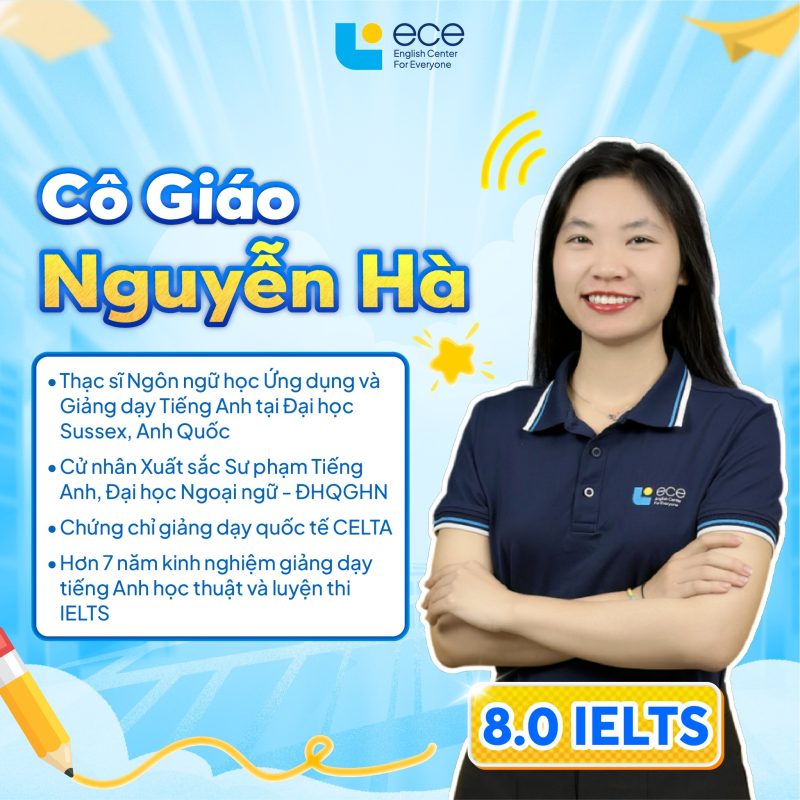
Cô Nguyễn Thu Hà – Giáo viên 8.0 IELTS tại trung tâm ngoại ngữ ECE
Từ vựng & cấu trúc ăn điểm cho topic dictionary IELTS Speaking
Để gây ấn tượng với giám khảo, bạn hãy thay thế những từ ngữ đơn giản bằng các thuật ngữ và cụm từ nâng cao (collocation, idiom, phrasal verb) liên quan đến ngôn ngữ học và học tập.
| Từ vựng / Cụm từ | Nghĩa tiếng Việt | Ví dụ áp dụng trong câu |
| A comprehensive resource | Một nguồn tài liệu toàn diện | A good dictionary serves as a comprehensive resource for language learners. |
| Lexical items | Các mục từ vựng, các từ riêng lẻ | I often look up new lexical items to expand my vocabulary. |
| Nuances of meaning | Các sắc thái, ý nghĩa tinh tế của từ | An advanced dictionary helps me understand the subtle nuances of meaning between synonyms. |
| To consult a dictionary | Tra cứu từ điển (cách nói trang trọng hơn “look up”) | Before using a new word in my essay, I always consult a dictionary. |
| To bridge the gap between… | Thu hẹp khoảng cách giữa… | Online dictionaries help bridge the gap between native speakers and learners. |
| Word formation | Sự hình thành từ (tiền tố, hậu tố, v.v.) | I find the section on word formation particularly useful for academic writing. |
| An indispensable tool | Một công cụ không thể thiếu | The Oxford Learner’s Dictionary is an indispensable tool for non-native speakers. |
| To foster language autonomy | Thúc đẩy sự tự chủ ngôn ngữ (tự học hỏi) | Learning how to use a dictionary effectively can foster language autonomy. |
| Of paramount importance | Cực kỳ quan trọng | Mastering vocabulary is of paramount importance in language acquisition. |
| Physical book / Hard copy | Sách vật lý, sách giấy (bản in) | While I appreciate the feel of a physical book, the digital version is more efficient. |
| Appropriate register | Ngữ điệu/phong cách sử dụng thích hợp | The dictionary also guides me on the appropriate register for different words. |
| Invaluable asset | Tài sản vô giá | My dictionary has proven to be an invaluable asset throughout my language journey. |
| Rigorous explanations | Giải thích chặt chẽ, chính xác | Online dictionaries offer rigorous explanations that I can trust. |
| Obsolete | Lỗi thời | I highly doubt dictionaries will become obsolete, though their format is changing. |
| Niche item | Vật phẩm dành cho thị trường ngách | Printed dictionaries might become a niche item for collectors. |
| Integral part | Phần không thể thiếu | Dictionaries, in digital form, remain an integral part of language education. |
| Semantics | Ngữ nghĩa học | A dictionary is primarily concerned with semantics, providing definitions. |
| Lexical variation | Sự đa dạng từ vựng | A thesaurus focuses on lexical variation, offering synonyms. |
| Stylistic quality | Chất lượng phong cách viết | A thesaurus helps improve the stylistic quality of my writing. |
| Double-edged sword | Con dao hai lưỡi | Reliance on translation tools is a double-edged sword. |
| Deciphering the general gist | Hiểu ý chính chung | Translation tools are good for deciphering the general gist of a text. |
| Lower the barrier | Hạ thấp rào cản | Online tools certainly lower the barrier to communication. |
| Cultural context | Bối cảnh văn hóa | Translation tools often fail to capture the cultural context. |
| Linguistic authority | Cơ quan/nguồn có thẩm quyền về ngôn ngữ | Dictionaries are crucial as a linguistic authority for standardization. |
| Too fluid and chaotic | Quá lỏng lẻo và hỗn loạn | Without dictionaries, language would become too fluid and chaotic. |
| Time consumption | Sự tốn thời gian | The main difficulty with paper dictionaries is the sheer time consumption. |
| Limited accessibility | Khả năng truy cập bị hạn chế | Paper dictionaries suffer from limited accessibility. |
| Lack of multimedia | Thiếu các tính năng đa phương tiện | Digital dictionaries offer multimedia features that paper ones lack. |
| Paramount | Tối quan trọng | Audio pronunciation is paramount for mastering spoken English. |
Bài mẫu IELTS Speaking part 1 topic Dictionary
Phần 1 yêu cầu câu trả lời trực tiếp, rõ ràng, và có sử dụng từ vựng linh hoạt để gây ấn tượng ngay từ đầu.
Câu hỏi mẫu & Bài trả lời band 8.5
1. Do you use a dictionary?
Bài trả lời: Absolutely, it’s a daily necessity for me as a language learner. I primarily use a digital one, specifically the Oxford Learner’s Dictionary app. I consider it an indispensable tool for understanding complex texts and expanding my lexical items.
2. Which do you prefer: an electronic dictionary or a paper dictionary?
Bài trả lời: I definitely prefer the electronic version. While I appreciate the feel of a physical book, the digital version offers immediate access and features like audio pronunciation and quick searching, which makes consulting a dictionary much more efficient. It also allows me to copy and paste definitions easily.
3. Do you think it is important to use a dictionary?
Bài trả lời: Yes, it is of paramount importance. Beyond just providing definitions, a good dictionary helps you grasp the nuances of meaning of a word, understand its correct usage through examples, and learn about word formation. It helps bridge the gap between a basic vocabulary and an advanced one.
4. When was the first time you used a dictionary?
Bài trả lời: I believe it was back in elementary school, around the age of seven or eight. I remember being given a small, colorful Vietnamese-English dictionary. It was my first attempt at understanding a foreign language, and though I found it a bit cumbersome to use, it ignited my interest in language learning.
5. How often do you use a dictionary?
Bài trả lời: Quite frequently, especially when I’m reading academic papers or listening to podcasts. I’d say I consult it at least 15 to 20 times a day, not only for looking up unfamiliar words but also for checking collocations and the appropriate register for a word.
Bài mẫu IELTS Speaking part 2 topic Dictionary
Trong Part 2, các bạn hãy tập trung mô tả chi tiết, sử dụng các tính từ chuyên môn và cấu trúc câu đa dạng để thể hiện khả năng nói trôi chảy và mạch lạc.
Cue card mẫu 1 & Bài trả lời band 8.5
Describe a dictionary you often use.
You should say:
-
what kind of dictionary it is
-
how you use it
-
what you like most about it
-
and explain how it helps you in your studies.
Bài trả lời: I’d like to talk about the Cambridge Dictionary, which is my go-to resource. It’s an electronic dictionary, specifically the online version, which I use primarily on my laptop and smartphone. Unlike a general dictionary, this is a learner’s dictionary, meaning the definitions are written using a controlled, simpler vocabulary, making them easier for non-native speakers like myself to grasp.
I use it almost constantly. When reading an article, I use the pop-up feature to quickly check the meaning of unfamiliar words. For writing, I use it not only for definitions but more importantly for checking the context and appropriate register of the word. For instance, I use the synonym feature to find a more academic equivalent for a common word, and the example sentences help me see the word in action.
What I appreciate most is the depth of information it provides beyond a simple definition. It offers phonetic transcription, different verb tenses, and a very clear illustration of the collocations that naturally accompany the word.
Ultimately, this dictionary is an invaluable asset to my studies because it helps me move beyond simply translating words into truly understanding their function and usage in English. It fosters my language autonomy and allows me to tackle increasingly complex texts with confidence.
Cue card mẫu 2 & Bài trả lời band 8.5
Describe something you always use to help you learn English. (If you choose a dictionary)
You should say:
-
what this thing is
-
how long you have been using it
-
how it has changed over time
-
and why it is important for you.
Bài trả lời: I’d like to discuss my old Merriam-Webster’s Collegiate Dictionary, a large, thick print dictionary that I’ve had since my high school days. I’ve been using it, or at least the digital version of it, for over ten years now.
The way I use it has changed dramatically. Initially, I would only use the hard copy for definitions and sometimes to check the spelling. It was a time-consuming process. However, the online version I use today is a comprehensive resource. It has integrated thesaurus functionality, pronunciation guides, and even historical origins of words. The convenience of searching is revolutionary; I no longer have to flip through hundreds of pages but can instantly find the information I need.
This dictionary is important to me because it is a reliable and authoritative source. While I use Google for quick answers, the dictionary offers rigorous explanations that I can trust, especially regarding the subtle nuances of meaning needed for academic writing. It remains the foundation of my language learning and is the single most effective tool I have to ensure accuracy and precision in my use of English.
Bài mẫu IELTS Speaking part 3 topic Dictionary
Phần 3 yêu cầu khả năng phân tích, so sánh, và thảo luận về các vấn đề rộng hơn, thể hiện chiều sâu tư duy và vốn từ vựng học thuật.
Câu hỏi mẫu & Bài trả lời band 8.5 – 9.0
1. Do you think dictionaries will become obsolete one day?
Bài trả lời: I highly doubt they will become obsolete, but their format is certainly evolving. The physical, printed dictionary might become a niche item reserved for collectors or academics. However, the concept of the dictionary—a standardized, authoritative record of a language—is absolutely essential. Online platforms now fulfill this role, offering living dictionaries that can adapt instantly to new words and slang, ensuring they remain an integral part of language education.
2. What is the difference between a dictionary and a thesaurus?
Bài trả lời: That’s an interesting distinction. A dictionary is primarily concerned with semantics, providing definitions and context for a word. Its goal is to explain what a word means. Conversely, a thesaurus focuses on lexical variation, offering synonyms and sometimes antonyms. Its purpose is to help writers find the most precise word to express an idea, thus improving the stylistic quality of their writing. They are complementary tools, but serve different functions.
3. Do you think people should rely on online translation tools?
Bài trả lời: Reliance on translation tools is a double-edged sword. On one hand, they are fantastic for speed and for deciphering the general gist of a foreign text. They certainly lower the barrier to communication. However, they are poor at capturing the cultural context and, critically, fail to recognize the nuances of meaning I mentioned earlier. Over-reliance can hinder the natural development of language skills, preventing learners from building the mental framework necessary for true comprehension.
4. How can dictionaries help a country’s language development?
Bài trả lời: Dictionaries are crucial for language standardization. They act as a linguistic authority, documenting and legitimizing new words while preserving the older ones. By recording proper spelling, grammar, and usage, they slow down language fragmentation and ensure that the language remains mutually intelligible across different regions and generations. Without dictionaries, the language would rapidly become too fluid and chaotic.
5. What difficulties do people face when using a paper dictionary?
Bài trả lời: The most immediate difficulty is the sheer time consumption. Searching for a word in a paper dictionary is cumbersome compared to an instant digital search. Furthermore, they suffer from limited accessibility—you can only use them when you have the physical book. Crucially, they lack the multimedia features of their digital counterparts, such as audio pronunciation, which is paramount for mastering the spoken aspect of a language. If you need to check the collocations of a verb, you often have to manually search for multiple entries, whereas a digital dictionary can provide this information instantly.
Lời kết
Chủ đề “Dictionary” là một cơ hội vàng để bạn thể hiện vốn từ vựng học thuật phong phú và khả năng thảo luận sâu rộng. Bằng cách áp dụng những từ vựng C1 – C2, cấu trúc câu đa dạng và chiến lược mở rộng câu trả lời đã được ECE biên soạn, bạn sẽ dễ dàng đạt được điểm số cao trong bài thi IELTS Speaking. Hãy luyện tập thường xuyên để biến những từ khóa như “comprehensive resource,” “nuances of meaning,” và “language autonomy” thành một phần tự nhiên trong cách nói của bạn, từ đó chinh phục band điểm 8.5+ một cách tự tin nhất.
Mời bạn tham khảo thêm một số bài mẫu IELTS Speaking được các thầy cô ECE biên soạn & tổng hợp:
IELTS speaking topic Historical Places

Đoàn Nương
Tôi là Đoàn Nương - Giám đốc trung tâm ngoại ngữ ECE. Tôi hiện đang là giảng viên của khoa ngôn ngữ các nước nói tiếng Anh - Trường Đại Học Quốc Gia Hà Nội. Tôi đã có 19 năm kinh nghiệm giảng dạy IELTS và 15 năm là giảng viên Đại Học. Tôi mong muốn đưa ECE trở thành trung tâm ngoại ngữ cho tất cả mọi người, mang tới cho học viên môi trường học tập tiếng Anh chuyên nghiệp và hiệu quả.
Tìm hiểu các khóa học tại ECE
Tin Tức Cùng Danh Mục

The Concept of Childhood in Western Countries IELTS Reading: Dịch & giải chi tiết

The Magic of Kefir IELTS Reading: Dịch bài đọc & đáp án chuẩn
The Columbian Exchange IELTS Reading: Dịch & giải chi tiết A-Z

Giải mã bài đọc: Complementary & alternative medicine IELTS Reading

Stadium Australia IELTS Reading: Giải chi tiết & Dịch nghĩa
Các tin liên quan
The Concept of Childhood in Western Countries IELTS Reading: Dịch & giải chi tiết
The Magic of Kefir IELTS Reading: Dịch bài đọc & đáp án chuẩn
The Columbian Exchange IELTS Reading: Dịch & giải chi tiết A-Z
Giải mã bài đọc: Complementary & alternative medicine IELTS Reading
Stadium Australia IELTS Reading: Giải chi tiết & Dịch nghĩa

Television and Sport IELTS Reading: Dịch chuẩn & Giải đề chi tiết

The Invention of Television IELTS Reading: Từ vựng & đáp án chuẩn

Frogwatch IELTS Reading: Bài dịch & đáp án chuẩn nhất
Consecutive and Simultaneous Translation IELTS Reading: Dịch chuẩn & Giải chi tiết

Fears IELTS Reading: Bản dịch chuẩn & giải chi tiết từ A-Z
Memory and Age IELTS Reading: Dịch chuẩn & Giải chi tiết

Đáp án & từ vựng bài đọc Photovoltaics on the rooftop IELTS Reading




Lượt Đăng Ký

NHẬN TƯ VẤN NGAY
Vui lòng để lại thông tin để được tư vấn chi tiết lộ trình học và thi IELTS ở trên
