

IELTS Reading: Franklin’s Lost Expedition – Từ vựng & phân tích đáp án chi tiết



Tóm Tắt Nội Dung Bài Viết
IELTS Reading: Franklin’s Lost Expedition – Từ vựng & phân tích đáp án chi tiết


Tóm Tắt Nội Dung Bài Viết
Năm 1845, 129 nhà thám hiểm dũng cảm trên hai con tàu hiện đại nhất thời bấy giờ đã giong buồm vào Bắc Cực để tìm kiếm Con đường Tây Bắc huyền thoại… và rồi biến mất không một dấu vết. Điều gì đã xảy ra với họ? Bài đọc IELTS “Franklin’s Lost Expedition” không chỉ là một bài kiểm tra tiếng Anh, mà còn là một cuộc điều tra lịch sử đầy kịch tính, đưa chúng ta đi qua những giả thuyết, những cuộc tìm kiếm và những khám phá khoa học kéo dài hơn một thế kỷ. Hãy cùng ECE English vén màn bí ẩn này và chinh phục các dạng câu hỏi đầy thử thách của bài đọc.
Nội dung bài đọc & câu hỏi
Franklin’s Lost Expedition
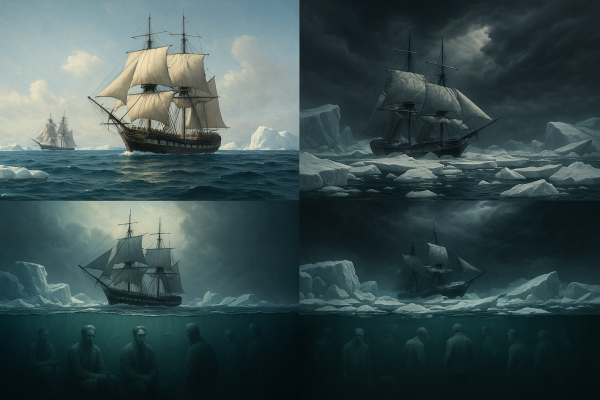
IELTS Reading: Franklin’s Lost Expedition
(A) What could have resulted in the deaths of 129 men and officers aboard the ship in Franklin’s lost expedition? … Sir John Franklin and his crew set sail from England in 1845 in search of the Northwest Passage, a sea route that was rumored to connect the continents of Europe and Asia. Two ships, HMS Erebus and HMS Terror, headed the expedition…
(B) All of these searches… were unsuccessful… That same year, searcher John Rae reported to the Admiralty that according to Inuit information and some discovered items, it seemed that Franklin and the crew had perished. In a desperate last attempt to survive, some may have even taken up cannibalism. Rae was given what would be about $400,000 Canadian dollars today as a reward.
(C) However, Lady Franklin did not give up there, and in 1857 she began commissioning another search with Leopold McClintock as its leader. It was McClintock who found many corpses on King William Island, along with a journal which outlined the journey… On May 1847… the ships were stuck in ice.
(D) Researchers, scientists and historians have continued to ponder this mystery for over 160 years. What had happened which had caused the men to abandon ship, rather than wait for the ice to melt? …
(E) In 1981, along the western coast of King William Island, the University of Alberta-led Franklin Expedition Forensic Anthropology Project dug up human remains. Forensic testing at the time suggested that the cause of death was likely either lead poisoning and scurvy. Lead poisoning has continued to persist as a possible explanation… However, proving this is not so simple, as surgeons’ journals (the “sick books”) which recorded illness on board have yet to be found.
(F) Still without Franklin sick books, a team of researchers from the University of Glasgow took up a study of the sick books of Royal Naval ships which were searching for Franklin. The search ships were equipped similarly, with the same provisions as Franklin’s vessels…
(G) …within the other search ships who had similar provisions, no evidence of lead poisoning was found, despite the relatively high exposure to lead that was unavoidable on ships of the era and within the overall British population. So, unless Franklin’s ships had a particular lead source, there is no substantial proof that lead poisoning had a role… patterns in illnesses led researchers to conclude that Franklin’s men would have suffered the same respiratory and gastrointestinal disorders, injuries and exposure… Moreover, the team suggested that the abnormally high number of deaths of Franklin’s officers was probably a result of non-medical circumstances such as accidents and injuries that happened when officers accepted the risky responsibility of hunting animals…
(H) It seems possible that the 2016 discovery by the Arctic Research Foundation made recently in the wreck of HMS Terror… could finally allow access to some first-hand evidence… If a ‘sick book’ has managed to survive aboard a ship, the events that led to the lost expedition may be revealed…
Câu hỏi
Questions 15 – 21
Do the following statements agree with the information given in the reading passage? In boxes 15-21 on your answer sheet, write
TRUE if the statement agrees with the information
FALSE if the statement contradicts the information
NOT GIVEN if there is no information on this.
15. Franklin’s lost expedition was a search party attempting to find Lady Jane Franklin.
16. John Rae suspected that Franklin’s lost expedition likely suffered from a food shortage aboard the ship.
17. The leaders of the search parties commissioned by Lady Franklin returned to England after some time.
18. It was common for people living in Britain during the 19th century to be exposed to lead.
19. Most of the crew aboard Franklin’s lost expedition were trained to hunt wild animals.
20. The most recent research from University of Glasgow suggests that some of the leaders of the crew on the Franklin expedition died from lead poisoning.
21. The research into the wreck of HMS Terror may shed light on the mystery of the lost expedition.
Questions 22 – 26
Complete the sentences below.
Choose NO MORE THAN THREE WORDS from the passage for each answer.
Write your answers in 22-26 on your answer sheet.
22. The Northwest Passage is a route which connects __________ by sea.
23. As a reward for seemingly having discovered the fate of the Franklin expedition, __________ was given an amount that would equal hundreds of thousands of Canadian dollars today.
24. Forensic testing available in the 80’s suggested that either __________ or lead poisoning led to the deaths of the crew in the Franklin expedition.
25. The __________ made by doctors aboard the ships in the Franklin expedition still have not been recovered.
26. Researchers have suggested that the leaders of Franklin’s crew might not have been ill, but could have died from __________ as a result of their behaviours.
Tóm tắt nội dung bài đọc Franklin’s Lost Expedition
Bài đọc tường thuật lại một trong những bí ẩn lớn nhất của lịch sử thám hiểm hàng hải.
- Sứ mệnh & Sự biến mất: Năm 1845, đoàn thám hiểm của Sir John Franklin lên đường tìm con đường Tây Bắc nối châu Âu và châu Á, nhưng rồi mất tích.
- Những cuộc tìm kiếm: Nhiều cuộc tìm kiếm đã được triển khai. John Rae là người đầu tiên báo cáo về cái chết của đoàn, dựa trên thông tin từ người Inuit, và cho rằng họ đã phải ăn thịt đồng loại để sinh tồn. Sau đó, McClintock tìm thấy các thi thể và một cuốn nhật ký xác nhận các con tàu đã bị kẹt trong băng.
- Giả thuyết khoa học: Bí ẩn lớn nhất là tại sao họ lại rời tàu. Các nhà khoa học đã đưa ra nhiều giả thuyết:
- Ngộ độc chì: Ban đầu được cho là nguyên nhân chính do các hộp đồ ăn được hàn bằng chì.
- Bệnh còi (Scurvy): Cũng là một khả năng được pháp y đề xuất.
- Các bệnh khác: Một nghiên cứu gần đây của Đại học Glasgow, bằng cách so sánh với các tàu tìm kiếm khác, cho rằng ngộ độc chì không phải là nguyên nhân chính. Thay vào đó, các bệnh về hô hấp, tim mạch và tai nạn khi đi săn mới là lời giải thích hợp lý hơn.
- Hy vọng mới: Việc phát hiện ra xác hai con tàu HMS Erebus (2014) và HMS Terror (2016) đã mở ra hy vọng tìm thấy các ghi chép trực tiếp, đặc biệt là sổ ghi chép bệnh tật (“sick books”), để giải mã bí ẩn này.
Tổng hợp từ vựng quan trọng trong bài đọc IELTS Franklin’s Lost Expedition
- Expedition (danh từ): Cuộc thám hiểm.
- Perished (động từ): Chết, thiệt mạng (thường trong một tai nạn hoặc điều kiện khắc nghiệt).
- Cannibalism (danh từ): Tục ăn thịt đồng loại.
- Dire (tính từ): Cực kỳ nghiêm trọng, tồi tệ.
- Ponder (động từ): Suy ngẫm, trầm tư.
- Forensic (tính từ): Thuộc về pháp y.
- Provisions (danh từ): Lương thực, thực phẩm dự trữ.
- Speculating (động từ): Suy đoán.
- Closure (danh từ): Sự khép lại, kết thúc (cho một vấn đề).
Đáp án bài đọc & phân tích chuyên sâu
15. FALSE
- Dẫn chứng (Đoạn A): “Sir John Franklin and his crew set sail from England in 1845 in search of the Northwest Passage…”
- Giải thích: Chuyến đi của Franklin là để tìm Con đường Tây Bắc, không phải là một nhóm tìm kiếm Lady Jane Franklin.
16. TRUE
- Dẫn chứng (Đoạn B): “In a desperate last attempt to survive, some may have even taken up cannibalism.”
- Giải thích: Việc ăn thịt đồng loại là một hành động tuyệt vọng, ngụ ý mạnh mẽ rằng họ đã bị thiếu lương thực trầm trọng.
17. NOT GIVEN
- Dẫn chứng (Đoạn B): “Collinson eventually found his way back to England, while McClure was found and returned back in 1854.”
- Giải thích: Bài đọc chỉ nói về McClure và Collinson, hai người dẫn đầu các cuộc tìm kiếm khác. Không có thông tin nào về việc người dẫn đầu cuộc tìm kiếm do Lady Franklin ủy nhiệm (Leopold McClintock – đoạn C) có trở về hay không.
18. TRUE
- Dẫn chứng (Đoạn G): “…the relatively high exposure to lead that was unavoidable on ships of the era and within the overall British population.”
- Giải thích: Câu này nói rõ rằng việc tiếp xúc với chì ở mức độ cao là không thể tránh khỏi đối với toàn bộ dân số Anh thời đó.
19. NOT GIVEN
- Dẫn chứng (Đoạn G): “…officers accepted the risky responsibility of hunting animals to provide food…”
- Giải thích: Bài đọc chỉ nói các sĩ quan chấp nhận rủi ro đi săn, không hề có thông tin nào cho biết “hầu hết” (“most”) thủy thủ đoàn có được “huấn luyện” (“trained”) để săn bắn hay không.
20. FALSE
- Dẫn chứng (Đoạn G): “…no evidence of lead poisoning was found… researchers to conclude that Franklin’s men would have suffered the same respiratory and gastrointestinal disorders… a result of non-medical circumstances such as accidents and injuries…”
- Giải thích: Nghiên cứu của Đại học Glasgow đã bác bỏ giả thuyết ngộ độc chì và đề xuất các nguyên nhân khác như bệnh tật và tai nạn.
21. TRUE
- Dẫn chứng (Đoạn H): “It seems possible that the 2016 discovery… could finally allow access to some first-hand evidence… the events that led to the lost expedition may be revealed…”
- Giải thích: Việc phát hiện ra xác tàu có thể cung cấp bằng chứng trực tiếp và “làm sáng tỏ” (“shed light on”) bí ẩn.
22. Europe and Asia
- Dẫn chứng (Đoạn A): “…a sea route that was rumored to connect the continents of Europe and Asia.”
23. John Rae
- Dẫn chứng (Đoạn B): “Rae was given what would be about $400,000 Canadian dollars today as a reward.”
24. scurvy
- Dẫn chứng (Đoạn E): “…suggested that the cause of death was likely either lead poisoning and scurvy.”
25. sick books
- Dẫn chứng (Đoạn E): “…surgeons’ journals (the “sick books”) which recorded illness on board have yet to be found.”
26. accidents and injuries
- Dẫn chứng (Đoạn G): “…a result of non-medical circumstances such as accidents and injuries that happened when officers accepted the risky responsibility of hunting animals…”
Bí ẩn về chuyến thám hiểm của Franklin là một câu chuyện hấp dẫn về lòng dũng cảm, bi kịch và nỗ lực không ngừng của khoa học để tìm ra sự thật. Về mặt kỹ năng, bài đọc này là một bài luyện tập tuyệt vời cho việc theo dõi một câu chuyện lịch sử phức tạp với nhiều mốc thời gian và giả thuyết đan xen. Nó đòi hỏi bạn phải đọc thật kỹ để phân biệt giữa thông tin được xác nhận, các giả thuyết và những gì hoàn toàn không được đề cập. Hy vọng rằng, qua cuộc “thám hiểm” vào bài đọc này cùng ECE, bạn đã trang bị thêm cho mình những kinh nghiệm quý báu để chinh phục kỳ thi IELTS.
Mời bạn tham khảo thêm một số bài mẫu IELTS Reading được ECE biên soạn và tổng hợp:
I Contain Multitudes IELTS Reading

Đoàn Nương
Tôi là Đoàn Nương - Giám đốc trung tâm ngoại ngữ ECE. Tôi hiện đang là giảng viên của khoa ngôn ngữ các nước nói tiếng Anh - Trường Đại Học Quốc Gia Hà Nội. Tôi đã có 19 năm kinh nghiệm giảng dạy IELTS và 15 năm là giảng viên Đại Học. Tôi mong muốn đưa ECE trở thành trung tâm ngoại ngữ cho tất cả mọi người, mang tới cho học viên môi trường học tập tiếng Anh chuyên nghiệp và hiệu quả.
Tìm hiểu các khóa học tại ECE
Tin Tức Cùng Danh Mục

The Concept of Childhood in Western Countries IELTS Reading: Dịch & giải chi tiết

The Magic of Kefir IELTS Reading: Dịch bài đọc & đáp án chuẩn
The Columbian Exchange IELTS Reading: Dịch & giải chi tiết A-Z

Giải mã bài đọc: Complementary & alternative medicine IELTS Reading

Stadium Australia IELTS Reading: Giải chi tiết & Dịch nghĩa
Các tin liên quan
The Concept of Childhood in Western Countries IELTS Reading: Dịch & giải chi tiết
The Magic of Kefir IELTS Reading: Dịch bài đọc & đáp án chuẩn
The Columbian Exchange IELTS Reading: Dịch & giải chi tiết A-Z
Giải mã bài đọc: Complementary & alternative medicine IELTS Reading
Stadium Australia IELTS Reading: Giải chi tiết & Dịch nghĩa

Television and Sport IELTS Reading: Dịch chuẩn & Giải đề chi tiết

The Invention of Television IELTS Reading: Từ vựng & đáp án chuẩn

Frogwatch IELTS Reading: Bài dịch & đáp án chuẩn nhất

Consecutive and Simultaneous Translation IELTS Reading: Dịch chuẩn & Giải chi tiết

Fears IELTS Reading: Bản dịch chuẩn & giải chi tiết từ A-Z
Memory and Age IELTS Reading: Dịch chuẩn & Giải chi tiết

Đáp án & từ vựng bài đọc Photovoltaics on the rooftop IELTS Reading




Lượt Đăng Ký

NHẬN TƯ VẤN NGAY
Vui lòng để lại thông tin để được tư vấn chi tiết lộ trình học và thi IELTS ở trên
