

IELTS Reading Elephant Communication – Bài đọc về cách loài voi giao tiếp



Tóm Tắt Nội Dung Bài Viết
IELTS Reading Elephant Communication – Bài đọc về cách loài voi giao tiếp


Tóm Tắt Nội Dung Bài Viết
Chủ đề về thế giới động vật, đặc biệt là các nghiên cứu khoa học chuyên sâu, là một mảng kiến thức thường xuyên xuất hiện trong IELTS Reading. Bài đọc “Elephant Communication” là một ví dụ điển hình, đi sâu vào cách loài voi giao tiếp bằng những phương pháp phức tạp và đáng kinh ngạc. Bài viết này của trung tâm ngoại ngữ ECE sẽ cung cấp cho bạn toàn bộ nội dung bài đọc, hệ thống câu hỏi, đáp án kèm giải thích chi tiết, và phân tích các từ vựng học thuật quan trọng.
Bài đọc và Câu hỏi chi tiết: Elephant Communication
Nội dung bài đọc
(Paragraph A) A postdoctoral fellow at Stanford University, O’Connell Rodwell has come to Namibia’s premiere wildlife sanctuary to explore the mysterious and complex world of elephant communication. She and her colleagues are part of a scientific revolution that began nearly two decades ago with the stunning revelation that elephants communicate over long distances using low-frequency sounds, also called infrasounds, that are too deep to be heard by most humans.
(Paragraph B) As might be expected, the African elephant’s ability to sense seismic sound may begin in the ears. The hammer bone of the elephant’s inner ear is proportionally very large for a mammal, but typical for animals that use vibrational signals. It may therefore be a sign that elephants can communicate with seismic sounds. Also, the elephant and its relative the manatee are unique among mammals in having reverted to a reptilian-like cochlear structure in the inner ear. The cochlea of reptiles facilitates a keen sensitivity to vibrations and may do the same in elephants.
(Paragraph C) But other aspects of elephant anatomy also support that ability. First, their enormous bodies, which allow them to generate low-frequency sounds almost as powerful as those of a jet takeoff, provide ideal frames for receiving ground vibrations and conducting them to the inner ear. Second, the elephant’s toe bones rest on a fatty pad that might help focus vibrations from the ground into the bone. Finally, the elephant’s enormous brain lies in the cranial cavity behind the eyes in line with the auditory canal. The front of the skull is riddled with sinus cavities that may function as resonating chambers for vibrations from the ground.
(Paragraph D) How the elephants sense these vibrations is still unknown, but O’Connell Rodwell who just earned a graduate degree in entomology at the University of Hawaii at Manoa, suspects the pachyderms are “listening” with their trunks and feet. The trunk may be the most versatile appendage in nature. Its uses include drinking, bathing, smelling, feeding and scratching. Both trunk and feet contain two kinds of pressure-sensitive nerve endings—one that detects infrasonic vibrations and another that responds to vibrations with slightly higher frequencies. For O’Connell-Rodwell, the future of the research is boundless and unpredictable: “Our work is really at the interface of geophysics, neurophysiology and ecology,” she says. “We’re asking questions that no one has really dealt with before.”
(Paragraph E) Scientists have long known that seismic communication is common in small animals… But O’Connell Rodwell was the first to suggest that a large land animal also is sending and receiving seismic messages. O’Connell Rodwell noticed something about the freezing behavior of Etosha’s six-ton bulls that reminded her of the tiny insects back in her lab. “I did my masters thesis on seismic communication in planthoppers,” she says. “I’d put a male planthopper on a stem and play back a female call, and the male would do the same thing the elephants were doing: He would freeze, then press down on his legs, go forward a little bit, then freeze again. It was just so fascinating to me, and it’s what got me to think, maybe there’s something else going on other than acoustic communication.”
(Paragraph F) Scientists have determined that an elephant’s ability to communicate over long distances is essential for its survival, particularly in a place like Etosha… The difficulty of finding a mate in this vast wilderness is compounded by elephant reproductive biology. Females breed only when in estrus, a period of sexual arousal that occurs every two years and lasts just a few days… These powerful estrus calls carry more than two miles in the air and may be accompanied by long-distance seismic signals, she adds. Breeding herds also use low-frequency vocalizations to warn of predators. Adult bulls and cows have no enemies, except for humans, but young elephants are susceptible to attacks by lions and hyenas. When a predator appears, older members of the herd emit intense warning calls that prompt the rest of the herd to clump together for protection, then flee.
(Paragraph G) Reacting to a warning call played in the air is one thing, but could the elephants detect calls transmitted only through the ground? To find out, the research team in 2002 devised an experiment using electronic equipment that allowed them to send signals through the ground at Mushara. The results of our 2002 study showed us that elephants do indeed detect warning calls played through the ground,” O’Connell Rodwell observes. “We expected them to clump up into tight groups and leave the area, and that’s in fact what they did…”
(Paragraph H) An experiment last year was designed to solve that problem by using three different recordings—the 1994 warning call from Mushara, an anti-predator call recorded by scientist Joyce Poole in Kenya and an artificial warble tone. Although still analyzing data from this experiment, O’Connell Rodwell is able to make a few preliminary observations: “The data I’ve seen so far suggest that the elephants were responding like I had expected… But what’s really interesting is that the unfamiliar anti-predator call from Kenya also caused them to clump up, get nervous and aggressively rumble—but they didn’t necessarily leave. I didn’t think it was going to be that clear cut.”
Câu hỏi
Questions 28-31
Complete the following summary of the paragraphs of Reading Passage, using no more than three words from the Reading Passage for each answer.
Write your answers in boxes 28-31 on your answer sheet.
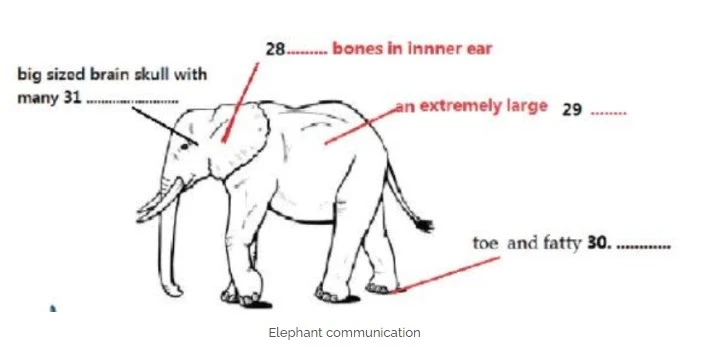
28………….
29………….
30………….
31………….
Questions 32-38 (Summary Completion)
Complete the following summary… using NO MORE THAN THREE WORDS OR A NUMBER from the Reading Passage for each answer.
How the elephants sense these sound vibrations is still unknown, but O’Connell Rodwell, a fresh graduate in entomology at the University of Hawaii, proposes that the elephants are “listening” with their 32…………., by two kinds of nerve endings—that responds to vibrations with both 33………….frequency and slightly higher frequencies. O’Connell Rodwell’s work is at the combination of geophysics, neurophysiology and 34………….and it also was the first to indicate that a large land animal also is sending and receiving 35………….,. O’Connell-Rodwell noticed the freezing behavior by putting a male planthopper communicative approach other than 36…………. Scientists have determined that an elephant’s ability to communicate over long distances is essential, especially, when elephant herds are finding a 37…………., or are warning of predators. Finally, the results of our 2002 study showed us that elephants can detect warning calls played through the 38………….
Questions 39-40 (Multiple Choice) Choose the correct letter. A, B, C or D.
39. According to the passage, it is determined that an elephant needs to communicate over long distances for its survival A. When a threatening predator appears. B. When young elephants meet humans. C. When older members of the herd want to flee from the group. D. when a male elephant is in estrus.
40. What is the author’s attitude toward the experiment by using three different recordings in the paragraph? A. the outcome is definitely out of the original expectation B. the data can not be very clearly obtained C. the result can be somewhat undecided or inaccurate D. the result can be unfamiliar to the public
Tóm tắt nội dung bài đọc
Bài đọc này giới thiệu về nghiên cứu của nhà khoa học O’Connell Rodwell về khả năng giao tiếp của loài voi.
- Nghiên cứu tập trung vào việc voi sử dụng âm thanh tần số thấp (hạ âm) và tín hiệu địa chấn (rung động mặt đất) để liên lạc trong khoảng cách xa.
- Bài viết phân tích các đặc điểm giải phẫu của voi hỗ trợ cho khả năng này, như xương tai trong lớn, cấu trúc ốc tai giống bò sát, cơ thể khổng lồ, và các miếng đệm mỡ ở chân.
- O’Connell Rodwell nghi ngờ rằng voi “lắng nghe” các rung động này bằng vòi và chân, nơi có các đầu dây thần kinh nhạy cảm với áp suất.
- Khả năng giao tiếp tầm xa này rất quan trọng cho sự sinh tồn của voi, đặc biệt là trong việc tìm bạn tình và cảnh báo về kẻ thù.
- Các thí nghiệm đã chứng minh rằng voi thực sự có thể phát hiện và phản ứng với các tín hiệu cảnh báo được truyền qua mặt đất, mặc dù phản ứng của chúng với các tín hiệu quen thuộc và xa lạ có sự khác biệt.
Tổng hợp từ vựng và cấu trúc hay trong bài
- Postdoctoral fellow (cụm danh từ): Nghiên cứu sinh sau tiến sĩ.
- Infrasounds (danh từ): Hạ âm (âm thanh có tần số quá thấp, con người không nghe được).
- Seismic sound/messages (cụm danh từ): Âm thanh/tín hiệu địa chấn (truyền qua mặt đất).
- Proportionally (trạng từ): Một cách tương xứng, theo tỉ lệ.
- Anatomy (danh từ): Giải phẫu học.
- Versatile appendage (cụm danh từ): Bộ phận phụ đa năng (ám chỉ cái vòi).
- Interface (danh từ): Giao diện, điểm giao thoa.
- Ví dụ: “Our work is really at the interface of geophysics, neurophysiology and ecology.”
- Be susceptible to (cụm tính từ): Dễ bị ảnh hưởng, dễ bị tấn công bởi.
- Ví dụ: “…young elephants are susceptible to attacks by lions and hyenas.”
- Preliminary observations (cụm danh từ): Những quan sát sơ bộ.
Gợi ý đáp án và giải thích chi tiết
Questions 28-31 (Diagram Completion)
28. hammer bone
- Keywords: bones, inner ear.
- Dẫn chứng (Đoạn B): “The hammer bone of the elephant’s inner ear is proportionally very large for a mammal…”
- Giải thích: Sơ đồ yêu cầu điền tên xương ở tai trong. Đoạn B chỉ rõ đó là “xương búa” (hammer bone).
29. body
- Keywords: an extremely large. Mũi tên chỉ vào thân voi.
- Dẫn chứng (Đoạn C): “First, their enormous bodies…”
- Giải thích: “Enormous” đồng nghĩa với “extremely large”. Mặc dù bài đọc dùng dạng số nhiều “bodies” (chỉ loài voi nói chung), sơ đồ lại chỉ về một con voi. Do đó, chúng ta cần dùng dạng số ít là “body” để đảm bảo đúng ngữ pháp cho cụm từ “an extremely large body”.
30. pad
- Keywords: toe, fatty. Mũi tên chỉ vào bàn chân.
- Dẫn chứng (Đoạn C): “Second, the elephant’s toe bones rest on a fatty pad…”
- Giải thích: Câu trong bài đọc mô tả xương ngón chân của voi nằm trên một “miếng đệm mỡ” (fatty pad).
31. sinus cavities
- Keywords: skull, with many. Mũi tên chỉ vào phần trước hộp sọ.
- Dẫn chứng (Đoạn C): “The front of the skull is riddled with sinus cavities…”
- Giải thích: Cụm từ “riddled with” có nghĩa là “có rất nhiều”. Đoạn văn cho biết phần trước của hộp sọ có rất nhiều “xoang” (sinus cavities).
Questions 32 – 38
32. trunks and feet
- Keywords: listening with their.
- Dẫn chứng (Đoạn D): “…suspects the pachyderms are “listening” with their trunks and feet.”
- Giải thích: Câu trong bài đọc nêu rõ O’Connell Rodwell nghi ngờ voi đang “lắng nghe” bằng vòi và chân.
33. infrasonic vibrations
- Keywords: responds to vibrations, both… frequency.
- Dẫn chứng (Đoạn D): “Both trunk and feet contain two kinds of pressure-sensitive nerve endings—one that detects infrasonic vibrations and another that responds to vibrations with slightly higher frequencies.”
- Giải thích: Đoạn văn mô tả hai loại đầu dây thần kinh, một loại phát hiện “rung động hạ âm” (infrasonic vibrations) và loại kia phản ứng với tần số cao hơn một chút.
34. ecology
- Keywords: combination of geophysics, neurophysiology and.
- Dẫn chứng (Đoạn D): “Our work is really at the interface of geophysics, neurophysiology and ecology,” she says.”
- Giải thích: “Interface” (giao diện/điểm giao thoa) đồng nghĩa với “combination” (sự kết hợp). Bài đọc liệt kê 3 lĩnh vực, trong đó “ecology” là lĩnh vực cuối cùng.
35. seismic messages
- Keywords: large land animal, sending and receiving.
- Dẫn chứng (Đoạn E): “…O’Connell Rodwell was the first to suggest that a large land animal also is sending and receiving seismic messages.”
- Giải thích: Câu này nói rõ O’Connell Rodwell là người đầu tiên cho rằng một loài động vật lớn trên cạn cũng gửi và nhận “tín hiệu địa chấn”.
36. acoustic communication
- Keywords: communicative approach other than.
- Dẫn chứng (Đoạn E): “…it’s what got me to think, maybe there’s something else going on other than acoustic communication.”
- Giải thích: Hành vi “đứng im” (freezing behavior) của voi khiến nhà khoa học nghĩ rằng có thể có một phương thức giao tiếp nào đó khác ngoài “giao tiếp âm thanh” (acoustic communication).
37. mate
- Keywords: elephant herds are finding a.
- Dẫn chứng (Đoạn F): “The difficulty of finding a mate in this vast wilderness is compounded by elephant reproductive biology.”
- Giải thích: Giao tiếp tầm xa rất cần thiết cho việc tìm kiếm bạn tình (“mate”).
38. the ground
- Keywords: detect warning calls played through the.
- Dẫn chứng (Đoạn G): “…elephants do indeed detect warning calls played through the ground,” O’Connell Rodwell observes.”
- Giải thích: Kết quả nghiên cứu năm 2002 cho thấy voi có thể phát hiện các cuộc gọi cảnh báo được phát qua mặt đất.
Questions 39-40
39. A. When a threatening predator appears.
- Keywords: need to communicate, survival.
- Dẫn chứng (Đoạn F): “Breeding herds also use low-frequency vocalizations to warn of predators… When a predator appears, older members of the herd emit intense warning calls…”
- Giải thích: Đoạn F liệt kê hai lý do chính cho việc giao tiếp tầm xa để sinh tồn: tìm bạn tình (không có trong lựa chọn) và cảnh báo kẻ thù. Lựa chọn A khớp chính xác với ý này. Lựa chọn D sai vì con cái (“female”) mới ở trong giai đoạn “estrus”, không phải con đực.
40. C. the result can be somewhat undecided or inaccurate
- Keywords: author’s attitude, experiment, three different recordings.
- Dẫn chứng (Đoạn H): “I didn’t think it was going to be that clear cut.”
- Giải thích: Cụm từ “clear cut” có nghĩa là rõ ràng, rành mạch. Khi O’Connell Rodwell nói rằng bà không nghĩ nó sẽ “rõ ràng đến thế”, điều đó ngụ ý rằng kết quả có phần phức tạp, không hoàn toàn rõ ràng hoặc chưa thể đi đến kết luận cuối cùng (undecided). Lựa chọn A sai vì kết quả đúng như mong đợi. Lựa chọn B sai vì dữ liệu vẫn thu được. Lựa chọn D không liên quan. Do đó, C là lựa chọn thể hiện đúng nhất thái độ của nhà khoa học.
Việc phân tích thành công bài đọc “Elephant Communication” cho thấy một kỹ năng quan trọng trong IELTS Reading: khả năng liên kết thông tin giữa các đoạn văn. Các chi tiết về giải phẫu của voi ở đoạn B và C không đứng một mình, mà chúng là cơ sở để giải thích cho giả thuyết về việc “lắng nghe” bằng chân và vòi ở đoạn D.
Đây chính là tư duy cốt lõi để chinh phục các bài đọc khoa học phức tạp. Thay vì chỉ tìm kiếm từ khóa đơn lẻ, hãy tập trung vào dòng chảy logic của toàn bộ văn bản: Vấn đề được nêu ra ở đâu? Giả thuyết là gì? Bằng chứng nằm ở đoạn nào?
Rèn luyện kỹ năng đọc-hiểu tổng thể này sẽ giúp bạn giải quyết hiệu quả không chỉ bài đọc này mà còn nhiều bài đọc khó khác trong kỳ thi IELTS.

Đoàn Nương
Tôi là Đoàn Nương - Giám đốc trung tâm ngoại ngữ ECE. Tôi hiện đang là giảng viên của khoa ngôn ngữ các nước nói tiếng Anh - Trường Đại Học Quốc Gia Hà Nội. Tôi đã có 19 năm kinh nghiệm giảng dạy IELTS và 15 năm là giảng viên Đại Học. Tôi mong muốn đưa ECE trở thành trung tâm ngoại ngữ cho tất cả mọi người, mang tới cho học viên môi trường học tập tiếng Anh chuyên nghiệp và hiệu quả.
Tìm hiểu các khóa học tại ECE
Tin Tức Cùng Danh Mục

The Concept of Childhood in Western Countries IELTS Reading: Dịch & giải chi tiết

The Magic of Kefir IELTS Reading: Dịch bài đọc & đáp án chuẩn

The Columbian Exchange IELTS Reading: Dịch & giải chi tiết A-Z

Giải mã bài đọc: Complementary & alternative medicine IELTS Reading

Stadium Australia IELTS Reading: Giải chi tiết & Dịch nghĩa
Các tin liên quan
The Concept of Childhood in Western Countries IELTS Reading: Dịch & giải chi tiết
The Magic of Kefir IELTS Reading: Dịch bài đọc & đáp án chuẩn
The Columbian Exchange IELTS Reading: Dịch & giải chi tiết A-Z
Giải mã bài đọc: Complementary & alternative medicine IELTS Reading
Stadium Australia IELTS Reading: Giải chi tiết & Dịch nghĩa

Television and Sport IELTS Reading: Dịch chuẩn & Giải đề chi tiết

The Invention of Television IELTS Reading: Từ vựng & đáp án chuẩn

Frogwatch IELTS Reading: Bài dịch & đáp án chuẩn nhất

Consecutive and Simultaneous Translation IELTS Reading: Dịch chuẩn & Giải chi tiết

Fears IELTS Reading: Bản dịch chuẩn & giải chi tiết từ A-Z
Memory and Age IELTS Reading: Dịch chuẩn & Giải chi tiết

Đáp án & từ vựng bài đọc Photovoltaics on the rooftop IELTS Reading




Lượt Đăng Ký

NHẬN TƯ VẤN NGAY
Vui lòng để lại thông tin để được tư vấn chi tiết lộ trình học và thi IELTS ở trên
