

Giải chi tiết đề IELTS Reading: Fishbourne Roman Palace



Tóm Tắt Nội Dung Bài Viết
Giải chi tiết đề IELTS Reading: Fishbourne Roman Palace


Tóm Tắt Nội Dung Bài Viết
Nước Anh thời La Mã ẩn chứa vô số bí ẩn, và cung điện La Mã Fishbourne (Fishbourne Roman Palace) là một trong những di sản lộng lẫy và bí ẩn nhất. Bài đọc IELTS Reading này đưa chúng ta vào một hành trình khảo cổ, khám phá lịch sử, quá trình xây dựng, và những giả thuyết về chủ nhân của cung điện La Mã lớn nhất từng được phát hiện ở phía bắc dãy Alps.
Bài viết này của ECE sẽ giúp các bạn “giải mã” từng đoạn văn, cung cấp từ vựng, tóm tắt nội dung, và giải thích cặn kẽ từng đáp án để giúp bạn chinh phục chủ đề lịch sử này.
Nội dung bài đọc (Reading Passage)
Fishbourne Roman Palace
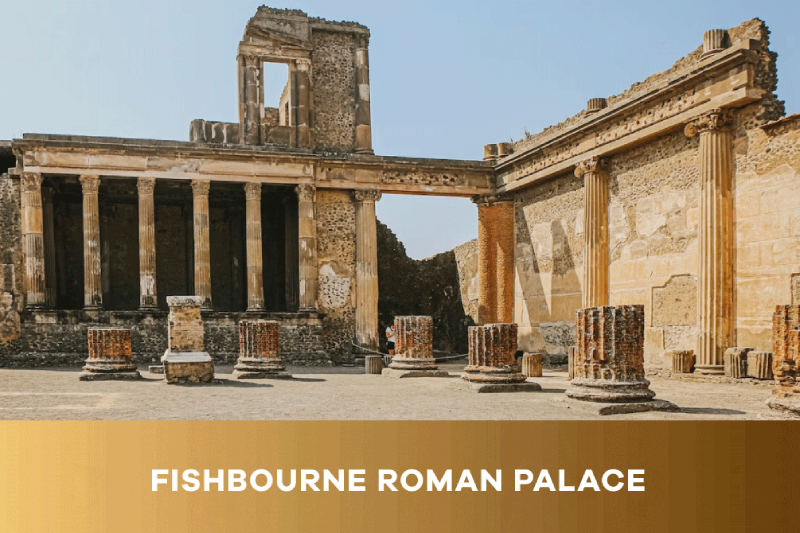
Fishbourne Roman Palace IELTS Reading
A Fishbourne Roman Palace is in the village of Fishbourne in West Sussex, England. This large palace was built in the 1st century AD, around thirty years after the Roman conquest of Britain, on the site of Roman army grain stores which had been established after the invasion, during the reign of the Roman Emperor Claudius in 43 AD. The rectangular palace was built around formal gardens, the northern half of which has been reconstructed. There were extensive alterations in the 2nd and 3rd centuries AD, with many of the original black and white mosaic floors being overlaid with more sophisticated colored ones, including a perfectly preserved mosaic of a dolphin in the north wing. More alterations were in progress when the palace burned down around 270 AD, after which it was abandoned.
B Local people had long believed that a Roman palace once existed in the area. However, it was not until 1960 that the archaeologist Barry Cunliffe, of Oxford University, first systematically excavated the site, after workmen accidentally uncovered a wall while laying a water main. The Roman villa excavated by Cunliffe’s team was so grand that it became known as Fishbourne Roman Palace, and a museum was erected to preserve some of the remains. This is administered by the Sussex Archaeological Society.
C In its day, the completed palace would have comprised four large wings with colonnaded fronts. The north and east wings consisted of suites of private rooms built around courtyards, with a monumental entrance in the middle of the east wing. In the north-east corner, there was an assembly hall. The west wing contained state rooms, a large ceremonial reception room, and a gallery. The south wing contained the owner’s private apartments. The palace included as many as 50 mosaic floors, under-floor central heating, and a bathhouse. In size, Fishbourne Palace would have been approximately equivalent to some of the great Roman palaces of Italy and was by far the largest known Roman residence north of the European Alps, measuring about 500 feet (150 m) square. A team of volunteers and professional archaeologists are involved in ongoing archaeological excavation on the site of nearby, possibly military, buildings.
D The first buildings to be erected on the site were constructed in the early part of the conquest in 43 AD. Later, two timber buildings were constructed, one with clay and mortar floors and plaster walls, which appears to have been a house of some comfort. These buildings were demolished in the 60s AD and replaced by a substantial stone house, which included colonnades and a bath suite. It has been suggested that the palace itself, incorporating the previous house in its south-east corner, was constructed around 73–75 AD. However, Dr. Miles Russell, of Bournemouth University, reinterpreted the ground plan and the collection of objects found and suggested that, given the extremely close parallels with the imperial palace of Domitian in Rome, its construction may more plausibly date to after 92 AD.
E With regard to who lived in Fishbourne Palace, there are a number of theories. For example, one proposed by Professor Cunliffe is that, in its early phase, the palace was the residence of Tiberius Claudius Cogidubnus, a local chieftain who supported the Romans and may have been installed as king of a number of territories following the first stage of the conquest. Cogidubnus is known from a reference to his loyalty in Agricola, a work by the Roman writer Tacitus, and from an inscription commemorating a temple dedicated to the gods Neptune and Minerva found in the nearby city of Chichester.
F Another theory is that it was built for Sallustius Lucullus, a Roman governor of Britain in the late 1st century, who may have been the son of the British prince Adminius. Two inscriptions recording the presence of Lucullus have been found in Chichester, and the redating by Miles Russell suggests that if the palace was designed for Lucullus, it may have only been in use for a few years, as the Roman historian Suetonius records that Lucullus was executed by the Emperor Domitian in or shortly after 93 AD. Additional theories suggest that either Verica, a British king of the Roman Empire in the years preceding the Claudian invasion, was the owner of the palace, or Tiberius Claudius Catuarus, following the recent discovery of a gold ring belonging to him. The palace outlasted the original owner, whoever he was, and was extensively re-planned early in the 2nd century AD and subdivided into a series of lesser apartments. Further redevelopment was begun in the late 3rd century AD, but these alterations were incomplete when the north wing was destroyed in a fire around 270 AD. The damage was too great to repair, and the palace was abandoned and later dismantled.
G A modern museum has been built by the Sussex Archaeological Society, incorporating most of the visible remains, including one wing of the palace. The gardens have been re-planted using authentic plants from the Roman period.
Questions 1 – 6 (TRUE/ FALSE/ NOT GIVEN)
Do the following statements agree with the information given in the Reading Passage? Write:
- TRUE if the statement agrees with the information
- FALSE if the statement contradicts the information
- NOT GIVEN if there is no information on this
1. Fishbourne Palace was the first structure to be built on its site.
2. Fishbourne Palace was renovated more than once.
3. Fishbourne Palace was large in comparison with Roman palaces in Italy.
4. Research is continuing in the area close to Fishbourne Palace.
5. Researchers agree on the identity of the person for whom Fishbourne Palace was constructed.
6. Fishbourne Palace was burnt down by local people.
Questions 7 – 13
Complete the notes below. Choose NO MORE THAN TWO WORDS AND/OR A NUMBER from the passage for each answer.
Fishbourne Palace
Construction
- The first buildings on the site contained food for the 7…
- The palace building surrounded 8…
- In the 2nd and 3rd centuries, color was added to the 9… of the palace.
Discovery
- The first part of the palace to be found was part of a 10…
- Possible Inhabitants
- Congidubnus – he is named in several writings
- Sallustius Lucullus – he may have lived there until approximately 11… AD
- Verica – a British king
- Catuarus – his 12… was found there
Present Day
- A 13… has been built on the site to help protect it.
Tóm tắt nội dung bài đọc
Bài đọc mô tả lịch sử, kiến trúc, và các giả thuyết xung quanh Cung điện La Mã Fishbourne.
- Tổng quan & Lịch sử (A): Giới thiệu cung điện, được xây dựng vào thế kỷ 1 sau Công Nguyên trên nền một kho chứa ngũ cốc (grain stores) cũ của quân đội La Mã. Nó đã trải qua nhiều lần sửa chữa (alterations) trước khi bị cháy và bỏ hoang vào khoảng năm 270 SCN.
- Phát hiện (B): Được phát hiện tình cờ vào năm 1960 bởi công nhân, sau đó được nhà khảo cổ Barry Cunliffe khai quật.
- Kiến trúc (C): Mô tả sự hùng vĩ của cung điện: 4 cánh, 50 sàn khảm, có hệ thống sưởi dưới sàn. Kích thước của nó “tương đương” (equivalent to) với các cung điện lớn ở Ý.
- Các giả thuyết về chủ nhân (D, E, F): Có nhiều giả thuyết về chủ sở hữu.
- Cogidubnus: Một tù trưởng địa phương ủng hộ La Mã (theo Cunliffe).
- Sallustius Lucullus: Một thống đốc La Mã (có thể chỉ ở vài năm vì bị xử tử năm 93 SCN).
- Verica hoặc Catuarus: Các vua/nhân vật khác (dựa trên một chiếc nhẫn vàng).
- Hiện tại (G): Một bảo tàng hiện đại (modern museum) đã được xây dựng để bảo tồn và trưng bày các di tích.
Tổng hợp từ vựng quan trọng trong bài đọc
- conquest (n) (Đoạn A): cuộc chinh phục.
- alterations (n) (Đoạn A): những sự thay đổi, sửa chữa, cải tạo.
- Ví dụ: “There were extensive alterations in the 2nd and 3rd centuries…”
- overlaid with (v.p) (Đoạn A): được phủ lên, được đặt chồng lên.
- Ví dụ: “…mosaic floors being overlaid with more sophisticated colored ones.”
- excavated (v) (Đoạn B): khai quật.
- comprised (v) (Đoạn C): bao gồm.
- colonnaded (adj) (Đoạn C): có hàng cột.
- approximately equivalent to (phrase) (Đoạn C): xấp xỉ tương đương với.
- ongoing (adj) (Đoạn C): đang diễn ra, đang tiếp diễn.
- Ví dụ: “…involved in ongoing archaeological excavation…”
- demolished (v) (Đoạn D): phá hủy, dỡ bỏ.
- reinterpreted (v) (Đoạn D): diễn giải lại, phân tích lại.
- chieftain (n) (Đoạn E): tù trưởng, thủ lĩnh.
- inscription (n) (Đoạn E): một bản khắc, văn bia.
- subdivided (v) (Đoạn F): được chia nhỏ ra.
- dismantled (v) (Đoạn F): bị tháo dỡ, triệt hạ.
- authentic (adj) (Đoạn G): (nguyên) bản, đích thực.
Gợi ý đáp án và giải thích chi tiết
Questions 1 – 6 (TRUE/FALSE/NOT GIVEN)
1. FALSE
- Câu hỏi: Cung điện Fishbourne là cấu trúc đầu tiên được xây dựng trên địa điểm của nó.
- Vị trí (Đoạn A): “…This large palace was built… on the site of Roman army grain stores which had been established after the invasion…”
- Giải thích: Cung điện được xây “trên nền” của “các kho chứa ngũ cốc” của quân đội La Mã. Điều này có nghĩa là các kho chứa ngũ cốc mới là cấu trúc đầu tiên, không phải cung điện.
2. TRUE
- Câu hỏi: Cung điện Fishbourne đã được cải tạo (renovated) nhiều hơn một lần.
- Vị trí (Đoạn A): “There were extensive alterations in the 2nd and 3rd centuries AD… More alterations were in progress when the palace burned down…”
- Giải thích: “Alterations” (sự sửa đổi) đồng nghĩa với “renovated” (cải tạo). Bài đọc chỉ ra có “các sửa đổi lớn” VÀ “thêm nhiều sửa đổi nữa”, rõ ràng là “nhiều hơn một lần”.
3. FALSE
- Câu hỏi: Cung điện Fishbourne lớn hơn (large in comparison with) so với các cung điện La Mã ở Ý.
- Vị trí (Đoạn C): “In size, Fishbourne Palace would have been approximately equivalent to some of the great Roman palaces of Italy…”
- Giải thích: “Approximately equivalent to” (xấp xỉ tương đương) trái ngược với “large in comparison with” (lớn hơn).
4. TRUE
- Câu hỏi: Nghiên cứu đang tiếp tục (continuing) ở khu vực gần Cung điện Fishbourne.
- Vị trí (Đoạn C): “A team of volunteers and professional archaeologists are involved in ongoing archaeological excavation on the site of nearby… buildings.”
- Giải thích: “Ongoing” (đang tiếp diễn) đồng nghĩa với “continuing”. “In the area close to” (ở khu vực gần) đồng nghĩa với “nearby”.
5. FALSE
- Câu hỏi: Các nhà nghiên cứu đồng ý (agree on) về danh tính của người mà Cung điện Fishbourne được xây cho.
- Vị trí (Đoạn E): “With regard to who lived in Fishbourne Palace, there are a number of theories.”
- Giải thích: Việc có “một số giả thuyết” (a number of theories) (như Cogidubnus, Lucullus, v.v.) cho thấy các nhà nghiên cứu không đồng ý (disagree), điều này trái ngược với “agree on”.
6. NOT GIVEN
- Câu hỏi: Cung điện Fishbourne bị người dân địa phương (local people) đốt cháy.
- Vị trí (Đoạn F): “…the north wing was destroyed in a fire around 270 AD.”
- Giải thích: Bài đọc chỉ nói rằng cung điện bị “phá hủy trong một đám cháy” (destroyed in a fire). Hoàn toàn không có thông tin về nguyên nhân của đám cháy hay ai là người gây ra (ví dụ: “local people”, tai nạn, quân xâm lược…).
Questions 7 – 13 (Note Completion)
7. Roman army
- Vị trí: Đoạn A
- Dẫn chứng: “…built… on the site of Roman army grain stores [contained food]…”
- Giải thích: Các tòa nhà đầu tiên là “kho chứa ngũ cốc” (grain stores = contained food). Các kho này thuộc về “quân đội La Mã” (Roman army).
8. (formal) gardens
- Vị trí: Đoạn A
- Dẫn chứng: “The rectangular palace was built around formal gardens…”
- Giải thích: “Surrounded” (bao quanh) đồng nghĩa với “built around”. Cung điện được xây bao quanh “khu vườn chính thức” (formal gardens).
9. floors / mosaic floors
- Vị trí: Đoạn A
- Dẫn chứng: “…many of the original black and white mosaic floors being overlaid with more sophisticated colored ones…”
- Giải thích: “Color” (màu sắc) đã được “added to” (overlayed with) các “sàn nhà” (floors), cụ thể là “sàn khảm” (mosaic floors).
10. wall
- Vị trí: Đoạn B
- Dẫn chứng: “…workmen accidentally uncovered a wall while laying a water main.”
- Giải thích: Phần đầu tiên được công nhân tìm thấy (found) là một “bức tường” (wall).
11. 93
- Vị trí: Đoạn F
- Dẫn chứng: “…Lucullus was executed… in or shortly after 93 AD.”
- Giải thích: Câu hỏi liên quan đến Sallustius Lucullus. Đoạn F nói rằng ông ta có thể chỉ sống ở đó cho đến khi bị xử tử vào “năm 93 SCN”.
12. (gold) ring
- Vị trí: Đoạn F
- Dẫn chứng: “…Tiberius Claudius Catuarus, following the recent discovery of a gold ring belonging to him.”
- Giải thích: Giả thuyết về Catuarus xuất hiện sau khi người ta tìm thấy “chiếc nhẫn vàng” (gold ring) của ông ấy.
13. (modern) museum
- Vị trí: Đoạn G
- Dẫn chứng: “A modern museum has been built by the Sussex Archaeological Society, incorporating most of the visible remains…”
- Giải thích: “Protect” (bảo vệ) đồng nghĩa với “incorporating… remains” (bảo tồn các di tích). Một “bảo tàng hiện đại” (modern museum) đã được xây dựng.
Kết bài
Bài đọc “Fishbourne Roman Palace” đã tóm tắt lịch sử của một cung điện La Mã lớn, từ khi được xây dựng trên nền kho ngũ cốc, qua nhiều lần cải tạo, cho đến khi bị bỏ hoang và được tái phát hiện. Nó cũng trình bày các giả thuyết trái ngược nhau về chủ nhân và mục đích sử dụng của cung điện.
Bài viết phân tích này mang đến một phương pháp học hiệu quả cho IELTS Reading. Bằng cách đối chiếu trực tiếp câu hỏi với (các) từ khóa cụ thể trong bài đọc, nó giúp bạn rèn luyện tư duy phản biện. Đây là kỹ năng thiết yếu để bạn tránh được các bẫy phổ biến và nâng cao điểm số của mình.

Đoàn Nương
Tôi là Đoàn Nương - Giám đốc trung tâm ngoại ngữ ECE. Tôi hiện đang là giảng viên của khoa ngôn ngữ các nước nói tiếng Anh - Trường Đại Học Quốc Gia Hà Nội. Tôi đã có 19 năm kinh nghiệm giảng dạy IELTS và 15 năm là giảng viên Đại Học. Tôi mong muốn đưa ECE trở thành trung tâm ngoại ngữ cho tất cả mọi người, mang tới cho học viên môi trường học tập tiếng Anh chuyên nghiệp và hiệu quả.
Tìm hiểu các khóa học tại ECE
Tin Tức Cùng Danh Mục

The Concept of Childhood in Western Countries IELTS Reading: Dịch & giải chi tiết

The Magic of Kefir IELTS Reading: Dịch bài đọc & đáp án chuẩn
The Columbian Exchange IELTS Reading: Dịch & giải chi tiết A-Z

Giải mã bài đọc: Complementary & alternative medicine IELTS Reading
Stadium Australia IELTS Reading: Giải chi tiết & Dịch nghĩa
Các tin liên quan
The Concept of Childhood in Western Countries IELTS Reading: Dịch & giải chi tiết
The Magic of Kefir IELTS Reading: Dịch bài đọc & đáp án chuẩn
The Columbian Exchange IELTS Reading: Dịch & giải chi tiết A-Z
Giải mã bài đọc: Complementary & alternative medicine IELTS Reading
Stadium Australia IELTS Reading: Giải chi tiết & Dịch nghĩa

Television and Sport IELTS Reading: Dịch chuẩn & Giải đề chi tiết

The Invention of Television IELTS Reading: Từ vựng & đáp án chuẩn
Frogwatch IELTS Reading: Bài dịch & đáp án chuẩn nhất
Consecutive and Simultaneous Translation IELTS Reading: Dịch chuẩn & Giải chi tiết

Fears IELTS Reading: Bản dịch chuẩn & giải chi tiết từ A-Z

Memory and Age IELTS Reading: Dịch chuẩn & Giải chi tiết
Đáp án & từ vựng bài đọc Photovoltaics on the rooftop IELTS Reading




Lượt Đăng Ký

NHẬN TƯ VẤN NGAY
Vui lòng để lại thông tin để được tư vấn chi tiết lộ trình học và thi IELTS ở trên
