
Fatal Attraction IELTS Reading – Giải mã bài đọc về thực vật ăn thịt



Tóm Tắt Nội Dung Bài Viết
Fatal Attraction IELTS Reading – Giải mã bài đọc về thực vật ăn thịt


Tóm Tắt Nội Dung Bài Viết
Bài đọc “Fatal Attraction” là một trong những bài đọc hấp dẫn và đầy thử thách trong IELTS Reading. Bài đọc này khám phá thế giới kỳ diệu của thực vật ăn thịt, từ cách chúng săn mồi, tiêu hóa cho đến cách chúng tiến hóa. Với các đoạn văn cung cấp thông tin chi tiết về từng loại cây và các nghiên cứu khoa học, bài đọc đòi hỏi người học phải có kỹ năng đọc quét (scanning) và nhận diện thông tin cụ thể rất tốt.
ECE sẽ giúp bạn tìm hiểu chi tiết nội dung, từ vựng, cấu trúc hay, cùng với giải thích chi tiết đáp án và chiến lược làm bài hiệu quả cho bài đọc này.
Fatal Attraction IELTS Reading
Fatal Attraction
Evolutionist Charles Darwin first marveled at flesh-eating plants in the mid-19th century. Today, biologists, using 21st-century tools to study cells and DNA, are beginning to understand how these plants hunt, eat and digest – and how such bizarre adaptations arose in the first place.
A
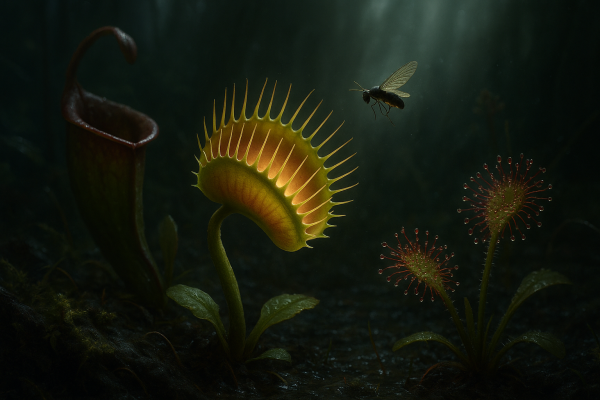
The leaves of the Venus flytrap plant are covered in hairs. When an insect brushes against them, this triggers a tiny electric charge, which travels down tunnels in the leaf and opens up pores in the leaf’s cell membranes. Water surges from the cells on the inside of the leaf to those on the outside, causing the leaf to rapidly flip in shape from convex to concave, like a soft contact lens. As the leaves flip, they snap together, trapping the insect in their sharp-toothed jaws.
B
The bladderwort has an equally sophisticated way of setting its underwater trap. It pumps water out of tiny bag-like bladders, making a vacuum inside. When small creatures swim past, they bend the hairs on the bladder, causing a flap to open. The low pressure sucks water in, carrying the animal along with it. In one five-hundredth of a second, the door swings shut again. The Drosera sundew, meanwhile, has a thick, sweet liquid oozing from its leaves, which first attracts insects, then holds them fast before the leaves snap shut. Pitcher plants use yet another strategy, growing long tube-shaped leaves to imprison their prey. Raffles’ pitcher plant, from the jungles of Borneo, produces nectar that both lures insects and forms a slick surface on which they can’t get a grip. Insects that land on the rim of the pitcher slide on the liquid and tumble in.
C
Many carnivorous plants secrete enzymes to penetrate the hard exoskeleton of insects so they can absorb nutrients from inside their prey. But the purple pitcher plant, which lives in bogs and infertile sandy soils in North America, enlists other organisms to process its food. It is home to an intricate food web of mosquito larvae, midges and bacteria, many of which can survive only in this unique habitat. These animals shred the prey that fall into the pitcher, and the smaller organisms feed on the debris. Finally, the plant absorbs the nutrients released.
D
While such plants clearly thrive on being carnivorous, the benefits of eating flesh are not the ones you might expect. Carnivorous animals such as ourselves use the carbon in protein and the fat in meat to build muscles and store energy. Carnivorous plants instead draw nitrogen, phosphorus, and other critical nutrients from their prey in order to build light-harvesting enzymes. Eating animals, in other words, lets carnivorous plants do what all plants do: carry out photosynthesis, that is, grow by harnessing energy directly from the sun.
E
Carnivorous plants are, in fact, very inefficient at converting sunlight into tissue. This is because of all the energy they expend to make the equipment to catch animals – the enzymes, the pumps, and so on. A pitcher or a flytrap cannot carry out much photosynthesis because, unlike plants with ordinary leaves, they do not have flat solar panels that can grab lots of sunlight. There are, however, some special conditions in which the benefits of being carnivorous do outweigh the costs. The poor soil of bogs, for example, offers little nitrogen and phosphorus, so carnivorous plants enjoy an advantage over plants that obtain these nutrients by more conventional means. Bogs are also flooded with sunshine, so even an inefficient carnivorous plant can photosynthesise enough light to survive.
F
Evolution has repeatedly made this trade-off. By comparing the DNA of carnivorous plants with other species, scientists have found that they evolved independently on at least six separate occasions. Some carnivorous plants that look nearly identical turn out to be only distantly related. The two kinds of pitcher plants – the tropical genus Nepenthes and the North American Sarracenia – have, surprisingly, evolved from different ancestors, although both grow deep pitcher-shaped leaves and employ the same strategy for capturing prey.
G
In several cases, scientists can see how complex carnivorous plants evolved from simpler ones. Venus flytraps, for example, share an ancestor with Portuguese sundews, which only catch prey passively, via ‘flypaper’ glands on their stems. They share a more recent ancestor with Drosera sundews, which can also curl their leaves over their prey. Venus flytraps appear to have evolved an even more elaborate version of this kind of trap, complete with jaw-like leaves.
H
Unfortunately, the adaptations that enable carnivorous plants to thrive in marginal habitats also make them exquisitely sensitive. Agricultural run-off and pollution from power plants are adding extra nitrogen to many bogs in North America. Carnivorous plants are so finely tuned to low levels of nitrogen that this extra fertilizer is overloading their systems, and they eventually burn themselves out and die.
Humans also threaten carnivorous plants in other ways. The black market trade in exotic carnivorous plants is so vigorous now that botanists are keeping the location of some rare species a secret. But even if the poaching of carnivorous plants can be halted, they will continue to suffer from other assaults. In the pine savannah of North Carolina, the increasing suppression of fires is allowing other plants to grow too quickly and outcompete the flytraps in their native environment. Good news, perhaps, for flies. But a loss for all who, like Darwin, delight in the sheer inventiveness of evolution.
Questions 14 – 18: Complete the notes below. Choose NO MORE THAN TWO WORDS from the passage for each answer.
How a Venus flytrap traps an insect
• Insect touches (14)…………………………….on leaf of plant
• Small (15)……………………………..passes through leaf
• (16)…………………………….in cell membrane open
• Outside cells of leaves fill with (17)…………………………….
• Leaves change so that they have a (18)………………………………..shape and snap nut
Questions 19 – 22: Look at the following statements (Questions 19-22) and the list of plants. Match each statement with the correct plant, A. B. C, D or E. Write the correct letter, A, B, C, D or E, in boxes 19-22 on your answer sheet.
19. It uses other creatures to help it digest insects.
20. It produces a slippery substance to make insects fall inside it.
21. It creates an empty space into which insects are sucked.
22. It produces a sticky substance which traps insects on its surface.
List of plants
A Venus flytrap
B bladderwort
C Drosera sundew
D Raffles’ pitcher plant
E purple pitcher plant
Questions 23 – 26
Reading Passage 2 has nine paragraphs, A-I.
Which paragraph contains the following information?
23 a mention of a disadvantage of the leaf shape of some carnivorous plants
24 an example of an effort made to protect carnivorous plants
25 unexpected information about the origins of certain carnivorous plants
26 an example of environmental changes that shorten the life cycles of carnivorous plants
Tổng quan về bài đọc
Bài đọc “Fatal Attraction” là một tác phẩm khoa học hấp dẫn, được lấy cảm hứng từ những khám phá ban đầu của Charles Darwin về thực vật ăn thịt. Bài viết này không chỉ đơn thuần là mô tả mà còn đào sâu vào cơ chế săn mồi phức tạp và câu chuyện tiến hóa kỳ diệu của chúng.
Nội dung bài đọc được chia thành nhiều phần, mỗi phần hé lộ một khía cạnh riêng biệt:
- Cơ chế săn mồi tinh vi: Bạn sẽ được tìm hiểu cách các loài cây như cây bắt ruồi Venus, cây gọng vó hay cây nắp ấm sử dụng những chiến thuật độc đáo, từ bẫy sập, bẫy dính đến bẫy chân không, để bắt con mồi.
- Mục đích thực sự của việc ăn thịt: Bài đọc giải thích một sự thật bất ngờ rằng thực vật ăn thịt không ăn côn trùng để lấy năng lượng, mà để hấp thụ các chất dinh dưỡng thiết yếu như nitơ và phốt pho, những chất mà chúng không thể lấy được từ đất đai cằn cỗi.
- Sự tiến hóa độc lập: Bạn sẽ khám phá ra rằng các loài cây ăn thịt, dù có vẻ ngoài tương đồng, lại tiến hóa độc lập với nhau trong nhiều trường hợp. Điều này minh chứng cho tính sáng tạo của tự nhiên trong việc thích nghi với môi trường sống khắc nghiệt.
- Những mối đe dọa hiện hữu: Bài đọc cũng chỉ ra những mối nguy hiểm mà con người và môi trường đang gây ra cho các loài thực vật quý hiếm này, từ nạn buôn bán trái phép đến ô nhiễm môi trường.
Tóm lại, “Fatal Attraction” là một bài đọc toàn diện, kết hợp giữa sinh học thực vật và lịch sử tiến hóa, giúp người đọc vừa nâng cao kiến thức vừa rèn luyện kỹ năng đọc hiểu chuyên sâu.
Từ vựng & cấu trúc hay trong bài
Nắm vững các từ vựng học thuật và cụm từ chuyên ngành là chìa khóa để hiểu bài đọc này.
Lời giải kèm giải thích chi tiết cho bài đọc Fatal Attraction
1. Dạng bài: Flow Chart Completion (Hoàn thành sơ đồ)
Dạng bài này yêu cầu bạn tìm thông tin cụ thể theo một quy trình nhất định. Mẹo là điền từ khóa từ bài đọc vào sơ đồ, tuân thủ giới hạn từ và thứ tự xuất hiện của thông tin.
- Câu 14: hairs
- Vị trí: “The leaves of the Venus flytrap plant are covered in hairs.”
- Câu 15: (electric) charge
- Vị trí: “When an insect brushes against them, this triggers a tiny electric charge.”
- Câu 16: pores
- Vị trí: “…and opens up pores in the leaf’s cell membranes.”
- Câu 17: water
- Vị trí: “Water surges from the cells on the inside of the leaf to those on the outside…”
- Câu 18: concave
- Vị trí: “…the leaf to rapidly flip in shape from convex to concave…”
2. Dạng bài: Matching Plants (Nối thông tin với loài cây)
Dạng bài này yêu cầu bạn kết nối các câu mô tả với tên của loài cây tương ứng. Mẹo là tìm tên của từng loài cây trong bài đọc và đọc kỹ thông tin xung quanh nó.
- Câu 19: It uses other creatures to help it digest insects.
Đáp án: E. purple pitcher plant.
Vị trí: Đoạn C nói rằng cây nắp ấm tía “enlists other organisms to process its food.” (tận dụng các sinh vật khác để xử lý thức ăn).
- Câu 20: It produces a slippery substance to make insects fall inside it.
Đáp án: D. Raffles’ pitcher plant.
Vị trí: Đoạn B nói về cây nắp ấm của Raffles: “produces nectar that both lures insects and forms a slick surface on which they can’t get a grip.” (tạo ra một bề mặt trơn bóng mà chúng không thể bám vào).
- Câu 21: It creates an empty space into which insects are sucked.
Đáp án: B. bladderwort.
Vị trí: Đoạn B nói rằng cây bladderwort “pumps water out of tiny bag-like bladders, making a vacuum inside.” (tạo ra một khoảng chân không bên trong).
- Câu 22: It produces a sticky substance which traps insects on its surface.
Đáp án: C. Drosera sundew.
Vị trí: Đoạn B nói về cây Drosera sundew: “has a thick, sweet liquid oozing from its leaves, which first attracts insects, then holds them fast…” (có một chất lỏng đặc, ngọt chảy ra từ lá của nó, thu hút rồi giữ chặt côn trùng).
3. Dạng bài: Matching Information (Nối thông tin với đoạn văn)
Dạng bài này yêu cầu bạn tìm đoạn văn chứa thông tin cụ thể. Mẹo là đọc lướt các đoạn để nắm ý chính, sau đó dùng kỹ năng đọc quét để tìm từ khóa.
- Câu 23: a mention of a disadvantage of the leaf shape of some carnivorous plants.
Đáp án: E.
Vị trí: Đoạn E nói: “A pitcher or a flytrap cannot carry out much photosynthesis because, unlike plants with ordinary leaves, they do not have flat solar panels that can grab lots of sunlight.” (Cây nắp ấm hay bẫy ruồi không thể quang hợp nhiều vì không có lá phẳng để lấy ánh sáng mặt trời). Đây là một bất lợi do hình dạng lá.
- Câu 24: an example of an effort made to protect carnivorous plants.
Đáp án: I.
Vị trí: Đoạn I nói rằng các nhà thực vật học đang “keeping the location of some rare species a secret.” (giữ bí mật vị trí của một số loài quý hiếm). Đây là một nỗ lực để bảo vệ chúng khỏi buôn bán.
- Câu 25: unexpected information about the origins of certain carnivorous plants.
Đáp án: F.
Vị trí: Đoạn F có câu: “Some carnivorous plants that look nearly identical turn out to be only distantly related… The two kinds of pitcher plants… have, surprisingly, evolved from different ancestors…” (Một số loài cây ăn thịt trông gần giống hệt nhau hóa ra chỉ có họ hàng xa… Hai loại cây nắp ấm… đã tiến hóa từ các tổ tiên khác nhau một cách đáng ngạc nhiên…).
- Câu 26: an example of environmental changes that shorten the life cycles of carnivorous plants.
Đáp án: H.
Vị trí: Đoạn H nói về “Agricultural run-off and pollution… adding extra nitrogen to many bogs… this extra fertilizer is overloading their systems, and they eventually burn themselves out and die.” (Dòng chảy nông nghiệp và ô nhiễm… thêm nitơ quá mức, làm quá tải hệ thống của cây và cuối cùng chúng chết).
Kết bài
Bài đọc “Fatal Attraction” là một minh chứng rõ ràng cho thấy IELTS Reading không chỉ kiểm tra khả năng đọc mà còn cả kiến thức tổng quát và khả năng phân tích thông tin. Bằng cách nắm vững các chiến lược đọc quét, nhận diện từ đồng nghĩa và phân tích kỹ lưỡng từng dạng câu hỏi, bạn sẽ dễ dàng xử lý các bài đọc phức tạp như thế này. Hy vọng bài phân tích chi tiết này của ECE English sẽ giúp bạn tự tin hơn trên con đường chinh phục band điểm cao trong kỳ thi IELTS sắp tới.

Đoàn Nương
Tôi là Đoàn Nương - Giám đốc trung tâm ngoại ngữ ECE. Tôi hiện đang là giảng viên của khoa ngôn ngữ các nước nói tiếng Anh - Trường Đại Học Quốc Gia Hà Nội. Tôi đã có 19 năm kinh nghiệm giảng dạy IELTS và 15 năm là giảng viên Đại Học. Tôi mong muốn đưa ECE trở thành trung tâm ngoại ngữ cho tất cả mọi người, mang tới cho học viên môi trường học tập tiếng Anh chuyên nghiệp và hiệu quả.
Tìm hiểu các khóa học tại ECE
Tin Tức Cùng Danh Mục

The Concept of Childhood in Western Countries IELTS Reading: Dịch & giải chi tiết

The Magic of Kefir IELTS Reading: Dịch bài đọc & đáp án chuẩn
The Columbian Exchange IELTS Reading: Dịch & giải chi tiết A-Z

Giải mã bài đọc: Complementary & alternative medicine IELTS Reading

Stadium Australia IELTS Reading: Giải chi tiết & Dịch nghĩa
Các tin liên quan
The Concept of Childhood in Western Countries IELTS Reading: Dịch & giải chi tiết
The Magic of Kefir IELTS Reading: Dịch bài đọc & đáp án chuẩn
The Columbian Exchange IELTS Reading: Dịch & giải chi tiết A-Z
Giải mã bài đọc: Complementary & alternative medicine IELTS Reading
Stadium Australia IELTS Reading: Giải chi tiết & Dịch nghĩa

Television and Sport IELTS Reading: Dịch chuẩn & Giải đề chi tiết

The Invention of Television IELTS Reading: Từ vựng & đáp án chuẩn
Frogwatch IELTS Reading: Bài dịch & đáp án chuẩn nhất

Consecutive and Simultaneous Translation IELTS Reading: Dịch chuẩn & Giải chi tiết
Fears IELTS Reading: Bản dịch chuẩn & giải chi tiết từ A-Z
Memory and Age IELTS Reading: Dịch chuẩn & Giải chi tiết

Đáp án & từ vựng bài đọc Photovoltaics on the rooftop IELTS Reading




Lượt Đăng Ký

NHẬN TƯ VẤN NGAY
Vui lòng để lại thông tin để được tư vấn chi tiết lộ trình học và thi IELTS ở trên
