
Coral Reefs IELTS Reading: Phân tích bài đọc & giải mã chi tiết



Tóm Tắt Nội Dung Bài Viết
Coral Reefs IELTS Reading: Phân tích bài đọc & giải mã chi tiết


Tóm Tắt Nội Dung Bài Viết
Trong các bài thi IELTS Reading, các chủ đề về môi trường, khoa học thường xuyên xuất hiện và Coral Reefs (rạn san hô) là một ví dụ điển hình. Bài đọc này không chỉ cung cấp kiến thức giá trị về một trong những hệ sinh thái đa dạng nhất Trái Đất mà còn là một “bài test” hoàn hảo để kiểm tra kỹ năng đọc hiểu và xử lý thông tin của thí sinh.
Với cấu trúc bài phức tạp, kết hợp nhiều dạng câu hỏi khác nhau, việc nắm vững chiến lược làm bài là chìa khóa để chinh phục bài đọc này. Bài viết dưới đây của ECE sẽ đi sâu phân tích từng phần, từ tổng quan nội dung đến hướng dẫn giải chi tiết các câu hỏi, giúp bạn tự tin “phá đảo” bài đọc này một cách hiệu quả.
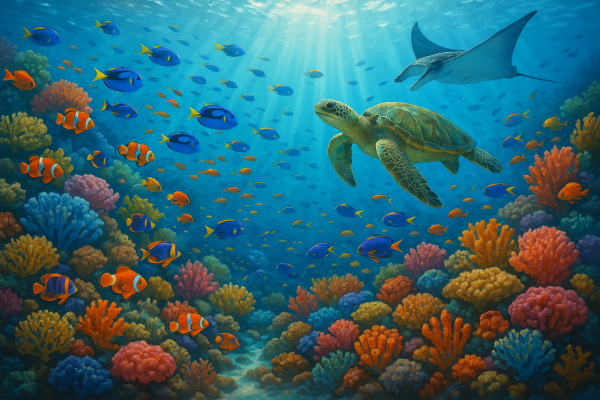
Cùng ECE phân tích và giải đáp bài đọc: Coral Reefs trong IELTS Reading
READING PASSAGE
Coral Reefs
Coral reefs are underwater structures made from calcium carbonate secreted by corals. Coral reefs are colonies of tiny living animals found in marine waters that contain few nutrients. Most coral reefs are built from stony corals, which in turn consist of polyps that cluster in groups.
A. Coral reefs are estimated to cover 284,300 km2 just under 0.1% of the oceans‘ surface area, about half the area of France. The Indo-Pacific region accounts for 91.9% of this total area. Southeast Asia accounts for 32.3% of that figure, while the Pacific including Australia accounts for 40.8%. Atlantic and Caribbean coral reefs account for 7.6%. Yet often called – rainforests of the sea‖, coral reefs form some of the most diverse ecosystems on Earth. They provide a home for 25% of all marine species, including fish, mollusks worms, crustaceans, echinoderms, sponges, tunicates and other cnidarians. Paradoxically, coral reefs flourish even though they are surrounded by ocean waters that provide few nutrients. They are most commonly found at shallow depths in tropical waters, but deep water and cold water corals also exist on smaller scales in other areas. Although corals exist both in temperate and tropical waters, shallow-water reefs form only in a zone extending from 30°N to 30°S of the equator. Deepwater coral can exist at greater depths and colder temperatures at much higher latitudes, as far north as Norway. Coral reefs are rare along the American and African west coasts. This is due primarily to upwelling and strong cold coastal currents that reduce water temperatures in these areas (respectively the Peru, Benguela and Canary streams). Corals are seldom found along the coastline of South Asia from the eastern tip of India (Madras) to the Bangladesh and Myanmar borders. They are also rare along the coast around northeastern South America and Bangladesh due to the freshwater released from the Amazon and Ganges Rivers, respectively.
B. Coral reefs deliver ecosystem services to tourism, fisheries and coastline protection. The global economic value of coral reefs has been estimated at as much as $US375 billion per year. Coral reefs protect shorelines by absorbing wave energy, and many small islands would not exist without their reef to protect them.
C. The value of reefs in biodiverse regions can be even higher. In parts of Indonesia and the Caribbean where tourism is the main use, reefs are estimated to be worth US$1 million per square kilometer, based on the cost of maintaining sandy beaches and the value of attracting snorkelers and scuba divers. Meanwhile, a recent study of the Great Barrier Reef in Australia found that the reef is worth more to the country as an intact ecosystem than an extractive reserve for fishing. Each year more than 1.8 million tourists visit the reef, spending an estimated AU$4.3 billion (Australian dollars) on reef-related industries from diving to boat rental to posh island resort stays. In the Caribbean, says UNEP, the net annual benefits from diver tourism were US$2 billion in 2000 with US$625 million spent directly on diving on reefs. Further, reef tourism is an important source of employment, especially for some of the world‘s poorest people. UNEP says that of the estimated 30 million small-scale fishers in the developing world, most are dependent to a greater or lesser extent on coral reefs. In the Philippines, for example, more than one million small-scale fishers depend directly on coral reefs for their livelihoods. The report estimates that reef fisheries were worth between $15,000 and $150,000 per square kilometer a year, while fish caught for aquariums were worth $500 a kilogram against $6 for fish caught as food. The aquarium fish export industry supports around 50,000 people and generates some US$5.5 million a year in Sri Lanka along.
D. Unfortunately, coral reefs are dying around the world. In particular, coral mining, agricultural and urban runoff, pollution (organic and inorganic), disease, and the digging of canals and access into islands and bays are localized threats to coral ecosystems. Broader threats are sea temperature rise, sea-level rise and pH changes from ocean acidification, all associated with greenhouse gas emissions. Some current fishing practices are destructive and unsustainable. These include cyanide fishing, overfishing and blast fishing. Although cyanide fishing supplies live reef fish for the tropical aquarium market, most fish caught using this method are sold in restaurants, primarily in Asia, where live fish are prized for their freshness. To catch fish with cyanide, fishers dive down to the reef and squirt cyanide in coral crevices and on the fast-moving fish, to stun the fish making them easy to catch. Overfishing is another leading cause for coral reef degradation. Often, too many fish are taken from one reef to sustain a population in that area. Poor fishing practices, such as banging on the reef with sticks (muro-ami), destroy coral formations that normally function as fish habitat. In some instances, people fish with explosives (blast fishing), which blast apart the surrounding coral.
E. Tourist resorts that empty their sewage directly into the water surrounding coral reefs contribute to coral reef degradation. Wastes kept in poorly maintained septic tanks can also leak into surrounding groundwater, eventually seeping out to the reefs. Careless boating, diving, snorkeling and fishing can also damage coral reefs. Whenever people grab, kick, and walk on, or stir up sediment in the reefs, they contribute to coral reef destruction. Corals are also harmed or killed when people drop anchors on them or when people collect coral.
F. To find answers for these problems, scientists and researchers study the various factors that impact reefs. The list includes the ocean‘s role as a carbon dioxide sink, atmospheric changes, ultraviolet light, ocean acidification, viruses, impacts of dust storms carrying agents to far-flung reefs, pollutants, algal blooms and others. Reefs are threatened well beyond coastal areas. General estimates show approximately 10% of the worlds coral reefs are dead. About 60% of the world‘s reefs are at risk due to destructive, human-related activities. The threat to the health of reefs is particularly strong in Southeast Asia, where 80% of reefs are endangered.
G. In Australia, the Great Barrier Reef is protected by the Great Barrier Reef Marine Park Authority and is the subject of much legislation, including a biodiversity action plan. Inhabitants of Ahus Island, Manus Province, Papua New Guinea, have followed a generations-old practice of restricting fishing in six areas of their reef lagoon. Their cultural traditions allow line fishing, but not net or spearfishing. The result is both the biomass and individual fish sizes are significantly larger in these areas than in places where fishing is unrestricted.
Questions 1 – 6
The reading Passage has seven paragraphs A-G.
Which paragraph contains the following information?
Write the correct letter A-G, in boxes 1-6 on your answer sheet. NB You may use any letter more than once.
1. Geographical Location of the world‘s coral reef
2. How does coral reef benefit economy locally
3. The statistics of coral reef‘s economic significance
4. The listed reasons for the declining number of coral reef
5. Physical approach to the coral reef by people
6. Unsustainable fishing methods are applied in regions of the world
Questions 7-12
Do the following statements agree with the information given in Reading Passage? Write your answers in boxes 7-12 on your answer sheet.
TRUE if the statement is true
FALSE if the statement is false
NOT GIVEN if the information is not given in the passage
7. Coral reefs provide habitat to a variety of marine life.
8. Coral reef distributes around the ocean disproportionally.
9. Coral reef is increasingly important for scientific purpose.
10. Coral reefs are greatly exchanged among and exported to other counties.
11. Reef tourism is of economic essence generally for some poor people.
12. As with other fishing business, coral fishery is not suitable to women and children.
Question 13
Choose the correct letter, A, B,C or D. Write your answers in boxes 13 on your answer sheet.
What is the main purpose of this passage?
A. Demonstrate how coral reef growth in the ocean
B. To tell that coral reef is widely used as a scientific project
C. Present the general benefits and an alarming situation of coral reef
D. To show the vital efforts made to protect the coral reef in Australia
Phân tích bài đọc IELTS: Coral Reefs
Bài đọc “Coral Reefs” là một ví dụ điển hình cho dạng bài Academic Reading trong kỳ thi IELTS. Bài đọc cung cấp một lượng lớn thông tin về rạn san hô, bao gồm định nghĩa, vị trí địa lý, tầm quan trọng kinh tế, các mối đe dọa và những nỗ lực bảo tồn. Mục tiêu chính của bạn khi làm bài này là xác định vị trí thông tin một cách nhanh chóng và chính xác.
1. Tổng quan nội dung từng đoạn văn
Để nắm bắt ý chính, bạn nên đọc lướt (skimming) qua từng đoạn:
- Đoạn A: Giới thiệu định nghĩa rạn san hô, phân bố địa lý (Indo-Pacific, Đông Nam Á, Đại Tây Dương…) và vai trò là hệ sinh thái đa dạng.
- Đoạn B: Đề cập đến giá trị kinh tế của rạn san hô đối với du lịch, nghề cá và bảo vệ bờ biển.
- Đoạn C: Phân tích sâu hơn giá trị kinh tế ở các khu vực cụ thể như Indonesia, Caribe và rạn san hô Great Barrier ở Úc, nhấn mạnh lợi ích từ du lịch lặn biển và nghề cá.
- Đoạn D: Liệt kê các mối đe dọa đối với rạn san hô, bao gồm cả những yếu tố cục bộ (khai thác san hô, ô nhiễm) và những yếu tố rộng hơn (biến đổi khí hậu, axit hóa đại dương), cũng như các phương pháp đánh bắt thiếu bền vững.
- Đoạn E: Nêu các hành vi của con người gây hại trực tiếp đến rạn san hô, như xả thải, neo đậu tàu thuyền và các hoạt động lặn thiếu ý thức.
- Đoạn F: Đề cập đến nghiên cứu khoa học về các yếu tố tác động đến san hô và đưa ra các số liệu thống kê về tình trạng rạn san hô trên toàn cầu.
- Đoạn G: Giới thiệu các biện pháp bảo tồn và bảo vệ rạn san hô, với các ví dụ cụ thể tại Úc và Papua New Guinea.
2. Hướng dẫn giải chi tiết các câu hỏi
Dạng bài: Matching Information (Nối thông tin)
Đây là dạng bài yêu cầu bạn tìm đoạn văn chứa thông tin cụ thể. Mẹo là hãy tìm từ khóa (keywords) trong câu hỏi và quét (scanning) trong bài đọc để tìm đoạn tương ứng.
- Câu 1: Geographical Location of the world’s coral reef
Đáp án: A.
Giải thích: Câu hỏi yêu cầu thông tin về vị trí địa lý. Ngay đoạn A, câu “The Indo-Pacific region accounts for 91.9% of this total area. Southeast Asia accounts for 32.3%…” cung cấp các số liệu và khu vực địa lý cụ thể.
- Câu 2: How does coral reef benefit economy locally
Đáp án: C.
Giải thích: Câu hỏi tập trung vào lợi ích kinh tế ở cấp độ địa phương (locally). Đoạn C cung cấp các ví dụ cụ thể như “In parts of Indonesia and the Caribbean where tourism is the main use, reefs are estimated to be worth US$1 million per square kilometer…” và “In the Philippines, for example, more than one million small-scale fishers depend directly on coral reefs for their livelihoods.”
- Câu 3: The statistics of coral reef’s economic significance
Đáp án: B.
Giải thích: Câu hỏi yêu cầu thông tin về số liệu thống kê (statistics) về tầm quan trọng kinh tế. Đoạn B là đoạn duy nhất đưa ra một con số tổng quát: “The global economic value of coral reefs has been estimated at as much as $US375 billion per year.”
- Câu 4: The listed reasons for the declining number of coral reef
Đáp án: D.
Giải thích: Câu hỏi yêu cầu các lý do cho sự suy giảm rạn san hô. Đoạn D liệt kê một loạt các mối đe dọa: “coral mining, agricultural and urban runoff, pollution (organic and inorganic), disease…” và “sea temperature rise, sea-level rise and pH changes from ocean acidification…”.
- Câu 5: Physical approach to the coral reef by people
Đáp án: E.
Giải thích: Câu hỏi nói về các hành động vật lý của con người. Đoạn E trực tiếp đề cập đến các hành động này: “Whenever people grab, kick, and walk on, or stir up sediment in the reefs, they contribute to coral reef destruction.”
- Câu 6: Unsustainable fishing methods are applied in regions of the world
Đáp án: D.
Giải thích: Câu hỏi đề cập đến phương pháp đánh bắt thiếu bền vững. Đoạn D liệt kê cụ thể các phương pháp này: “cyanide fishing, overfishing and blast fishing” và giải thích cách chúng được sử dụng.
Dạng bài: True/False/Not Given
Dạng bài này đòi hỏi bạn phải xác định xem thông tin trong câu hỏi có khớp, mâu thuẫn hay không được đề cập trong bài đọc.
- Câu 7: Coral reefs provide habitat to a variety of marine life.
Đáp án: TRUE.
Giải thích: Đoạn A nêu rõ: “They provide a home for 25% of all marine species, including fish, mollusks worms, crustaceans, echinoderms, sponges, tunicates and other cnidarians.” (Chúng cung cấp một ngôi nhà cho 25% của tất cả các loài sinh vật biển…). Đây là thông tin khớp hoàn toàn.
- Câu 8: Coral reef distributes around the ocean disproportionally.
Đáp án: TRUE.
Giải thích: Đoạn A cung cấp các số liệu cho thấy sự phân bố không đồng đều (disproportionally): “The Indo-Pacific region accounts for 91.9%… Atlantic and Caribbean coral reefs account for 7.6%.” Sự chênh lệch lớn về tỷ lệ cho thấy sự phân bố không cân xứng.
- Câu 9: Coral reef is increasingly important for scientific purpose.
Đáp án: NOT GIVEN.
Giải thích: Đoạn F đề cập đến việc các nhà khoa học “study the various factors that impact reefs” (nghiên cứu các yếu tố tác động đến rạn san hô), nhưng không hề nói rằng tầm quan trọng của chúng cho mục đích khoa học đang tăng lên.
- Câu 10: Coral reefs are greatly exchanged among and exported to other countries.
Đáp án: NOT GIVEN.
Giải thích: Bài đọc có nhắc đến việc “aquarium fish export industry” (ngành công nghiệp xuất khẩu cá cảnh) nhưng không hề đề cập đến việc rạn san hô nói chung được xuất khẩu hay trao đổi giữa các quốc gia.
- Câu 11: Reef tourism is of economic essence generally for some poor people.
Đáp án: TRUE.
Giải thích: Đoạn C có câu: “reef tourism is an important source of employment, especially for some of the world’s poorest people.” (du lịch rạn san hô là một nguồn việc làm quan trọng, đặc biệt đối với một số người nghèo nhất thế giới).
- Câu 12: As with other fishing business, coral fishery is not suitable to women and children.
Đáp án: NOT GIVEN.
Giải thích: Bài đọc chỉ đề cập đến việc “30 million small-scale fishers in the developing world” (30 triệu ngư dân quy mô nhỏ ở các nước đang phát triển) phụ thuộc vào rạn san hô. Không có bất kỳ thông tin nào về việc nghề cá san hô có phù hợp với phụ nữ và trẻ em hay không.
Dạng bài: Multiple Choice (Chọn đáp án đúng nhất)
- Câu 13: What is the main purpose of this passage?
- Đáp án: C.
- Giải thích:
A. Sai. Bài đọc có đề cập đến cách san hô phát triển nhưng đây không phải mục đích chính.
B. Sai. Mục đích khoa học chỉ là một phần nhỏ trong đoạn F.
C. Đúng. Bài đọc mở đầu bằng cách giới thiệu định nghĩa và lợi ích chung của rạn san hô (beneficial) trong các đoạn B và C. Sau đó, các đoạn D và E lại tập trung vào tình trạng đáng báo động (alarming situation) của chúng do các mối đe dọa.
D. Sai. Những nỗ lực bảo vệ chỉ được đề cập ngắn gọn ở đoạn G, không phải mục đích chính của toàn bộ bài.
Mẹo và chiến lược làm bài hiệu quả
- Đọc lướt tổng quan (Skimming): Dành 2-3 phút đọc nhanh toàn bộ bài để nắm được ý chính của mỗi đoạn. Điều này giúp bạn trả lời các câu hỏi Matching Information và Multiple Choice.
- Đọc quét chi tiết (Scanning): Khi tìm từ khóa, hãy “quét” nhanh mắt qua bài đọc. Đừng đọc từng từ.
- Lưu ý từ đồng nghĩa (Synonyms): Đôi khi từ khóa trong câu hỏi sẽ được thay thế bằng từ đồng nghĩa trong bài đọc. Ví dụ, “geographical location” trong câu hỏi 1 tương ứng với việc liệt kê tên các khu vực địa lý trong bài.
- Phân biệt TRUE, FALSE và NOT GIVEN:
- TRUE: Thông tin trong câu hỏi khớp hoàn toàn với bài đọc.
- FALSE: Thông tin trong câu hỏi mâu thuẫn với bài đọc.
- NOT GIVEN: Thông tin không được đề cập trong bài đọc.
- Dạng Matching Information có thể dùng lại đoạn văn: Lưu ý câu “You may use any letter more than once.” (Bạn có thể sử dụng bất kỳ chữ cái nào nhiều hơn một lần). Điều này có nghĩa một đoạn văn có thể chứa thông tin trả lời cho nhiều câu hỏi.
Bài đọc “Coral Reefs” là một ví dụ điển hình cho thấy tầm quan trọng của việc nắm vững các chiến lược đọc trong IELTS. Bằng cách kết hợp giữa đọc lướt (skimming) để nắm ý chính, đọc quét (scanning) để tìm từ khóa và phân tích câu hỏi cẩn thận, bạn hoàn toàn có thể xử lý một lượng thông tin lớn trong thời gian ngắn. Hy vọng bài phân tích chi tiết này của ECE English sẽ giúp bạn không chỉ làm tốt bài đọc này mà còn tự tin đối mặt với các bài đọc học thuật tương tự trong kỳ thi IELTS sắp tới.

Đoàn Nương
Tôi là Đoàn Nương - Giám đốc trung tâm ngoại ngữ ECE. Tôi hiện đang là giảng viên của khoa ngôn ngữ các nước nói tiếng Anh - Trường Đại Học Quốc Gia Hà Nội. Tôi đã có 19 năm kinh nghiệm giảng dạy IELTS và 15 năm là giảng viên Đại Học. Tôi mong muốn đưa ECE trở thành trung tâm ngoại ngữ cho tất cả mọi người, mang tới cho học viên môi trường học tập tiếng Anh chuyên nghiệp và hiệu quả.
Tìm hiểu các khóa học tại ECE
Tin Tức Cùng Danh Mục

The Concept of Childhood in Western Countries IELTS Reading: Dịch & giải chi tiết

The Magic of Kefir IELTS Reading: Dịch bài đọc & đáp án chuẩn
The Columbian Exchange IELTS Reading: Dịch & giải chi tiết A-Z

Giải mã bài đọc: Complementary & alternative medicine IELTS Reading

Stadium Australia IELTS Reading: Giải chi tiết & Dịch nghĩa
Các tin liên quan
The Concept of Childhood in Western Countries IELTS Reading: Dịch & giải chi tiết
The Magic of Kefir IELTS Reading: Dịch bài đọc & đáp án chuẩn
The Columbian Exchange IELTS Reading: Dịch & giải chi tiết A-Z
Giải mã bài đọc: Complementary & alternative medicine IELTS Reading
Stadium Australia IELTS Reading: Giải chi tiết & Dịch nghĩa

Television and Sport IELTS Reading: Dịch chuẩn & Giải đề chi tiết

The Invention of Television IELTS Reading: Từ vựng & đáp án chuẩn
Frogwatch IELTS Reading: Bài dịch & đáp án chuẩn nhất

Consecutive and Simultaneous Translation IELTS Reading: Dịch chuẩn & Giải chi tiết

Fears IELTS Reading: Bản dịch chuẩn & giải chi tiết từ A-Z
Memory and Age IELTS Reading: Dịch chuẩn & Giải chi tiết
Đáp án & từ vựng bài đọc Photovoltaics on the rooftop IELTS Reading




Lượt Đăng Ký

NHẬN TƯ VẤN NGAY
Vui lòng để lại thông tin để được tư vấn chi tiết lộ trình học và thi IELTS ở trên
