

Antibiotic Resistance IELTS Reading – Bài đọc IELTS về kháng kháng sinh



Tóm Tắt Nội Dung Bài Viết
Antibiotic Resistance IELTS Reading – Bài đọc IELTS về kháng kháng sinh


Tóm Tắt Nội Dung Bài Viết
Kháng kháng sinh không chỉ là một thuật ngữ trong phòng thí nghiệm mà đã trở thành mối đe dọa đe dọa tính mạng con người trên toàn thế giới. Bài đọc “Antibiotic Resistance” đưa chúng ta đi từ nguyên lý hoạt động của kháng sinh đến những hậu quả khôn lường của việc lạm dụng thuốc trong y tế và chăn nuôi. Với từ vựng chuyên ngành Y học đa dạng, đây là một bài tập xuất sắc để bạn luyện tập kỹ năng Matching Features và giải quyết dạng Diagram Labeling đầy hóc búa trong IELTS Reading. Xin mời các bạn theo dõi bài viết này của ECE!
Thông tin bài đọc & Câu hỏi (Reading Passage & Questions)
Antibiotic Resistance
Paragraph 1: An antibiotic is a drug that kills or prevents the growth of bacteria. The term ‘antibiotic’, coined by Selman Waksman, originally described only those antibiotics derived from living bodies, in contrast to ‘chemotherapeutic agents’, which are purely synthetic. Currently, the term antibiotic is also applied to synthetic antimicrobials.
Paragraph 2: Overuse or misuse of antibiotics may result in the development of antibiotic resistance in the infecting organisms, similar to the development of pesticide resistance in insects. Doctor Iain Nicholson explains. “The concept of genetic selection requires that as close as possible to 100 per cent of the infecting organisms be killed off to avoid selection of resistance. If a small subset of the population survives the treatment and is allowed to multiply, the average susceptibility of this new population to the compound will be much less than that of the original population, since they have descended from those few organisms that survived the original treatment.”
Paragraph 3: Antibiotic resistance has become a serious problem in both developed and underdeveloped nations. In certain settings, such as hospitals, the rate of antibiotic resistance is so high today that the normal, low-cost antibiotics are virtually useless for the treatment of frequently seen infections. This leads to more common use of newer and more expensive compounds, which in turn leads to the rise of resistance to those drugs. Drug company spokesperson, Emma Thompson, explains the challenge facing the drug industry. “A continuous race to discover new and different antibiotics results in an attempt to keep humanity from losing ground in the battle against infection. The fear is that we will eventually fail to keep up in this race, and that people may again face life-threatening bacterial infections.”
Paragraph 4: An example of antibiotic resistance is Staphylococcus aureus, which used to be treated successfully with penicillin in the 1940s and 1950s. At present, nearly all strains are resistant to penicillin, and many are resistant to other antibiotics, leaving only a narrow selection of drugs useful for treatment. The situation is worsened by the fact that gene coding for antibiotic resistance can be transferred between bacteria, making it possible for bacteria never exposed to an antibiotic to acquire resistance from those which have.
Paragraph 5: Microbial resistance to antibiotics is a natural consequence of selective pressures placed on bacteria. However, humans have greatly accelerated the evolution of resistant bacteria by the overuse and misuse of antibiotics in the community. Government health official, Georgina Haynes, explains. “One of the major problems is when antibiotics are used to treat disorders for which they have no efficacy, such as the common cold or other viral complaints, and when they are used widely as prophylaxis rather than treatment, because this exposes more bacteria to selection for resistance.” Similarly, in order to kill all the bacteria of an infection, antibiotics must be used for a whole course and not stopped just when symptoms improve. The discoverer of penicillin himself, Alexander Fleming, warned the scientific community: “The administration of too small doses leads to the production of resistant strains of bacteria.” This can happen due to patient ignorance and to improper pharmacy actions, usually in the developing world. In developing countries, antibiotic prescriptions are often broken up. For example, in some Asian countries, it is common for pharmacies to sell as many tablets as the patient can afford, which may only be two or three. This is an insufficient dose to cure infection and will only further contribute to the evolution of resistant strains of bacteria. Recent reports have also shown that containers of medicine from some African countries sometimes contain only half the drug content that was indicated on the label. This may be due to ‘counterfeit’ medicines or improper storage, but also tropical conditions, such as those often found in Africa, readily cause degradation of medical compounds. Chenbo Okonkwa, a pharmaceutical wholesaler, describes the problem. “Although local regulations may require pharmacies to store drugs in air-conditioned premises, most undergo frequent power outages and warehouses are rarely kept cool. Furthermore, unauthorised dealers rarely bother to follow official storage guidelines.”
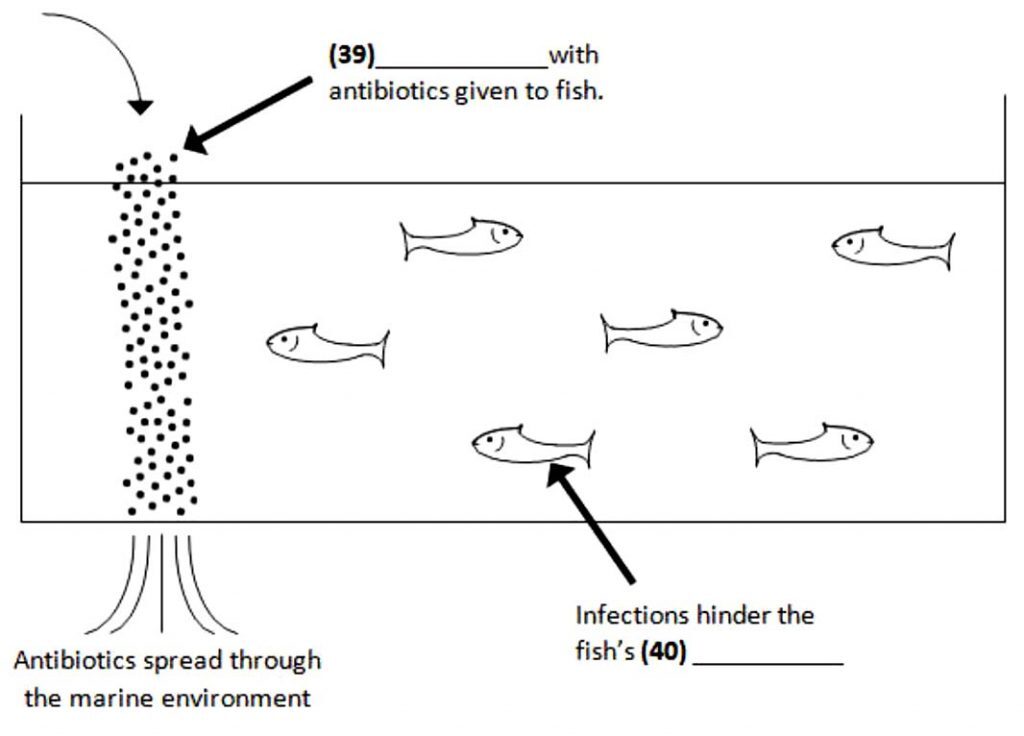
Paragraph 6: Another problem contributing to antibiotic resistance is that antibiotics are widely used in foodproducing animals, which contributes to the emergence of antibiotic-resistant bacteria in them. These resistant bacteria can contaminate the foods that come from these animals, and persons who consume these foods can develop antibiotic-resistant infections. This can be seen, for instance, in the fish farm industry. It is common to put upwards of 100,000 fish into each pen, which creates cramped and stressful conditions. This increases the susceptibility of fish to certain bacterial diseases, such as furunculosis. Furunculosis, an infection of the kidneys, is easily transmitted through water and so is devastating to fish farms. To combat the disease, antibiotics were added to fish food pellets, but these were unpalatable to the fish. They were already suffering from loss of appetite due to their infections and so most of the antibiotics ended up at the bottom of the pens, allowing residual drugs to spread throughout the marine environment. Fish farmer, Jo Hardwick, explains that this is different now. “Today, vaccines are replacing the antibiotic pellets as a treatment for the disease, but unfortunately, most of the damage has already been done.”
Paragraph 7: In conclusion, antibiotics must be used judiciously in humans and animals, because both uses contribute to the emergence, persistence, and spread of resistant bacteria. Resistant bacteria in foodproducing animals are of particular concern. Food animals serve as a reservoir of resistant pathogens and resistance mechanisms that can directly or indirectly result in antibiotic resistant infections in humans. If people do not wish to be faced with an attack of all the diseases they thought they had conquered in the twentieth century, society has to change its approach to antibiotic use.
Questions 27 – 33
Match each statement with the correct person’s initials. Write the correct initials in boxes 27-33.
IN: Iain Nicholson
ET: Emma Thompson
GH: Georgina Haynes
AF: Alexander Fleming
CO: Chenbo Okonkwa
JH: Jo Hardwick
27. Resistant bacteria can develop if doctors do not prescribe enough antibiotic.
28. Society may again have to face infectious diseases that were previously thought treatable.
29. Using antibiotics as a preventative measure is a key factor in the development of antibiotic resistance.
30. Better practice in fish farms when dealing with disease is too late when it comes to the spread of antibiotics in the environments around fish farms.
31. Drug companies may not be able to keep finding new antibiotics to fight lethal resistant infections.
32. All a patient’s infection must be destroyed by prescribed antibiotics in order to stop resistance growing.
33. Illicit antibiotic salesmen hardly ever follow the instructions for keeping antibiotics in the right way.
Questions 34 – 38
Do the following statements agree with the information given in the text? Write TRUE, FALSE, or NOT GIVEN.
34. The current definition of an antibiotic only includes drugs originating from live organisms.
35. Antibiotic resistance is a significant issue in both first and second world countries.
36. Some hospitals nowadays have to fund new antibiotic research themselves.
37. Climate conditions in some parts of Africa can damage antibiotics in their containers.
38. Resistant bacteria in food cannot be passed on to humans who eat it.
Questions 39 and 40
Label the diagram below.
Write NO MORE THAN THREE WORDS from the text for each answer.
Write your answers in boxes 39 and 40 on your answer sheet.
The Misuse of Antibiotics in the Fish Farm Industry
Tổng hợp từ vựng quan trọng trong bài đọc
| Từ vựng tiếng Anh | Loại từ | Nghĩa tiếng Việt |
| Susceptibility | (n) | Sự nhạy cảm, dễ mắc phải |
| Prophylaxis | (n) | Sự phòng bệnh, biện pháp phòng ngừa |
| Efficacy | (n) | Hiệu quả, công hiệu |
| Counterfeit | (adj) | Giả mạo |
| Degradation | (n) | Sự xuống cấp, suy thoái |
| Unpalatable | (adj) | Không ngon miệng, khó ăn |
| Residual | (adj) | Còn dư thừa, cặn bã |
| Judiciously | (adv) | Một cách thận trọng, khôn ngoan |
Đáp án & giải thích chi tiết
27. AF (Alexander Fleming)
-
Vị trí: Đoạn 5: Alexander Fleming cảnh báo: “The administration of too small doses leads to the production of resistant strains of bacteria.” (Việc sử dụng liều lượng quá nhỏ sẽ dẫn đến việc sản sinh ra các chủng vi khuẩn kháng thuốc).
-
Giải thích: “Too small doses” tương đương với “do not prescribe enough antibiotic”.
28. ET (Emma Thompson)
-
Vị trí: Đoạn 3: Emma Thompson giải thích: “…people may again face life-threatening bacterial infections.” (Mọi người có thể lại phải đối mặt với những bệnh nhiễm trùng đe dọa tính mạng).
-
Giải thích: Khớp với ý “xã hội lại phải đối mặt với các bệnh truyền nhiễm từng được cho là có thể điều trị”.
29. GH (Georgina Haynes)
-
Vị trí: Đoạn 5: Georgina Haynes giải thích: “when they are used widely as prophylaxis rather than treatment, because this exposes more bacteria to selection for resistance.”
-
Giải thích: “Prophylaxis” (phòng bệnh) chính là “preventative measure” trong câu hỏi.
30. JH (Jo Hardwick)
-
Vị trí: Đoạn 6: Jo Hardwick nói: “Today, vaccines are replacing the antibiotic pellets… but unfortunately, most of the damage has already been done.”
-
Giải thích: Việc thay thế thuốc (better practice) đã diễn ra nhưng “too late” (hầu hết thiệt hại đã xảy ra).
31. ET (Emma Thompson)
Vị trí: Đoạn 3: Emma Thompson nói: “The fear is that we will eventually fail to keep up in this race…” (Nỗi sợ là cuối cùng chúng ta sẽ thất bại trong việc bắt kịp cuộc đua tìm thuốc mới này).
32. IN (Iain Nicholson)
Vị trí: Đoạn 2: Iain Nicholson giải thích: “100 per cent of the infecting organisms be killed off to avoid selection of resistance.” (100% sinh vật lây nhiễm phải bị tiêu diệt để tránh chọn lọc kháng thuốc).
33. CO (Chenbo Okonkwa)
-
Vị trí: Đoạn 5: Chenbo Okonkwa nói: “unauthorised dealers rarely bother to follow official storage guidelines.”
-
Giải thích: “Unauthorised dealers” = “illicit antibiotic salesmen”, và “follow storage guidelines” = “keeping antibiotics in the right way”.
34. FALSE
-
Vị trí: Đoạn 1: “Currently, the term antibiotic is also applied to synthetic antimicrobials.”
-
Giải thích: Kháng sinh hiện nay bao gồm cả loại tổng hợp (synthetic), không chỉ giới hạn ở “thuốc bắt nguồn từ sinh vật sống” như câu hỏi nhận định.
35. TRUE
-
Vị trí: Đoạn 3: “Antibiotic resistance has become a serious problem in both developed and underdeveloped nations.”
-
Giải thích: “Developed and underdeveloped” tương ứng với ý “first and second world countries” (các quốc gia thế giới thứ nhất và thứ hai – ý chỉ quy mô toàn cầu).
36. NOT GIVEN
Giải thích: Bài đọc (Đoạn 3) có nói tỷ lệ kháng thuốc ở bệnh viện (hospitals) rất cao, nhưng không hề đề cập đến việc các bệnh viện phải tự tài trợ (fund) cho nghiên cứu kháng sinh mới.
37. TRUE
-
Vị trí: Đoạn 5: “…tropical conditions, such as those often found in Africa, readily cause degradation of medical compounds.”
-
Giải thích: Điều kiện khí hậu nhiệt đới ở Châu Phi dễ dàng gây suy thoái/hư hỏng (degradation = damage) thuốc.
38. FALSE
-
Vị trí: Đoạn 6: “These resistant bacteria can contaminate the foods… and persons who consume these foods can develop antibiotic-resistant infections.”
-
Giải thích: Câu hỏi nói vi khuẩn “không thể truyền sang người” (cannot be passed on) là hoàn toàn sai so với dữ kiện bài đọc.
39. (fish) food pellets (hoặc food pellets)
Giải thích: Sơ đồ có hình mũi tên chỉ vào các hạt nhỏ thả xuống nước kèm dòng chữ “[39]… with antibiotics given to fish”. Đoạn 6 ghi: “antibiotics were added to fish food pellets”.
40. appetite
Giải thích: Sơ đồ chỉ vào con cá với dòng chữ “Infections hinder the fish’s [40]…” (Nhiễm trùng cản trở… của cá). Đoạn 6 có câu: “They were already suffering from loss of appetite due to their infections”. Từ cần điền là “appetite” (sự ngon miệng/sự thèm ăn).
Bài đọc “Antibiotic Resistance” thực sự là một bức tranh toàn cảnh về cách IELTS khai thác và cấu trúc nhóm chủ đề Khoa học. Thông qua việc bóc tách nguyên nhân và hệ lụy của việc lạm dụng thuốc, bạn không chỉ rèn luyện được kỹ năng quét thông tin sắc bén mà còn học được cách triển khai một bài luận Problem-Solution mẫu mực. Hãy tận dụng ngay hệ thống từ vựng học thuật mà trung tâm ngoại ngữ ECE vừa tổng hợp để biến chúng thành “vũ khí” nâng band điểm cho cả bài thi Writing Task 2 của bạn nhé!

Đoàn Nương
Tôi là Đoàn Nương - Giám đốc trung tâm ngoại ngữ ECE. Tôi hiện đang là giảng viên của khoa ngôn ngữ các nước nói tiếng Anh - Trường Đại Học Quốc Gia Hà Nội. Tôi đã có 19 năm kinh nghiệm giảng dạy IELTS và 15 năm là giảng viên Đại Học. Tôi mong muốn đưa ECE trở thành trung tâm ngoại ngữ cho tất cả mọi người, mang tới cho học viên môi trường học tập tiếng Anh chuyên nghiệp và hiệu quả.
Tìm hiểu các khóa học tại ECE
Tin Tức Cùng Danh Mục

Giải mã bài đọc Just Relax IELTS Reading về bí ẩn thuật thôi miên

Spider silk IELTS Reading: Dịch bài đọc & đáp án chi tiết

Knowledge in Medicine IELTS Reading – Từ vựng & đáp án chuẩn

Angkor Wat IELTS Reading Answers – Bài đọc về ngôi đền Angkor Wat

IELTS Speaking Topic: Conversation & Public Speaking
Các tin liên quan
Giải mã bài đọc Just Relax IELTS Reading về bí ẩn thuật thôi miên
Spider silk IELTS Reading: Dịch bài đọc & đáp án chi tiết
Knowledge in Medicine IELTS Reading – Từ vựng & đáp án chuẩn
Angkor Wat IELTS Reading Answers – Bài đọc về ngôi đền Angkor Wat
IELTS Speaking Topic: Conversation & Public Speaking

Gợi ý từ vựng, ý tưởng cho IELTS speaking topic films

ELTS Speaking topic Birthday: Bài mẫu & Từ vựng chuẩn

Grey Workers IELTS Reading – Đáp án bài đọc & dịch chi tiết
Radio Automation IELTS Reading – Bài dịch & đáp án chuẩn

Martin Luther King IELTS Reading: Từ vựng & đáp án chi tiết

Từ vựng & Bài mẫu IELTS Speaking Topic Money

Giải mã topic Internet IELTS Speaking: Từ vựng & Bài mẫu chi tiết




Lượt Đăng Ký

NHẬN TƯ VẤN NGAY
Vui lòng để lại thông tin để được tư vấn chi tiết lộ trình học và thi IELTS ở trên
