
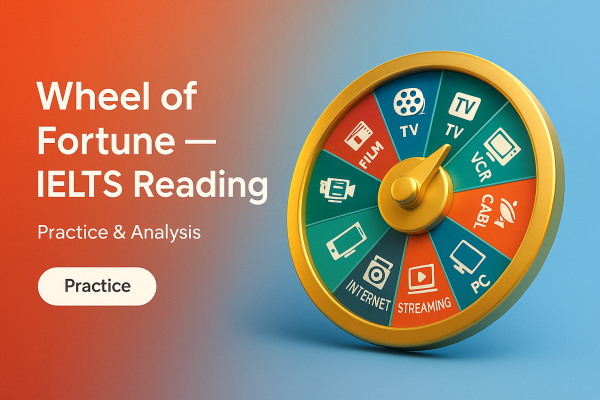
Wheel of Fortune IELTS: Phân tích chi tiết bài đọc về ngành giải trí



Tóm Tắt Nội Dung Bài Viết
Wheel of Fortune IELTS: Phân tích chi tiết bài đọc về ngành giải trí


Tóm Tắt Nội Dung Bài Viết
Bài đọc “Wheel of Fortune” là một ví dụ điển hình cho dạng bài IELTS Reading, tập trung vào sự phát triển và biến đổi của ngành công nghiệp giải trí dưới tác động của công nghệ. Bài viết này của trung tâm ngoại ngữ ECE sẽ phân tích chi tiết từ nội dung chính, từ vựng, cho đến cách trả lời từng dạng câu hỏi, giúp bạn nắm vững kiến thức và chiến thuật làm bài hiệu quả.
Wheel of Fortune IELTS
I. Bài đọc và câu hỏi
Reading Passage: Wheel of Fortune
A. Since moving pictures were invented a century ago, a new way of distributing entertainment to consumers has emerged about once every generation. Each such innovation has changed the industry irreversibly; each has been accompanied by a period of fear mixed with exhilaration. The arrival of digital technology, which translates music, pictures and text into the zeros and ones of computer language, marks one of those periods.
B. This may sound familiar, because the digital revolution, and the explosion of choice that would go with it, has been heralded for some time. In 1992, John Malone, chief executive of TCI, an American cable giant, welcomed the ‘500-channel universe’. Digital television was about to deliver everything except pizzas to people’s living rooms. When the entertainment companies tried out the technology, it worked fine – but not at a price that people were prepared to pay.
C. Those 500 channels eventually arrived but via the Internet and the PC rather than through television. The digital revolution was starting to affect the entertainment business in unexpected ways. Eventually it will change every aspect of it, from the way cartoons are made to the way films are screened to the way people buy music. That much is clear. What nobody is sure of is how it will affect the economics of the business.
D. New technologies always contain within them both threats and opportunities. They have the potential both to make the companies in the business a great deal richer, and to sweep them away. Old companies always fear new technology. Hollywood was hostile to television, television terrified by the VCR. Go back far enough, points out Hal Varian, an economist at the University of California at Berkeley, and you find publishers complaining that ‘circulating libraries’ would cannibalise their sales. Yet whenever a new technology has come in, it has made more money for existing entertainment companies. The proliferation of the means of distribution results, gratifyingly, in the proliferation of dollars, pounds, pesetas and the rest to pay for it.
E. All the same, there is something in the old companies’ fears. New technologies may not threaten their lives, but they usually change their role. Once television became widespread, film and radio stopped being the staple form of entertainment. Cable television has undermined the power of the broadcasters. And as power has shifted the movie studios, the radio companies and the television broadcasters have been swallowed up. These days, the grand old names of entertainment have more resonance than power. Paramount is part of Viacom, a cable company; Universal, part of Seagram, a drinks-and-entertainment company; MGM, once the roaring lion of Hollywood, has been reduced to a whisper because it is not part of one of the giants. And RCA, once the most important broadcasting company in the world, is now a recording label belonging to Bertelsmann, a large German entertainment company.
F. Part of the reason why incumbents got pushed aside was that they did not see what was coming. But they also faced a tighter regulatory environment than the present one. In America, laws preventing television broadcasters from owning programme companies were repealed earlier this decade, allowing the creation of vertically integrated businesses. Greater freedom, combined with a sense of history, prompted the smarter companies in the entertainment business to re-invent themselves. They saw what happened to those of their predecessors who were stuck with one form of distribution. So, these days, the powers in the entertainment business are no longer movie studios, or television broadcasters, or publishers; all those businesses have become part of bigger businesses still, companies that can both create content and distribute it in a range of different ways.
G. Out of all this, seven huge entertainment companies have emerged – Time Warner, Walt Disney, Bertelsmann, Viacom, News Corp, Seagram and Sony. They cover pretty well every bit of the entertainment business except pornography. Three are American, one is Australian, one Canadian, one German and one Japanese. ‘What you are seeing’, says Christopher Dixon, managing director of media research at PaineWebber, a stockbroker, ‘is the creation of a global oligopoly. It happened to the oil and automotive businesses earlier this century; now it is happening to the entertainment business.’ It remains to be seen whether the latest technology will weaken those great companies, or make them stronger than ever.
Questions 1 – 8
Reading Passage 2 has seven paragraphs A-G.
Which paragraph mentions the following (Questions 1-8)?
Write the appropriate letters (A-G) in boxes 1-8 on your answer sheet.
NB Some of the paragraphs will be used more than once.
1 the contrasting effects that new technology can have on existing business
2 the fact that a total transformation is going to take place in the future in the delivery of all forms of entertainment
3 the confused feelings that people are known to have experienced in response to technological innovation
4 the fact that some companies have learnt from the mistakes of others
5 the high cost to the consumer of new ways of distributing entertainment
6 uncertainty regarding the financial impact of wider media access
7 the fact that some companies were the victims of strict government policy
8 the fact that the digital revolution could undermine the giant entertainment companies
Questions 9 – 12
The writer refers to various individuals and companies in the reading passage.
Match the people or companies (A-E) with the points made in Questions 9-12 about the introduction of new technology.
Write the appropriate letter (A-E) in boxes 9-12 on your answer sheet.
A John Malone
B Hal Varian
C MGM
D Walt Disney
E Christopher Dixon
9 Historically, new forms of distributing entertainment have alarmed those well-established in the business.
10 The merger of entertainment companies follows a pattern evident in other industries.
11 Major entertainment bodies that have remained independent have lost their influence.
12 News of the most recent technological development was published some years ago.
Questions 13 – 14 Choose the appropriate letters A-D and write them in boxes 13-14 on your answer sheet.
13. How does the writer put across his views on the digital revolution?
A by examining the forms of media that will be affected by it
B by analysing the way entertainment companies have reacted to it
C by giving a personal definition of technological innovation
D by drawing comparisons with other periods of technological innovation
14. Which of the following best summarises the writer’s views in Reading Passage 2?
A The public should cease resisting the introduction of new technology.
B Digital technology will increase profits in the entertainment business.
C Entertainment companies should adapt to technological innovation.
D Technological change only benefits big entertainment companies.
II. Tổng hợp từ vựng hay trong bài
- Irreversibly (adv): Không thể đảo ngược. Ví dụ: Each such innovation has changed the industry irreversibly.
- Exhilaration (n): Sự phấn khích, vui vẻ tột độ. Ví dụ: a period of fear mixed with exhilaration.
- Herald (v): Báo trước, loan tin. Ví dụ: The digital revolution has been heralded for some time.
- Hostile to (adj): Thù địch, chống đối. Ví dụ: Hollywood was hostile to television.
- Cannibalise (v): Gây hại đến doanh số của sản phẩm khác cùng loại. Ví dụ: ‘circulating libraries’ would cannibalise their sales.
- Proliferation (n): Sự tăng nhanh, sự sinh sôi nảy nở. Ví dụ: The proliferation of the means of distribution results in the proliferation of dollars.
- Undermine (v): Làm suy yếu. Ví dụ: Cable television has undermined the power of the broadcasters.
- Swallow up (v): Nuốt chửng, thôn tính. Ví dụ: the radio companies and the television broadcasters have been swallowed up.
- Resonance (n): Sự vang vọng, sức ảnh hưởng (thay vì quyền lực thực tế). Ví dụ: The grand old names of entertainment have more resonance than power.
- Incumbent (n): Người đương nhiệm, công ty đang thống trị thị trường. Ví dụ: Part of the reason why incumbents got pushed aside was that they did not see what was coming.
- Regulatory environment (n): Môi trường pháp lý. Ví dụ: they also faced a tighter regulatory environment than the present one.
- Vertically integrated businesses (n): Các doanh nghiệp được tích hợp theo chiều dọc (kiểm soát nhiều giai đoạn sản xuất và phân phối).
- Oligopoly (n): Độc quyền nhóm, một thị trường bị chi phối bởi một số ít công ty lớn. Ví dụ: the creation of a global oligopoly.
III. Đáp án và phân tích chi tiết
Phân tích chi tiết câu hỏi 1 – 8
Dạng bài: Matching Information (Nối thông tin với đoạn văn).
Đây là dạng bài yêu cầu tìm đoạn văn có chứa thông tin được đưa ra trong câu hỏi. Kỹ năng quan trọng nhất ở đây là scanning (đọc quét) để tìm từ khóa và skimming (đọc lướt) để nắm ý chính của từng đoạn.
- Câu 1: “the contrasting effects that new technology can have on existing business” (những tác động trái ngược mà công nghệ mới có thể có đối với các doanh nghiệp hiện tại)
- Đáp án: D
- Phân tích: Đoạn D mở đầu với câu: “New technologies always contain within them both threats and opportunities.” (Công nghệ mới luôn chứa đựng cả mối đe dọa và cơ hội). “Threats and opportunities” chính là cụm từ đồng nghĩa hoàn hảo cho “contrasting effects” (tác động trái ngược).
- Câu 2: “the fact that a total transformation is going to take place in the future in the delivery of all forms of entertainment” (sự thật rằng một sự biến đổi toàn diện sẽ diễn ra trong tương lai đối với việc phân phối tất cả các hình thức giải trí)
- Đáp án: C
- Phân tích: Đoạn C có câu: “Eventually it will change every aspect of it, from the way cartoons are made to the way films are screened to the way people buy music.” (Cuối cùng, nó sẽ thay đổi mọi khía cạnh của ngành, từ cách phim hoạt hình được sản xuất đến cách phim được chiếu và cách mọi người mua nhạc). Cụm từ “change every aspect” (thay đổi mọi khía cạnh) tương đương với “total transformation” (biến đổi toàn diện).
- Câu 3: “the confused feelings that people are known to have experienced in response to technological innovation” (những cảm xúc bối rối mà mọi người đã trải qua khi đối mặt với sự đổi mới công nghệ)
- Đáp án: A
- Phân tích: Đoạn A có câu: “each has been accompanied by a period of fear mixed with exhilaration.” (mỗi sự đổi mới đều đi kèm với một giai đoạn sợ hãi lẫn phấn khích). “Fear mixed with exhilaration” là cách diễn đạt chính xác cho “confused feelings” (những cảm xúc bối rối/trái ngược).
- Câu 4: “the fact that some companies have learnt from the mistakes of others” (thực tế rằng một số công ty đã học hỏi từ sai lầm của những công ty khác)
- Đáp án: F
- Phân tích: Đoạn F có câu: “prompted the smarter companies in the entertainment business to re-invent themselves. They saw what happened to those of their predecessors who were stuck with one form of distribution.” (thúc đẩy các công ty thông minh hơn trong ngành giải trí tự đổi mới bản thân. Họ đã thấy điều gì xảy ra với những người tiền nhiệm bị mắc kẹt với một hình thức phân phối). Điều này trực tiếp chỉ ra rằng các công ty đã rút kinh nghiệm từ thất bại của người đi trước.
- Câu 5: “the high cost to the consumer of new ways of distributing entertainment” (chi phí cao đối với người tiêu dùng của những cách phân phối giải trí mới)
- Đáp án: B
- Phân tích: Đoạn B nói về truyền hình kỹ thuật số: “When the entertainment companies tried out the technology, it worked fine – but not at a price that people were prepared to pay.” (khi các công ty giải trí thử nghiệm công nghệ, nó hoạt động tốt – nhưng không với một mức giá mà mọi người sẵn sàng trả). “Not at a price that people were prepared to pay” chính là cách diễn đạt cho “high cost to the consumer”.
- Câu 6: “uncertainty regarding the financial impact of wider media access” (sự không chắc chắn về tác động tài chính của việc tiếp cận phương tiện truyền thông rộng rãi hơn)
- Đáp án: C
- Phân tích: Đoạn C có câu: “That much is clear. What nobody is sure of is how it will affect the economics of the business.” (Điều đó là rõ ràng. Điều mà không ai chắc chắn là nó sẽ ảnh hưởng đến nền kinh tế của ngành kinh doanh này như thế nào). “Nobody is sure of” đồng nghĩa với “uncertainty regarding” và “the economics of the business” đề cập đến “the financial impact”.
- Câu 7: “the fact that some companies were the victims of strict government policy” (thực tế rằng một số công ty là nạn nhân của chính sách chính phủ nghiêm ngặt)
- Đáp án: F
- Phân tích: Đoạn F có câu: “But they also faced a tighter regulatory environment than the present one.” (Nhưng họ cũng phải đối mặt với một môi trường pháp lý chặt chẽ hơn so với hiện tại). “A tighter regulatory environment” chính là cách diễn đạt khác của “strict government policy”.
- Câu 8: “the fact that the digital revolution could undermine the giant entertainment companies” (thực tế rằng cuộc cách mạng kỹ thuật số có thể làm suy yếu các công ty giải trí khổng lồ)
- Đáp án: G
- Phân tích: Đoạn G kết thúc bằng câu: “It remains to be seen whether the latest technology will weaken those great companies, or make them stronger than ever.” (Vẫn còn phải xem liệu công nghệ mới nhất sẽ làm suy yếu những công ty vĩ đại đó, hay làm chúng trở nên mạnh hơn bao giờ hết). Câu này trực tiếp đề cập đến khả năng công nghệ làm suy yếu (weaken) các công ty lớn, khớp với nội dung câu hỏi.
Questions 9 – 12 (Matching Information)
- Đáp án 9: B
- Phân tích: Câu hỏi nói về việc “trong lịch sử, các hình thức phân phối giải trí mới đã làm những người có vị trí vững chắc trong ngành kinh doanh lo sợ”.
- Trong đoạn D, tác giả trích dẫn Hal Varian: “Go back far enough, points out Hal Varian… and you find publishers complaining that ‘circulating libraries’ would cannibalise their sales.” Hal Varian được sử dụng để đưa ra một ví dụ lịch sử, chứng minh rằng nỗi sợ hãi này đã tồn tại từ lâu.
- Đáp án 10: E
- Phân tích: Câu hỏi nói về “sự sáp nhập của các công ty giải trí theo một khuôn mẫu rõ ràng trong các ngành công nghiệp khác”.
- Trong đoạn G, tác giả trích lời Christopher Dixon: “It happened to the oil and automotive businesses earlier this century; now it is happening to the entertainment business.” Dixon đã so sánh sự hợp nhất của các công ty giải trí với các ngành công nghiệp khác như ô tô và dầu mỏ, khớp với nội dung câu hỏi.
- Đáp án 11: C
- Phân tích: Câu hỏi đề cập đến “các tổ chức giải trí lớn đã duy trì sự độc lập nhưng đã mất đi sức ảnh hưởng của mình”.
- Trong đoạn E, MGM được đề cập: “MGM, once the roaring lion of Hollywood, has been reduced to a whisper because it is not part of one of the giants.” Điều này trực tiếp chỉ ra rằng MGM đã mất đi quyền lực vì không tham gia vào các tập đoàn lớn.
- Đáp án 12: A
- Phân tích: Câu hỏi hỏi về người đã công bố tin tức về sự phát triển công nghệ gần đây nhất một vài năm trước.
- Trong đoạn B, John Malone được nhắc đến: “In 1992, John Malone… welcomed the ‘500-channel universe’.” Đây là một ví dụ về việc công bố một bước tiến công nghệ (kênh truyền hình kỹ thuật số), và sự việc này đã xảy ra cách đây một vài năm so với thời điểm bài viết được viết.
Questions 13 – 14 (Multiple Choice)
- Đáp án 13: D
- Phân tích: Câu hỏi hỏi cách tác giả thể hiện quan điểm của mình về cuộc cách mạng kỹ thuật số.
- Trong đoạn A, tác giả bắt đầu bằng cách so sánh cuộc cách mạng kỹ thuật số hiện tại với những đổi mới trước đó: “a new way of distributing entertainment to consumers has emerged about once every generation.”
- Đoạn D, tác giả tiếp tục sử dụng các ví dụ lịch sử để so sánh: “Hollywood was hostile to television, television terrified by the VCR.” và trích dẫn Hal Varian về “circulating libraries”. Các ví dụ này cho thấy tác giả luôn dùng cách so sánh với các giai đoạn đổi mới công nghệ trong quá khứ để làm rõ quan điểm của mình.
- Đáp án 14: C
- Phân tích: Câu hỏi hỏi đâu là ý tóm tắt tốt nhất quan điểm của tác giả.
- Đoạn E và F là những đoạn quan trọng nhất để trả lời câu này. Tác giả chỉ ra rằng các công ty cũ thường bị suy yếu vì không nhìn thấy sự thay đổi hoặc không thể thích nghi.
- Đoạn F, tác giả nhấn mạnh: “Greater freedom, combined with a sense of history, prompted the smarter companies in the entertainment business to re-invent themselves. They saw what happened to those of their predecessors who were stuck with one form of distribution.” Câu này cho thấy rõ ràng quan điểm của tác giả là các công ty giải trí phải thích ứng và tự đổi mới để tồn tại và phát triển trước những thay đổi công nghệ.
IV. Kết luận
Bài đọc “Wheel of Fortune” là một ví dụ tuyệt vời để thực hành các kỹ năng làm bài IELTS Reading. Từ việc xác định vị trí thông tin cho các câu hỏi “Matching Information” đến việc tóm tắt và suy luận ý chính cho “Multiple Choice”, bài viết này đòi hỏi thí sinh phải đọc hiểu sâu và nắm bắt được cấu trúc lập luận của tác giả. Việc học và phân tích từ vựng theo ngữ cảnh cũng là một yếu tố then chốt để thành công.
Hy vọng rằng phân tích chi tiết trên của ECE sẽ giúp bạn có cái nhìn rõ ràng hơn về cách tiếp cận dạng bài này một cách hiệu quả.

Đoàn Nương
Tôi là Đoàn Nương - Giám đốc trung tâm ngoại ngữ ECE. Tôi hiện đang là giảng viên của khoa ngôn ngữ các nước nói tiếng Anh - Trường Đại Học Quốc Gia Hà Nội. Tôi đã có 19 năm kinh nghiệm giảng dạy IELTS và 15 năm là giảng viên Đại Học. Tôi mong muốn đưa ECE trở thành trung tâm ngoại ngữ cho tất cả mọi người, mang tới cho học viên môi trường học tập tiếng Anh chuyên nghiệp và hiệu quả.
Tìm hiểu các khóa học tại ECE
Tin Tức Cùng Danh Mục

The Concept of Childhood in Western Countries IELTS Reading: Dịch & giải chi tiết

The Magic of Kefir IELTS Reading: Dịch bài đọc & đáp án chuẩn
The Columbian Exchange IELTS Reading: Dịch & giải chi tiết A-Z

Giải mã bài đọc: Complementary & alternative medicine IELTS Reading

Stadium Australia IELTS Reading: Giải chi tiết & Dịch nghĩa
Các tin liên quan
The Concept of Childhood in Western Countries IELTS Reading: Dịch & giải chi tiết
The Magic of Kefir IELTS Reading: Dịch bài đọc & đáp án chuẩn
The Columbian Exchange IELTS Reading: Dịch & giải chi tiết A-Z
Giải mã bài đọc: Complementary & alternative medicine IELTS Reading
Stadium Australia IELTS Reading: Giải chi tiết & Dịch nghĩa
Television and Sport IELTS Reading: Dịch chuẩn & Giải đề chi tiết

The Invention of Television IELTS Reading: Từ vựng & đáp án chuẩn

Frogwatch IELTS Reading: Bài dịch & đáp án chuẩn nhất
Consecutive and Simultaneous Translation IELTS Reading: Dịch chuẩn & Giải chi tiết
Fears IELTS Reading: Bản dịch chuẩn & giải chi tiết từ A-Z
Memory and Age IELTS Reading: Dịch chuẩn & Giải chi tiết
Đáp án & từ vựng bài đọc Photovoltaics on the rooftop IELTS Reading




Lượt Đăng Ký

NHẬN TƯ VẤN NGAY
Vui lòng để lại thông tin để được tư vấn chi tiết lộ trình học và thi IELTS ở trên
