
Tóm Tắt Nội Dung Bài Viết
IELTS Reading ngày 3/8/2024 mang đến một bài đọc thú vị ở Passage 3 với chủ đề Termite Mounds – công trình sinh học độc đáo của loài mối tại châu Phi. Bài viết dưới đây của ECE English sẽ cung cấp toàn văn bài đọc, hệ thống từ vựng học thuật, và đặc biệt là phần giải thích chi tiết từng câu hỏi IELTS Reading giúp bạn hiểu sâu và nâng cao kỹ năng làm bài. Nếu bạn đang ôn luyện IELTS Reading Band 7.0+, đừng bỏ qua bài phân tích này!
TERMITE MOUNDS
Could the vast towers of mud constructed by insects in sub-Saharan Africa hold the key to our energy-efficient building of the future?
A.
To most of us, termites are destructive insects which can cause damage on a devastating scale. But according to Dr Rupert Soar of Loughborough University’s School of Mechanical and Manufacturing Engineering, these pests may serve a useful purpose for us after all. His multi-disciplinary team of British and American engineers and biologists have set out to investigate the giant mounds built by termites in Namibia, in sub-Saharan Africa, as part of the most extensive study of these structures ever taken.
B.
Termite mounds are impressive for their size alone; typically they are three metres high, and some as tall as eight metres by found. They also reach far into the earth, where the insects ‘mine’ their building materials, carefully selecting each grain of sand they use. The termite’s nest is contained in the central cavity of the mound, safely protected from the harsh environment outside. The mound itself is formed of an intricate lattice of tunnels, which split into smaller and smaller tunnels, much like a person’s blood vessels.
C.
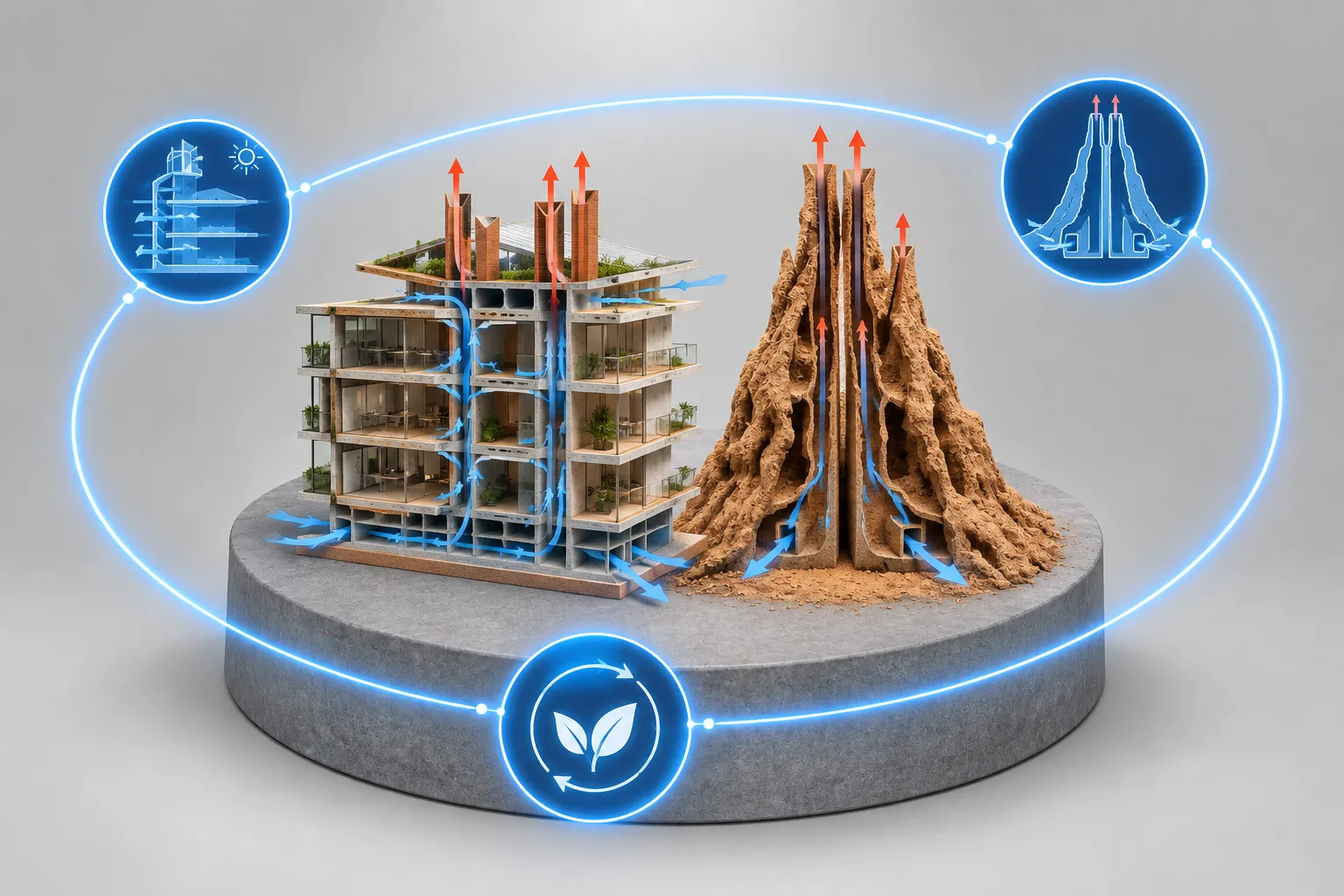
This complex system of tunnels draws in air from the outside, capturing wind energy to drive it through the mound. It also serves to expel spent respiratory gases from the nest to prevent the termites from suffocating, so ensuring them a continuous provision of fresh, breathable air. So detailed is the design that the nest stays within three degrees of a constant temperature, despite variations on the outside of up to 50°C, from blistering heat in the daytime to below freezing on the coldest nights. The mound also automatically regulates moisture in the air, by means of best its underground ‘cellar’, and evaporation from the top of the mound. Some colonies even had ‘chimneys’ at a height of 20m to control moisture loss in the hottest regions of sub-Saharan Africa.
D.
Furthermore, the termites have evolved in such a way as to outsource some of their biological functions. Part of their digestive process is carried out by a fungus, which they ‘farm’ inside the mound. This fungus, which is found nowhere else on earth, thrives in the constant and optimum environment of the mound. The termites feed the fungus with slightly chewed wood pulp, which the fungus then breaks down into a digestible sugary food to provide the insects with energy, and cellulose which they use for building. And, although the termites must generate waste, none ever leaves the structure, indicating that there is also some kind of internal waste-recycling system.
E.
Scientists are so excited by the mounds that they have labelled them a ‘super organism’ because, in Soar’s words: “They dance on the edge of what we would perceive to cool down, or if you’re too cold you need to thrive: that’s called homeostasis. What the termites have done is to move homeostatic function away from their body, into the structure in which they live.” As more information comes to light about the unique features of termite mounds, we may ultimately need to redefine our understanding of what constitutes a ‘living’ organism.
F.
To reveal the structure of the mounds, Soar’s team begins by filling and covering them with plaster of Paris, a chalky white paste based on the mineral gypsum, which becomes rock-solid when dry. The researchers then carve the plaster of Paris into half-millimetre-thick slices, and photograph them sequentially. Once the pictures are digitally scanned, computer technology is able to recreate complex three-dimensional images of the mounds. These models have enabled the team to map termite architecture at a level of detail never before attained.
G.
Soar hopes that the models will explain how termite mounds create a self-regulating living environment which manages to respond to changing internal and external conditions without drawing on any outside source of power. If they do, the findings could be invaluable in informing future architectural design, and could inspire buildings that are self-sufficient, environmentally friendly, and cheap to run. “As we approach a world of climate change, we need temperatures to rise,” he explains, “there will not be enough fuel to drive air conditioners around the world.” It is hoped, says Soar, “that the findings will provide clues that aid the ultimate development of new kinds of human habitats, suitable for a variety of arid, hostile environments not only on the earth but maybe one day on the moon and beyond.”
📝 QUESTIONS 1–7
Reading Passage 3 has seven paragraphs A–G.
Choose the correct heading for each paragraph from the list of headings below.
Write the correct number, i–ix, in boxes 1–7 on your answer sheet.
List of Headings
i. Methods used to investigate termite mound formation
ii. Challenging our assumptions about the nature of life
iii. Reconsidering the termite’s reputation
iv. Principal functions of the termite mound
v. Distribution of termite mounds in sub-Saharan Africa
vi. Some potential benefits of understanding termite architecture
vii. The astonishing physical dimensions of the termite mound
viii. Termite mounds under threat from global climate change
ix. A mutually beneficial relationship
QUESTIONS 8–11
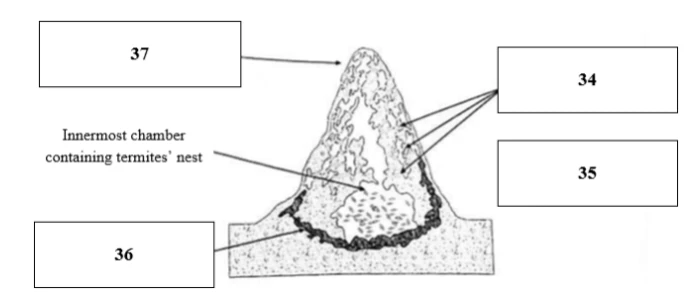
Label the diagram below.
Choose ONE WORD ONLY from the passage for each answer.
Write your answers in boxes 8–11 on your answer sheet.
- network of 8 helps to give the termites a constant
- 9 supply and to maintain a limited temperature range
- cellar to aid control of 10 levels in mound
- top of the mound permits 11
QUESTIONS 12–14
Do the following statements agree with the claims of the writer in Reading Passage 3?
In boxes 12–14 on your answer sheet, write:
-
YES if the statement agrees with the claims of the writer
-
NO if the statement contradicts the claims of the writer
-
NOT GIVEN if it is impossible to say what the writer thinks about this
12. The termite mound appears to process its refuse material internally.
13. Dr Soar’s reconstruction involves scanning a single photograph of a complete mound into a computer.
14. New information about termite architecture could help people deal with future energy crises.
Từ vựng & Cấu trúc học thuật trong bài
A. Từ vựng học thuật & chuyên ngành
| Từ vựng | Loại từ | Nghĩa |
|---|---|---|
| destructive | adj | phá hoại |
| multi-disciplinary | adj | liên ngành |
| extensive | adj | rộng lớn, bao quát |
| lattice | n | mạng lưới, kết cấu dạng lưới |
| respiratory gases | n | khí hô hấp |
| suffocate | v | ngạt thở |
| regulate | v | điều tiết |
| evaporation | n | sự bốc hơi |
| outsource | v | thuê ngoài, giao phó |
| digestible | adj | dễ tiêu hoá |
| cellulose | n | chất xơ (xenlulo) |
| waste-recycling | adj | tái chế chất thải |
| homeostasis | n | sự cân bằng nội môi |
| reveal | v | làm lộ ra |
| self-regulating | adj | tự điều chỉnh |
| self-sufficient | adj | tự cung tự cấp |
| arid | adj | khô cằn |
| habitat | n | môi trường sống |
B. Cấu trúc hay
-
“…safely protected from the harsh environment outside” → cụm bị động nhấn mạnh tính chất bảo vệ.
-
“…none ever leaves the structure” → nhấn mạnh bằng cách đảo ngữ (none đứng đầu).
-
“…they dance on the edge of what we would perceive…” → thành ngữ bóng bẩy để chỉ trạng thái cân bằng tinh tế.
-
“…without drawing on any outside source of power” → “draw on” = sử dụng, dựa vào (nguồn lực).
Đáp án tham khảo
QUESTIONS 1–7: MATCH HEADINGS
1. Paragraph A → iii. Reconsidering the termite’s reputation
🔍 Dẫn chứng:
“To most of us, termites are destructive insects… But according to Dr Rupert Soar… these pests may serve a useful purpose for us after all.”
📌 Giải thích:
-
Mở đầu đoạn nói về cái nhìn tiêu cực của con người về mối.
-
Nhưng phần còn lại lại nói rằng chúng thực ra có ích, nghiên cứu đang chỉ ra điều đó.
✅ Do đó: tiêu đề đúng là “Reconsidering the termite’s reputation” (xem xét lại danh tiếng của mối)
2. Paragraph B → vii. The astonishing physical dimensions of the termite mound
🔍 Dẫn chứng:
“typically they are three metres high, and some as tall as eight metres…”
“…reach far into the earth…”
📌 Giải thích:
-
Mô tả chiều cao “astonishing” và độ sâu của tổ mối.
-
Tập trung hoàn toàn vào kích thước vật lý.
✅ Đáp án đúng: “The astonishing physical dimensions…”
3. Paragraph C → iv. Principal functions of the termite mound
🔍 Dẫn chứng:
“…expel spent respiratory gases…”
“…a continuous provision of fresh, breathable air…”
“…regulates moisture…”
“…chimneys to control moisture…”
📌 Giải thích:
-
Nêu rất nhiều chức năng: thông khí, kiểm soát nhiệt, độ ẩm.
✅ Đây chính là “principal functions” – chức năng chính.
4. Paragraph D → ix. A mutually beneficial relationship
🔍 Dẫn chứng:
“Part of their digestive process is carried out by a fungus…”
“…they ‘farm’ inside the mound…”
“This fungus… breaks down into a digestible sugary food…”
📌 Giải thích:
-
Fungus và mối cộng sinh – cùng có lợi: fungus được sống ổn định, mối có thức ăn.
✅ Đây là mutually beneficial relationship (mối quan hệ hai bên cùng có lợi)
5. Paragraph E → ii. Challenging our assumptions about the nature of life
🔍 Dẫn chứng:
“We may ultimately need to redefine our understanding of what constitutes a ‘living’ organism.”
📌 Giải thích:
-
Câu cuối đoạn đặt nghi vấn về định nghĩa “sinh vật sống” – tổ mối gần như có “sự sống”.
✅ Đáp án: Challenging assumptions about nature of life (thách thức định nghĩa sự sống)
6. Paragraph F → i. Methods used to investigate termite mound formation
🔍 Dẫn chứng:
“Soar’s team begins by filling and covering… with plaster of Paris…”
“…carves into half-millimetre-thick slices…”
“…digitally scanned…”
📌 Giải thích:
-
Toàn bộ đoạn nói về cách nghiên cứu tổ mối (từ đổ thạch cao → scan ảnh → dựng mô hình).
✅ Đáp án đúng: “Methods used…”
7. Paragraph G → vi. Some potential benefits of understanding termite architecture
🔍 Dẫn chứng:
“…could inspire buildings that are self-sufficient…”
“…aid the ultimate development of new kinds of human habitats…”
“…not only on the earth but maybe one day on the moon and beyond.”
📌 Giải thích:
-
Nêu tiềm năng ứng dụng kiến trúc tổ mối trong thiết kế nhà ở cho môi trường khắc nghiệt.
✅ Đáp án: Potential benefits of understanding termite architecture
🔹 QUESTIONS 8–11: Diagram Labelling (Chọn ONE WORD từ bài)
8. Answer: tunnels
🔍 Dẫn chứng (Paragraph B):
“The mound itself is formed of an intricate lattice of tunnels…”
📌 Giải thích:
-
Phần sơ đồ yêu cầu tên của hệ thống dẫn khí → chính là tunnels (đường hầm).
9. Answer: air
🔍 Dẫn chứng (Paragraph C):
“…draws in air from the outside…”
📌 Giải thích:
-
Nguồn vào của khí – là air được hút vào từ bên ngoài.
10. Answer: moisture
🔍 Dẫn chứng (Paragraph C):
“The mound also automatically regulates moisture in the air…”
📌 Giải thích:
-
Câu này nói rõ chức năng của tổ là điều tiết moisture (độ ẩm).
11. Answer: evaporation
🔍 Dẫn chứng (Paragraph C):
“…and evaporation from the top of the mound.”
📌 Giải thích:
-
Đề cập đến quá trình bốc hơi tại phần trên đỉnh tổ → chính là evaporation.
🔹 QUESTIONS 12–14: Yes / No / Not Given
12. The termite mound appears to process its refuse material internally. → ✅ YES
🔍 Dẫn chứng (Paragraph D):
“…none ever leaves the structure, indicating that there is also some kind of internal waste-recycling system.”
📌 Giải thích:
-
Rõ ràng nói là chất thải không rời khỏi tổ, cho thấy có hệ thống xử lý bên trong → YES.
13. Dr Soar’s reconstruction involves scanning a single photograph of a complete mound into a computer. → ❌ NO
🔍 Dẫn chứng (Paragraph F):
“…carves the plaster of Paris into half-millimetre-thick slices, and photograph them sequentially…”
📌 Giải thích:
-
Họ scan nhiều ảnh nhỏ sau khi cắt lát – không phải 1 ảnh duy nhất của toàn bộ tổ → sai → NO.
14. New information about termite architecture could help people deal with future energy crises. → ❓ NOT GIVEN
🔍 Dẫn chứng (Paragraph G):
“…inspire buildings that are self-sufficient…cheap to run…”
“…temperatures to rise… not enough fuel to drive air conditioners…”
📌 Giải thích:
-
Đề cập đến thiết kế nhà tiết kiệm năng lượng, nhưng không nhắc đến “crisis” hoặc “năng lượng khan hiếm” → thông tin chưa đủ để kết luận → NOT GIVEN
Hy vọng bài phân tích chi tiết đề IELTS Reading 3/8/2024 – Termite Mounds đã giúp bạn nắm rõ chiến lược làm từng dạng câu hỏi, cũng như mở rộng vốn từ vựng và tư duy đọc hiểu. Hãy tiếp tục theo dõi các bài giải đề thi thật IELTS mới nhất của ECE để chuẩn bị vững vàng cho kỳ thi nhé!
Mời bạn tham khảo thêm một số bài mẫu IELTS Reading được ECE biên soạn và tổng hợp:
IELTS Reading: I Contain Multitudes




 Khai giảng Khóa học Hè cực HOT.
Mình thấy phần Từ vựng & Cấu trúc học thuật trong bài khá hữu ích khi tìm hiểu về IELTS Reading Termite Mounds: Từ vựng hay kèm đáp án chi tiết. Nội dung trình bày rõ và dễ theo dõi.