
Tóm Tắt Nội Dung Bài Viết
The IELTS Reading passage **”The Rainmaker”** introduces a groundbreaking solution to water scarcity: Charlie Paton’s seawater greenhouse. This unique technology transforms desert air into freshwater, creating ideal conditions for farming in arid regions. In this article, the ECE language center provides a detailed analysis of the structure, operating principles, and benefits of this “artificial rain,” helping you gain a deeper understanding of the topic and master your IELTS Reading skills.
The Rainmaker
A. Sometimes ideas just pop up out of the blue. Or in Charlie Paton’s case, out of the rain. ‘I was on a bus in Morocco traveling through the desert,’ he remembers. ‘It had been raining and the bus was full of hot, wet people. The windows steamed up and I went to sleep with a towel against the glass. When I woke, the thing was soaking wet. I had to wring it out. And it set me thinking. Why was it so wet?’
B. The answer, of course, was condensation. Back home in London, a physicist friend, Philip Davies, explained that the glass, chilled by the rain outside, had cooled the hot humid air inside the bus below its dew point, causing droplets of water to form on the inside of the window. Intrigued, Paton – a lighting engineer by profession – started rigging up his own equipment. ‘I made my own solar stills. It occurred to me that you might be able to produce water in this way in the desert, simply by cooling the air. I wondered whether you could make enough to irrigate fields and grow crops.’
C. Today, a decade on, his dream has taken shape as a giant greenhouse on a desert island off Abu Dhabi in the Persian Gulf – the first commercially viable version of his ‘seawater greenhouse’. Local scientists, working with Paton, are watering the desert and growing vegetables in what is basically a giant dew-making machine that produces freshwater and cool air from sun and seawater. In awarding Paton first prize in a design competition two years ago, Marco Goldschmied, president of the Royal Institute of British Architects, called it ‘a truly original idea which has the potential to impact on the lives of millions of people living in coastal water-starved areas around the world’.
D. The seawater greenhouse as developed by Paton has three main parts. They both air-condition the greenhouse and provide water for irrigation. The front of the greenhouse faces into the prevailing wind so that hot dry air blows in through a front wall. The wall is made of perforated cardboard kept moist by a constant trickle of seawater pumped up from the ocean. The purpose is to cool and moisten the incoming desert air. The cool moist air allows the plants to grow faster. And, crucially, because much less water evaporates from the leaves, the plants need much less moisture to grow than if they were being irrigated in the hot dry desert air outside the greenhouse.
E. The air-conditioning of the interior of the greenhouse is completed by the second feature: the roof. It has two layers: an outer layer of clear polyethylene and an inner coated layer that reflects infrared radiation. This combination ensures that visible light can stream through to the plants, maximizing the rate of plant growth through photosynthesis but at the same time heat from the infrared radiation is trapped in the space between the layers, and kept away from the plants. This helps keep the air around the plants cool.
F. At the back of the greenhouse sits the third element. This is the main water production unit. Here, the air hits a second moist cardboard wall that increases its humidity as it reaches the condenser, which finally collects from the hot humid air the moisture for irrigating the plants. The condenser is a metal surface kept cool by still more seawater. It is the equivalent of the window on Paton’s Moroccan bus. Drops of pure distilled water form on the condenser and flow into a tank for irrigating the crops.
G. The Abu Dhabi greenhouse more or less runs itself. Sensors switch everything on when the sun rises and alter flows of air and seawater through the day in response to changes in temperature, humidity, and sunlight. On windless days, fans ensure a constant flow of air through the greenhouse. ‘Once it is tuned to the local environment, you don’t need anyone there for it to work,’ says Paton. ‘We can run the entire operation off one 13-amp plug, and in the future, we could make it entirely independent of the grid, powered from a few solar panels.’
H. Critics point out that construction costs of around $4 a square foot are quite high. By illustration, however, Paton presents that it can cool as efficiently as a 500-kilowatt air conditioner while using less than 3 kilowatts of electricity. Thus the plants need only an eighth of the volume of water used by those grown conventionally. And so the effective cost of the desalinated water in the greenhouse is only a quarter that of water from a standard desalinator, which is good economics. Besides, it really suggests an environmentally-friendly way of providing air conditioning on a scale large enough to cool large greenhouses where crops can be grown despite the high outside temperatures.
Detailed Translation:
A. Sometimes ideas just pop up out of the blue. Or in Charlie Paton’s case, out of the rain. ‘I was on a bus in Morocco traveling through the desert,’ he remembers. ‘It had been raining and the bus was full of hot, wet people. The windows steamed up and I went to sleep with a towel against the glass. When I woke, the thing was soaking wet. I had to wring it out. And it set me thinking. Why was it so wet?’
B. The answer, of course, was condensation. Back home in London, a physicist friend, Philip Davies, explained that the glass, chilled by the rain outside, had cooled the hot humid air inside the bus below its dew point, causing droplets of water to form on the inside of the window. Intrigued, Paton – a lighting engineer by profession – started rigging up his own equipment. ‘I made my own solar stills. It occurred to me that you might be able to produce water in this way in the desert, simply by cooling the air. I wondered whether you could make enough to irrigate fields and grow crops.’
C. Today, a decade on, his dream has taken shape as a giant greenhouse on a desert island off Abu Dhabi in the Persian Gulf – the first commercially viable version of his ‘seawater greenhouse’. Local scientists, working with Paton, are watering the desert and growing vegetables in what is basically a giant dew-making machine that produces freshwater and cool air from sun and seawater. In awarding Paton first prize in a design competition two years ago, Marco Goldschmied, president of the Royal Institute of British Architects, called it ‘a truly original idea which has the potential to impact on the lives of millions of people living in coastal water-starved areas around the world’.
D. The seawater greenhouse as developed by Paton has three main parts. They both air-condition the greenhouse and provide water for irrigation. The front of the greenhouse faces into the prevailing wind so that hot dry air blows in through a front wall. The wall is made of perforated cardboard kept moist by a constant trickle of seawater pumped up from the ocean. The purpose is to cool and moisten the incoming desert air. The cool moist air allows the plants to grow faster. And, crucially, because much less water evaporates from the leaves, the plants need much less moisture to grow than if they were being irrigated in the hot dry desert air outside the greenhouse.
E. The air-conditioning of the interior of the greenhouse is completed by the second feature: the roof. It has two layers: an outer layer of clear polyethylene and an inner coated layer that reflects infrared radiation. This combination ensures that visible light can stream through to the plants, maximizing the rate of plant growth through photosynthesis but at the same time heat from the infrared radiation is trapped in the space between the layers, and kept away from the plants. This helps keep the air around the plants cool.
F. At the back of the greenhouse sits the third element. This is the main water production unit. Here, the air hits a second moist cardboard wall that increases its humidity as it reaches the condenser, which finally collects from the hot humid air the moisture for irrigating the plants. The condenser is a metal surface kept cool by still more seawater. It is the equivalent of the window on Paton’s Moroccan bus. Drops of pure distilled water form on the condenser and flow into a tank for irrigating the crops.
G. The Abu Dhabi greenhouse more or less runs itself. Sensors switch everything on when the sun rises and alter flows of air and seawater through the day in response to changes in temperature, humidity, and sunlight. On windless days, fans ensure a constant flow of air through the greenhouse. ‘Once it is tuned to the local environment, you don’t need anyone there for it to work,’ says Paton. ‘We can run the entire operation off one 13-amp plug, and in the future, we could make it entirely independent of the grid, powered from a few solar panels.’
H. Critics point out that construction costs of around $4 a square foot are quite high. By illustration, however, Paton presents that it can cool as efficiently as a 500-kilowatt air conditioner while using less than 3 kilowatts of electricity. Thus the plants need only an eighth of the volume of water used by those grown conventionally. And so the effective cost of the desalinated water in the greenhouse is only a quarter that of water from a standard desalinator, which is good economics. Besides, it really suggests an environmentally-friendly way of providing air conditioning on a scale large enough to cool large greenhouses where crops can be grown despite the high outside temperatures.
Questions 27-31
Do the following statements agree with the claims of the writer in Reading Passage 3?
In boxes 27-31 on your answer sheet, write
YES if the statement is true
NO if the statement is false
NOT GIVEN if the information is not given in the passage
27 The idea just came to Charlie Paton by accident.
28 The bus was well ventilated.
29 After waking up, Paton found his towel was wet.
30 The fan on the bus did not work well.
31 Paton immediately operated his own business in the Persian Gulf after talking with Philip Davies.
Questions 32-36
Label the diagram below.
Choose NO MORE THAN THREE WORDS from the passage for each answer.
Write your answers in boxes 32-36 on your answer sheet.
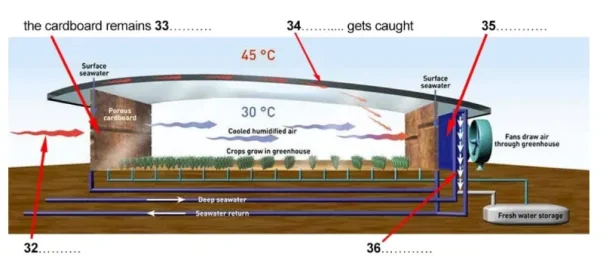
Questions 37-40
Complete the summary below.
Using NO MORE THAN TWO WORDS from the Reading Passage for each answer.
Write your answers in boxes 37-40 on your answer sheet.
To some extent, the Abu Dhabi greenhouse functions automatically. When the day is sunny, the equipment can respond to the changes in several natural elements. When there is no wind, 37………………….. help to retain the flow of air. Even in the future, we have an ideal plan to power the greenhouse from 38………………………. However, there are still some critics who argue that 39………………………. are not good economics.
To justify himself, Paton presents favorable arguments against these critics and suggests that it is an 40……………………… approach to provide air conditioning on a large scale.
IELTS Reading Analysis: The Rainmaker
The “The Rainmaker” reading passage tells the story of Charlie Paton and his groundbreaking idea for a greenhouse that uses seawater to produce freshwater and air conditioning, enabling farming in arid desert regions. The article delves into the origins of the idea, how the greenhouse works, and the economic and environmental benefits it provides.
We will now analyze each type of question.
Part 1: Do the following statements agree with the claims of the writer? (Questions 27-31)
The YES/NO/NOT GIVEN question type requires you to determine if the statement matches the information in the passage (YES), contradicts it (NO), or if the information is not mentioned (NOT GIVEN).
27. The idea just came to Charlie Paton by accident.
- Question analysis: Find information about how Charlie Paton came up with the idea.
- Search in the passage: Paragraph A states: “Sometimes ideas just pop up out of the blue. Or in Charlie Paton’s case, out of the rain.” The phrase “pop up out of the blue” means to appear unexpectedly or by chance.
- Comparison: The statement “came by accident” matches “pop up out of the blue.”
- Answer: 27. YES
28. The bus was well ventilated.
- Question analysis: Find information about the bus’s ventilation system.
- Search in the passage: Paragraph A describes: “The bus was full of hot, wet people. The windows steamed up…” This indicates that the bus was hot, humid, and the windows were fogged, implying that it was not well ventilated. There is no information suggesting the bus was “well ventilated.”
- Comparison: The information in the passage contradicts the statement.
- Answer: 28. NO
29. After waking up, Paton found his towel was wet.
- Question analysis: Find information about the state of the towel after Paton woke up.
- Search in the passage: Paragraph A says: “When I woke, the thing was soaking wet. I had to wring it out.” “The thing” here refers to the towel he had placed against the glass (“I went to sleep with a towel against the glass”).
- Comparison: The statement matches the information in the passage perfectly.
- Answer: 29. YES
30. The fan on the bus did not work well.
- Question analysis: Find information about the fan on the bus.
- Search in the passage: Paragraph A describes the situation of “hot, wet people” and “windows steamed up” but does not mention a fan on the bus or its operating condition.
- Comparison: The information is not provided in the passage.
- Answer: 30. NOT GIVEN
31. Paton immediately operated his own business in the Persian Gulf after talking with Philip Davies.
- Question analysis: Find information about when Paton started his business in the Persian Gulf after talking to Philip Davies.
- Search in the passage:
- Paragraph B: Paton talks to Philip Davies, then “started rigging up his own equipment” and “made his own solar stills.”
- Paragraph C: “Today, a decade on, his dream has taken shape as a giant greenhouse on a desert island off Abu Dhabi in the Persian Gulf…” The phrase “a decade on” (ten years later) clearly shows it was not “immediately.”
- Comparison: The statement contradicts the information in the passage.
- Answer: 31. NO
Part 2: Label the diagram (Questions 32-36)
This question type requires you to fill in words for the diagram, with a limit of NO MORE THAN THREE WORDS. Look for paragraphs describing the structure and function of the seawater greenhouse.
32. (Arrow pointing to the airflow entering from the left)
- Position analysis: The red arrow from outside points to the airflow entering the greenhouse from the left.
- Search in the passage (Paragraph D): “The front of the greenhouse faces into the prevailing wind so that hot dry air blows in through a front wall.”
- Comparison: Matches “hot dry air.”
- Correct answer: 32. hot dry air
33. the cardboard remains ________ (Arrow pointing to the Porous cardboard wall on the left)
- Position analysis: The arrow points to the “Porous cardboard” wall at the front (left), where water trickles down. The question implies the state of the cardboard.
- Search in the passage (Paragraph D): “The wall is made of perforated cardboard kept moist by a constant trickle of seawater…”
- Comparison: Matches “moist.” The cardboard is kept moist.
- Correct answer: 33. moist
34. ________ gets caught (Arrow pointing to the inside of the roof, with red curves and heat indicators)
- Position analysis: The arrow points to the inner layer of the roof, where there are red curves (representing heat/radiation). The question suggests something is “caught” (trapped).
- Search in the passage (Paragraph E): “The roof… It has two layers: an outer layer of clear polyethylene and an inner coated layer that reflects infrared radiation… but at the same time heat from the infrared radiation is trapped in the space between the layers, and kept away from the plants.”
- Comparison: Matches “infrared radiation.” This is what is trapped/caught by the inner layer of the roof.
- Correct answer: 34. infrared radiation
35. ________ (Arrow pointing to the clear water droplets dripping from the rear unit)
- Position analysis: The arrow points to the clear water droplets falling from the large box-like unit at the back (right).
- Search in the passage (Paragraph F): “Drops of pure distilled water form on the condenser and flow into a tank for irrigating the crops.”
- Comparison: Matches “pure distilled water.” This is the clean water produced.
- Correct answer: 35. pure distilled water
36. ________ (Arrow pointing to the entire large box-like unit at the rear right)
- Position analysis: The arrow points to the main unit at the rear right, where condensation occurs and water is produced.
- Search in the passage (Paragraph F): “…as it reaches the condenser, which finally collects from the hot humid air the moisture for irrigating the plants. The condenser is a metal surface kept cool by still more seawater.”
- Comparison: Matches “condenser.” This is the main condensation unit.
- Correct answer: 36. condenser
Part 3: Complete the summary (Questions 37-40)
This question type requires you to complete the summary by filling in words from the passage, with a limit of NO MORE THAN TWO WORDS.
37. When there is no wind, ________ help to retain the flow of air.
- Question analysis: Find information about what helps maintain airflow when there is no wind.
- Search in the passage: Paragraph G says: “On windless days, fans ensure a constant flow of air through the greenhouse.”
- Word to fill: “fans”
- Answer: 37. fans
38. Even in the future, we have an ideal plan to power the greenhouse from ________.
- Question analysis: Find information about the plan to power the greenhouse in the future.
- Search in the passage: Paragraph G says: “We can run the entire operation off one 13-amp plug, and in the future, we could make it entirely independent of the grid, powered from a few solar panels.”
- Word to fill: “solar panels”
- Answer: 38. solar panels
39. However, there are still some critics who argue that ________ are not good economics.
- Question analysis: Find information about what critics argue is not economically sound.
- Search in the passage: Paragraph H says: “Critics point out that construction costs of around $4 a square foot are quite high.”
- Word to fill: “construction costs”
- Answer: 39. construction costs
40. To justify himself, Paton presents favorable arguments against these critics and suggests that it is an ________ approach to provide air conditioning on a large scale.
- Question analysis: Find information about how Paton justifies his work and suggests an air conditioning method.
- Search in the passage: Paragraph H says: “Besides, it really suggests an environmentally-friendly way of providing air conditioning on a scale large enough to cool large greenhouses…”
- Word to fill: “environmentally-friendly”
- Answer: 40. environmentally-friendly
We hope this detailed analysis from ECE English has helped you better understand the “The Rainmaker” reading passage and how to approach each question type in IELTS Reading! If you have any other questions or would like us to analyze another passage, please don’t hesitate to contact us.
We invite you to check out some other IELTS Reading sample passages compiled and summarized by ECE:
Language diversity IELTS reading



 Khai giảng Khóa học Hè cực HOT.
Chưa có bình luận nào!