
Tóm Tắt Nội Dung Bài Viết
Lợn biển (Manatees) là những “gã khổng lồ hiền lành” của đại dương, và chúng là một chủ đề quen thuộc trong các bài đọc IELTS về thế giới động vật. Bài đọc “Manatees” từ sách Cambridge 20 (Test 2, Passage 1) là một ví dụ điển hình cho dạng bài Passage 1: cung cấp thông tin khoa học mô tả với các dạng câu hỏi phổ biến như Note Completion và True/False/Not Given.
Bài viết này của trung tâm ngoại ngữ ECE sẽ cung cấp nội dung bài đọc, phân tích từ vựng, và quan trọng nhất là giải thích đáp án chi tiết cho từng câu hỏi, giúp bạn hiểu sâu và chinh phục bài đọc này một cách trọn vẹn.
Nội dung bài đọc (Reading Passage)
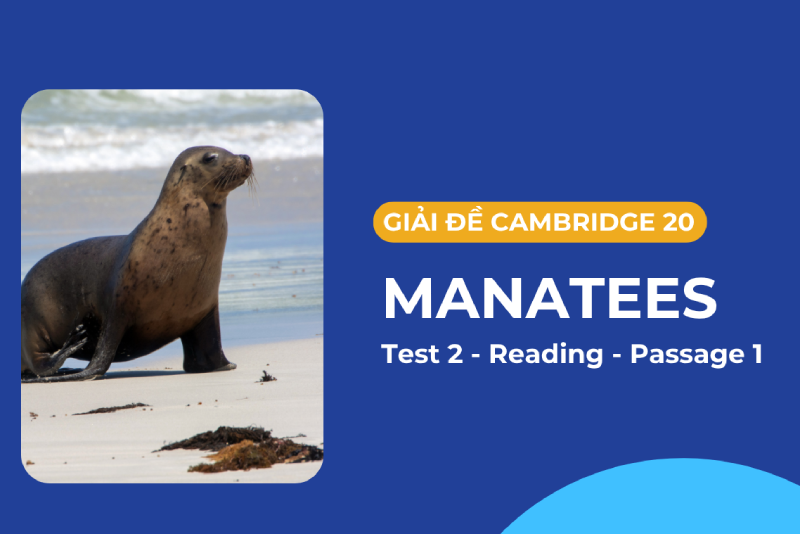
Manatees
Manatees, also known as sea cows, are aquatic mammals that belong to a group of animals called Sirenia. This group also contains dugongs. Dugongs and manatees look quite alike – they are similar in size, colour and shape, and both have flexible flippers for forelimbs. However, the manatee has a broad, rounded tail, whereas the dugong’s is fluked, like that of a whale. There are three species of manatees: the West Indian manatee (Trichechus manatus), the African manatee (Trichechus senegalensis) and the Amazonian manatee (Trichechus inunguis).
Unlike most mammals, manatees have only six bones in their neck – most others, including humans and giraffes, have seven. This short neck allows a manatee to move its head up and down, but not side to side. To see something on its left or its right, a manatee must turn its entire body, steering with its flippers. Manatees have pectoral flippers but no back limbs, only a tail for propulsion. They do have pelvic bones, however – a leftover from their evolution from a four-legged to a fully aquatic animal. Manatees share some visual similarities to elephants. Like elephants, manatees have thick, wrinkled skin. They also have some hairs covering their bodies which help them sense vibrations in the water around them.
Seagrasses and other marine plants make up most of a manatee’s diet. Manatees spend about eight hours each day grazing and uprooting plants. They eat up to 15% of their weight in food each day. African manatees are omnivorous – studies have shown that molluscs and fish make up a small part of their diets. West Indian and Amazonian manatees are both herbivores.
Manatees’ teeth are all molars – flat, rounded teeth for grinding food. Due to manatees’ abrasive aquatic plant diet, these teeth get worn down and they eventually fall out, so they continually grow new teeth that get pushed forward to replace the ones they lose. Instead of having incisors to grasp their food, manatees have lips which function like a pair of hands to help tear food away from the seafloor.
Manatees are fully aquatic, but as mammals, they need to come up to the surface to breathe. When awake, they typically surface every two to four minutes, but they can hold their breath for much longer. Adult manatees sleep underwater for 10–12 hours a day, but they come up for air every 15 – 20 minutes. Active manatees need to breathe more frequently. It’s thought that manatees use their muscular diaphragm and breathing to adjust their buoyancy. They may use diaphragm contractions to compress and store gas in folds in their large intestine to help them float.
The West Indian manatee reaches about 3.5 metres long and weighs on average around 500 kilograms. It moves between fresh water and salt water, taking advantage of coastal mangroves and coral reefs, rivers, lakes and inland lagoons. There are two subspecies of West Indian manatee: the Antillean manatee is found in waters from the Bahamas to Brazil, whereas the Florida manatee is found in US waters, although some individuals have been recorded in the Bahamas. In winter, the Florida manatee is typically restricted to Florida. When the ambient water temperature drops below 20°C, it takes refuge in naturally and artificially warmed water, such as at the warm-water outfalls from powerplants.
The African manatee is also about 3.5 metres long and found in the sea along the west coast of Africa, from Mauritania down to Angola. The species also makes use of rivers, with the mammals seen in landlocked countries such as Mali and Niger.
The Amazonian manatee is the smallest species, though it is still a big animal. It grows to about 2.5 metres long and 350 kilograms. Amazonian manatees favour calm, shallow waters that are above 23°C. This species is found in fresh water in the Amazon Basin in Brazil, as well as in Colombia, Ecuador and Peru.
All three manatee species are endangered or at a heightened risk of extinction. The African manatee and Amazonian manatee are both listed as Vulnerable by the International Union for Conservation of Nature (IUCN). It is estimated that 140,000 Amazonian manatees were killed between 1935 and 1954 for their meat, fat and skin, with the latter used to make leather. In more recent years, African manatee decline has been tied to incidental capture in fishing nets and hunting. Manatee hunting is now illegal in every country the African species is found in.
The two subspecies of West Indian manatee are listed as Endangered by the IUCN. Both are also expected to undergo a decline of 20% over the next 40 years. A review of almost 1,800 cases of entanglement in fishing nets and of plastic consumption among marine mammals in US waters from 2009 to 2020 found that at least 700 cases involved manatees. The chief cause of death in Florida manatees is boat strikes. However, laws in certain parts of Florida now limit boat speeds during winter, allowing slow-moving manatees more time to respond.
Questions 1 – 6
Complete the notes below. Choose ONE WORD AND/OR A NUMBER from the passage for each answer.
Manatees
Appearance
- look similar to dugongs, but with a differently shaped 1 ______ Movement
- have fewer neck bones than most mammals
- need to use their 2 ______ to help to turn their bodies around in order to look sideways
- sense vibrations in the water by means of 3 ______ on their skin Feeding
- eat mainly aquatic vegetation, such as 4 ______
- grasp and pull up plants with their 5 ______ Breathing
- come to the surface for air every 2–4 minutes when awake and every 15–20 while sleeping
- may regulate the 6 ______ of their bodies by using muscles of diaphragm to store air internally
Questions 7 – 13
Do the following statements agree with the information given in Reading Passage 1?
Write:
TRUE if the statement agrees with the information
FALSE if the statement contradicts the information
NOT GIVEN if there is no information on this
7. West Indian manatees can be found in a variety of different aquatic habitats.
8. The Florida manatee lives in warmer waters than the Antillean manatee.
9. The African manatee’s range is limited to coastal waters between the West African countries of Mauritania and Angola.
10. The extent of the loss of Amazonian manatees in the mid-twentieth century was only revealed many years later.
11. It is predicted that West Indian manatee populations will fall in the coming decades.
12. The risk to manatees from entanglement and plastic consumption increased significantly in the period 2009 – 2020.
13. There is some legislation in place which aims to reduce the likelihood of boat strikes on manatees in Florida.
Tóm tắt nội dung bài đọc Manatees
Bài đọc này là một văn bản mô tả khoa học về loài lợn biển (manatee), bao gồm các khía cạnh chính sau:
- Phân loại: Giới thiệu lợn biển thuộc nhóm Sirenia, so sánh sự giống và khác nhau với loài dugong (bò biển), đặc biệt là hình dạng đuôi.
- Đặc điểm thể chất: Mô tả các đặc điểm độc đáo như chỉ có 6 đốt sống cổ, không thể quay đầu, phải dùng vây (flippers) để xoay người, có lông để cảm nhận rung động.
- Chế độ ăn: Hầu hết là ăn cỏ (seagrasses), riêng loài ở châu Phi là loài ăn tạp. Chúng có bộ răng hàm đặc biệt (chỉ có răng hàm) liên tục được thay thế.
- Hô hấp & Sinh lý: Là động vật có vú nên phải lên mặt nước để thở; có khả năng điều chỉnh độ nổi (buoyancy) bằng cách nén khí trong cơ thể.
- Các loài & Môi trường sống: Mô tả chi tiết 3 loài (West Indian, African, Amazonian) về kích thước, môi trường sống (nước mặn, nước ngọt, sông ngòi, khu vực ven biển).
- Mối đe dọa & Bảo tồn: Tất cả các loài đều đang bị đe dọa. Nguyên nhân bao gồm săn bắt, vướng vào lưới đánh cá, và va chạm với tàu thuyền. Một số luật bảo vệ (như giới hạn tốc độ tàu) đã được ban hành.
Tổng hợp từ vựng hay trong bài
- aquatic mammals (n.p): động vật có vú sống dưới nước.
- propulsion (n): lực đẩy, sự đẩy (tiến về phía trước).
- Ví dụ: “…only a tail for propulsion.”
- herbivores / omnivorous (n/adj): động vật ăn cỏ / ăn tạp.
- Ví dụ: “African manatees are omnivorous… West Indian and Amazonian manatees are both herbivores.”
- abrasive (adj): (có tính) mài mòn.
- Ví dụ: “Due to manatees’ abrasive aquatic plant diet, these teeth get worn down…”
- buoyancy (n): khả năng nổi, sức nổi.
- Ví dụ: “…to adjust their buoyancy.”
- ambient (adj): (thuộc) môi trường xung quanh.
- Ví dụ: “When the ambient water temperature drops below 20°C…”
- landlocked countries (n.p): các quốc gia không giáp biển.
- incidental capture (n.p): (sự) vô tình đánh bắt.
- Ví dụ: “…decline has been tied to incidental capture in fishing nets…”
- entanglement (n): sự vướng vào, mắc vào.
- legislation (n): pháp luật, (hệ thống) luật pháp.
- Ví dụ: “However, legislation in certain parts of Florida now limit boat speeds…”
Đáp án gợi ý và giải thích chi tiết
1. Đáp án: tail
- Vị trí: Đoạn 1
- Dẫn chứng: “However, the manatee has a broad, rounded tail, whereas the dugong’s is fluked, like that of a whale.”
- Giải thích: Câu hỏi yêu cầu tìm điểm khác biệt về hình dạng so với dugong. Đoạn 1 so sánh hai loài và chỉ ra điểm khác biệt chính là cái “đuôi” (tail).
2. Đáp án: flippers
- Vị trí: Đoạn 2
- Dẫn chứng: “To see something on its left or its right, a manatee must turn its entire body, steering with its flippers.”
- Giải thích: Lợn biển không thể quay cổ, nên để nhìn sang ngang, chúng phải xoay cả người và dùng “vây” (flippers) để điều khiển.
3. Đáp án: hairs
- Vị trí: Đoạn 2
- Dẫn chứng: “They also have some hairs covering their bodies which help them sense vibrations in the water around them.”
- Giải thích: “sense vibrations” (cảm nhận rung động) “by means of” (bằng phương tiện) “hairs” (lông).
4. Đáp án: seagrasses
- Vị trí: Đoạn 3
- Dẫn chứng: “Seagrasses and other marine plants make up most of a manatee’s diet.”
- Giải thích: Câu hỏi yêu cầu một ví dụ (“such as”) về thảm thực vật dưới nước mà lợn biển ăn. “Seagrasses” (Cỏ biển) là ví dụ đầu tiên và rõ ràng nhất.
5. Đáp án: lips
- Vị trí: Đoạn 4
- Dẫn chứng: “Instead of having incisors to grasp their food, manatees have lips which function like a pair of hands to help tear food away from the seafloor.”
- Giải thích: Câu hỏi yêu cầu tìm bộ phận dùng để “grasp and pull up” (nắm và kéo) thức ăn. Đoạn 4 nói rằng chúng dùng “môi” (lips) để “tear food away” (xé thức ăn).
6. Đáp án: buoyancy
- Vị trí: Đoạn 5
- Dẫn chứng: “It’s thought that manatees use their muscular diaphragm and breathing to adjust their buoyancy.”
- Giải thích: Câu hỏi hỏi về thứ mà lợn biển điều chỉnh (regulate) bằng cơ hoành. “Regulate” là từ đồng nghĩa của “adjust”, và “buoyancy” (khả năng nổi) là thứ được điều chỉnh.
7. TRUE
- Câu hỏi: Lợn biển Tây Ấn có thể được tìm thấy ở nhiều môi trường sống dưới nước khác nhau.
- Dẫn chứng (Đoạn 6): “It moves between fresh water and salt water, taking advantage of coastal mangroves and coral reefs, rivers, lakes and inland lagoons.”
- Giải thích: Việc chúng di chuyển giữa nước ngọt, nước mặn và sống ở cả rạn san hô, sông, hồ, đầm phá… cho thấy chúng sống ở “nhiều môi trường sống khác nhau” (a variety of different aquatic habitats).
8. NOT GIVEN
- Câu hỏi: Lợn biển Florida sống ở vùng nước ấm hơn lợn biển Antillean.
- Dẫn chứng (Đoạn 6): Đoạn 6 mô tả môi trường sống của cả hai. Lợn biển Florida cần nơi trú ẩn khi nhiệt độ < 20°C. Lợn biển Antillean sống ở vùng Bahamas đến Brazil.
- Giải thích: Bài đọc không hề có bất kỳ sự so sánh trực tiếp nào về nhiệt độ nước ưa thích của hai loài này. Chúng ta không thể kết luận loài nào sống ở nước “ấm hơn”. (Lưu ý: Bài của đối thủ ghi đáp án là FALSE, đây là một lỗi phân tích phổ biến. Không có thông tin so sánh nghĩa là NOT GIVEN).
9. FALSE
- Câu hỏi: Phạm vi của lợn biển châu Phi bị giới hạn ở vùng nước ven biển…
- Dẫn chứng (Đoạn 7): “The species also makes use of rivers, with the mammals seen in landlocked countries such as Mali and Niger.”
- Giải thích: “Landlocked countries” là các quốc gia không giáp biển. Việc chúng được tìm thấy ở các quốc gia này (sống ở sông) chứng tỏ phạm vi của chúng không “bị giới hạn ở vùng nước ven biển”.
10. NOT GIVEN
- Câu hỏi: Mức độ tổn thất của lợn biển Amazon… chỉ được tiết lộ nhiều năm sau đó.
- Dẫn chứng (Đoạn 9): “It is estimated that 140,000 Amazonian manatees were killed between 1935 and 1954…”
- Giải thích: Bài đọc đưa ra con số ước tính, nhưng không hề nói con số này được “tiết lộ” (revealed) vào thời điểm nào (ngay lậpo tức hay nhiều năm sau đó).
11. TRUE
- Câu hỏi: Dự đoán rằng quần thể lợn biển Tây Ấn sẽ giảm trong những thập kỷ tới.
- Dẫn chứng (Đoạn 10): “Both [subspecies of West Indian manatee] are also expected to undergo a decline of 20% over the next 40 years.”
- Giải thích: “Fall” đồng nghĩa với “decline”. “In the coming decades” (trong những thập kỷ tới) đồng nghĩa với “over the next 40 years” (trong 40 năm tới).
12. NOT GIVEN
- Câu hỏi: Nguy cơ từ việc vướng lưới và ăn phải nhựa… đã tăng lên đáng kể trong giai đoạn 2009–2020.
- Dẫn chứng (Đoạn 10): “A review of… cases… from 2009 to 2020 found that at least 700 cases involved manatees.”
- Giải thích: Bài đọc chỉ đưa ra một con số tổng (700 ca) trong giai đoạn này. Nó không so sánh con số này với giai đoạn trước đó, do đó chúng ta không thể biết liệu nguy cơ này có “tăng lên đáng kể” (increased significantly) hay không.
13. TRUE
- Câu hỏi: Có một số luật lệ được áp dụng nhằm giảm khả năng tàu thuyền va chạm vào lợn biển ở Florida.
- Dẫn chứng (Đoạn 10): “However, laws in certain parts of Florida now limit boat speeds… allowing slow-moving manatees more time to respond.”
- Giải thích: “Laws” (luật) đồng nghĩa với “legislation” (pháp luật). “Limit boat speeds” (giới hạn tốc độ tàu) chính là một biện pháp “nhằm giảm khả năng tàu thuyền va chạm”.
Kết bài
Bài đọc “Manatees” là một ví dụ tuyệt vời cho Reading Passage 1, nơi kiểm tra kỹ năng đọc quét (scanning) để tìm thông tin chi tiết và khả năng phân biệt rõ ràng giữa thông tin “sai” (FALSE) và “không được đề cập” (NOT GIVEN). Bằng cách phân tích kỹ lưỡng các đặc điểm sinh học và môi trường sống của lợn biển, bạn không chỉ rèn luyện được kỹ năng làm bài mà còn có thêm kiến thức về một trong những loài động vật có vú hiền lành nhất đại dương. Hy vọng bài phân tích chi tiết này của ECE sẽ giúp bạn tự tin hơn trong hành trình chinh phục IELTS.





 Khai giảng Khóa học Hè cực HOT.
Mình thấy phần Nội dung bài đọc (Reading Passage) khá hữu ích khi tìm hiểu về Giải bài đọc IELTS Reading Manatees (Cambridge 20 – Test 2, Reading Passage 1). Nội dung trình bày rõ và dễ theo dõi.