
Tóm Tắt Nội Dung Bài Viết
Bài đọc “Alfred Nobel” là một trong những chủ đề nổi bật và thú vị trong IELTS Reading, cung cấp cái nhìn sâu sắc về cuộc đời và sự nghiệp của người sáng lập ra giải thưởng danh giá nhất thế giới. Bài viết này của ECE English sẽ giúp bạn hệ thống hóa kiến thức, làm quen với các dạng câu hỏi thường gặp và trang bị những chiến lược làm bài hiệu quả để đạt điểm cao.
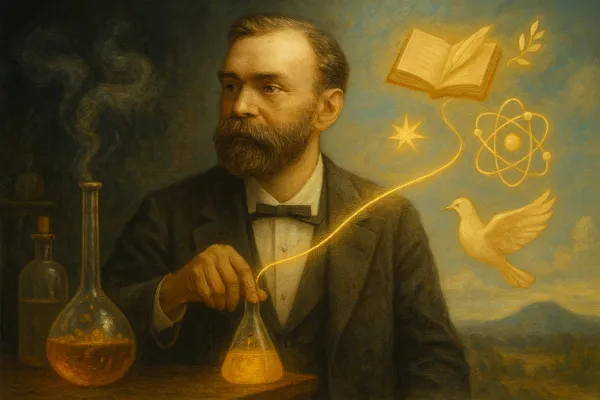
Alfred Nobel
The man behind the Nobel Prize
A
Since 1901, the Nobel Prize has been honoring men and women from all corners of the globe for outstanding achievements in physics, chemistry, medicine, literature, and for work in peace. The foundations for the prize were laid in 1895 when Alfred Nobel wrote his last will, leaving much of his wealth to the establishment of the Nobel Prize.
B
Alfred Nobel was born in Stockholm on October 21, 1833. His father Immanuel Nobel was an engineer and inventor who built bridges and buildings in Stockholm. In connection with his construction work, Immanuel Nobel also experimented with different techniques for blasting rocks. Successful in his industrial and business ventures, Immanuel Nobel was able, in 1842, to bring his family to St. Petersburg. There, his sons were given a first-class education by private teachers. The training included natural sciences, languages and literature. By the age of 17, Alfred Nobel was fluent in Swedish, Russian, French, English and German. His primary interests were in English literature and poetry as well as in chemistry and physics. Alfred’s father, who wanted his sons to join his enterprise as engineers, disliked Alfred’s interest in poetry and found his son rather introverted.
C
In order to widen Alfred’s horizons, his father sent him abroad for further training in chemical engineering. During a two year period, Alfred Nobel visited Sweden, Germany, France and the United States. In Paris, the city he came to like best, he worked in the private laboratory of Professor T. J. Pclouze, a famous chemist. There he met the young Italian chemist Ascanio Sobrero who, three years earlier, had invented nitroglycerine, a highly explosive liquid. But it was considered too dangerous to be of any practical use. Although its explosive power greatly exceeded that of gunpowder, the liquid would explode in a very unpredictable manner if subjected to heat and pressure. Alfred Nobel became very interested in nitroglycerine and how it could be put to practical use in construction work. He also realized that the safety problems had to be solved and a method had to be developed for the controlled detonation of nitroglycerine.
D
After his return to Sweden in 1863, Alfred Nobel concentrated on developing nitroglycerine as an explosive. Several explosions, including one (1864) in which his brother Emil and several other persons were killed, convinced the authorities that nitroglycerine production was exceedingly dangerous. They forbade further experimentation with nitroglycerine within the Stockholm city limits and Alfred Nobel had to move his experimentation to a barge anchored on Lake Malaren. Alfred was not discouraged and in 1864 he was able to start mass production of nitroglycerine. To make the handling of nitroglycerine safer Alfred Nobel experimented with different additives. He soon found that mixing nitroglycerine with kieselguhr would turn the liquid into a paste which could be shaped into rods of a size and form suitable for insertion into drilling holes. In 1867 he patented this material under the name of dynamite. To be able to detonate the dynamite rods he also invented a detonator (blasting cap) which could be ignited by lighting a fuse. These inventions were made at the same time as the pneumatic drill came into general use. Together these inventions drastically reduced the cost of blasting rock, drilling tunnels, building canals and many other forms of construction work.
E
The market for dynamite and detonating caps grew very rapidly and Alfred Nobel also proved himself to be a very skillful entrepreneur and businessman. Over the years he founded factories and laboratories in some 90 different places in more than 20 countries. Although he lived in Paris much of his life he was constantly traveling. When he was not traveling or engaging in business activities Nobel himself worked intensively in his various laboratories, first in Stockholm and later in other places. He focused on the development of explosives technology as well as other chemical inventions including such materials as synthetic rubber and leather, artificial silk, etc. By the time of his death at 18%, he had 355 patents.
F
Intensive work and travel did not leave much time for private life. At the age of 43, he was feeling like an old man. At this time he advertised in a newspaper “Wealthy, highly-educated elderly gentleman seeks the lady of mature age, versed in languages, as secretary and supervisor of household.” The most qualified applicant turned out to be an Austrian woman, Countess Bertha Kinsky. After working a very short time for Nobel she decided to return to Austria to marry Count Arthur von Suttner. In spite of this Alfred Nobel and Bertha von Suttner remained friends and kept writing letters to each other for decades. Over the years Bertha von Suttner became increasingly critical of the arms race. She wrote a famous book, Lay Down Your Arms and became a prominent figure in the peace movement. No doubt this influenced Alfred Nobel when he wrote his final will which was to include a Prize for persons or organizations who promoted peace. Several years after the death of Alfred Nobel, the Norwegian Storting (Parliament) decided to award the 1905 Nobel Peace Prize to Bertha von Suttner.
G
Alfred Nobel died in San Remo, Italy, on December 10, 1896. When his will was opened it came as a surprise that his fortune was to be used for Prizes in Physics, Chemistry, Physiology or Medicine, Literature and Peace. The executors of his will were two young engineers, Ragnar Sohlman and Rudolf Lilljequist. They set about forming the Nobel Foundation as an organization to take care of the financial assets left by Nobel for this purpose and to coordinate the work of the Prize-Awarding Institutions. This was not without its difficulties since the will was contested by relatives and questioned by authorities in various countries.
H
Alfred Nobel’s greatness lay in his ability to combine the penetrating mind of the scientist and inventor with the forward-looking dynamism of the industrialist. Nobel was very interested in social and peace-related issues and held what were considered radical views in his era. He had a great interest in literature and wrote his own poetry and dramatic works. The Nobel Prizes became an extension and a fulfillment of his lifetime interests.
Questions 1-6
Do the following statements agree with the information given in Reading Passage?
In boxes 1-6 on your answer sheet, write
- TRUE if the statement is true
- FALSE if the statement is false
- NOT GIVEN if the information is not given in the passage
1 The first Nobel Prize was awarded in 1895.
2 Nobel’s father wanted his son to have a better education than what he had had.
3 Nobel was an unsuccessful businessman.
4 Bertha von Suttner was selected by Nobel himself for the first peace prize.
5 The Nobel Foundation was established after the death of Nobel
6 Nobel’s social involvement was uncommon in the 1800s.
Questions 7-13
Complete the notes below using NO MORE THAN TWO WORDS from the passage.
Write your answers in boxes 7-13 on your answer sheet.
Education:
Having accumulated a great fortune in his business, Nobel’s father determined to give his son the best education and sent him abroad to be trained in 7………………… during Nobel’s study in Paris, he worked in a private laboratory, where he came in contact with a young engineer 8…………..…… and his invention nitroglycerine, a more powerful explosive than 9…………..………
Benefits in construction works:
Nobel became really interested in this new explosive and experimented on it. But nitroglycerine was too dangerous and was banned for experiments within the city of 10………………. So Nobel had to move his experiments to a lake. To make nitroglycerine easily usable, Nobel invented dynamite along with 11…………………. while in the meantime 12………………. became popular, all of which dramatically lowered the 13……………..…. of construction works.
Questions 11-13
Do the following statements agree with the information given in Reading passage 1.
In boxes 11-13 on your answer sheet, write
- TRUE if the statement agrees with the information,
- FALSE if the statement contradicts the information and
- NOT GIVEN if there is no information provided in the passage.
11. Both men and women laugh more when they are with members of the same sex.
12. Primates lack sufficient breath control to be able to produce laughs the way humans do.
13. Chimpanzees produce laughter in a wider range of situations than rats do.
Tổng quan về nội dung bài đọc
Bài đọc “Alfred Nobel” kể về cuộc đời và sự nghiệp của một trong những nhà phát minh vĩ đại nhất thế kỷ 19, đồng thời giải thích nguồn gốc của Giải thưởng Nobel.
- Đoạn A giới thiệu về Giải thưởng Nobel và nguồn gốc của nó, bắt nguồn từ di chúc của Alfred Nobel vào năm 1895.
- Đoạn B mô tả thời thơ ấu và quá trình học vấn của Alfred Nobel, người đã sớm thể hiện tài năng trong nhiều lĩnh vực, đặc biệt là hóa học.
- Đoạn C nói về việc Nobel tìm thấy cảm hứng từ nitroglycerine, một chất nổ nguy hiểm, và quyết tâm tìm cách kiểm soát nó.
- Đoạn D kể về quá trình Nobel phát minh ra dynamite và kíp nổ sau nhiều thử nghiệm nguy hiểm, thậm chí phải chuyển ra ngoài thành phố để làm việc.
- Đoạn E làm nổi bật tài năng kinh doanh của Nobel, người đã xây dựng một đế chế toàn cầu với 355 bằng sáng chế.
- Đoạn F đề cập đến cuộc sống riêng tư của Nobel và mối quan hệ với Bertha von Suttner, người đã có ảnh hưởng lớn đến quyết định thành lập giải Nobel Hòa bình của ông.
- Đoạn G tiết lộ sự ngạc nhiên của nhiều người khi di chúc của Nobel được công bố và quá trình thành lập Quỹ Nobel để quản lý giải thưởng.
- Đoạn H tóm tắt lại sự vĩ đại của Alfred Nobel, người đã kết hợp tài năng khoa học với tầm nhìn của một nhà công nghiệp, và giải thưởng Nobel là sự kế thừa những sở thích cả đời của ông.
Từ vựng & cấu trúc hay trong bài đọc Alfred Nobel
Gợi ý đáp án & phân tích chi tiết
a. Dạng bài: TRUE/FALSE/NOT GIVEN
- Câu 1:
The first Nobel Prize was awarded in 1895.
Phân tích: Đoạn A nói “The foundations for the prize were laid in 1895…” (Nền tảng được đặt ra năm 1895) nhưng “Since 1901, the Nobel Prize has been honoring men and women…” (Kể từ năm 1901, Giải thưởng Nobel đã tôn vinh…). Thông tin mâu thuẫn.
Đáp án: FALSE.
- Câu 2:
Nobel’s father wanted his son to have a better education than what he had had.
Phân tích: Đoạn B nói Nobel được “a first-class education” (giáo dục hạng nhất) và cha ông muốn các con trai “join his enterprise as engineers” (tham gia vào công việc kinh doanh với tư cách kỹ sư). Tuy nhiên, bài đọc không so sánh trình độ học vấn của ông với cha mình.
Đáp án: NOT GIVEN.
- Câu 3:
Nobel was an unsuccessful businessman.
Phân tích: Đoạn E nói “Alfred Nobel also proved himself to be a very skillful entrepreneur and businessman.” (Alfred Nobel cũng chứng tỏ mình là một doanh nhân và nhà kinh doanh rất khéo léo). Thông tin mâu thuẫn.
Đáp án: FALSE.
- Câu 4:
Bertha von Suttner was selected by Nobel himself for the first peace prize.
Phân tích: Đoạn F nói “Several years after the death of Alfred Nobel, the Norwegian Storting (Parliament) decided to award the 1905 Nobel Peace Prize to Bertha von Suttner.” (Vài năm sau cái chết của Alfred Nobel, Quốc hội Na Uy quyết định trao Giải Nobel Hòa bình năm 1905 cho Bertha von Suttner). Cô được trao giải sau khi Nobel qua đời, không phải do ông trực tiếp chọn.
Đáp án: FALSE.
- Câu 5:
The Nobel Foundation was established after the death of Nobel
Phân tích: Đoạn G nói “Alfred Nobel died in San Remo, Italy, on December 10, 1896… They set about forming the Nobel Foundation…” (Alfred Nobel qua đời… Họ bắt đầu thành lập Quỹ Nobel…). Thông tin này chính xác.
Đáp án: TRUE.
- Câu 6:
Nobel’s social involvement was uncommon in the 1800s.
Phân tích: Đoạn H nói “Nobel was very interested in social and peace-related issues and held what were considered radical views in his era.” (có những quan điểm được coi là cấp tiến so với thời đại của ông). Điều này ngụ ý rằng những quan điểm của ông không phổ biến.
Đáp án: TRUE.
b. Dạng bài: Notes Completion (Hoàn thành ghi chú)
- Câu 7:
...to be trained in _________
Vị trí: Đoạn C nói “his father sent him abroad for further training in chemical engineering“.
Đáp án: chemical engineering.
- Câu 8:
...he came in contact with a young engineer _________
Vị trí: Đoạn C nói “…he met the young Italian chemist Ascanio Sobrero…” Lưu ý: bài đọc dùng “chemist” chứ không phải “engineer”.
Đáp án: Ascanio Sobrero.
- Câu 9:
...a more powerful explosive than _________
Vị trí: Đoạn C nói “its explosive power greatly exceeded that of gunpowder“.
Đáp án: gunpowder.
- Câu 10:
...banned for experiments within the city of _________
Vị trí: Đoạn D nói “They forbade further experimentation with nitroglycerine within the Stockholm city limits”.
Đáp án: Stockholm.
- Câu 11, 12:
...invented dynamite along with a _________ while in the meantime a _________ became popular...
Vị trí: Đoạn D nói “…he also invented a detonator… at the same time as the pneumatic drill came into general use.”
Đáp án: detonator, pneumatic drill.
- Câu 13:
...dramatically lowered the _________ of construction works.
Vị trí: Đoạn D nói “…these inventions drastically reduced the cost of blasting rock… and many other forms of construction work.”
Đáp án: cost.
Bài đọc “Alfred Nobel” là một minh chứng cho thấy các bài thi IELTS Reading không chỉ kiểm tra khả năng đọc hiểu mà còn là cơ hội để khám phá những câu chuyện lịch sử và khoa học đầy cảm hứng. Bằng việc nắm chắc cấu trúc bài, nhận diện từ đồng nghĩa và áp dụng chiến lược làm bài thông minh, bạn có thể dễ dàng giải quyết các câu hỏi phức tạp. Hãy coi mỗi bài đọc là một hành trình khám phá tri thức, và việc học IELTS sẽ trở nên thú vị và ý nghĩa hơn bao giờ hết.
Mời bạn tham khảo thêm lời giải một số đề IELTS Reading khác:
Robert Louis Stevenson ielts reading
Education Philosophy IELTS Reading







 Khai giảng Khóa học Hè cực HOT.
Mình thấy phần Alfred Nobel khá hữu ích khi tìm hiểu về Alfred Nobel IELTS Reading – Giải mã cuộc đời & di sản vĩ đại. Nội dung trình bày rõ và dễ theo dõi.