
Tóm Tắt Nội Dung Bài Viết
In today’s globalized world, proficiency in a foreign language—especially English—has become a key factor in determining opportunities for employment, education, and immigration abroad. Among the various international English certifications, IELTS (International English Language Testing System) stands out as a benchmark recognized by many countries and organizations.
So, what is considered a “good” IELTS score, and what is required for goals like studying abroad, immigration, or career advancement? This article provides comprehensive information about the IELTS exam, how it is scored, and the target scores you need to achieve your goals.

Introduction to the IELTS exam – Importance and Format
IELTS (International English Language Testing System) is one of the most widely recognized international English certifications in the world. The IELTS exam is designed to comprehensively assess a candidate’s language proficiency across four practical skills: Listening, Reading, Writing, and Speaking.
With over 3 million test-takers annually, IELTS is accepted by more than 10,000 organizations, including universities, colleges, government agencies, and employers in over 140 countries. Consequently, IELTS has become a vital standard not only for international students but also for professionals, those working in international environments, and individuals seeking to immigrate abroad.
The IELTS exam structure consists of four sections with the following durations:
- Listening: 30 minutes
- Reading: 60 minutes
- Writing: 60 minutes
- Speaking: 11–14 minutes
The IELTS exam results are graded on a scale from 1.0 to 9.0, with 9.0 being the highest and 1.0 the lowest. Candidates receive an overall band score for the entire test, along with individual scores for each skill.
How is the IELTS score calculated?
Understanding the IELTS band scale (1.0 – 9.0)
The IELTS exam results are graded on a scale from 1.0 to 9.0, where:
- 9.0: Expert User – Has fully operational command of the language; appropriate, accurate, and fluent.
- 8.0: Very Good User – Has fully operational command with only occasional unsystematic inaccuracies.
- 7.0: Good User – Has operational command, though with occasional inaccuracies and misunderstandings.
- 6.0: Competent User – Has generally effective command despite some inaccuracies and misunderstandings.
- 5.0: Modest User – Has partial command, coping with overall meaning in most situations.
- 4.0: Limited User – Basic competence is limited to familiar situations.
- 3.0: Extremely Limited User – Conveys and understands only general meaning in very familiar situations.
- 2.0: Intermittent User – No real communication is possible except for the most basic information.
- 1.0: Non-user – Essentially has no ability to use the language.
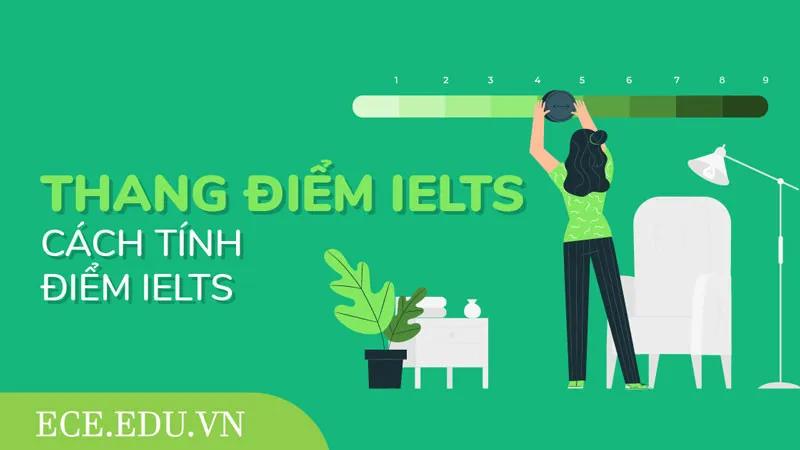
Overview of the 4 IELTS skills (Listening, Reading, Writing, Speaking)
The IELTS exam tests four language skills:
- Listening: Candidates listen to recordings and answer questions related to the content.
- Reading: Candidates read various texts and answer questions based on the content.
- Writing: Candidates complete two tasks: the first involves describing data from a chart or graph, and the second requires writing an essay in response to a point of view or argument.
- Speaking: A face-to-face interview with an examiner, consisting of three parts: self-introduction, a discussion on a specific topic, and a deeper Q&A session.
Each skill is scored from 1.0 to 9.0, and the average of these four scores determines the overall band score.
See more: The most popular types of IELTS exams today.
What is a good IELTS score?
IELTS scores for studying abroad (UK, USA, Canada, Australia)
For international students, the IELTS score is one of the most critical criteria for admission to universities and colleges in developed countries like the UK, USA, Canada, and Australia.

Required IELTS scores typically range from 6.0 to 7.5, depending on the institution and major. Specifically:
- UK: Usually 6.0 to 7.5, depending on the school and program.
- USA: Usually 6.5 to 7.5, depending on the school and program.
- Canada: Usually 6.0 to 7.0, depending on the school and program.
- Australia: Usually 6.0 to 7.0, depending on the school and program.
Note that top-tier universities often require higher scores, typically 7.0 or above.
See more: Should you take the IELTS if you aren’t planning to study abroad?
IELTS scores for immigration
Many countries, especially developed ones, use IELTS as a key criterion to assess the English proficiency of immigration applicants.

Specifically, the minimum IELTS requirements for immigration are:
- UK: Minimum 5.5 to 7.0, depending on the visa category.
- Canada: Minimum 6.0 to 7.0, depending on the immigration program.
- Australia: Minimum 5.0 to 7.0, depending on the visa category.
- New Zealand: Minimum 5.0 to 7.0, depending on the visa category.
Keep in mind that requirements can change, so always check the official government websites of the respective countries for the latest information.
IELTS scores for employment
Beyond studying abroad and immigration, IELTS is used by many international companies as a standard for evaluating candidates. Required scores typically range from 6.0 to 7.5, depending on the role.
- Management, director, and analyst roles often require 7.0 or above.
- Roles involving international communication or customer service often require 6.5 or above.
- Support and administrative roles often require 6.0 or above.
Additionally, fields such as Healthcare, Education, and Law often have specific, higher IELTS requirements.
Reference table for various goals
Based on the information above, here is a summary table for your reference:
| Goal | Minimum IELTS Score |
| Study abroad (UK, USA, Canada, Australia) | 6.0 – 7.5 |
| Immigration (UK, Canada, Australia, New Zealand) | 5.0 – 7.0 |
| Employment (Management/Director roles) | 7.0+ |
| Employment (International communication/Customer service) | 6.5+ |
| Employment (Support/Admin roles) | 6.0+ |
| Exemption from high school graduation English exam | 7.0+ |
| Direct admission to top-tier universities | 7.0+ |
| University English course exemption | 7.0+ |
Note that requirements can vary by specific case, so always verify with reliable sources.
How to achieve a high IELTS score?
Plan and set clear goals
To achieve a high IELTS score, first define your goal—whether it’s studying abroad, immigration, or career advancement. Then, create a specific roadmap.
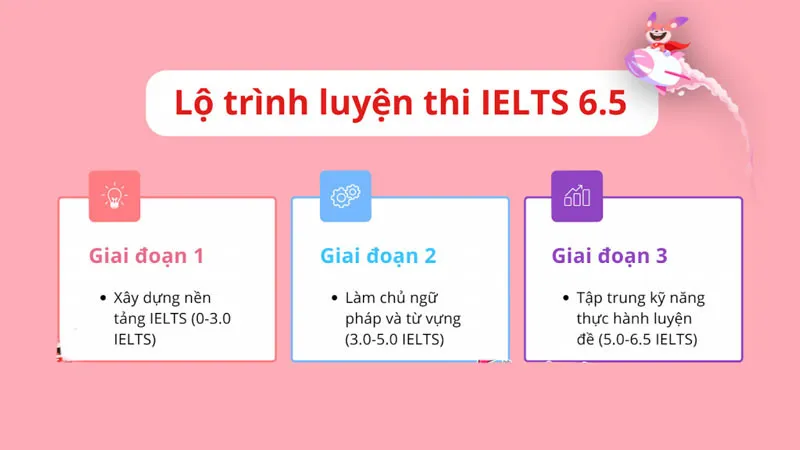
For example, if you aim to study in the UK, you likely need a 6.5 or higher. Plan for 6–12 months of preparation, focusing on improving each skill and taking mock tests to track your progress.
Choose suitable study materials
To improve your IELTS score, use appropriate materials. Some effective suggestions include:
- Official IELTS preparation books, such as the Cambridge IELTS series.
- Enrolling in online or offline courses at reputable centers.
- Using mobile apps designed for English learning and IELTS practice.
Choosing the right materials will help you master the content and prepare effectively.
Enroll in IELTS preparation courses
Beyond self-study, enrolling in IELTS preparation courses is highly recommended. You will be guided by professional instructors experienced in teaching and grading IELTS.
These courses not only clarify the exam structure but also provide tips and strategies to boost your performance and score.
Practice regularly with mock tests
Finally, to achieve a high IELTS score, you must practice regularly with mock tests. This helps you get familiar with the exam structure, increase your speed, and improve your listening, reading, and writing skills.
You can find mock tests online, in preparation books, or through your training center. Always review your mistakes to learn and improve.
4 Trusted Names in IELTS Preparation
British Council
The British Council is the UK’s international organization for cultural relations and educational opportunities. In Vietnam, they offer high-quality English courses, including IELTS preparation.
With professional teaching methods and experienced native-speaking instructors, the British Council helps students master the language and achieve their goals.
IDP Education
IDP Education is a globally recognized organization specializing in studying abroad, IELTS testing, and educational consulting. In Vietnam, IDP provides IELTS preparation courses, study materials, and expert advice.
With their professional support, students can confidently prepare for the IELTS and achieve high scores.
ECE English Center
ECE English Center (English Center for Education) is a reputable destination for English learning and IELTS preparation in Vietnam. With a team of qualified teachers and modern teaching methods, ECE is committed to providing the best preparation for the IELTS exam.
ECE is currently a Gold Partner of the British Council in Northern Vietnam. Along with other leading training institutions, ECE consistently provides the most accurate information to users.
Additionally, ECE organizes workshops and seminars on exam skills and provides quality study materials to help students feel confident on test day.
ACET
ACET (Achieve Centre for Education and Training) is a leading IELTS preparation center in Vietnam with over 10 years of experience. ACET is committed to providing comprehensive preparation, covering knowledge, skills, strategies, and exam psychology.
Through effective teaching methods and a professional environment, ACET has helped thousands of students achieve high IELTS scores and realize their dreams.
Keys to Success
Achieving a high IELTS score requires a combination of effort, persistence, and effective study methods. Here are some tips for success:
- Define your goals clearly and create a reasonable plan.
- Choose reliable and suitable study materials.
- Join preparation courses for guidance and supervision.
- Practice regularly with mock tests to improve your skills.
- Self-evaluate and learn from every practice test.
With dedication and support from reputable centers, you can achieve a high IELTS score and reach your goals.
In this article, we explored the importance of the IELTS exam, how it is scored, and the requirements for studying abroad, immigration, and employment. We also covered preparation tips and a list of 4 trusted names to support your IELTS journey.
We hope this information helps you better understand the IELTS exam and motivates you in your preparation. Good luck!





 Khai giảng Khóa học Hè cực HOT.
Chưa có bình luận nào!