
Tóm Tắt Nội Dung Bài Viết
The “Tasmanian Tiger” IELTS Reading passage is a fascinating topic centered on the mystery of an animal long thought to be extinct. In this guide, ECE English provides an in-depth analysis of the text, exploring the history of the species, the ongoing search efforts, and the debates surrounding whether the Tasmanian tiger might still roam the wild.
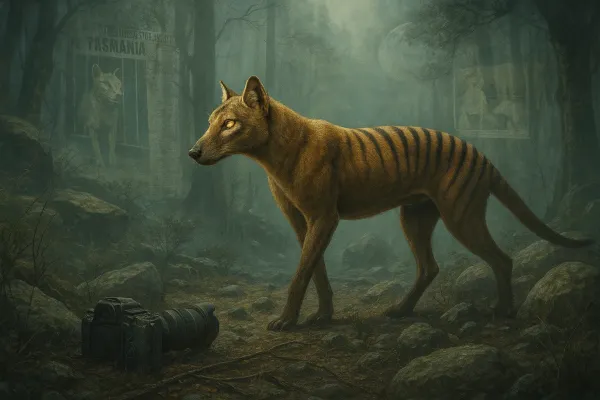
TASMANIAN TIGER
A.
Although it was called a tiger, it looked like a dog with black stripes on its back and was the largest known carnivorous marsupial of modern times. Yet, despite its fame as one of the most fabled animals in the world, it remains one of the least understood of Tasmania’s native species. The scientific name for the Tasmanian tiger is Thylacine, and it is believed to have become extinct in the 20th century.
B.
Fossils of thylacines dating back nearly 12 million years have been unearthed at various sites in Victoria, South Australia, and Western Australia. They were widespread across Australia 7,000 years ago but likely became extinct on the mainland roughly 2,000 years ago. This is believed to be due to the introduction of dingoes around 8,000 years ago.
Due to disease, thylacine numbers may have already been declining in Tasmania at the time of European settlement 200 years ago, but the decline was certainly accelerated by the new arrivals. The last known Tasmanian Tiger died in Hobart Zoo in 1936, and the animal is officially classified as extinct. Technically, this means it has not been officially sighted in the wild or captivity for 50 years. However, unsubstantiated sightings continue to be reported.
C.
Hans Naarding, whose wildlife studies had taken him around the world, was conducting a survey of an endangered migratory bird species. The animal he saw that night is now regarded as the most credible recorded sighting of a thylacine—a creature many believe has been extinct for more than 70 years.
D.
“I had to work at night,” Naarding recalls. “I was in the habit of intermittently shining a spotlight around. The beam fell on an animal in front of the vehicle, less than 10m away. Instead of risking movement by reaching for a camera, I decided to register very carefully what I was seeing. The animal was about the size of a small shepherd dog, a very healthy male in prime condition.
What set it apart from a dog, though, was a slightly sloping hindquarter, with a fairly thick tail being a straight continuation of the backline. It had 12 distinct stripes on its back, continuing onto its butt. I knew perfectly well what I was seeing. As soon as I reached for the camera, it disappeared into the tea-tree undergrowth and scrub.”
E.
The director of Tasmania’s National Parks at the time, Peter Morrow, decided to keep Naarding’s sighting a secret for two years. When the news finally broke, it sparked absolute pandemonium. “I was besieged by television crews, including four to five from Japan, and others from the United Kingdom, Germany, New Zealand, and South America,” said Naarding.
F.
Government and private search parties combed the region, but no further sightings were made. The tiger, as always, had retreated to its lair—a place many insist exists only in our imagination. But since then, the thylacine has staged something of a comeback, becoming a permanent fixture of Australian mythology.
G.
There have been more than 4,000 claimed sightings of the beast since it supposedly died out, with an average of 150 claims reported to authorities each year. Randolph Rose, an associate professor of zoology at the University of Tasmania, has said he dreams of seeing a thylacine. But Rose, who has fielded countless reports during his 35 years in Tasmanian academia, is now convinced that his dream will remain unfulfilled.
H.
“The consensus among conservationists is that, usually, any animal with a population base of less than 1,000 is headed for extinction within 60 years,” says Rose. “Sixty years ago, there was only one thylacine that we know of, and that was in Hobart Zoo,” he notes.
I.
Dr. David Pemberton, curator of zoology at the Tasmanian Museum and Art Gallery, whose PhD thesis focused on the thylacine, says that despite the scientific theory that 500 animals are required to sustain a population, the Florida panther is down to a dozen or so animals and is still surviving, albeit with some inbreeding problems. “I’ll take a punt and say that if we manage to find one thylacine in the scrub, it means there are 50-plus animals out there.”
J.
After all, animals can be notoriously elusive. The strange fish known as the coelacanth, with its “proto-legs,” was thought to have died out along with the dinosaurs 70 million years ago—until a specimen was dragged to the surface in a shark net off the southeast coast of South Africa in 1938.
K.
Wildlife biologist Nick Mooney has the unenviable task of investigating all “sightings” of the tiger, totaling 4,000 since the mid-1980s. It was Mooney who was first consulted late last month regarding the authenticity of digital photographs purportedly taken by a German tourist during a recent bushwalk. At face value, Mooney says, the account and the two photographs submitted as proof constitute one of the most convincing cases for the species’ survival he has ever seen.
L.
And Mooney has seen it all—the mistakes, the hoaxes, the illusions, and the plausible accounts. Hoaxers aside, most people who report sightings truly believe they have seen a thylacine and are so convinced they could pass a lie-detector test. Others become utterly obsessed, like the Tasmanian resident who has registered 99 sightings to date.
Mooney has seen individuals bankrupted by this obsession and families destroyed. “It is a case of blind optimism that something exists, rather than a cynicism that it doesn’t,” Mooney says. “If something crosses the road, they don’t wonder what it was; they immediately think, ‘That’s a thylacine!’ It’s like a gold prospector’s blind faith—it just has to be there.”
M.
However, Mooney treats all reports at face value. “I never try to embarrass people or make fools of them. But the fact that I don’t pack the car the moment they ring is often taken as ridicule. Obsessive characters get irate that someone in my position isn’t out there when they are certain the thylacine is present.”
N.
But Hans Naarding, whose sighting two decades ago was the highlight of “a life of animal spotting,” remains bemused by the time and money people waste on tiger searches. He believes resources would be better spent saving the Tasmanian devil and protecting migratory bird populations, which are declining due to shrinking wetlands across Australia.
O.
Could the thylacine still be out there? “Sure,” Naarding says. But he also believes any discovery of surviving thylacines would be “rather pointless.” “How do you save a species from extinction at that stage? What could you do with it? If there are thylacines out there, they are better off right where they are.”
Question 14-17
Complete the summary below.
Choose NO MORE THAN TWO WORDS AND/OR A NUMBER from the passage for each answer.
The Tasmanian tiger, also called thylacine, resembles the look of a dog and has 14……………. on its fur coat. Many fossils have been found, showing that thylacines had existed as early as 15……………. years ago. They lived throughout 16……………. before disappearing from the mainland. And soon after the 17……………. settlers arrived the size of the thylacine population in Tasmania shrunk at a higher speed.
Question 18-23
Look at the following statements (Questions 18-23) and the list of people below, match each statement with the correct person A, B, C or D.
NB You may use any letter more than once.
List of People
A. Hans Naarding
B. Randolph Rose
C. David Pemberton
D. Nick Mooney
18. His report of seeing a live thylacine in the wild attracted international interest………………
19. Many eye-witnesses’ reports are not trustworthy………………
20. It doesn’t require a certain number of animals to ensure the survival of a species………………
21. There is no hope of finding a surviving Tasmanian tiger………………
22. Do not disturb them if there are any Tasmanian tigers still living today………………
23. The interpretation of evidence can be affected by people’s beliefs………………
Question 24-26
Choose the correct letter A, B, C or D.
24. Hans Naarding’s sighting has resulted in
A. government and organisations’ cooperative efforts to protect
B. thylacine extensive interests to find a living thylacine.
C. increase in the number of reports of thylacine worldwide.
D. growth of popularity of thylacine in literature.
25. The example of the coelacanth is to illustrate
A. it lived in the same period with dinosaurs.
B. has dinosaurs evolved legs.
C. some animals are difficult to catch in the wild.
D. extinction of certain species can be mistaken.
26. Mooney believes that all sighting reports should be
A. given some credit as they claim even if they are untrue.
B. acted upon immediately.
C. viewed as equally untrustworthy.
D. questioned and carefully investigated.
Content Overview
The “Tasmanian Tiger” reading passage provides a comprehensive look at the largest carnivorous marsupial of modern times, commonly known as the Thylacine.
- Paragraph A introduces the Thylacine, a dog-like animal with black stripes on its back, believed to have gone extinct in the 20th century.
- Paragraph B details the historical origins of the Thylacine, which once lived across Australia but vanished from the mainland due to the introduction of Dingoes. Their extinction in Tasmania was further accelerated by European settlers.
- Paragraphs C, D, E, and F recount the story of Hans Naarding, an animal expert who had what is considered the most credible encounter with a Thylacine. However, the decision to keep this information secret initially led to chaos and subsequent fruitless searches.
- Paragraphs G through N present various perspectives on the animal’s potential survival, ranging from persistent public sightings to the scientific viewpoints of experts like Randolph Rose, David Pemberton, and biologist Nick Mooney.
- Paragraph O concludes with Hans Naarding’s view that even if the Thylacine still exists, finding them might be “pointless,” and they are “better off right where they are.”
Key Vocabulary & Structures
| Vocabulary/Structure | Phonetics/Meaning |
Contextual Example
|
| extinct | /ɪkˈstɪŋkt/ no longer in existence |
“…believed that they have become extinct in the 20th century.”
|
| carnivorous marsupial | /kɑːrˈnɪvərəs mɑːrˈsuːpiəl/ a meat-eating pouched mammal |
“…the largest known carnivorous marsupial of modern times.”
|
| unsubstantiated sightings | /ˌʌnsəbˈstænʃieɪtɪd ˈsaɪtɪŋz/ reports not supported by evidence |
“…there are still unsubstantiated sightings.”
|
| credible sighting | /ˈkredəbl ˈsaɪtɪŋ/ a believable or trustworthy report |
“…the most credible sighting recorded of thylacine…”
|
| prime condition | /praɪm kənˈdɪʃən/ in the best possible health or state |
“…a very healthy male in prime condition.”
|
| obsessed | /əbˈsest/ preoccupied with something to a troubling extent |
“…then become utterly obsessed like the Tasmanian who has registered 99 thylacine sightings…”
|
| blind optimism | /blaɪnd ˈɒptɪmɪzəm/ hopefulness without regard for facts |
“It is a blind optimism that something is, rather than a cynicism that something isn’t.”
|
| unassailable | /ˌʌnəˈseɪləbl/ unable to be attacked, questioned, or defeated |
“…the fact that I don’t pack the car immediately they ring can often be taken as ridicule.” (Implies the reports are seen as undeniable by the observers).
|
| notoriously elusive | /nəˈtɔːriəsli ɪˈluːsɪv/ famous for being difficult to find or catch |
“animals can be notoriously elusive.”
|
| on face value | /ɒn feɪs ˈvæljuː/ accepting something as it appears to be |
“Mooney treats all reports on face value.”
|
Answer Key & Detailed Explanations
a. Question Type: Summary Completion
- Question 14:
...resembles the look of a dog and has 14................ on its fur coat.
Location: Paragraph A states “…it looked like a dog with black stripes on its back…”
Answer: black stripes.
- Question 15:
...existed as early as 15................ years ago.
Location: Paragraph B states “Fossils of thylacines dating from about almost 12 million years ago…”
Answer: 12 million.
- Question 16:
They lived throughout 16................ before disappearing from the mainland.
Location: Paragraph B states “They were widespread in Australia 7,000 years ago…”
Answer: widespread in Australia.
- Question 17:
...soon after the 17................ settlers arrived...
Location: Paragraph B states “…the decline was certainly accelerated by the new arrivals.” In this context, “new arrivals” refers to the European settlers.
Answer: new arrivals.
b. Question Type: Matching People
- Question 18:
His report of seeing a live thylacine in the wild attracted international interest.
Location: Paragraph E states “When the news finally broke, it was accompanied by pandemonium. ‘I was besieged by television crews, including four to five from Japan…'” – This refers to Hans Naarding.
Answer: A. Hans Naarding.
- Question 19:
Many eye-witnesses’ reports are not trustworthy.
Location: Paragraphs K and L discuss Nick Mooney, whose job is “investigating all ‘sightings'” and who has seen “the mistakes, the hoaxes, the illusions…”.
Answer: D. Nick Mooney.
- Question 20:
It doesn’t require a certain number of animals to ensure the survival of a species.
Location: Paragraph I mentions David Pemberton: “…says that despite scientific thinking that 500 animals are required to sustain a population, the Florida panther is down to a dozen or so animals and… is still ticking along.”
Answer: C. David Pemberton.
- Question 21:
There is no hope of finding a surviving Tasmanian tiger.
Location: Paragraph G mentions Randolph Rose: “…is now convinced that his dream will go unfulfilled.”
Answer: B. Randolph Rose.
- Question 22:
Do not disturb them if there are any Tasmanian tigers still living today.
Location: In Paragraph O, Hans Naarding says “…they are better off right where they are.”
Answer: A. Hans Naarding.
- Question 23:
The interpretation of evidence can be affected by people’s beliefs.
Location: In Paragraph L, Nick Mooney states “It is a blind optimism… ‘that’s a thylacine!’ It is a bit like a gold prospector’s blind faith…” This indicates that belief influences how they interpret what they see.
Answer: D. Nick Mooney.
c. Question Type: Multiple Choice Questions
- Question 24:
Hans Naarding’s sighting has resulted in
Location: Paragraph F mentions “Government and private search parties combed the region…” and Paragraph E notes “When the news finally broke, it was accompanied by pandemonium.”
Answer: B. thylacine extensive interests to find a living thylacine.
- Question 25:
The example of the coelacanth is to illustrate
Location: Paragraph J states “The strange fish is known as the coelacanth… was thought to have died out along with the dinosaurs 70 million years ago until a specimen was dragged to the surface…”
Answer: D. extinction of certain species can be mistaken.
- Question 26:
Mooney believes that all sighting reports should be
Location: Paragraph M states “Mooney treats all reports on face value. ‘I never try to embarrass people or make fools of them.'”
Answer: A. given some credit as they claim even if they are untrue.
The “Tasmanian Tiger” IELTS Reading passage is more than just a test of comprehension; it is a compelling narrative that explores the boundary between fact and folklore, science and myth. By carefully analyzing the text and linking key ideas, you can master these question types. Use every reading passage as an opportunity to discover something new and expand your academic horizons.
Explore more IELTS Reading practice materials curated by ECE:





 Khai giảng Khóa học Hè cực HOT.
Chưa có bình luận nào!