
Tóm Tắt Nội Dung Bài Viết
The SAT (Scholastic Assessment Test) is a standardized test administered by the College Board to evaluate a student’s academic readiness and support the university admissions process, primarily in the United States. It serves as a tool for colleges and universities to assess a student’s critical thinking and academic potential.
For those who may not know, the College Board is a non-profit educational organization based in the U.S. It is well-known for developing and managing standardized tests used widely around the world, such as the SAT, AP (Advanced Placement), and PSAT.
Overview of the SAT
1. The Role of the SAT
- Standardized Assessment: The SAT provides a common metric that helps universities compare students from different high schools, as each school may have different grading standards. The test helps ensure fairness in evaluating students from diverse geographical backgrounds.
- University Admissions: SAT scores are a key component of admissions applications for many universities in the U.S. and other countries. Many institutions use SAT scores as a significant part of their selection process, alongside other factors such as academic transcripts, extracurricular activities, and letters of recommendation.
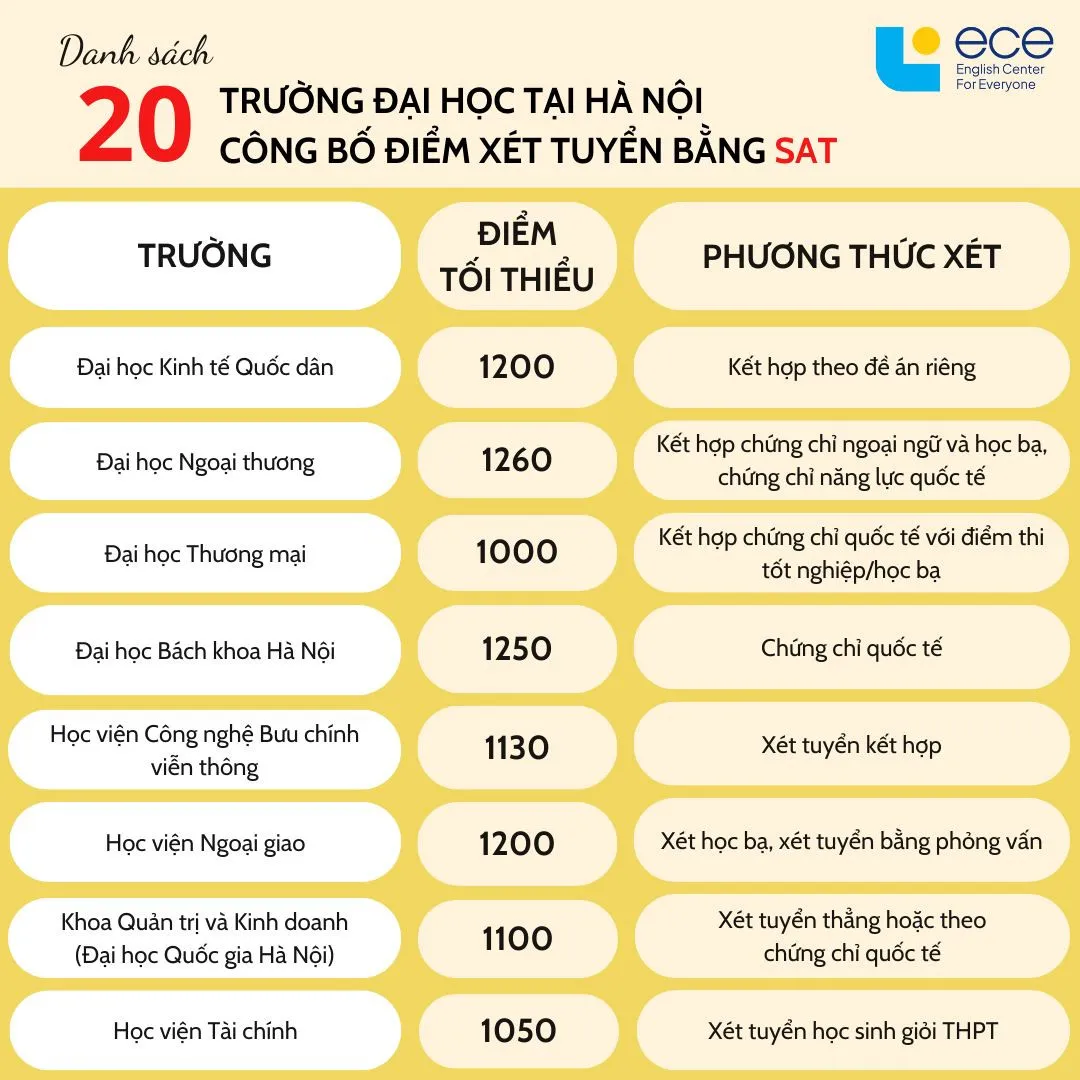
In Vietnam, specifically during the 2024–2026 period, the SAT has become a significant advantage in the admissions process. While the average minimum score for application submission ranges from 1000 to 1250, the actual competitive cutoff scores are much higher. Specifically, top-tier Economics programs (such as Foreign Trade University or National Economics University) report admission scores ranging from 1350 to over 1500, while Engineering and Medical programs typically require a safe range of 1250–1400. It is expected that by 2026, even if application thresholds remain stable, actual admission scores will continue to edge upward due to the increasing number of students achieving high SAT scores.
Research shows that SAT scores have a certain correlation with a student’s academic performance at the university level. Higher scores often indicate a better ability to adapt to university curricula. The SAT does not just assess knowledge; it also evaluates skills such as reading comprehension, writing, and problem-solving—all of which are essential for success in higher education.
To look up relevant information such as university graduation rates, tuition fees, and SAT entry requirements, you can visit this link!
- Scholarships: The SAT also plays a vital role in scholarship consideration. Many organizations and universities use SAT scores to determine a student’s eligibility for scholarships or other financial aid programs.
- Critical Thinking Assessment: The SAT goes beyond testing academic knowledge; it assesses critical thinking, analytical, and problem-solving skills—abilities that are crucial for success in both academics and life.
2. Test Schedule, Format, and Results
Regarding the schedule, the SAT is administered multiple times a year, typically in the following months:
- March
- May
- June
- August
- October
- November
- December
Specific test dates may change annually and are announced on the College Board website. Registration deadlines are usually about 3 weeks before the test date. Additionally, there are late registration deadlines and opportunities for students to change their test date if necessary. You can check specific information regarding test dates, registration deadlines, and detailed regulations on the official College Board website here.
As for receiving your results, while it may vary slightly depending on the specific test session and other factors, you can generally expect to receive your scores within about 2 weeks after the test date.
A few points to note:
- June Test: For the SAT held in June, the score release time may take slightly longer, approximately 6 weeks after the test date, due to the higher volume of tests to be graded.
- Checking Results: You can check your results online through your account on the College Board website or via the email address you registered with.
Regarding the format, since 2023, the SAT has transitioned to a digital format worldwide. Students can use their personal laptops or school-issued devices to take the test. If you do not have a device, you can borrow one from test centers or schools. This provides flexibility and makes it easier for students to prepare for the exam.
Since June 2021, the SAT has removed the essay section and now consists of two main parts: Reading and Writing and Math. The Reading and Writing section lasts 64 minutes, while the Math section lasts 70 minutes, for a total test time of 2 hours and 14 minutes. Despite this, the test remains highly effective at accurately assessing student aptitude with a high level of differentiation.
3. Validity of the SAT Certificate
SAT scores are valid for 5 years from the date you take the test. This means that after you receive your results, your score will be accepted by universities for up to 5 years. However, even though the SAT is valid for 5 years, many universities typically only consider SAT scores from the most recent 1–2 years for admissions.
Detailed Content of Each SAT Section
The SAT is divided into three main areas: Reading, Writing and Language, and Math. Each section evaluates different skills.
Each section is divided into two equal-length modules, with a 10-minute break between the Reading and Writing section and the Math section. The first module of each section includes a broad mix of easy, medium, and hard questions. Based on how a student performs on the first module, the second module will be either more or less difficult.
Compared to the ACT, the SAT provides 68% more time per question:
| Section | Time Allotted (minutes) | Number of Questions/Tasks |
|---|---|---|
| Reading and Writing | 64 (two 32-minute modules) | 54 |
| Math | 70 (two 35-minute modules) | 44 |
| Total | 134 | 98 |
Most questions are multiple-choice, although some math questions require you to enter your own answer rather than selecting one.
1. Reading Section
- Objective: To evaluate reading comprehension and the ability to analyze texts from various fields such as science, social studies, humanities, and evidence-based texts.
- Content:
- Text types: Includes articles, essays, book excerpts, and other documents.
- Questions:
- Literal comprehension: Questions about information directly presented in the text.
- Inferential comprehension: Questions about metaphorical meaning, implications, or the author’s purpose.
- Text structure analysis: Questions about how the author organizes ideas, uses evidence, and develops arguments.
- Compare and contrast: Questions about differences and similarities between texts.
- Drawing conclusions: Requires students to draw conclusions based on information provided in the text.
2. Writing and Language Section
- Objective: To evaluate the ability to use language effectively to convey ideas clearly and accurately.
- Content:
- Grammar correction: Identifying and fixing errors in grammar, vocabulary, and sentence structure.
- Sentence improvement: Choosing appropriate words and structures to clarify meaning and improve the coherence of the text.
- Text organization: Arranging ideas logically and using transition words to create flow between sentences and paragraphs.
- Argument analysis: Evaluating the validity of arguments and evidence presented in the text.
3. Math Section
- Objective: To evaluate the ability to solve problems related to arithmetic, algebra, geometry, and data analysis.
- Content: The math section now allows the use of a calculator for the entire section, unlike the previous format which was split into non-calculator and calculator portions.
- Key topics:
- Arithmetic: Basic operations, integers, rational and irrational numbers, ratios, and percentages.
- Algebra: Equations, inequalities, functions, and graphs.
- Geometry: Plane geometry, solid geometry, and trigonometry.
- Data analysis: Charts, tables, probability, and statistics.
SAT Scoring
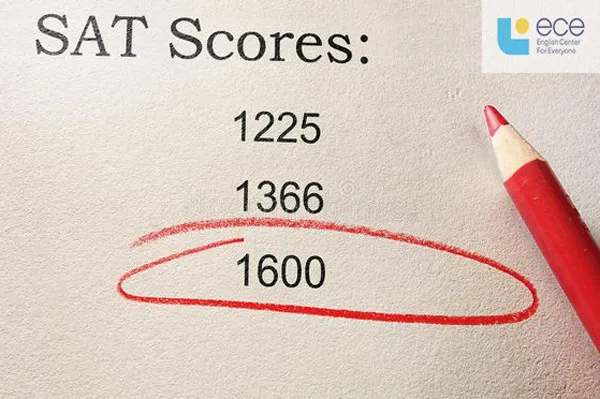
The SAT score scale ranges from 400 to 1600, with the average student score falling between 1050 and 1100. Below are some specific score benchmarks:
- Average Score: Approximately 1050–1100 is the average score for test-takers, sufficient to meet the requirements of many community colleges and universities in the U.S. and other countries.
- Good Score: Scores from 1200 to 1400 are considered good and can help students qualify for many universities. This score typically indicates strong academic ability and can increase the chances of receiving scholarships.
- High Score: Scores of 1400 and above are considered high, competitive enough for top-tier universities. Institutions like the Ivy League and other prestigious universities often have an average SAT score for admitted students above 1500.
- Excellent Score: Scores of 1500 and above are considered excellent and provide a significant advantage in the admissions process for top-tier universities.
The specific score required to be considered competitive also depends on the university you are applying to. Some schools have higher requirements, while others may accept lower scores.
Advice from ECE for those planning to take this test:
- Set high goals: Aim for a high SAT score to have more options when choosing a university.
- Start preparing early: SAT preparation takes time, so start as early as possible.
- Seek support: You can look for help from tutors, test prep centers, or friends who have taken the SAT. If you are interested in the SAT course at ECE, visit us now for a free consultation.
This article has summarized the essential information regarding the SAT. “While your SAT score is important, the preparation process is the most valuable part. Through studying, you will develop essential life skills such as self-study, teamwork, and problem-solving. Enjoy the journey and try not to feel too pressured by the final result.”





 Khai giảng Khóa học Hè cực HOT.
Chưa có bình luận nào!