
Tóm Tắt Nội Dung Bài Viết
The digital SAT maintains a total score scale of 1600, consisting of two main sections: Reading and Writing, and Math. Each section is scored on an 800-point scale, and your total score is the sum of these two parts. If you are looking for an explanation of how the SAT is scored, be sure to read on!
1. Scoring for each SAT section
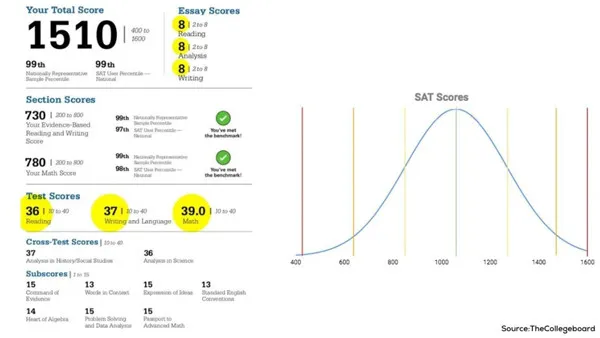
- Reading and Writing: Scores for this section range from 200 to 800. Questions in this section are evenly distributed across topics that test reading comprehension, grammar, and analysis.
- Math: Scores for this section also range from 200 to 800. The Math section includes questions on algebra, problem-solving, data analysis, geometry, and basic trigonometry.
2. How the digital SAT is scored
The digital SAT uses an adaptive scoring method:
- Adaptive Scoring: The digital SAT is scored using a multistage adaptive model. This means that based on how you perform in the initial stage, the system adjusts the difficulty of the questions in the subsequent stage.
For example: If you answer many questions correctly in the first module, the next module will contain more challenging questions. Your final score is based on both the number of correct answers and the difficulty level of those questions.
- No penalty for wrong answers: You are not penalized for incorrect answers, so it is best not to leave any questions blank.
- Raw score to scaled score conversion: Your number of correct answers (raw score) is converted into a scaled score on a 200–800 scale for each section.
Raw scores are calculated based on the number of correct answers in each section of the SAT.
- Reading and Writing section: The number of correct answers in this section is totaled.
- Math section: The number of correct answers in the math section is also totaled. The raw math score includes both multiple-choice and “grid-in” questions.
2.1. Scaled Score Conversion
After calculating the raw score, the College Board uses a conversion table to translate the raw score into a scaled score between 200 and 800 for each section. This process adjusts for the varying difficulty levels of different test forms, ensuring fairness for all students.
How conversion works:
- Using a conversion table: Each SAT administration has its own unique conversion table because each test form may have a different difficulty level. This table helps balance scores among students who take tests of varying difficulty.
For example: If your test form is more difficult, you may receive a higher scaled score for the same number of correct answers compared to an easier test form.
Examples of score conversion:
- Math: If you answer all questions correctly (maximum raw score), you will receive a scaled score of 800. If you only answer a small number of questions correctly, such as about 30, you might receive a score of around 600–650.
- Reading and Writing: Similarly, the raw score from the total number of correct answers is converted into a scaled score on the 200–800 range.
2.2. Total SAT Score
- The total SAT score is calculated by adding the scaled scores of the two main sections:
- Reading and Writing: 200–800 points.
- Math: 200–800 points.
- Total Score: The maximum total score is 1600 (800 points per section).
2.3. Differences between conversion tables
Each SAT exam has a different conversion table because test forms can vary in difficulty. These tables are typically released by the College Board for each test date and are used to ensure that students across all test administrations are evaluated fairly.
3. Sample SAT score report and how to read it
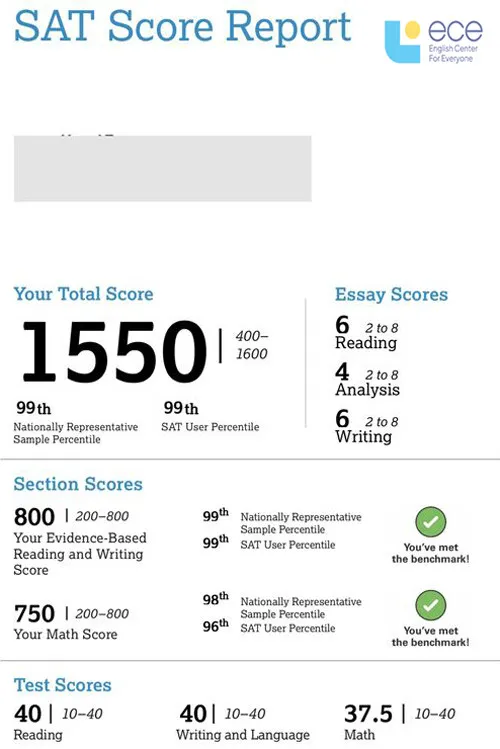
When you receive your SAT score report from the College Board, you will see various components listed in detail. Below is how to read and understand the key parts of your SAT Score Report:
1. Total Score: The total SAT score ranges from 400 to 1600, calculated by adding the scores from the two main sections:
- Reading and Writing: Scaled from 200 to 800.
- Math: Scaled from 200 to 800.
2. Section Scores:
- Evidence-Based Reading and Writing (EBRW): This section includes both reading and grammar questions. Scores for this section range from 200 to 800.
- Math: Math scores also range from 200 to 800.
- The sum of these two sections is your total SAT score (400–1600 scale).
3. Detailed section analysis:
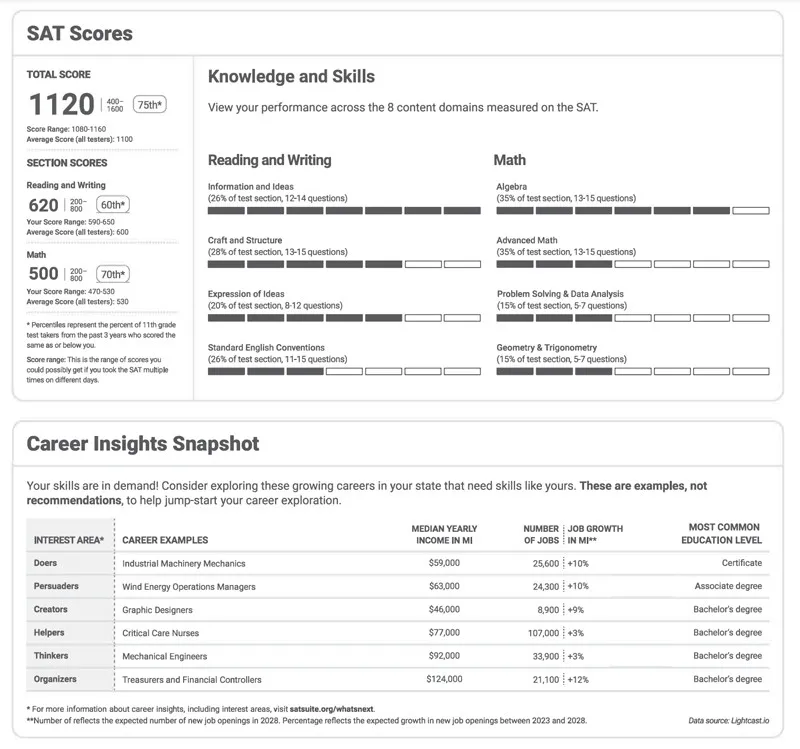
Subscores: These are smaller scores calculated based on specific skills assessed by the SAT. Subscores typically range from 1 to 15. These include:
- Command of Evidence: Ability to use and analyze information in passages.
- Words in Context: Ability to understand vocabulary within a given context.
- Expression of Ideas and Standard English Conventions: Assessment of grammar and expression in the Writing section.
- Heart of Algebra, Problem Solving & Data Analysis, and Passport to Advanced Math: Specific skill sets within the Math section.
4. Percentiles:
- Nationally Representative Sample Percentile: This ranking shows how your score compares to the entire student population in the U.S.
- SAT User Percentile: Shows the percentage of other students who took the same SAT exam that you scored higher than.
5. Cross-Test Scores:
- These scores reflect your ability to work with questions related to Science and History/Social Studies, drawn from both the Reading & Writing and Math sections. Each of these scores ranges from 10 to 40.
6. Using your SAT score report:
- Sending scores to universities: You can choose to send your SAT score report to the universities you are applying to. Some institutions will require you to send official scores directly from the College Board.
This article is a summary from the ECE language center to help you understand how the SAT is scored and how to read your detailed score report. If you need answers to any SAT-related questions or would like to learn more about our SAT preparation courses, please do not hesitate to contact the center for support.





 Khai giảng Khóa học Hè cực HOT.
Chưa có bình luận nào!