
Tóm Tắt Nội Dung Bài Viết
IELTS is one of the most popular English language exams in the world, used to assess the proficiency of non-native English speakers. So, what is IELTS, and do you truly understand its purpose? Let’s join ECE in exploring some interesting facts about IELTS that you might not know yet.
What is IELTS? What does it stand for?
IELTS stands for International English Language Testing System, an international standardized English exam designed to evaluate the language proficiency of non-native speakers. The exam was developed by the British Council, IDP: IELTS Australia, and Cambridge English.
The IELTS certificate is widely recognized and accepted by over 10,000 educational institutions, employers, and government agencies worldwide. With an IELTS certificate, you can apply for scholarships, study abroad, work, and even immigrate to English-speaking countries.
So, what does studying for IELTS involve?
Studying for IELTS (International English Language Testing System) is a comprehensive process of honing the four core English skills assessed by the exam, while also mastering the strategies and knowledge needed to reach your target score. Specifically, your preparation will focus on the following areas:
1. Listening Skills
- Goal: Understand conversations, monologues, lectures, and announcements in English across various accents (British, American, Australian, etc.).
- Content: Practice different question types (multiple choice, gap-fill, matching, diagram/map labeling), familiarize yourself with common traps, learn to grasp main ideas, specific details, speaker opinions and attitudes, and develop effective note-taking skills.
2. Reading Skills
- Goal: Read and comprehend long, complex texts on diverse topics, typically academic in nature (for Academic) or practical, real-life texts (for General Training).
- Content: Master skimming for main ideas and scanning for specific information. Understand details, identify the author’s viewpoint/attitude, and analyze text structure. Learn to handle various question types (True/False/Not Given, Yes/No/Not Given, matching headings, gap-fill, multiple choice, etc.) and expand your academic and topic-specific vocabulary.
3. Writing Skills
- Goal: Write coherent, logical essays, reports, or letters with correct grammar and a rich, appropriate vocabulary.
- Content:
Task 1: Learn to analyze and describe information from charts, tables, processes, or maps (Academic), or learn to write letters for various purposes like requesting information, complaining, or making requests (General Training).
Task 2: Learn to write essays on social issues, opinions, or debates. Practice outlining, developing ideas, organizing paragraphs logically, using linking words effectively, and diversifying sentence structures and vocabulary.
General: Improve grammar, academic vocabulary, and the ability to express ideas clearly and coherently.
4. Speaking Skills
- Goal: Communicate in English fluently, coherently, and naturally with an examiner on both familiar and abstract topics.
- Content:
Part 1: Practice answering short questions about yourself, family, hobbies, work/studies, etc.
Part 2: Practice speaking for 1–2 minutes on a given topic based on a cue card, including preparing ideas within 1 minute.
Part 3: Practice discussing topics from Part 2 in greater depth, demonstrating the ability to analyze, present, and defend your opinions.
General: Improve fluency and coherence, pronunciation (intonation, stress, ending sounds), expand vocabulary, and use grammar flexibly and accurately.
5. Other Supporting Elements
- Vocabulary: Expand your vocabulary based on common IELTS topics (education, environment, technology, society, health, etc.) and Academic Vocabulary.
- Grammar: Strengthen and advance your grammatical knowledge, learning to use a variety of sentence structures accurately.
- Test-taking Strategies: Learn tips and techniques for each question type and how to manage your time during the exam.
- Familiarization with Exam Structure and Scoring Criteria: Understand the exam sections, timing, scoring, and Band Descriptors for Writing and Speaking to know where to focus your improvements.
- Practice Tests: Practice with mock exams to get used to time pressure and apply the knowledge and skills you have learned.
In short, studying for IELTS is not just about learning English; it is a structured language training process combined with test-taking strategies and familiarization with the specific exam format to achieve the best possible results.
IELTS Validity Period
An IELTS certificate is valid for 2 years from the test date (the date printed on your Test Report Form – TRF). After 2 years, results are generally not accepted by organizations (schools, immigration authorities, employers, etc.) because your language proficiency may have changed. Therefore, always check the specific requirements of the organization you are applying to, ensuring your certificate remains valid according to their regulations.
Why take the IELTS? Undeniable benefits of holding an IELTS certificate

2.1. Meeting domestic academic requirements
IELTS is increasingly becoming a common requirement within the Vietnamese education system. Many major universities, such as Vietnam National University, National Economics University, and Hanoi University of Science and Technology, have incorporated IELTS into their admission criteria or graduation standards. For example:
- Admission: Some majors require an IELTS score of 6.0 or higher for direct admission, especially in fields like foreign languages, international economics, and information technology.
- Graduation requirements: Some universities require students to achieve an IELTS score between 4.5 and 6.0 to meet output standards, ensuring they can use English for work and research.
- Scholarship and international exchange opportunities: Students with an IELTS certificate are often more likely to receive exchange scholarships or participate in international cooperation programs, gaining a significant advantage in global academic environments.
Additionally, holding an IELTS certificate helps students access international academic materials, develop research skills, and participate in online courses from prestigious universities worldwide.
2.2. Supporting study abroad and immigration
IELTS is not only an international standard for assessing English proficiency but also a key to realizing your dreams of studying abroad and immigrating. Holding this certificate helps you meet entry requirements and opens up attractive immigration opportunities. Here is how IELTS effectively supports this journey:
Supporting study abroad
1. Entry requirements at international universities
Most universities and colleges in English-speaking countries like the UK, USA, Australia, and Canada require IELTS as part of the application process. Minimum scores typically range from 6.0 to 7.5 depending on the major.
Example: The University of Melbourne (Australia) requires a minimum IELTS score of 6.5 for undergraduate programs, while the University of Oxford (UK) requires 7.0 or higher for certain subjects like Medicine or Law.
2. Scholarship support
Major scholarship programs like Chevening (UK), Fulbright (USA), and Australia Awards (Australia) require applicants to provide an IELTS score of 6.5 or higher. Holding an IELTS certificate not only meets mandatory criteria but also demonstrates your thorough preparation and international academic capability.
3. Participating in international exchange programs
Many universities partner with international educational organizations, allowing students to participate in exchange programs. An IELTS certificate is often a prerequisite, making you a strong candidate and helping you adapt easily to a new academic environment.
Supporting immigration
- Requirements for immigration visas
Developed nations like Australia, Canada, New Zealand, and the UK often require IELTS for immigration visa applications. The required score depends on the specific program:- Australia: The Skilled Migration program requires a minimum IELTS score of 6.0.
- Canada: Express Entry requires scores corresponding to a minimum Canadian Language Benchmark (CLB) of 7.
- UK: The Skilled Worker visa usually requires an IELTS General score of 4.0 to 5.0 for each skill.
- Increasing application competitiveness
Holding an IELTS certificate with a high score not only helps you meet requirements but also makes your application more competitive. Governments often prioritize candidates with strong language skills, as evidenced by their IELTS scores. - Adapting to a new life
IELTS helps you confidently communicate, work, and integrate into new countries. Strong language skills will help you overcome cultural barriers, build professional networks, and develop your career in your new home.
Practical examples
- Australia: The Australian government offers a Permanent Residency (PR) program for skilled workers, where an IELTS score of 7.0 or higher provides a significant advantage in the points-based immigration system.
- Canada: A high IELTS score helps improve your Comprehensive Ranking System (CRS) score, increasing your chances of receiving an Invitation to Apply (ITA).
2.3. Increasing career opportunities
1. Boosting career prospects

Holding an IELTS certificate is compelling proof of your English proficiency. Especially when applying to multinational companies, this certificate helps you stand out from other candidates. According to British Council research, 73% of employers in English-speaking countries require an IELTS certificate as a mandatory standard, as strong English communication is considered a key factor for professional success.
Having an IELTS certificate shows that you can communicate effectively in an international work environment, thereby increasing your chances of being hired and promoted.
2. International work
An IELTS certificate opens doors to working abroad or in international organizations. According to IDP Education research, over 90% of global employers confirm that English proficiency is a deciding factor during recruitment. Achieving a high score on the IELTS exam allows you to overcome language barriers and quickly adapt to an international work environment.
This not only helps you secure a good job but also provides opportunities to learn, develop your career, and experience new cultures. Companies like Google, IBM, and Unilever require an IELTS certificate for management and expert positions because they need candidates who can communicate fluently in English within a multinational environment.
3. Enhancing your resume
An IELTS certificate is particularly useful when applying for leadership or expert roles. Large companies often require a minimum IELTS score to prove effective English communication skills. According to a CareerBuilder report, employers state that candidates with an IELTS certificate demonstrate better problem-solving, presentation, and teamwork skills in a global environment.
Having an IELTS certificate helps you stand out to recruiters and paves the way for rapid career advancement. Positions such as directors, consultants, or international project managers often require an IELTS score of 6.5 or higher to ensure effective communication on the job.
2.4. Developing comprehensive English skills
IELTS is not just a standard language exam; it is a useful tool that helps learners develop all-around English skills.
1. Listening: Familiarizing yourself with various English accents
The IELTS exam requires learners to listen to various accents, from British and American to others like Australian, Canadian, and New Zealand English. This helps learners develop listening comprehension in diverse contexts. According to a British Council report, 73% of IELTS test-takers said that familiarizing themselves with different accents improved their listening and understanding in real-life communication situations.
2. Speaking: Enhancing communication and quick thinking in an international environment
The IELTS Speaking section requires learners to communicate directly with an examiner, handle situations, and react quickly in an international setting. Research from IDP Education shows that 80% of test-takers feel more confident in international communication after achieving their IELTS certificate. This skill is crucial when you need to converse with partners or colleagues from different countries.
3. Reading: Expanding academic vocabulary
The IELTS Reading section includes complex passages from academic fields. According to a report from Cambridge University Press, while learners often find it difficult to understand and analyze these passages, familiarizing themselves with them helps expand their specialized vocabulary and deep reading comprehension.
4. Writing: Developing logical and clear expression
The IELTS Writing section requires learners to write essays with a clear, logical structure and accurate grammar. According to the British Council, 85% of candidates reported that their writing skills improved after practicing and taking the IELTS, thanks to training in coherent expression and the use of academic vocabulary.
In summary, IELTS is not just an exam for a score; it is an effective tool for developing comprehensive English skills. Investing time and effort into practicing and taking the IELTS helps learners become more confident in international communication, gain deeper reading comprehension for academic materials, and express themselves clearly and logically in writing.
>>> See more: Is grammar important in IELTS?
Professions that require or prioritize an IELTS certificate
IELTS is not just for studying abroad or immigration; it is also an important tool for career development in many fields. Below are industries that currently require or encourage employees to hold an IELTS certificate:
1. Education and Teaching

- English Teachers: An IELTS certificate is a necessary requirement for English teachers who want to teach at international schools, especially at large centers or schools in countries where English is the primary language of instruction. According to a British Council report, 90% of international schools require English teachers to have an IELTS certificate with a score of 7.5 or higher.
This not only proves language proficiency but also ensures that teachers can teach effectively in English. Research from IDP Education shows that holding an IELTS certificate helps teachers easily meet international recruitment requirements and have opportunities for career advancement.
- IELTS Examiners: For professionals who want to become IELTS examiners, this certificate is a mandatory requirement. Organizations like IDP Education require examiners to have an IELTS score of 8.0 or higher, along with teaching experience and in-depth knowledge of the English language. This ensures that examiners have the ability to understand and accurately assess candidates’ tests.
- Lecturers at international schools: For lecturers at international schools, a high IELTS score is a mandatory requirement. Many schools require teachers to have an IELTS score of 7.0 or higher to ensure effective teaching in English. According to a British Council report, 85% of international schools require an IELTS certificate from their teaching candidates.
2. Tourism and Hospitality
- Tour Guides: An IELTS certificate is also very important in the tourism industry, especially for international tour guides. Major travel agencies require guides to have good English communication skills, and an IELTS score of 6.0 or higher is an important piece of evidence. According to a British Council survey, 70% of major travel agencies require an IELTS certificate to recruit tour guides.
- Hotel Staff: High-end hotels in international tourist destinations require staff with good English communication skills. Many hotels require staff to have an IELTS score of 5.5 to 6.5 to ensure they can communicate effectively with international guests. A report from the International Hotel Group shows that 60% of high-end hotels in tourist destinations require an IELTS certificate for recruitment.
3. Healthcare
- Doctors, nurses, and healthcare professionals: In the healthcare industry, especially when working in English-speaking countries, an IELTS certificate is a mandatory requirement. Many countries like the UK, Australia, and Canada require healthcare professionals to have an IELTS score of 7.0 or higher to practice. According to a report from the UK General Medical Council, 80% of international doctor candidates must have an IELTS certificate to be licensed to practice.
- Therapists, dentists, and other healthcare specialists: Professionals in these fields also need an IELTS certificate to ensure good communication with international patients. An IDP Education survey shows that 75% of recruiting organizations require healthcare specialists to have an IELTS score of 6.5 or higher.
4. Business and Management
- Business Leaders: Many multinational companies require managers to have an IELTS score of 6.5 or higher. This ensures they can communicate effectively with international partners and manage international teams. According to a Financial Times report, 70% of large corporations require leadership candidates to have an IELTS certificate to ensure fluent English communication.
- International Finance and Marketing Specialists: In fields like finance, marketing, and sales, an IELTS score of 6.0 to 7.0 is often a mandatory requirement. A Forbes survey shows that 65% of companies recruiting international finance and marketing specialists require an IELTS certificate.
These are just 4 of the many professions that currently prioritize, encourage, or require candidates to hold an IELTS certificate for their work. There are many other jobs and industries that require IELTS or strong English communication skills, such as flight attendants, interpreters, IT professionals, journalists, etc.
>>> Please refer to the roadmap and IELTS course tuition at the ECE language center
Overview of the IELTS exam structure
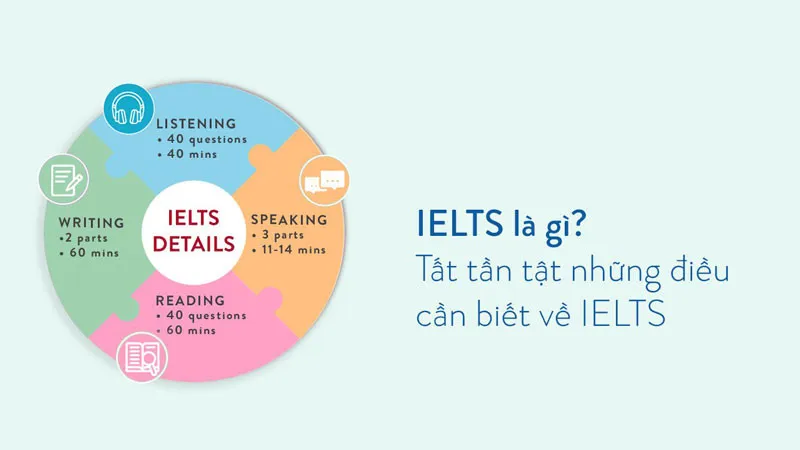
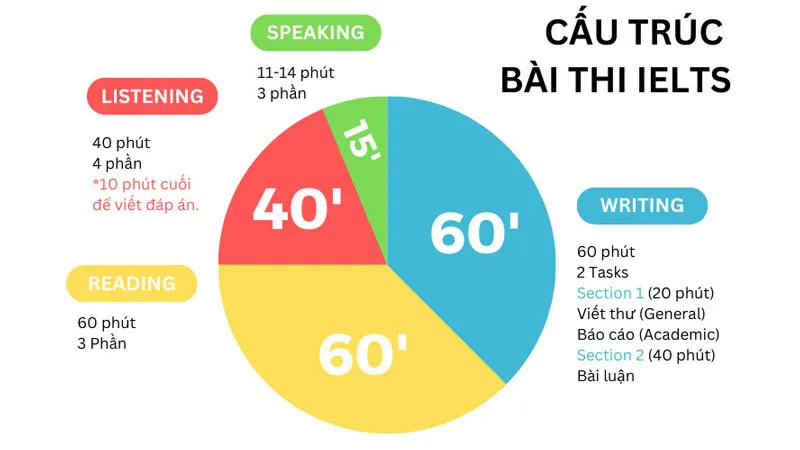
An IELTS exam consists of four parts: Listening, Reading, Writing, and Speaking. Each part has a different duration and scoring method.
| Section | Duration | Number of questions | Format | Main content |
| Listening | 30 minutes | 40 questions | Listen via headphones, fill in answers on the answer sheet. | 4 audio recordings with various topics like daily conversations, lectures, news, etc. |
| Reading | 60 minutes | 40 questions | Read passages and answer questions, fill in answers on the answer sheet. | 3 passages with academic topics |
| Writing | 60 minutes | 2 tasks | Write on paper or computer, based on Task 1 and Task 2 requirements. | Task 1: Describe a chart, table, diagram, or process.
Task 2: Write an argumentative essay on a social issue |
| Speaking | 11 – 14 minutes | 3 parts | Face-to-face interview with an examiner or computer-based with an online examiner. | Part 1: Self-introduction and general questions.
Part 2: Speak on a specific topic for 2 minutes. Part 3: Deeper discussion on the topic from Part 2 |
How IELTS is scored
Each section is scored on a scale from 0 to 9, with 0.5-point increments. There is no “pass” or “fail” in IELTS. Candidates receive a Test Report Form showing scores from 1 to 9. A score of 9 represents expert proficiency, while a score of 0 represents someone who did not attempt the test.
The Overall Band Score is calculated by averaging the four section scores. If the average ends in .25, it is rounded up to the next .5; if it ends in .75, it is rounded up to the next whole band.
Example: A candidate has the following scores:
- Listening 7.5, Reading 6.5, Writing 8.0, and Speaking 7.0. The average is (7.5 + 6.5 + 8.0 + 7.0) / 4 = 7.25. Following rounding rules, the final IELTS score is 7.5.
- Reading 6.5, Listening 5.5, Writing 5.0, and Speaking 6.0. The average is 5.75. Following rounding rules, the final IELTS score is 6.0.
IELTS testing organizations in Vietnam
- Currently, there are two organizations that administer the IELTS exam in Vietnam and worldwide: the British Council (BC) and IDP: IELTS Australia. Both allow candidates to choose test locations in Hanoi, Ho Chi Minh City, and nearly 40 other provinces across the country.
- The IELTS test content is developed and managed by Cambridge English Language Assessment. Therefore, the difficulty level is consistent across both organizations; neither is easier or harder than the other.
- Factors to consider when choosing between BC or IDP include geographical distance, test dates, examiners, test center facilities, headphones, soundproofing, or accents.
How much does the IELTS exam cost?
The IELTS exam fee is a matter of great interest to many candidates when registering.
The specific IELTS exam fees are as follows:
- Paper-based IELTS (Academic and General Training): 4,664,000 VND
- Computer-delivered IELTS (Academic and General Training): 4,664,000 VND
- IELTS for UKVI: 5,252,000 VND
- IELTS Life Skills: 4,414,000 VND
Through the content above, you surely understand what IELTS is and have had your questions answered!
In summary, an IELTS certificate brings many learning and career opportunities and is clear proof of your ability to use English as a second language. Keep working hard and practicing every day to achieve success in the future!





 Khai giảng Khóa học Hè cực HOT.
Chưa có bình luận nào!