
Tóm Tắt Nội Dung Bài Viết
Since 2024, the College Board has transitioned the SAT to a digital format, introducing several changes designed to make the exam more flexible and accessible for both students and educators. In this article, the ECE Language Center breaks down the structure and format of the latest digital SAT. Let’s dive in!
The Latest Digital SAT Structure from the College Board
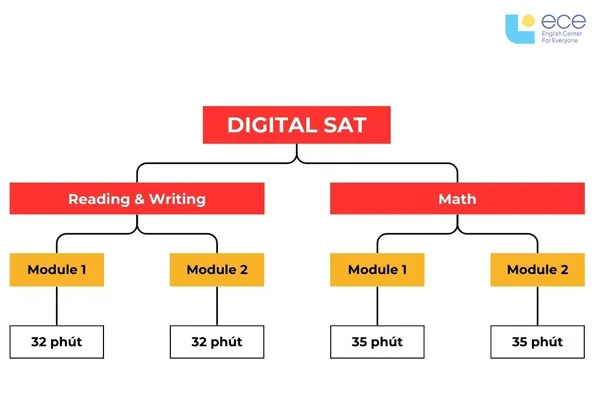
1. Time and Format Overview
- Test duration: Approximately 2 hours (down from the 3 hours of the previous SAT).
| Section | Time Allotted (minutes) | Number of Questions/Tasks |
|---|---|---|
| Reading and Writing | 64 (two 32-minute modules) | 54 |
| Math | 70 (two 35-minute modules) | 44 |
| Total | 134 | 98 |
Each section is divided into two equal-length modules, with a 10-minute break between the Reading and Writing section and the Math section. The first module of each section contains a broad mix of easy, medium, and hard questions. Based on your performance in the first module, the second module will be either more or less difficult.
- Digital testing: Students use their own laptops or school-issued devices.
- Multiple-choice format: All questions are now in a multiple-choice format.
- Maximum score: Remains 1600.
- Number of questions: Fewer than the traditional paper-based exam.
2. Overview of SAT Section 1: Reading and Writing
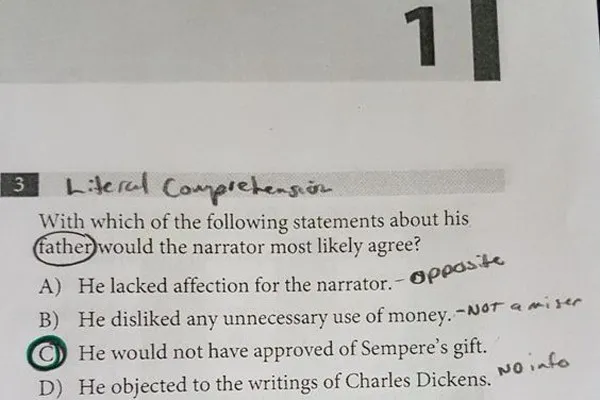
- Time: Approximately 64 minutes (two 32-minute modules with 54 questions/tasks). Each module covers all four content domains:
- Information and Ideas: Measures comprehension, analysis, and reasoning skills, as well as the ability to locate, interpret, evaluate, and synthesize information and ideas from texts and informational graphics (tables, bar charts, and line graphs).
- Craft and Structure: Measures comprehension, vocabulary, analysis, synthesis, and reasoning skills, as well as the knowledge needed to understand and use high-utility words and phrases in context, evaluate rhetorical texts, and make connections between topically related texts.
- Expression of Ideas: Measures the ability to revise texts to improve the effectiveness of written expression and meet specific rhetorical goals.
- Standard English Conventions: Measures the ability to edit texts to conform to core conventions of sentence structure, usage, and punctuation in Standard English.
- Structure: Features shorter passages compared to the old version, with each passage accompanied by a single multiple-choice question (rather than 10 questions per long passage).
- Topics: Covers a diverse range of subjects, including literature, history, social studies, and science.
- Question format: Tests reading comprehension, passage analysis, word choice, and grammar.
- Time per question: On average, you have more time per question than on the paper-based exam.
3. Overview of SAT Section 2: Math
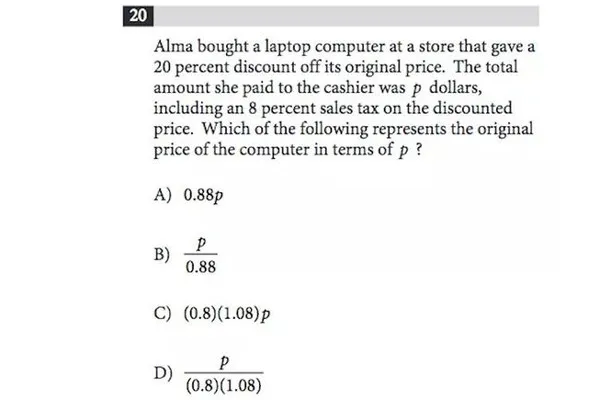
- Time: Approximately 70 minutes.
- Number of questions: Unlike the previous format, which was split into “no-calculator” and “calculator” sections, you may use a calculator for the entire Math section. However, the College Board notes: “The Math section includes some questions where it is better not to use a calculator, even though you are allowed to. In these cases, students who use their structural or reasoning skills may use their time more effectively than those who rely on a calculator.”
The expected number of questions in the Math section is 27–30 (fewer than before).
- Question types: Multiple-choice and student-produced responses (grid-in questions).
- The math domains covered in this exam include:
Algebra: Algebra assesses your ability to analyze, solve, and create linear equations and inequalities, as well as your ability to analyze and solve equations and systems of equations using various techniques.
Algebra includes the following question types:
- Linear equations in one variable
- Linear equations in two variables
- Linear functions
- Systems of linear equations in two variables
- Linear inequalities in one or two variables
Advanced Math: Advanced Math focuses on the mathematical knowledge needed for further study in fields like science or economics, as well as STEM-related career opportunities.
Advanced Math assesses the skills and knowledge required to progress to more advanced math courses, including demonstrating an understanding of absolute value, quadratic, exponential, polynomial, rational, radical, and other nonlinear equations.
Advanced Math includes the following question types:
- Equivalent expressions
- Nonlinear equations in one variable
- Systems of equations in two variables
- Nonlinear functions
Problem-Solving and Data Analysis: This domain assesses your ability to apply quantitative reasoning to ratios, rates, and proportional relationships; understand and apply unit rates; and analyze and interpret one- and two-variable data.
These skills relate to quantitative literacy and demonstrate mathematical ability useful in college courses, career training programs, and daily life.
Problem-Solving and Data Analysis includes:
- Ratios, rates, proportional relationships, and units
- Percentages
- One-variable data: distributions and measures of center and spread
- Two-variable data: models and scatterplots
- Probability and conditional probability
- Inference from sample statistics and margin of error
- Evaluating statistical claims: observational studies and experiments
Geometry and Trigonometry: Geometry and Trigonometry assesses your ability to solve problems focusing on:
- Area and volume formulas
- Lines, angles, and triangles
- Right triangles and trigonometry
- Circles
4. Key Improvements in the Digital SAT:
- Shorter: The digital SAT lasts only about 2 hours, reducing test-taker fatigue.
- More flexible: Students can test on their own laptops or school-issued devices, and the system is designed to ensure continuity in the event of technical issues.
- Faster: Scores are returned within days rather than weeks.
- More secure: Each student receives a unique test form, reducing the risk of cheating.
- More practical: Questions tend to present real-world scenarios, requiring students to apply problem-solving skills.
How to Get Familiar with the Digital SAT Structure
To get comfortable with the digital SAT format and practice effectively, you can use the following resources and strategies:
1. Use Official Practice Resources from the College Board
- Practice Tests: The College Board offers digital SAT practice tests online. You can download or take these tests directly to familiarize yourself with the question format, timing, and new structure. This is the most official and up-to-date source of material.
-> Access them: Here. After completing a test, you can view your score, the answer key, and detailed explanations for each question.
- Khan Academy: The College Board has partnered with Khan Academy to provide free practice tests and practice questions tailored to the digital SAT structure. Exercises are personalized based on your proficiency, helping you focus on areas that need improvement.
- Access them at: Khan Academy SAT Practice
2. Use Study Support Tools
- Bluebook™ App: This is the official College Board app for taking the digital SAT on your computer or tablet. The app provides simulated SAT tests, allowing you to experience the digital exam environment and track your progress.
-> You can download the Bluebook app at: College Board Bluebook
3. Practice Time Management and Test-Taking Skills
4. Refer to Practice Tests from Other Sources
- Beyond the College Board, you can find test prep materials from other educational organizations like Kaplan, The Princeton Review, or Barron’s. These materials often provide practice tests that closely mirror the new digital SAT structure.
This article summarizes the structure of the latest digital SAT that ECE Language Center wants to share with you. To master the digital SAT, you should practice consistently using official College Board resources and supplementary tools like Khan Academy. Additionally, getting comfortable with the digital interface and developing the necessary skills to optimize your time will be the key to your success.
>>> See more here: SAT Course at ECE Language Center.





 Khai giảng Khóa học Hè cực HOT.
Chưa có bình luận nào!