
Tóm Tắt Nội Dung Bài Viết
Do you need a certificate for an urgent study abroad application, or are you looking for lifetime proof of your English proficiency? The answer to this question will determine whether IELTS or CAE (C1 Advanced) is the right choice for you. This guide from ECE goes beyond a dry comparison of these two leading exams; it is a detailed roadmap designed to help you find the path that best aligns with your goals and future plans.
What is CAE? An Overview of the C1 Advanced Certificate
CAE, which stands for Certificate in Advanced English, is a high-level English qualification awarded by Cambridge Assessment English. Today, the exam is officially known as C1 Advanced to clearly reflect the C1 level on the Common European Framework of Reference for Languages (CEFR).
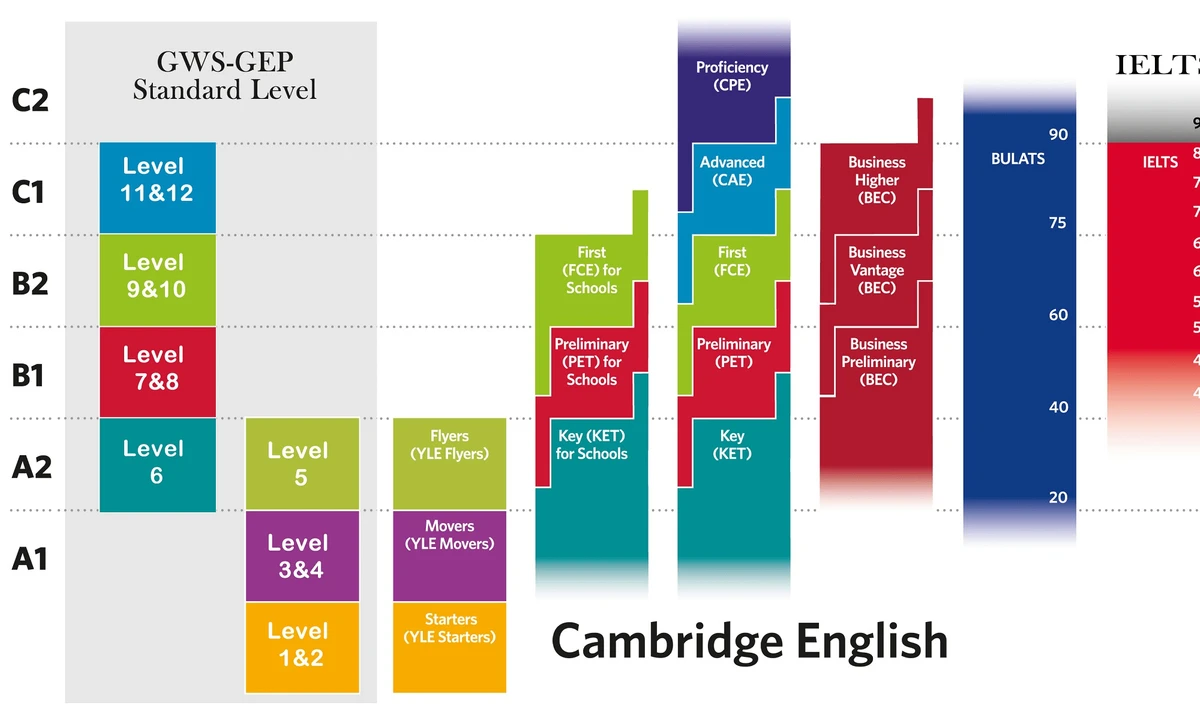
It serves as authentic proof that you possess the English skills to communicate with the confidence and flexibility required to succeed in international academic and professional environments.
Recognition & Benefits of the CAE Certificate
- Global Recognition: The certificate is accepted by over 25,000 organizations worldwide, including top-tier universities (Harvard, Oxford, MIT), multinational corporations (Sony, Bayer), and government agencies.
- Proof of Advanced Competence: Achieving C1 Advanced confirms that you are capable of pursuing Master’s and PhD programs, communicating effectively at a management level, and participating confidently in complex academic meetings and seminars.
- Lifetime Validity: This is the biggest advantage of CAE compared to IELTS. While IELTS scores are only valid for 2 years, the CAE certificate is valid for life, making it a sustainable and prestigious investment in your career.
Detailed Structure of the CAE (C1 Advanced) Exam
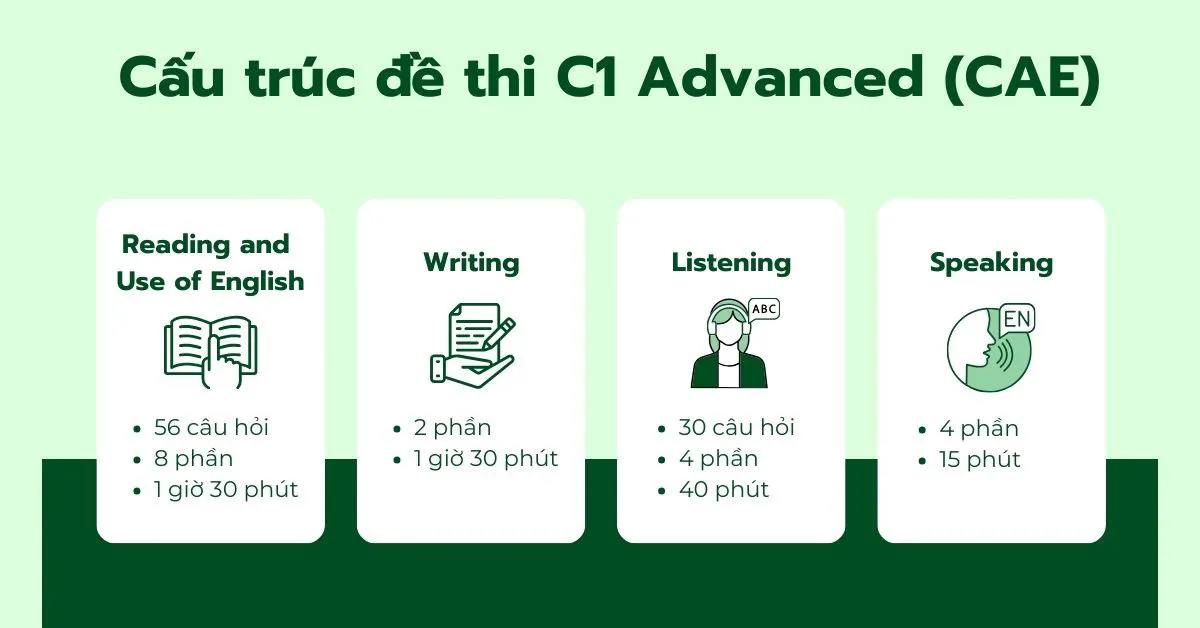
The CAE exam lasts approximately 4 hours and comprehensively assesses 4 language skills through 4 distinct sections.
Part 1: Reading and Use of English – 90 minutes
This combined section tests both reading comprehension and in-depth knowledge of grammar and vocabulary. It consists of 8 parts:
- Part 1 – Multiple-choice cloze: Fill in the blanks (4-option multiple choice), testing vocabulary and collocations.
- Part 2 – Open cloze: Fill in one appropriate word per blank, testing grammar and structure.
- Part 3 – Word formation: Transform the given word to fit the blank.
- Part 4 – Key word transformation: Rewrite sentences using a given word without changing the meaning.
- Part 5 – Multiple choice: Read long texts and answer multiple-choice questions.
- Part 6 – Cross-text multiple matching: Read 4 short texts by different authors and compare their viewpoints.
- Part 7 – Gapped text: Fill in missing paragraphs in a long reading passage.
- Part 8 – Multiple matching: Match given information with the corresponding paragraphs.
Part 2: Writing – 90 minutes
Consists of 2 parts, each requiring 220–260 words.
- Part 1 (Compulsory): Write an essay presenting and defending your viewpoint on a given topic.
- Part 2 (Choice): Choose one of three formats: letter/email, proposal, report, or review.
Part 3: Listening – 40 minutes
Consists of 4 parts with 30 questions, featuring various accents (British, American, Australian, etc.).
- Part 1: Listen to 3 short conversations and answer multiple-choice questions.
- Part 2: Listen to a monologue and complete sentences.
- Part 3: Listen to a long conversation and answer multiple-choice questions.
- Part 4: Listen to 5 short monologues and complete two matching tasks simultaneously.
Part 4: Speaking – 15 minutes
A unique feature of CAE: you will take the test in pairs (or a group of 3) with 2 examiners.
- Part 1 – Interview: The examiner asks general questions about yourself.
- Part 2 – Long turn: Each candidate is given 3 pictures, must compare 2 of them, and answer a question. Afterward, your partner provides a brief comment.
- Part 3 – Collaborative task: Two candidates discuss a topic based on given prompts and reach a joint decision.
- Part 4 – Discussion: The examiner asks deeper, follow-up questions based on the Part 3 topic.
CAE Scoring and IELTS Conversion
CAE uses the Cambridge English Scale. To “pass” the C1 Advanced exam, you need a score of 180 or higher.
- Grade A (200 – 210): Exceptional. The certificate recognizes your proficiency at the C2 level.
- Grade B (193 – 199): Good. The certificate recognizes your proficiency at the C1 level.
- Grade C (180 – 192): Pass. The certificate recognizes your proficiency at the C1 level.
The following table provides the official conversion to help you visualize the score value between the two exams.
Thus, if your goal is an IELTS 7.5, you will need to achieve at least 193 points (Grade B) in the CAE exam.
Advice: Should you take CAE or IELTS?
You can answer these questions to find your path:
➡️ You should choose IELTS if:
- Your goal is short-term and specific (e.g., you need to submit a study abroad application in the next 6 months). IELTS has frequent test dates and is a familiar requirement for most institutions.
- You are stronger at “real-world” communication than analyzing detailed grammar. The IELTS structure focuses on whether you can use the language to complete tasks.
- You are targeting countries like Canada or the US. Although many US universities now accept CAE, IELTS still has broader coverage in North America for study and immigration purposes.
➡️ You should choose CAE if:
- You want a certificate with lifetime validity. This is a long-term “investment” in your career, making your CV stand out without the worry of having to retake the test.
- You want to truly improve and prove your English proficiency at a deep level. The CAE preparation process forces you to systematically reinforce your grammar and vocabulary, helping you become a more sophisticated English user.
- Your goal is long-term study or work in the UK or Europe. CAE is extremely popular and highly regarded in this region.
- You feel more confident speaking with a partner. The CAE Speaking section simulates a natural discussion, which can help reduce pressure and showcase your interaction skills better.
What to know when taking the CAE in Vietnam
To prepare best for the CAE, understanding the logistics is crucial. Below are detailed answers to the most common questions.
1. What is the exact CAE exam fee?
Based on updated data for 2025, the official exam fee for the C1 Advanced (CAE) certificate is 3,300,000 VND.
However, please note that this fee may vary slightly depending on the policies of individual authorized test centers at the time of registration. Some centers may offer different service packages.
Advice: It is best to contact the center where you plan to take the exam directly for the most accurate and up-to-date fee information.
2. How and where do I register for the CAE?
You must register through an officially authorized Cambridge English exam center.
- Step 1: Find an authorized center: The most accurate way is to visit the official Cambridge English website and use the “Find a Centre” tool to see the list of centers in Vietnam.
- Step 2: Prepare documents: Typically, you will need:
- Original ID card/Citizen ID or Passport (valid).
- Passport-sized photos according to center requirements (some centers take photos on-site).
- Completed registration form from the center.
- Step 3: Choose test date and format: Paper-based exams have fixed dates throughout the year. Computer-based exams usually have more flexible and frequent dates.
- Step 4: Pay the fee: Submit the exam fee according to the center’s instructions.
3. Should I choose the paper-based or computer-based test?
This is an important decision that directly affects your test-taking experience. Consider the following pros and cons:
Advice: If you have good typing skills and want faster results, the computer-based test is the superior choice, especially due to the headphone advantage for Listening and the convenience for Writing.
4. What should I prepare for the test day? Is it all on the same day?
This is a very important note that many candidates overlook:
- Speaking Test: The Speaking section may very well be held on a different day than the other 3 skills (either 1–2 days before or after). The center will send your detailed schedule via email; be sure to check it carefully.
- On the day of the 3 skills (Reading & Use of English, Writing, Listening):
- Bring: Original ID/Passport used for registration.
- Do not bring: Phones, smartwatches, electronic devices, or study materials; these must be stored in the designated area outside the exam room.
5. How will I receive my results and certificate?
- View results online: When results are available, the center will send an email notification. You will use the information on your Confirmation of Entry to log in to the Cambridge Candidate Portal and view your Statement of Results.
- Receive the original certificate: The hard copy certificate will be sent from Cambridge to the test center a few weeks later. The center will notify you to pick it up in person or may offer a mailing service (for a fee).
6. If I don’t pass, can I retake the exam?
- Yes. You can register to retake the exam as many times as you like.
- Important note: Unlike some other exams, CAE does not allow you to retake individual sections. If you want to improve your score, you must retake all 4 papers.
Conclusion
This article has provided a comprehensive overview of the CAE (C1 Advanced) certificate—from its definition and exam structure to the lifetime value it offers. Furthermore, the score conversion and direct comparison with IELTS provide you with a clear frame of reference to evaluate and make the most suitable decision for your future.





 Khai giảng Khóa học Hè cực HOT.
Chưa có bình luận nào!