
Tóm Tắt Nội Dung Bài Viết
What is Academic English?

Academic English is the language used in scholarly environments, such as universities and specialized educational institutions. It goes beyond basic reading, writing, listening, and speaking skills; it requires learners to master information organization, logical idea development, and the precise use of professional terminology.
Academic English focuses on helping learners understand and utilize language within scholarly texts, write well-structured essays, engage in in-depth discussions, and present ideas persuasively. It is particularly essential for those aiming to study at international institutions, conduct research, or work in fields that demand a high level of professionalism.
Who should study Academic English?
While Academic English is not limited to a specific group, it is highly recommended for:
- Students: Those planning to study abroad or pursue undergraduate and postgraduate programs in English-speaking countries. Academic English prepares them for reading scholarly materials, writing essays, and participating in classroom discussions.
- Professionals in international environments: Experts working in international organizations, research, or education who need Academic English to write reports, research papers, and communicate at professional conferences.
- Lecturers and researchers: Individuals who need to participate in international conferences, write scientific papers, and publish in reputable journals.
- Candidates for academic exams: Exams such as IELTS and TOEFL require a strong command of Academic English to achieve high scores.
Academic English vs. Conversational English
| Feature | Academic English |
Conversational English
|
| Purpose | Conveying precise, professional information in academic and research settings. |
Everyday communication and sharing information or ideas naturally.
|
| Vocabulary | Specialized terminology and formal language; minimal use of slang or idioms. |
Common vocabulary, including slang, idioms, and expressive language.
|
| Sentence Structure | Long, complex sentences with subordinate clauses and conjunctions for logical clarity. |
Short, simple, easy-to-understand sentences, often using common verbs.
|
| Style/Context | Formal, objective, and emotionally detached. |
Natural, friendly, and often expressive with personal examples.
|
| Format | Found in scientific journals, theses, textbooks, reports, etc. |
Found in daily conversations, emails, texts, social media posts, etc.
|
| Learner Requirements | Requires strong logical thinking, analysis, and information synthesis. |
Requires flexible communication skills, confidence, and natural language use.
|
| Pronunciation & Intonation | Requires precise pronunciation; intonation is less critical than clarity and accuracy. |
Natural, friendly intonation. Pronunciation can be more flexible depending on context.
|
| Proficiency | Requires more time and effort to master, especially for reading academic papers and writing essays. |
More accessible and easier to practice daily through conversations or real-life situations.
|
What makes the Academic English course at ECE special?
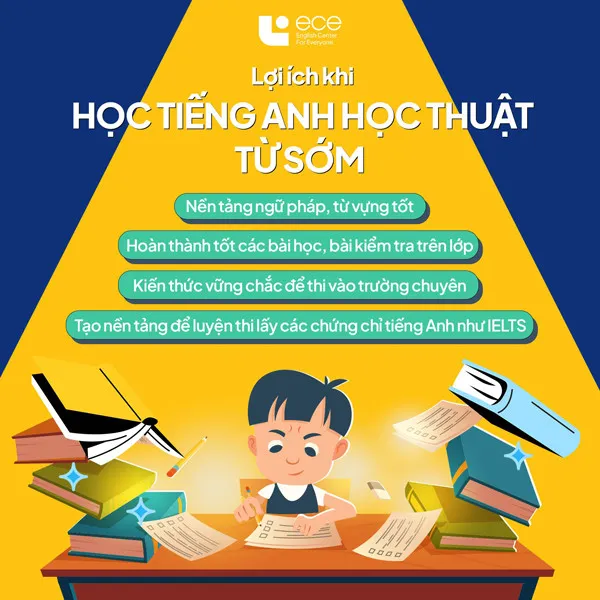
The AEF Academic English course at ECE Language Center is specifically designed to meet the needs of students and professionals in academic environments. These courses help learners not only improve their language skills but also develop critical thinking, essay writing, and effective communication skills for scholarly settings.
Introduction video to the Academic English course at ECE
Who is this course for?
This course is specifically designed for middle school students looking to build a strong Academic English foundation. Through this program, students will comprehensively develop their four skills—Listening, Speaking, Reading, and Writing—in an academic context, creating a solid base for future standardized tests like IELTS, TOEFL, and SAT.
The course goes beyond basic grammar, emphasizing deep comprehension of sentence structures and the ability to analyze implied meanings in listening and reading tasks. Knowledge from fields such as biology, history, technology, social studies, and law is integrated into the lessons, helping students expand their vocabulary while gaining a deeper understanding of academic topics to speak, write, and argue logically.
This course is also a powerful tool for students aiming to pass specialized high school entrance exams. In these competitive exams, Reading and Writing skills are often the deciding factors. Building a rich vocabulary and grammar foundation, combined with strong logical reasoning, will give students a significant advantage over their peers.
Note: 5th-grade students who pass the placement test are also eligible to join this course.
Academic English course content at ECE (30 hours/stage, 1 session of 2.5 hours per week)
Stage 1: For advanced 5th graders and 6th – 7th graders
- Entry level: A1 – A2
- Exit level: A2+
- Curriculum:
- Reinforce phonics, vocabulary, and basic grammar.
- Introduction to short reading passages and the use of mind maps to enhance comprehension.
- Writing letters for various purposes (responding, complaining, suggesting).
- Speaking practice using compound and complex sentences, discussing familiar topics for 1–2 minutes.
Stage 2: For 6th – 7th graders
- Entry level: A2
- Exit level: B1-
- Curriculum:
- Improve pronunciation, focusing on difficult sounds, stress, and linking.
- Introduction to academic vocabulary and more complex topics.
- Writing short paragraphs on introductory academic topics like cause-effect and problem-solving.
- Speaking practice with longer requirements and more complex vocabulary.
Stage 3: For 6th – 7th graders
- Entry level: B1-
- Exit level: B1 (reading, listening); B1- (speaking, writing)
- Curriculum:
- Exposure to longer reading and listening passages with more complex content.
- Focus on writing techniques to prepare for essay formats.
- Speaking practice with longer presentations, requiring students to sustain their talk time.
Students will focus on developing Reading, Listening, Speaking, Grammar, and Writing skills. This stage emphasizes consolidating basic grammar and vocabulary while practicing communication, as well as basic analysis of reading and writing tasks.
Stage 4: For 7th – 8th graders
- Entry level: B1 (reading, listening); B1- (speaking, writing)
- Exit level: B1 – B2 (listening, reading); B1 (speaking, writing)
- Curriculum:
- Writing essays and complex sentence structures.
- Discussing more difficult topics with a focus on presentations.
- Exposure to longer reading and listening materials with higher-level vocabulary and structures.
This stage is the next step in deepening Reading, Listening, Speaking, Grammar, and Writing skills, focusing on expanding vocabulary, familiarizing students with exam formats, and practicing timed test-taking skills.
Stages 5 – 6: For 7th – 8th graders
- Increased complexity in reading, listening, writing, and speaking, with longer passages requiring thorough analysis.
- Stage 5: Exit level is B2 for reading/listening, and late B1 for speaking/writing.
- Stage 6: Exit level is solid B2 for reading/listening, and B1 – B2 for speaking/writing.
In Stage 5, students continue to develop language skills through higher-difficulty exercises, particularly in Reading, Listening, Speaking, and Writing, with a focus on critical thinking, persuasive argumentation, and deeper listening comprehension.
Stage 6 advances Writing skills, aiming to practice logical thinking to form persuasive arguments, expand academic vocabulary, understand Writing Task 1 requirements, and practice writing under timed pressure.
Stage 7: For 8th – 9th graders
Objectives:
- Consolidate reading, listening, and grammar skills at the late B2 level, approaching C1.
- Develop speaking and writing skills at the mid-B2 level.
Curriculum:
- Reading and Listening: Students tackle higher-difficulty exercises from standardized tests like IELTS or SAT. These exercises provide a rich, diverse vocabulary, helping students master complex grammar and enhance cultural awareness.
- Writing: Continue writing essays on advanced social topics and introduce data analysis (graph writing).
- Speaking: Develop skills through debates and discussions on current affairs. Students practice impromptu speaking to respond quickly to unexpected questions. Students learn to distinguish between spoken and written styles while honing logical thinking and coherent argumentation.
Exit level:
- Reading and Listening: Late B2, approaching C1.
- Speaking and Writing: Mid-B2.
Stage 8: For 8th – 9th graders
Objectives:
- Students advance to C1-level reading, listening, and grammar practice.
- Speaking and writing skills advance to the C1 level.
Curriculum:
- Reading and Listening: Continued practice with standardized test materials to enhance deep reading comprehension and detailed listening, improving analytical thinking.
- Writing: Increased focus on graph writing, training students to analyze and present data logically and persuasively.
- Speaking: Introduction to more complex questions requiring in-depth discussion. Students practice structuring logical, coherent answers with clear supporting points related to real-world knowledge and social issues.
Exit level:
- Reading and Listening: Mid-C1.
- Speaking and Writing: Late B2 or early C1.
Stage 9: For 8th – 9th graders
Objectives:
- Students master reading, listening, and grammar skills at the C1 level.
- Speaking and writing skills reach the mid-C1 level.
Curriculum:
- Reading and Listening: Focus on C1-level proficiency using standardized test sources, aiming for deep comprehension and insightful analysis.
- Writing: Perfecting graph writing and essay skills, while developing the ability to present logical and coherent arguments for complex issues.
- Speaking: Achieving the ability to present and discuss in-depth, delivering presentations on difficult, highly academic topics. Speeches are structured clearly with supporting points and persuasive evidence.
Key highlights of the Academic English course at ECE include:
- Comprehensive Curriculum: The course focuses on the four essential skills: listening, speaking, reading, and writing. Students are also guided on how to analyze and write various essay types, as well as how to deliver presentations and participate in group discussions effectively.
- Critical Thinking Development: The course teaches more than just language; it helps students hone their analytical, critical, and logical argumentation skills—essential for facing rigorous essays and presentations.
- Experienced Teachers: At ECE, all teachers are experienced in Academic English and understand the requirements of international academic environments. They support students in overcoming challenges and provide detailed feedback for daily improvement.
- International Exam Preparation: The course includes intensive preparation for exams like IELTS Academic and TOEFL, with expert guidance to help students achieve high scores.





 Khai giảng Khóa học Hè cực HOT.
Chưa có bình luận nào!