
Tóm Tắt Nội Dung Bài Viết
Beyond band 4.0, IELTS 4.5 is the next significant milestone on the English learning journey for many, especially students. This score reflects clear progress and unlocks new opportunities. So, what does an IELTS 4.5 mean, what are its benefits, and how can you achieve it? This article provides a comprehensive overview of the IELTS 4.5 band score.
1. What Level is IELTS 4.5? Understanding the Score
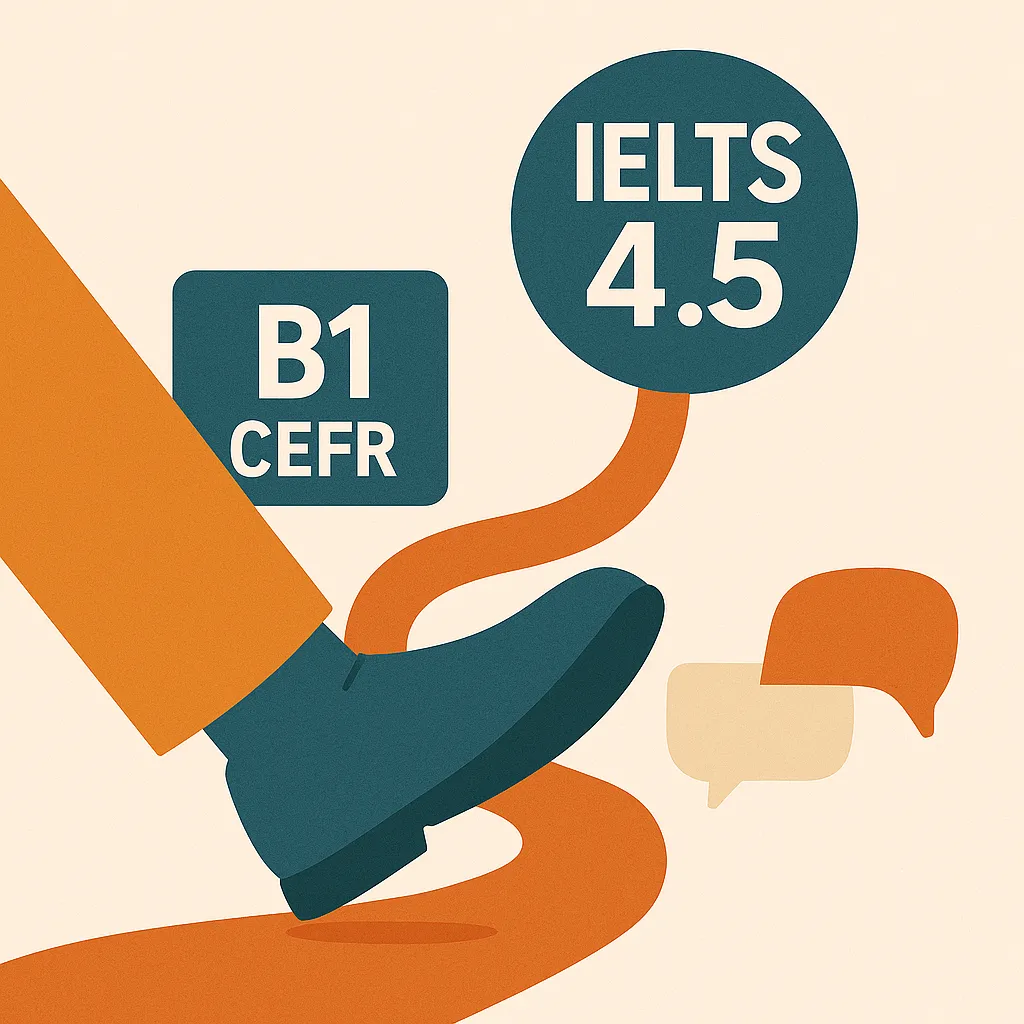
In the IELTS scoring system, 4.5 is an Intermediate level, generally considered average to low-intermediate on the 9.0 scale. However, compared to a 4.0, a 4.5 demonstrates a slightly more solid grasp of English across fundamental areas.
According to the Common European Framework of Reference for Languages (CEFR), IELTS 4.5 is equivalent to the B1 level. At this stage, learners can use English independently at a basic level in familiar situations.
When converted to other international certifications, IELTS 4.5 is roughly equivalent to:
- TOEIC: Approximately 340 – 500 points (Note: Different sources provide varying conversion scales, ranging from 340-360 to 405-600 or 450-500. These equivalencies are relative, as each exam has a different structure and assessment purpose).
- TOEFL iBT: Approximately 32 – 34 points.
- Cambridge Exam: Equivalent to the KET (Key English Test) or PET (Preliminary English Test).
- PTE (Pearson): Approximately 30 – 36 points.
An IELTS 4.5 holder is capable of:
- Communicating with more fluency on familiar topics, with fewer interruptions than at band 4.0.
- Understanding main ideas and key details in slightly more complex spoken or written texts.
- Using a wider variety of basic grammar structures and vocabulary, despite occasional errors.
- Writing short paragraphs with basic cohesion and presenting ideas relatively clearly.
Overall, 4.5 is a significant improvement over 4.0, showing that you can use English with more confidence and accuracy in familiar contexts.
2. Is Reaching Band 4.5 Difficult? Can You Self-Study?
Achieving an IELTS 4.5 is a very realistic goal and not overly difficult, even for beginners or those with a weak foundation. The level of difficulty depends primarily on:
- Starting level: Those starting from scratch will need more time and effort than those with a basic English foundation.
- Study method: A clear roadmap and the right approach are far more effective than aimless studying.
- Consistency and intensity: Dedicating time to study every day is the key factor.
Regarding self-study: Those with a basic English foundation (around A1/A2) can certainly reach 4.5 on their own if they can assess their own progress, follow a personal study plan, and maintain discipline. However, if you are starting from zero, self-study can be challenging and time-consuming without guidance or feedback from an experienced instructor. Many choose to enroll in a center for a structured curriculum and support, which helps shorten the preparation time.
3. How Long Does It Take to Reach IELTS 4.5 from Scratch?
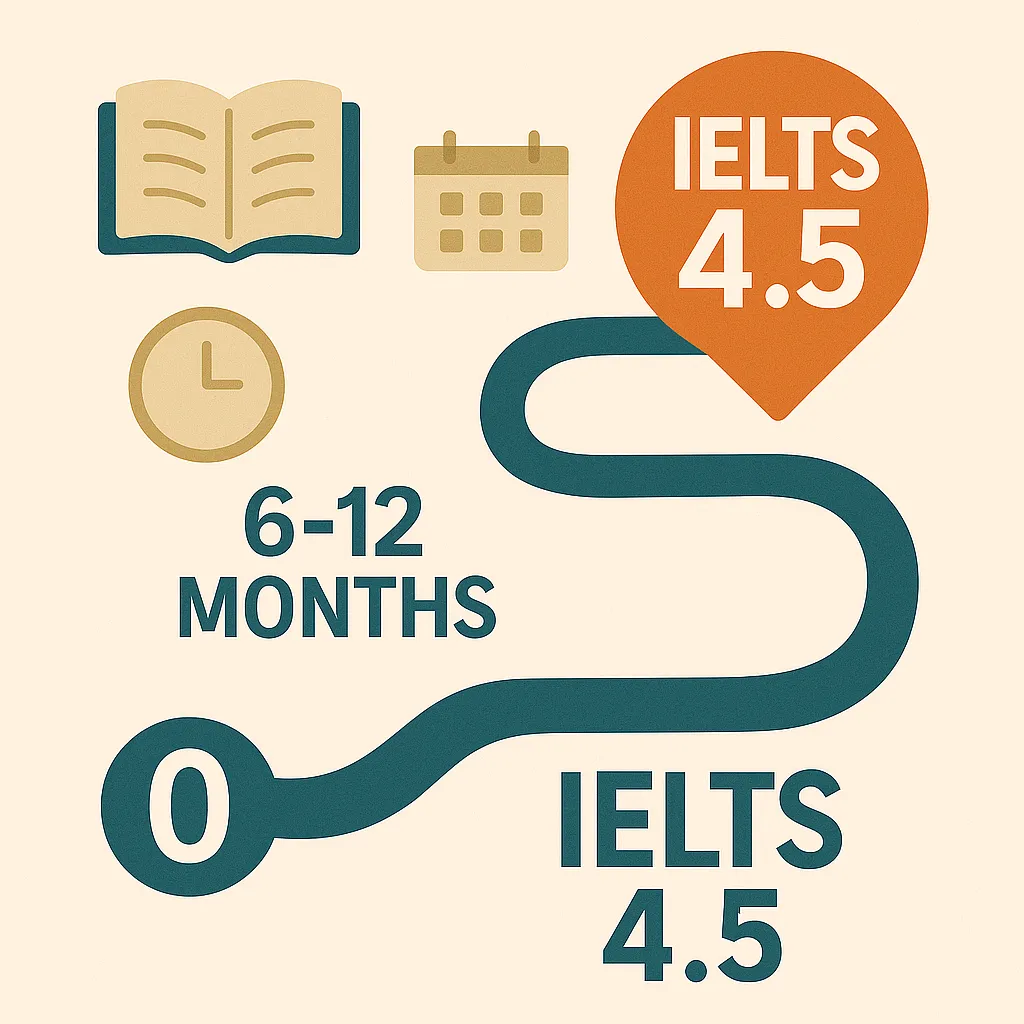
The time required to go from zero to IELTS 4.5 depends heavily on your starting level, time commitment, and individual effort. Typically, with a structured study plan and consistent practice, a beginner can reach band 4.5 in about 6 months to 1 year.
This timeframe can be significantly faster if you already have a basic English foundation (usually 3 to 5 months) or if you take intensive “crash courses.” Conversely, if your study schedule is inconsistent, it may take longer.
Preparation is usually divided into smaller stages (e.g., building a foundation, getting familiar with the test, and deep-diving into skills) to make the journey manageable and goal-oriented.
4. What Are the Benefits of IELTS 4.5?
While not a high score, an IELTS 4.5 certificate offers several important benefits:
- Exemption from the High School Graduation English Exam: Similar to band 4.0, holding an IELTS certificate of 4.0 or higher exempts you from the English portion of the National High School Graduation Exam, granting you a score of 10.
- University Admission Opportunities: Many universities use IELTS scores (usually 4.5 or 5.0 and above, combined with other criteria like high school transcripts) for direct or priority admission. A 4.5 band score makes you a potential candidate for this admission method at certain institutions.
- Meeting University English Proficiency Requirements: This is a notable benefit. Many universities in Vietnam require students to meet an English proficiency standard equivalent to TOEIC 450 or IELTS 4.0-4.5 to graduate. Having a 4.5 certificate early helps you meet this requirement, reducing academic pressure during your university years.
- Intermediate English Usage: You can feel more confident in daily communication, read and understand non-complex texts, and use English in jobs that do not require advanced proficiency.
- A Solid Stepping Stone: 4.5 is a good foundation for aiming at higher bands (5.0, 5.5, 6.0…) needed for study abroad or professional career goals.
5. Specific Criteria for Band 4.5 in Each Skill
To achieve an Overall 4.5, your average score across the four skills must reach this level. Below are the specific requirements for each skill at band 4.5:
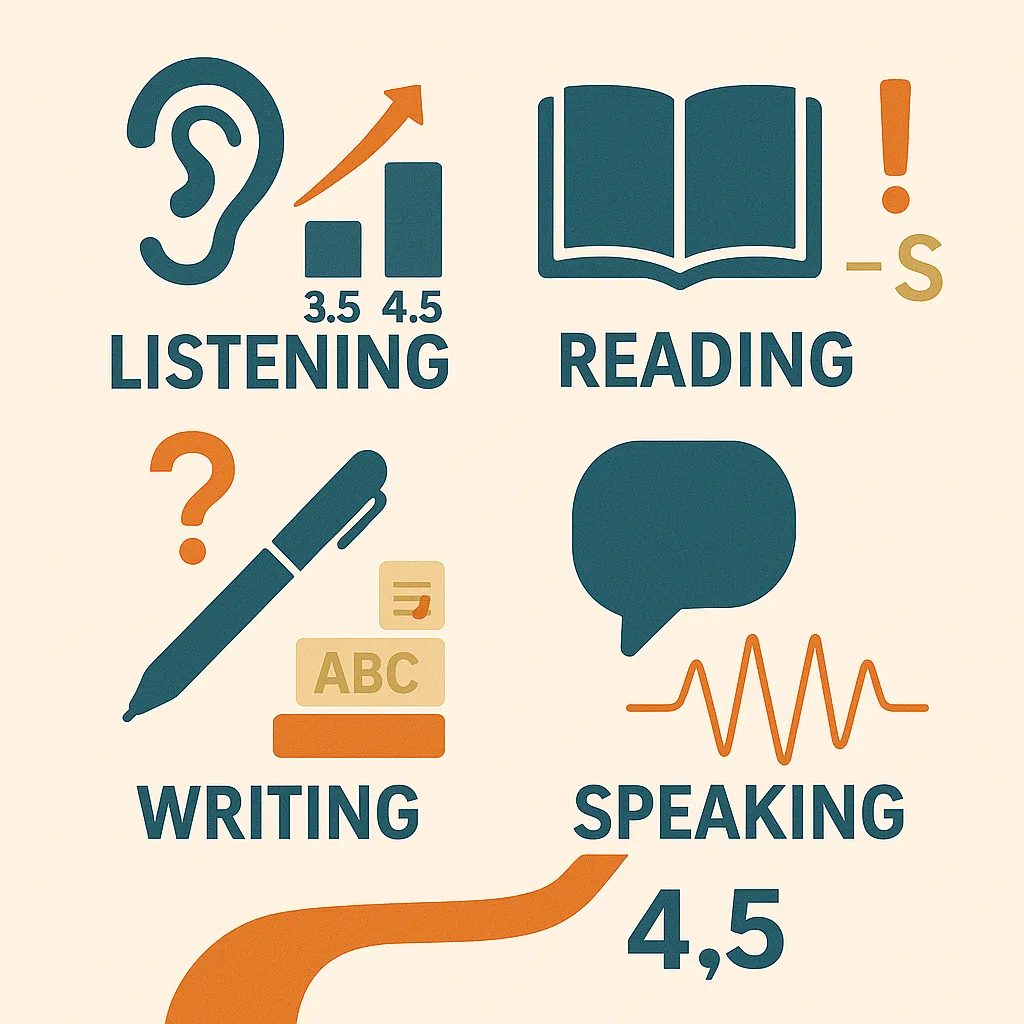
- Listening: You need to answer about 13 – 15/40 questions correctly. At this level, you can listen and understand the main idea and some specific details in talks about familiar topics, though you may sometimes need to hear things repeated.
- Reading:
- Academic: You need to answer about 13 – 15/40 questions correctly.
- General Training: You need to answer about 19 – 22/40 questions correctly. At band 4.5 Reading, you can understand the main ideas and key information in relatively simple texts, use skimming/scanning techniques, and are familiar with common question types.
- Speaking: Assessed based on 4 criteria (Fluency & Coherence, Lexical Resource, Grammatical Range & Accuracy, Pronunciation). To achieve a 4.5 in Speaking (averaging 4.5 across criteria, e.g., 5.0 for two and 4.0 for the other two):
- Fluency & Coherence: You can give relatively coherent answers on familiar topics, but you may hesitate, repeat words/ideas, or self-correct. You use simple connectors but lack variety.
- Lexical Resource: You have enough vocabulary for familiar topics and attempt to express ideas on unfamiliar ones, but with limited flexibility. You rarely paraphrase successfully.
- Grammatical Range & Accuracy: You use mostly simple sentences with few complex structures (subordinate clauses). You still make many basic grammatical errors that can cause confusion.
- Pronunciation: Your pronunciation still contains errors that may confuse the listener, despite attempts to control basic intonation.
- Writing: Assessed based on 4 criteria (Task Achievement/Response, Coherence & Cohesion, Lexical Resource, Grammatical Range & Accuracy). To achieve a 4.5 in Writing (averaging 4.5 across criteria, e.g., 5.0 for two and 4.0 for the other two):
- Task Achievement/Response: You attempt to complete the task but not fully; you may miss main points or confuse main and supporting ideas. Your position is not always clear.
- Coherence & Cohesion: Information is not entirely logical, and overall cohesion is lacking. You use simple connectors but may repeat them or use them incorrectly. Referencing is missing or misused.
- Lexical Resource: You have basic vocabulary, but you repeat words, use them in the wrong context, or make spelling errors that hinder readability.
- Grammatical Range & Accuracy: You use mostly simple sentence structures with few complex ones. You make many basic grammatical errors that impede comprehension.
6. Common Challenges When Aiming for Band 4.5
To reach 4.5 (improving from 4.0 or lower), learners often face the following challenges:
- Unstable Grammar: While you know simple structures, using them accurately and flexibly, or combining them into slightly more complex sentences, remains a challenge.
- Limited Vocabulary and Usage: You know words for familiar topics but struggle to expand, use words in the wrong context, or don’t know how to paraphrase effectively.
- Lack of Coherence and Cohesion: Difficulty in organizing ideas logically in speaking or writing, and using connectors unnaturally.
- Pronunciation Influenced by Native Language: Even if you know the sounds, failing to master linking sounds and intonation makes your speech sound unnatural and sometimes hard to understand.
- Lack of Test-Taking Techniques: Even if you are familiar with the test, applying skimming/scanning techniques under time pressure, identifying traps in Listening, or developing ideas for Writing/Speaking still requires more practice.
7. Roadmap & Effective Tips for Reaching IELTS 4.5
To conquer band 4.5, you need a structured study plan and discipline. Here are some effective preparation tips:
- Assessment & Detailed Planning: Start with a proficiency test to identify your strengths/weaknesses and build a study roadmap (about 6 months – 1 year from zero, or 3 – 5 months if you have a foundation) with specific goals for each stage (e.g., Stage 1: Basic Foundation -> Stage 2: Deep familiarity and skill practice by question type).
- Strengthening the Foundation is Top Priority:
- Grammar: Master and use basic tenses accurately. Learn how to use compound sentences and simple relative clauses. Practice writing accurate sentences.
- Vocabulary: Expand your vocabulary across more common academic and social topics (education, health, environment…). Learn common collocations.
- Pronunciation: Continue practicing standard sounds, paying attention to word and sentence stress. Listen frequently to mimic natural intonation.
- Targeted Skill Practice:
- Listening/Reading: Continue getting familiar with and practicing question types from real tests. Focus on identifying main ideas, key details, and effectively applying skimming/scanning techniques. Gradually try longer and more difficult listening/reading passages. Focus on reviewing your work, analyzing transcripts (Listening), and explaining answers (Reading).
- Writing: Start by writing grammatically correct sentences. Focus on the structure of Task 1 (describing simple trends/data) and Task 2 (presenting simple opinions/views, with an introduction, body, and conclusion). Practice linking sentences/paragraphs with basic connectors. Prioritize accuracy and clarity.
- Speaking: Practice answering Part 1 and Part 2 questions more completely. Try to extend your answers in simple ways (adding examples, explanations). Try to speak continuously, avoiding long hesitations. Practice clear pronunciation. Practice regularly with friends or record yourself to listen back.
- Use Appropriate Materials: Choose study books for B1/Pre-intermediate/Intermediate levels (e.g., Destination B1/B2, Cambridge IELTS books 1-6 if available, or suitable Get Ready/Mindset/Complete IELTS levels). Take advantage of reputable free online resources.
- Practice Regularly & Get Feedback: Dedicate time to study every day. Frequently take small tests to check your progress. If possible, ask an experienced person to correct your Writing or listen to your Speaking to get feedback and improve.
Conclusion
IELTS 4.5 is an important foundational band score, reflecting English proficiency at a basic intermediate level, slightly better than 4.0. While not sufficient for advanced academic or professional goals, band 4.5 offers practical benefits such as high school graduation exam exemption, increased university admission opportunities, and especially meeting English proficiency requirements at many universities. Achieving a 4.5 is a feasible goal if you have a clear study plan, persistently build your foundation in grammar, vocabulary, and pronunciation, and practice your skills with purpose. This is a solid stepping stone for you to continue your journey toward conquering higher band scores in the future.





 Khai giảng Khóa học Hè cực HOT.
Chưa có bình luận nào!