
Tóm Tắt Nội Dung Bài Viết
In academic writing and international language proficiency exams, the difference between an “average” essay and an “excellent” one rarely lies in overly sophisticated vocabulary; rather, it lies in the logic and structure of your ideas.
If the topic sentence is the “backbone,” then the supporting sentences are the “flesh and blood” that give your paragraph its shape and vitality. This ECE guide provides a comprehensive toolkit to help you build paragraphs that are cohesive, logical, and undeniably persuasive.
What are Supporting Sentences?
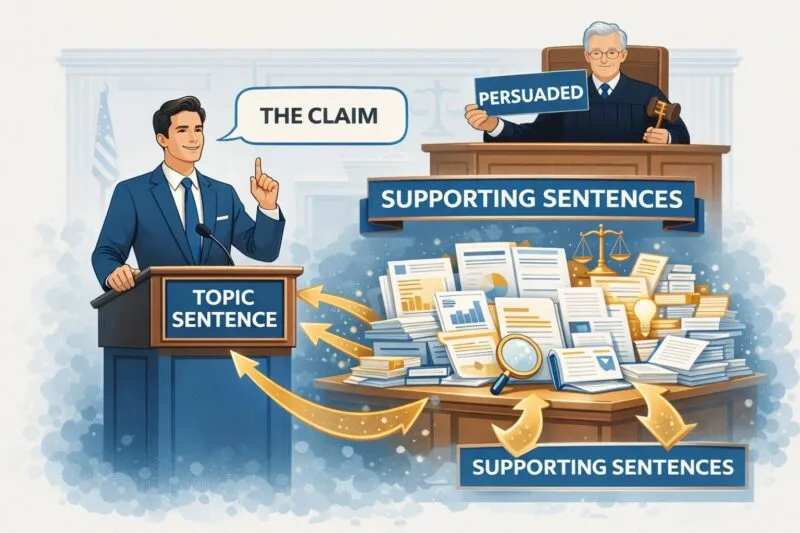
Supporting sentences are the sentences within the body of a paragraph that follow the topic sentence. Their sole purpose is to explain, prove, describe, or expand upon the main idea introduced in the topic sentence.
To visualize this, think like a lawyer in a courtroom:
-
Topic Sentence: The opening statement (“My client is innocent.”).
-
Supporting Sentences: The evidence, witnesses, and arguments (“Because he has an alibi for 8:00 PM…”).
-
Without supporting sentences, the opening statement is completely worthless.
Quick Comparison: Topic Sentence vs. Supporting Sentence
| Criteria | Topic Sentence | Supporting Sentence |
| Position | Usually at the beginning of the paragraph. | Follows the topic sentence (body). |
| Function | States the argument/claim. | Answers: Why? How? What specifically? |
| Nature | General. | Specific and detailed. |
The Secret to Depth in Writing
A common mistake is “jumping” from the main idea to an example too quickly, or writing disjointed sentences that lack a clear hierarchy. To fix this, apply the “Layering” mindset:
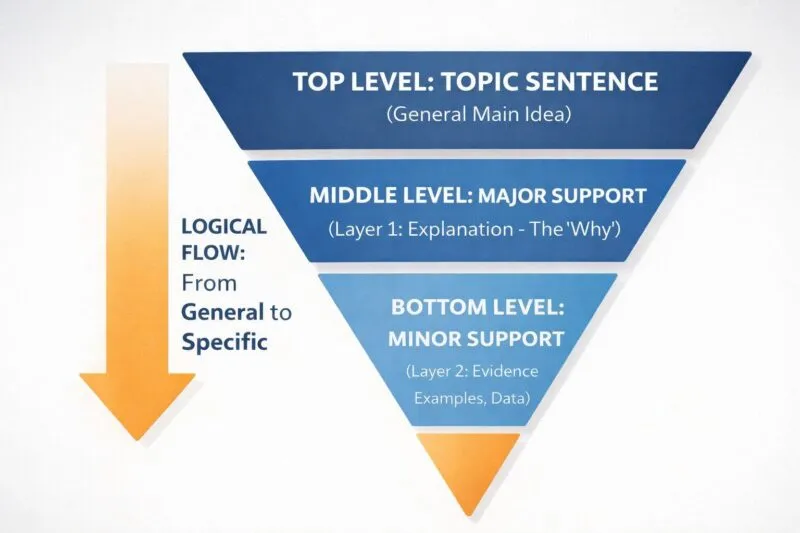
Layer 1: Major Supporting Sentences (Core Explanation)
-
Role: Directly explains why the topic sentence is true.
-
Nature: Still general; does not dive into trivial details yet.
-
Indicators: Often starts with connectors like Firstly, The main reason is, To be specific…
Layer 2: Minor Supporting Sentences (Practical Proof)
-
Role: Provides “evidence” to support the Major sentence above. This is where you introduce concrete data.
-
Tools: Examples, statistics, research, or hypothetical scenarios.
-
Indicators: For example, For instance, According to a study, This is illustrated by…
Example of layering:
(Topic) Remote work offers significant benefits for mental health.
- (Major – Layer 1) The primary reason is that it eliminates the unnecessary stress associated with daily commuting.
(Minor – Layer 2) Specifically, instead of spending two hours stuck in traffic and smog every morning, employees can use that time for meditation or exercise.
The Formula for a Complete Supporting Sentence
To ensure your supporting sentences stay on track, use this two-part formula:
-
Topic Reference: You must refer back to the subject mentioned in the previous sentence, using paraphrasing or pronouns to maintain flow.
-
Controlling Idea: Present the specific reason, benefit, or impact you wish to analyze.
Example analysis:
-
Topic: Online Learning.
-
Supporting Sentence:
-
(Topic Reference): This digital educational approach…
-
(Controlling Idea): …allows learners to access a global repository of knowledge without geographical limitations.
-
-> Complete sentence: “This digital educational approach allows learners to access a global repository of knowledge without geographical limitations.”
-
Standard Idea Development Process (P.E.E.L Model)
The P.E.E.L model is a framework that helps you organize your supporting sentences in the most logical order:
1. P – Point: The topic sentence stating the main idea.
2. E – Explanation (Major Support): Why is the point true? (Use reasoning).
3. E – Evidence/Example (Minor Support): Examples, statistics, or facts.
4. L – Link: A brief conclusion that reaffirms the point or transitions to the next idea.
Advanced Sentence Patterns for Idea Development
Instead of monotonous sentences, use these 7 groups of patterns to express logical relationships in a professional, academic style:
Group 1: Cause & Effect
Used to explain the reasons or consequences of an issue.
-
Structure: Subject + acts as a catalyst for + Noun.
-
Structure: This serves to + Verb.
-
Structure: Subject + facilitates + Noun.
Group 2: Function & Role
Used to emphasize importance.
-
Structure: Subject + plays a pivotal role in + V-ing/Noun.
-
Structure: Subject + equips [someone] with + [something].
Group 3: Illustration & Evidence
Used when providing Minor Support.
-
Structure: A salient example of this is…
-
Structure: This is exemplified by the fact that…
-
Structure: There is a direct correlation between A and B.
Group 4: Hypothetical
Used when you lack a specific example and want to paint a scenario to be persuasive.
-
Structure: If this were implemented, it would lead to…
-
Structure: Without [X], [Y] would likely struggle to…
Three Mistakes to Avoid When Writing Supporting Sentences
To avoid losing points unnecessarily, check if you are making these common reasoning errors:
Error 1: Circular Reasoning
-
Sign: Using different words to restate the topic sentence without providing a new reason.
-
Incorrect example: “Exercise is important (Topic). The reason is that it provides many essential benefits (Support).” -> (Important = Essential benefits -> No real explanation provided).
-
Correction: “Exercise is important because it helps improve the circulatory system and reduces the risk of cardiovascular disease.”
Error 2: Irrelevance – Violating Unity
-
Sign: The supporting sentence is well-written but does not directly serve the topic sentence.
-
Incorrect example: Writing about “Health benefits of jogging,” but inserting: “Running shoes today have very fashionable designs.” -> (This belongs to fashion/economics, not health).
Error 3: Listing without depth
-
Sign: Using too many connectors like Firstly, Secondly, Thirdly, but only writing one superficial sentence for each point before moving on.
-
Advice: “Less is More.” It is better to write two main points that are analyzed in depth (with sufficient Major/Minor support) than five points that are all shallow.
Writing supporting sentences is an art of organizing thought. A successful paragraph guides the reader smoothly from the first sentence to the last, clearly explaining why an issue occurs and building trust through authentic evidence. Start applying the Layering mindset and the PEEL model today to elevate your writing.





 Khai giảng Khóa học Hè cực HOT.
Chưa có bình luận nào!