


Tóm Tắt Nội Dung Bài Viết
In IELTS Reading tests, topics like Palaeontology and Computer Simulation are as fascinating as they are challenging. The passage about Peter Falkingham and the use of computers to reconstruct dinosaur movement is a prime example, blending biological and technological vocabulary.
This article from ECE Language Center provides the full reading passage, a bilingual translation, a list of high-scoring vocabulary, and a detailed breakdown of the answers for every question.
Reading Passage & Questions
Reading Passage: Walking with Dinosaurs (Reconstructed)
Paragraph A The media image of palaeontologists who study prehistoric life is often of field workers camped in the desert in the hot sun, carefully picking away at the rock surrounding a large dinosaur bone. But Peter Falkingham has done little of that for a while now. Instead, he devotes himself to his computer. Not because he has become inundated with paperwork, but because he is a new kind of palaeontologist: a computational palaeontologist.
Paragraph B What few people may consider is that uncovering a skeleton, or discovering a new species, is where the research begins, not where it ends. What we really want to understand is how the extinct animals and plants behaved in their natural habitats. Drs Bill Sellers and Phil Manning from the University of Manchester use a ‘genetic algorithm’ – a kind of computer code that can change itself and ‘evolve’ – to explore how extinct animals like dinosaurs, and our own early ancestors, walked and stalked.
Paragraph C The fossilized bones of a complete dinosaur skeleton can tell scientists a lot about the animal, but they do not make up the complete picture and the computer can try to fill the gap. The computer model is given a digitized skeleton, and the locations of known muscles. The model then randomly activates the muscles. This, perhaps unsurprisingly, results almost without fail in the animal falling on its face. So the computer alters the activation pattern and tries again … usually to similar effect. The modeled dinosaurs quickly ‘evolve’. If there is any improvement, the computer discards the old pattern and adopts the new one as the base for alteration. Eventually, the muscle activation pattern evolves a stable way of moving, the best possible solution is reached, and the dinosaur can walk, run, chase or graze. Assuming natural selection evolves the best possible solution too, the modeled animal should be moving in a manner similar to its now-extinct counterpart. And indeed, using the same method for living animals (humans, emu and ostriches) similar top speeds were achieved on the computer as in reality. By comparing their cyberspace results with real measurements of living species, the Manchester team of palaeontologists can be confident in the results computed showing how extinct prehistoric animals such as dinosaurs moved.
Paragraph D The Manchester University team have used the computer simulations to produce a model of a giant meat-eating dinosaur. It is called an Acrocanthosaurus which literally means ‘high spined lizard’ because of the spines which run along its backbone. It is not really known why they are there but scientists have speculated they could have supported a hump that stored fat and water reserves. There are also those who believe that the spines acted as a support for a sail. Of these, one half think it was used as a display and could be flushed with blood and the other half think it was used as a temperature-regulating device. It may have been a mixture of the two. The skull seems out of proportion with its thick, heavy body because it is so narrow and the jaws are delicate and fine. The feet are also worthy of note as they look surprisingly small in contrast to the animal as a whole. It has a deep broad tail and powerful leg muscles to aid locomotion. It walked on its back legs and its front legs were much shorter with powerful claws.
Paragraph E Falkingham himself is investigating fossilized tracks, or footprints, using computer simulations to help analyze how extinct animals moved. Modern-day trackers who study the habitats of wild animals can tell you what animal made a track, whether that animal was walking or running, sometimes even the sex of the animal. But a fossil track poses a more considerable challenge to interpret in the same way. A crucial consideration is knowing what the environment including the mud, or sediment, upon which the animal walked was like millions of years ago when the track was made. Experiments can answer these questions but the number of variables is staggering. To physically recreate each scenario with a box of mud is extremely time-consuming and difficult to repeat accurately. This is where computer simulation comes in.
Paragraph F Falkingham uses computational techniques to model a volume of mud and control the moisture content, consistency, and other conditions to simulate the mud of prehistoric times. A footprint is then made in the digital mud by a virtual foot. This footprint can be chopped up and viewed from any angle and stress values can be extracted and calculated from inside it. By running hundreds of these simulations simultaneously on supercomputers, Falkingham can start to understand what types of footprint would be expected if an animal moved in a certain way over a given kind of ground. Looking at the variation in the virtual tracks, researchers can make sense of fossil tracks with greater confidence.
Paragraph G The application of computational techniques in palaeontology is becoming more prevalent every year. As computer power continues to increase, the range of problems that can be tackled and questions that can be answered will only expand.
Questions
Questions 1-6: Do the following statements agree with the information given in Reading Passage 1?
In boxes 1-6 on your answer sheet, write
- TRUE if the statement agrees with the information
- FALSE if the statement contradicts the information
- NOT GIVEN If there is no information on this
1. In his study of prehistoric life, Peter Falkingham rarely spends time on outdoor research these days.
2. Several attempts are usually needed before the computer model of a dinosaur used by Sellers and Manning manages to stay upright.
3. When the Sellers and Manning computer model was used for people, it showed them moving faster than they are physically able to.
4. Some palaeontologists have expressed reservations about the conclusions reached by the Manchester team concerning the movement of dinosaurs.
5. An experienced tracker can analyse fossil footprints as easily as those made by live animals.
6. Research carried out into the composition of prehistoric mud has been found to be inaccurate.
Questions 7-9: Label the Diagram Complete the labels on the diagram below.
Choose NO MORE THAN ONE WORD from the passage for each answer. Write your answers in boxes 7-9 on your answer sheet.
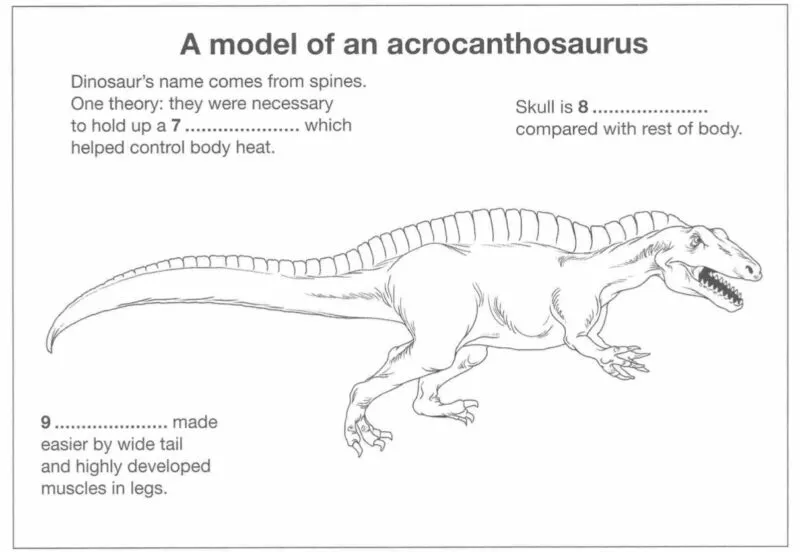
Dinosaur’s name comes from spines. One theory: they were necessary to hold up a 7……….. which helped control body heat.
Skull is 8 ………. compared with the rest of body.
9…………… made easier by wide tail and highly developed muscles in legs.
Questions 10-13: Flow-chart Completion Complete the flow-chart below. Write NO MORE THAN TWO WORDS for each answer.
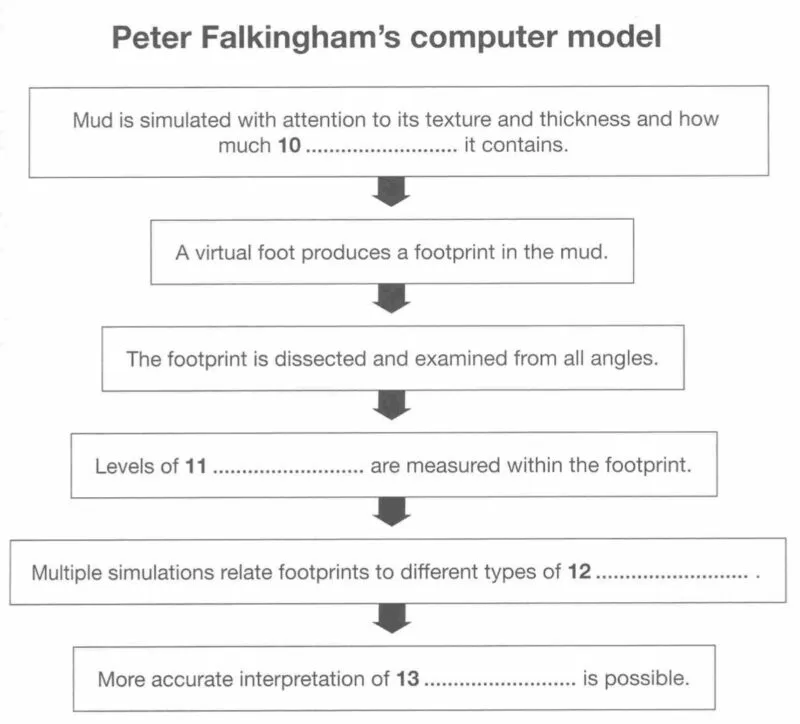
Mud is simulated with attention to its texture and thickness and how much 10………… it contains.
Levels of 11…………….. are measured within the footprint.
Multiple simulations relate footprints to different types of 12………….
More accurate interpretation of 13………….. is possible.
Summary of the Reading Passage
The passage discusses the application of computer technology in palaeontology:
-
Paragraph A: Introduces Peter Falkingham, a “computational palaeontologist” who works primarily on computers rather than in the field.
-
Paragraph B: The research goal is to understand the behavior (walking, hunting) of extinct animals. The University of Manchester team uses “genetic algorithms” to simulate locomotive evolution.
-
Paragraph C: How computers “teach” dinosaurs to walk: continuous trial and error until a stable movement pattern is found. The results were verified against living animals (humans, ostriches) with high accuracy.
-
Paragraph D: Detailed description of the Acrocanthosaurus: its spines may have supported a sail or hump; it had a narrow skull and small feet, but powerful muscles to aid locomotion.
-
Paragraph E: Challenges in analyzing fossil tracks compared to modern ones due to the complexity of prehistoric mud environments.
-
Paragraph F: Falkingham uses computer simulations to create virtual mud and footprints, calculating stress to better understand real fossil tracks.
-
Paragraph G: The promising future of computational techniques in palaeontology.
Key Vocabulary
| Word | Part of Speech | Meaning | Context |
| Palaeontologist | (n) | Palaeontologist | Someone who studies fossils. |
| Simulate / Simulation | (v/n) | Simulate / Simulation | Using computers to model mud and tracks. |
| Locomotion | (n) | Locomotion | Tail and leg muscles aid movement. |
| Sediment | (n) | Sediment | Mud or deposits the animal walked on. |
| Interpret | (v) | Interpret | Fossil tracks are harder to interpret. |
| Staggering | (adj) | Staggering | The number of variables is overwhelming. |
| Consistency | (n) | Consistency | Controlling moisture and mud texture. |
Grammar Structures:
-
Passive Voice: The computer model is given a digitized skeleton…
-
Comparison: …poses a more considerable challenge to interpret…
Answers & Detailed Explanations
1. TRUE
-
Question: Peter Falkingham rarely spends time on outdoor research these days.
-
Location: Paragraph A: “But Peter Falkingham has done little of that for a while now. Instead, he devotes himself to his computer.”
-
Explanation: The text states he has “done little of that” (referring to outdoor work) and “devotes himself to his computer.”
2. TRUE
-
Question: Several attempts are usually needed before the computer model of a dinosaur manages to stay upright.
-
Location: Paragraph C: “This… results almost without fail in the animal falling on its face. So the computer alters… and tries again… usually to similar effect.”
-
Explanation: The computer has to try repeatedly; initially, the model falls, but it eventually “evolves a stable way of moving.”
3. FALSE
-
Question: When the model was used for people, it showed them moving faster than they are physically able to.
-
Location: Paragraph C: “…similar top speeds were achieved on the computer as in reality.”
-
Explanation: The text confirms that the computer speeds and real-life speeds were “similar,” not faster.
4. NOT GIVEN
-
Question: Some palaeontologists have expressed reservations about the conclusions reached by the Manchester team.
-
Explanation: The text only mentions that the Manchester team is “confident” in their results; it does not mention the reactions or doubts of other scientists.
5. FALSE
-
Question: An experienced tracker can analyse fossil footprints as easily as those made by live animals.
-
Location: Paragraph E: “But a fossil track poses a more considerable challenge to interpret in the same way.”
-
Explanation: The text says fossil tracks pose a “more considerable challenge,” meaning they are harder to interpret, not equally easy.
6. NOT GIVEN
-
Question: Research carried out into the composition of prehistoric mud has been found to be inaccurate.
-
Explanation: Paragraph E mentions that physical mud recreation is “difficult to repeat accurately,” but it does not state that previous research was “inaccurate.” It only discusses the difficulty of the manual method.
7. sail
-
Location: Paragraph D: “There are also those who believe that the spines acted as a support for a sail.”
-
Explanation: One theory suggests the spines supported a “sail” that helped regulate body temperature.
8. narrow
-
Location: Paragraph D: “The skull seems out of proportion… because it is so narrow…”
-
Explanation: The skull looks disproportionate because it is very narrow.
9. locomotion
-
Location: Paragraph D: “It has a deep broad tail and powerful leg muscles to aid locomotion.”
-
Explanation: The broad tail and strong leg muscles aid in movement (locomotion).
Question 10: Mud is simulated with attention to its texture and thickness and how much ……………….. it contains.
-
Answer: moisture
-
Location: Paragraph F: “Falkingham uses computational techniques to model a volume of mud and control the moisture content…”
-
Explanation: The phrase “control the moisture content” directly corresponds to “how much moisture it contains.”
Question 11: Levels of ……………….. are measured within the footprint.
-
Answer: stress
-
Location: Paragraph F: “…and stress values can be extracted and calculated from inside it.”
-
Explanation: “Stress values” corresponds to “Levels of stress,” and “extracted and calculated” corresponds to “measured.”
Question 12: Multiple simulations relate footprints to different types of ……………….. .
-
Answer: ground
-
Location: Paragraph F: “…if an animal moved in a certain way over a given kind of ground.”
-
Explanation: “Given kind of ground” is synonymous with “different types of ground.”
Question 13: More accurate interpretation of ……………….. is possible.
-
Answer: fossil tracks
-
Location: Paragraph F: “Looking at the variation in the virtual tracks, researchers can make sense of fossil tracks with greater confidence.”
-
Explanation: “Make sense of… with greater confidence” is equivalent to “more accurate interpretation.”
The passage “Walking with Dinosaurs” is an excellent IELTS practice resource, helping you familiarize yourself with Labeling Diagram and Flow-chart Completion tasks in a scientific context. Mastering vocabulary related to simulation and palaeontology will boost your confidence when encountering similar topics.
We hope this detailed explanation from ECE Language Center helps clarify any questions you had about the “Walking with Dinosaurs (Reconstructed)” passage. Happy studying!




 Khai giảng Khóa học Hè cực HOT.
No comments yet!