


Tóm Tắt Nội Dung Bài Viết
In IELTS Speaking, the topic of getting lost frequently appears under various types of questions, especially in Part 2 and Part 3. This is a common theme, and students can effectively develop their answers by combining several familiar lexical sets, such as directions, maps, navigation, landmarks, asking for help, and dealing with unexpected situations.
In the article below, Ms. Thanh Thuy compiles useful vocabulary and structures, along with sample answers for several IELTS Speaking Part 1, Part 2, and Part 3 questions on this topic.

Useful Vocabulary & Structures for the Topic of Getting Lost
1.1. Vocabulary for Directions and Location
| Word/Phrase | Pronunciation | Vietnamese Meaning |
| get lost | /ɡet lɒst/ | bị lạc |
| lose my way | /luːz maɪ weɪ/ | mất phương hướng |
| be unfamiliar with an area | /biː ʌn.fəˈmɪl.i.ər/ | không quen thuộc với một khu vực |
| find my bearings | /faɪnd maɪ ˈbeə.rɪŋz/ | xác định lại phương hướng |
| get my bearings | /ɡet maɪ ˈbeə.rɪŋz/ | định hướng lại |
| navigate my way around | /ˈnæv.ɪ.ɡeɪt/ | tìm đường di chuyển trong một khu vực |
| follow the directions | /ˈdɪˌrek.ʃənz/ | đi theo chỉ dẫn |
| take a wrong turn | /teɪk ə rɒŋ tɜːn/ | rẽ nhầm đường |
| go in the wrong direction | /ɡəʊ ɪn ðə rɒŋ dɪˈrek.ʃən/ | đi sai hướng |
| lose track of where I am | /luːz træk əv weər aɪ æm/ | không biết mình đang ở đâu |
| have no idea where I am | /hæv nəʊ aɪˈdɪə weər aɪ æm/ | hoàn toàn không biết mình đang ở đâu |
| ask someone for directions | /ɑːsk ˈsʌmwʌn fə dɪˈrek.ʃənz/ | hỏi đường ai đó |
| check a map | /tʃek ə mæp/ | xem bản đồ |
| use a navigation app | /juːz ə ˌnæv.ɪˈɡeɪ.ʃən æp/ | sử dụng ứng dụng chỉ đường |
| use GPS | /juːz ˌdʒiː.piːˈes/ | sử dụng GPS |
| look for a landmark | /lʊk fə ə ˈlænd.mɑːk/ | tìm một địa danh/vật mốc |
| recognisable landmark | /ˈrek.əɡ.naɪ.zə.bəl ˈlænd.mɑːk/ | địa điểm dễ nhận biết |
| a dead end | /ə ded end/ | đường cụt |
| a shortcut | /ə ˈʃɔːt.kʌt/ | đường tắt |
| a roundabout | /ə ˈraʊn.də.baʊt/ | vòng xuyến |
1.2. Natural Collocations
Instead of simply using I got lost, you can incorporate the following collocations to make your responses more natural and varied:
- get completely lost: bị lạc hoàn toàn
- get hopelessly lost: bị lạc đến mức không biết phải làm gì
- lose my sense of direction: mất phương hướng
- struggle to find my way: chật vật tìm đường
- have trouble navigating: gặp khó khăn trong việc định hướng
When describing ways to find your way when lost, you can refer to the following phrases:
- rely heavily on GPS: phụ thuộc nhiều vào GPS
- ask a local for directions: hỏi đường người dân địa phương
- retrace my steps: quay lại theo con đường vừa đi
- find my way back: tìm được đường quay lại
- figure out where I was: xác định được mình đang ở đâu
- recognise a familiar landmark: nhận ra một địa điểm quen thuộc
- end up somewhere unexpected: cuối cùng lại đến một nơi không ngờ tới
1.3. Storytelling Structures for Part 2 on the Topic of Getting Lost
Introduction
It happened when I was…
Chuyện đó xảy ra khi tôi…
I remember it quite clearly because…
Tôi nhớ khá rõ bởi vì…
It was the first time I had ever…
Đó là lần đầu tiên tôi…
Describing the Timing
It wasn’t until I had been walking for about 20 minutes that I realised I was lost.
At first, I thought I was heading in the right direction, but then I realised that nothing looked familiar.
Describing Emotions
I started to feel a little anxious.
I was confused and didn’t know which way to go.
I began to panic slightly, but I tried to stay calm.
Describing the Solution
The first thing I did was…
I decided to… rather than…
Luckily, I managed to…
Eventually, I found my way back by…
Conclusion
Looking back, I realised that…
Since then, I’ve always made sure to…
It taught me that…
Sample Answers for the Topic of Getting Lost in IELTS Speaking
IELTS Speaking Part 1 – Directions & Maps
Question 1: Are you good at following directions?
I’d say I’m fairly good at following directions, especially if they’re clear and straightforward. I usually remember landmarks rather than street names, so I tend to think in terms of places like cafés, shops or major buildings. However, if I’m in an unfamiliar area, I normally rely on GPS just to be on the safe side.
Vocabulary:
- fairly good at
- clear and straightforward
- remember landmarks
- an unfamiliar area
- rely on GPS
- to be on the safe side
Question 2: Do you often use maps?
Yes, quite often. Whenever I visit a new place, I usually check the map beforehand so that I have a rough idea of where everything is. I don’t necessarily memorise the whole route, but I like to know the general direction and identify a few landmarks along the way. It makes me feel more confident when I’m travelling around an unfamiliar area.
Question 3: Can you read a paper map?
Yes, although I wouldn’t say I’m particularly good at it. I can understand the basic symbols and work out the general direction, but I sometimes struggle with complicated maps with lots of roads and intersections. These days, I usually use digital maps because they’re much more convenient and can show me exactly where I am.
Vocabulary:
- paper map
- basic symbols
- work out the direction
- intersections
- digital maps
- show me exactly where I am
Question 4: Have you ever gotten lost?
Yes, a few times, actually. The most memorable occasion was when I was visiting a new city and decided to walk around on my own. I took a wrong turn and ended up in a residential area that I didn’t recognise at all. Luckily, I had my phone with me, so I eventually managed to find my way back.
IELTS Speaking Part 2: Describe an occasion when you got lost and didn’t know where you were.
You should say:
- where you were
- what you were doing
- how you got lost
- and explain how you found your way back
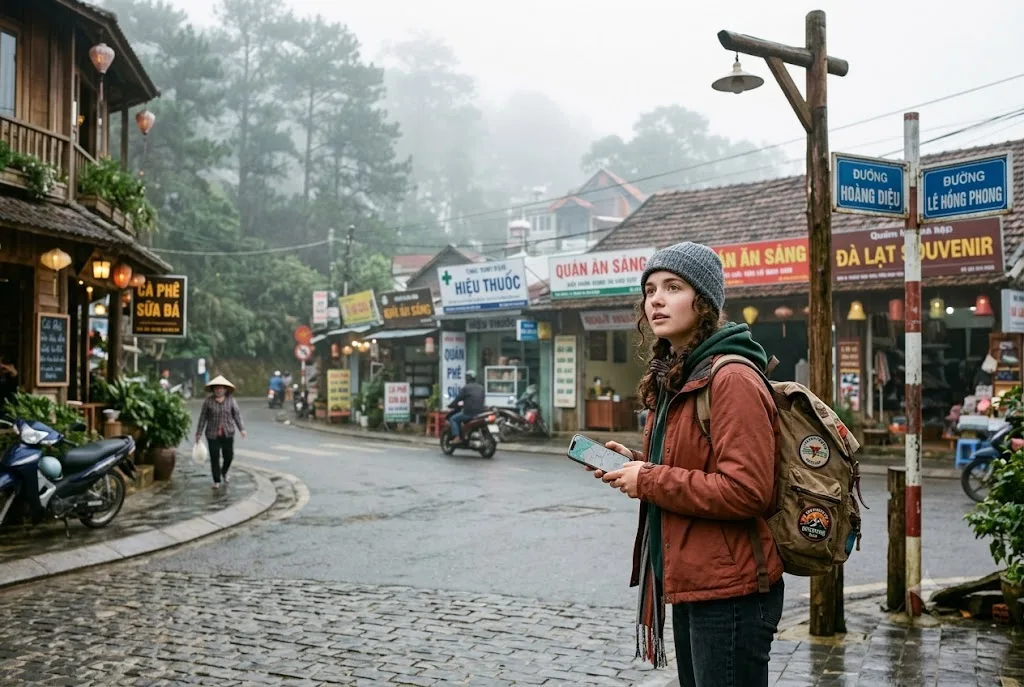
I’d like to talk about an occasion when I got completely lost while I was visiting Da Lat with a couple of friends. It happened about two years ago, when we decided to explore the city on foot instead of taking a taxi.
We had just finished having lunch in the city centre, and I suggested that we take a shortcut to a café that one of my friends had recommended. I was quite confident that I knew the way, so I didn’t bother checking Google Maps. Unfortunately, I took a wrong turn at an intersection, and we ended up walking down a small road that none of us recognised.
At first, I wasn’t too worried because I assumed we’d eventually come across a familiar street. However, after about twenty minutes, I realised that we had completely lost our way. There were very few people around, and I had no idea where we were. To make matters worse, my phone battery was running low, so I couldn’t rely on GPS for very long.
I tried to retrace our steps, but I couldn’t remember exactly which street we’d come from. In the end, we stopped at a small local shop and asked the owner for directions. Fortunately, she was really friendly and pointed us towards a main road. Once we reached the main road, I recognised a nearby landmark, so I was able to figure out where we were and find our way back to the city centre.
Looking back, it was actually quite a funny experience rather than a frightening one. It taught me not to be overconfident when I’m in an unfamiliar place. Since then, I’ve always checked the route before setting off, even if I think I know where I’m going.
Vocabulary:
take a shortcut
take a wrong turn
lose my way
retrace my steps
rely on GPS
ask someone for directions
recognise a landmark
figure out where I was
find my way back
IELTS Speaking Part 3
Question 1: Why do some people have a better sense of direction than others?
I think there are several possible reasons. Some people naturally have a better sense of spatial awareness, so they can remember the relationship between different places quite easily. Others may simply have more experience navigating unfamiliar areas. For example, people who travel frequently may become more comfortable reading maps, recognising landmarks and working out directions.
Vocabulary/Phrases:
- sense of direction
- spatial awareness
- navigate unfamiliar areas
- recognise landmarks
- work out directions
Question 2: Do you think people rely too much on GPS nowadays?
To some extent, yes. GPS is extremely convenient because it can provide real-time directions and help people find places very quickly. However, if someone relies on it all the time, they may not develop their own sense of direction. For instance, some people simply follow the instructions on their phone without paying attention to the surrounding streets or landmarks. So, while GPS is useful, I think people should still develop basic navigation skills.
Question 3: What should people do if they get lost in an unfamiliar place?
The first thing they should do is stay calm rather than panic. They can check their location on a map or use a navigation app if they have access to one. If their phone isn’t working, they could look for a public place, such as a shop, hotel or information centre, and ask someone for help. It’s also a good idea to avoid walking around randomly because that could make the situation even more confusing.
Question 4: Are young people better at using navigation technology than older people?
Generally speaking, younger people may be more familiar with navigation apps because they’ve grown up using smartphones and digital technology. However, that doesn’t necessarily mean they’re better at finding their way. Older people who have travelled extensively may have a stronger sense of direction and may be more comfortable navigating without technology. So I think age is only one factor; experience and familiarity with a place are also important.
Question 5: How can people prepare for unexpected problems when travelling?
I think the key is to prepare for a few basic scenarios in advance. Before travelling, people can save important addresses, download offline maps and make sure their phones are fully charged. It’s also useful to carry some cash and know how to contact local authorities or emergency services if necessary. These simple preparations don’t take much time, but they can make a big difference if something unexpected happens.
Quick Brainstorming Steps for Part 2 on the Topic of Getting Lost
Set the scene
It happened when I was travelling to…
Explain how you got lost – Cause
I took a wrong turn because…
Describe your reaction
At first, I wasn’t too worried, but after a while…
Explain how you solved the problem – Solution
I checked my phone / asked a local / retraced my steps…
Give a reflection – Lesson learned
Looking back, it taught me that…
Students should pay attention to avoiding common word choice and phrasing errors when discussing the topic of getting lost. For example:
- I didn’t know where I was lost. → I didn’t know where I was. / I was completely lost and had no idea where I was.
- I went wrong way. → I went the wrong way. / I went in the wrong direction.
- I lost my direction. → I lost my sense of direction. / I lost my way.
- I asked a person the way. → I asked someone for directions.
- I followed Google Map. → I followed Google Maps. / I used Google Maps to find my way.
Getting lost is a highly applicable topic that integrates multiple related themes, thus requiring candidates to possess a broad vocabulary to handle various question prompts. To achieve a high score, candidates do not necessarily need to use an array of overly academic vocabulary. More importantly, they should know how to combine natural collocations and structure their ideas clearly. In addition, it is essential to understand vocabulary in context to use it naturally.
Above is the vocabulary and sample IELTS Speaking Part 1, 2, and 3 content for the topic of Getting Lost. Ms. Thanh Thuy wishes all students great success in their studies and hopes you achieve your target speaking band score soon!



 Khai giảng Khóa học Hè cực HOT.
No comments yet!