
Tóm Tắt Nội Dung Bài Viết
IMPORTANT UPDATE (Nov 26, 2025): The Ministry of Education and Training has just released a draft of a new Circular to replace Circular 01/2014/TT-BGDĐT. The most significant change is the addition of a Pre-A1 level, bringing the total number of levels to seven.
Note: This draft is expected to take effect on January 1, 2027. Therefore, until the end of 2026, VSTEP exams and certificates will continue to follow the 6-level Foreign Language Proficiency Framework (A1-C2) as outlined below.
Circular 01/2014/TT-BGDĐT was issued by the Vietnamese Ministry of Education and Training on January 24, 2014, and took effect on March 16, 2014. This circular established the 6-level foreign language proficiency framework in Vietnam, applicable to foreign language training programs within the national education system and based on the Common European Framework of Reference for Languages (CEFR).
The Vietnamese foreign language proficiency framework consists of 6 levels, from A1 to C2, corresponding to levels from elementary to advanced. This framework aims to standardize language proficiency requirements across all educational levels and supports the design of curricula, testing, and assessment.
The 6 levels of the Vietnamese foreign language proficiency framework (Current)
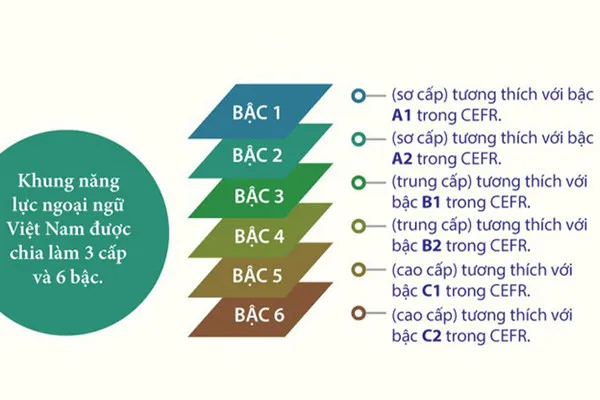
Level 1 (A1 – Elementary): At this level, learners can understand and use simple, everyday phrases to meet basic needs. They can introduce themselves and ask simple questions about personal information, such as where they live, their job, or family members. In conversation, learners can understand others if they speak slowly and clearly and provide assistance.
Level 2 (A2 – High Elementary): At this level, learners can grasp commonly used sentences and phrases related to familiar situations, such as family, shopping, work, and travel. They can exchange information on daily or familiar topics and provide brief descriptions of themselves, their surroundings, and basic aspects of daily life.
Level 3 (B1 – Intermediate): At the B1 level, learners can understand the main points of standard texts and speeches related to work, study, and personal interests. They can handle most communication situations when visiting places where the language is spoken. They are capable of writing short, coherent paragraphs on familiar topics and can describe experiences, events, and dreams, as well as briefly explain personal opinions and plans.
Level 4 (B2 – Upper Intermediate): At the B2 English level, learners can understand the main ideas of complex texts on both concrete and abstract topics, including technical discussions in their field of specialization. They can interact with native speakers with a degree of fluency and spontaneity, and write clear, detailed texts on a wide range of subjects. Additionally, learners can present and explain personal viewpoints, highlighting the pros and cons of various options.
Level 5 (C1 – Advanced): At the C1 level, learners can understand long and difficult texts, including implicit meanings. They can express themselves fluently and spontaneously without much obvious searching for expressions. Using the language effectively for social, academic, and professional purposes, learners can write clear, well-structured, and logical texts on complex topics, using organizational patterns and cohesive devices effectively.
Level 6 (C2 – Proficiency): Finally, at level 6 of the foreign language proficiency framework, learners can understand virtually everything they hear or read, including the most complex content. They have the ability to summarize information from various sources, reconstructing arguments and accounts in a coherent presentation. Learners can express themselves precisely and fluently, demonstrating a subtle grasp of different linguistic nuances in complex situations.
Draft of the new Foreign Language Proficiency Framework (Updated Nov/2025)
On November 26, 2025, the Ministry of Education and Training announced a draft Circular issuing a new Foreign Language Proficiency Framework for Vietnam. Below are the key changes that learners need to be aware of:
Addition of the Pre-A1 Level
Instead of the previous 6 levels (Level 1-6), the new framework will add a Pre-A1 level.
-
Purpose: To cover the entire spectrum of language proficiency, starting from the introductory stage, meeting the needs of foreign language instruction for young learners (preschool and primary school).
-
Significance: This addition aligns with the 2020 CEFR standards and the Prime Minister’s Decision 2371/QĐ-TTg regarding the strategy to make English a second language in schools for the 2025 – 2035 period.
Implementation Timeline
The new draft Circular is expected to officially take effect on January 1, 2027, replacing Circular 01/2014 in its entirety.
Conversion of the 6-level foreign language proficiency framework to IELTS and TOEIC scores
| VSTEP Framework | Proficiency Description | IELTS | TOEIC |
|---|---|---|---|
| Level 1 (A1) | Elementary | 1.0 – 2.5 | 120 – 250 |
| Level 2 (A2) | High Elementary | 3.0 – 3.5 | 255 – 400 |
| Level 3 (B1) | Intermediate | 4.0 – 4.5 | 405 – 600 |
| Level 4 (B2) | Upper Intermediate | 5.5 – 6.0 | 605 – 780 |
| Level 5 (C1) | Advanced | 6.5 – 8.0 | 785 – 940 |
| Level 6 (C2) | Proficiency | 8.5 – 9.0 | 945 – 990 |
Additional Explanation:
- Level 1 (A1) and Level 2 (A2): These levels are suitable for beginners, focusing on basic understanding and communication.
- Level 3 (B1): Intermediate level; learners can understand and use the language in familiar situations, suitable for work or travel.
See more: B1 English Learning Roadmap
- Level 4 (B2): Capable of good communication and flexible language use in work and study.
- Level 5 (C1): Advanced level; capable of using complex language to meet professional and academic needs.
- Level 6 (C2): Proficient; near-native level, with the ability to understand and use the language accurately and fluently.
The essential role of proficiency frameworks
1. Language exit requirements for undergraduate and postgraduate students
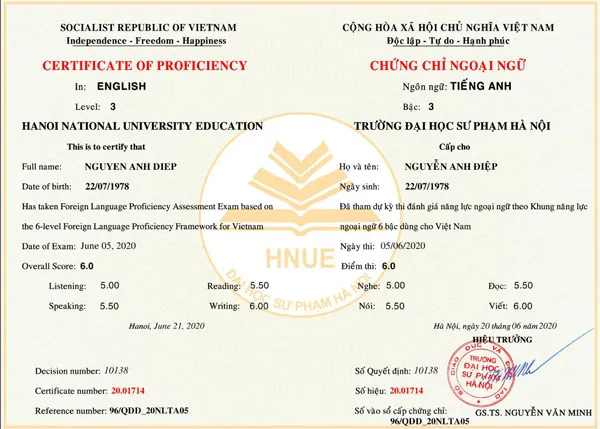
- Description: Many universities and colleges require students to achieve a minimum language proficiency level according to the 6-level framework to graduate. Typically, undergraduate students need to reach B1, while postgraduate programs require B2 or higher.
- Impact: This helps improve the quality of education and encourages students to develop their language skills to meet international integration needs. Universities also regularly organize language proficiency exams to assess student competence.
2. Civil service recruitment and promotion
- Description: In civil service and public employee recruitment exams, many government agencies require candidates to reach a certain level of language proficiency. Specifically, provincial-level civil servants are often required to have B1, while central-level positions may require B2 or C1.
- Impact: This regulation ensures that civil servants have the ability to communicate and handle tasks involving foreign languages, especially in fields such as diplomacy, international cooperation, and foreign project management.
3. Language certificates for English teachers
- Description: English teachers at all levels, especially primary, secondary, and high school, must achieve at least B1 proficiency. Higher requirements may apply to teachers of specialized programs or those at international schools.
- Impact: This ensures that teachers have the necessary competence to instruct and convey knowledge to students, while simultaneously improving the quality of English teaching and learning in schools.
4. Scholarships and international exchange programs
- Description: Students and lecturers participating in scholarship or international exchange programs are usually required to demonstrate a minimum level of language proficiency, typically B2 or C1. This ensures effective learning and communication in an international environment.
- Impact: This requirement helps participants better prepare for integration into new learning environments, enhancing their opportunities for study and personal development.
5. Recruitment requirements in businesses
- Description: Businesses, especially foreign or multinational companies, often prioritize candidates with language certificates based on the 6-level framework, with levels ranging from B1 to C1 depending on job requirements.
- Impact: This not only improves communication in the workplace but also helps businesses expand their markets, foster international cooperation, and improve the quality of their human resources.
The above is basic information regarding the 6-level foreign language proficiency framework in Vietnam, as well as the conversion table between the framework and the IELTS and TOEIC certificates. Thank you for reading!





 Khai giảng Khóa học Hè cực HOT.
Chưa có bình luận nào!