
Tóm Tắt Nội Dung Bài Viết
For US study abroad applications, having a TOEFL or IELTS English proficiency certificate is almost always a mandatory requirement. Many students struggle with deciding which test will give them the best advantage.
This article from the ECE language center provides a detailed comparison of the differences between TOEFL and IELTS based on the latest 2025 updates. Our goal is to provide you with enough data to decide for yourself which test best suits your abilities and study habits.

1. Acceptance of TOEFL and IELTS in the US
The old belief that US schools prioritize TOEFL is no longer accurate.
Today, most colleges and universities in the US accept both TOEFL and IELTS as equivalent. Admissions committees view specific IELTS scores as comparable to TOEFL scores (e.g., an IELTS 7.0 is equivalent to a TOEFL iBT 95).
Practical evidence includes:
- Statistics: More than 3,400 educational institutions in the US officially accept IELTS scores, including all major and most prestigious universities.
- Requirements from top-tier schools:
- Ivy League: All 8 schools (Harvard, Princeton, Yale, etc.) clearly state on their admissions websites that they accept both TOEFL and IELTS without favoring one over the other.
- Stanford University: Admission requirements explicitly state that both TOEFL (minimum 100) and IELTS (minimum 7.0) scores are accepted.
- University of California (UC) System: This entire public university system, including prestigious schools like UC Berkeley and UCLA, accepts IELTS.
Therefore, you should focus on choosing the test that aligns with your personal strengths to maximize your chances of achieving a high score.
2. Overview Comparison of TOEFL and IELTS (2025 Update)
The table below summarizes the fundamental differences and incorporates the latest updates, particularly the significantly shortened TOEFL test duration.
Detailed Comparison by Section
This is the most important part for making your decision, as the structure of each test section varies significantly.
Speaking
- TOEFL: You speak into a microphone and your response is recorded. The structure consists of 4 questions, 3 of which require you to listen to or read a short passage before responding (integrated skills).
- IELTS: You have a face-to-face conversation with an examiner for about 11-14 minutes, consisting of 3 parts: introduction, a topic presentation, and an in-depth discussion.
Which one should you choose?
- TOEFL is better if you prefer time to think, respond according to a set structure, and feel uncomfortable communicating directly with strangers.
- IELTS is better if you are confident in communication, can improvise quickly, and prefer the test to feel like a natural conversation.
Writing
- TOEFL: Taken entirely on a computer.
- Task 1 (Integrated Task): Read a passage, listen to a lecture on the same topic, then write a summary and compare information from both sources.
- Task 2 (Academic Discussion): Write an essay presenting and defending your viewpoint on an academic topic.
- IELTS: You can choose to write by hand or take the test on a computer.
- Task 1: Describe the main information from a provided chart, table, map, or process.
- Task 2: Write an essay on a social issue.
Which one should you choose?
- TOEFL is better if you have strong information synthesis skills and are a fast typist.
- IELTS is better if you are strong at data analysis and describing visual information.
Reading
- TOEFL: All questions are in multiple-choice format.
- IELTS: Question types are very diverse (fill-in-the-blanks, matching headings, True/False/Not Given, multiple-choice, etc.).
Which one should you choose?
- TOEFL is better if you are accustomed to and perform well with multiple-choice questions.
- IELTS is better if you don’t mind handling various question types within the same test.
Listening
- TOEFL: You listen to long conversations or lectures, then answer a series of questions. This requires strong memory and note-taking skills. The accent is primarily North American.
- IELTS: You listen and answer questions simultaneously. Accents are diverse (British, Australian, American, etc.).
Which one should you choose?
- TOEFL is better if you have the ability to focus on long audio and retain information well.
- IELTS is better if you have the ability to process information quickly (listening and answering at the same time) and are familiar with various English accents.
4. Steps to Help You Choose the Right Test
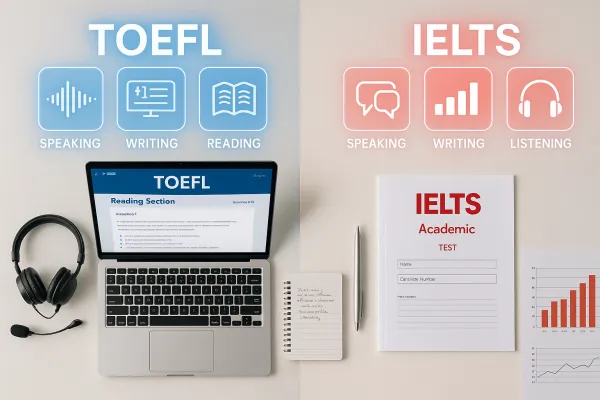
This is a systematic process to help you make a decision based on actual data and self-awareness, rather than just intuition.
Step 1: Research and list requirements for your target schools
This is the most important step and cannot be skipped. Instead of thinking in general terms, pick 3 to 5 universities you truly want to attend and research their requirements thoroughly.
- Where to find information? Visit the school’s official website, look for sections like “Admissions,” then select “International Applicants” or “Application Requirements.” English proficiency requirements will be in this section.
- What information do you need?
- Minimum total score: For example, TOEFL iBT 100 or IELTS 7.0.
- Minimum section scores (very important): Many schools require minimum scores for each skill. For example, the University of Washington might require an overall IELTS of 7.0 but no less than 6.5 in Speaking.
- TOEFL “MyBest Scores” policy: Check if the school accepts the “superscoring” format from multiple TOEFL test dates.
- Practical example:
- New York University (NYU): On their admissions page, NYU clearly states: “We do not have a preference for any particular exam” and requires a minimum of TOEFL iBT 100 or IELTS Academic 7.5.
- University of Michigan – Ann Arbor: Requires TOEFL iBT 100+ (with section scores of 23+) or IELTS 7.0+ (with section scores of 6.5+).
Advice: Create a simple Excel file with columns: School Name, Requirements Link, Minimum TOEFL Score (total/section), Minimum IELTS Score (total/section). This will give you a clear overall picture.
Step 2: Experience it firsthand with a practice test
Reading about the differences is one thing, but experiencing the pressure and structure of the test yourself is another. This will give you the deepest insights.
- Reliable practice test sources: Do not use tests from unknown sources. Use free practice tests from the official organizers:
- TOEFL iBT: ETS Free TOEFL iBT Practice Test
- IELTS Academic: British Council Free IELTS Practice Tests or the IDP website.
You need to simulate a real test environment: choose a quiet space, set a strict timer for each section, and do not take breaks longer than allowed.
After completing both tests, answer these questions instead of just looking at the scores:
-
- Which test made you feel more stressed and exhausted?
- Did you have difficulty focusing on a long lecture before answering questions (TOEFL)?
- Did speaking into a microphone instead of talking to a real person make you feel unnatural?
- Did you manage your time better with multiple-choice questions (TOEFL) or the diverse question types (IELTS)?
Step 3: Self-assess your abilities and personal habits
Based on your experience in Step 2 and the skill analysis in Section 3, complete the following self-assessment checklist:
- Communication Style (Speaking):
- ☐ I prefer having preparation time and responding according to a structure, with less influence from the person opposite me. (Advantage: TOEFL)
- ☐ I communicate naturally, improvise well, and feel more comfortable talking to a real person. (Advantage: IELTS)
- Academic Skills (Writing):
- ☐ I am strong at synthesizing information (reading and listening) to form an opinion. (Advantage: TOEFL)
- ☐ I am good at analyzing charts, data, and visual information. (Advantage: IELTS)
- Test-taking Style (Reading & Listening):
- ☐ I am familiar and perform well with 100% multiple-choice formats. (Advantage: TOEFL)
- ☐ I enjoy the variety of question types and have the ability to process information quickly to answer immediately. (Advantage: IELTS)
Theoretical analysis cannot replace practical experience. If you have read this far and are still hesitant, the most important action you can take right now is to take a full practice test for both TOEFL and IELTS under real testing conditions.
The feeling of time pressure, your comfort with the question types, and the actual results will provide the most accurate answer for you.
In case you still find it difficult to decide, rely on the biggest difference: the Speaking section. Ask yourself: Will you perform better when chatting directly with an examiner (IELTS) or when presenting a structured response into a microphone (TOEFL)? The answer is often the deciding factor.
The right choice isn’t about finding the “easier” test, but finding the test that helps you showcase your abilities in the best way possible. A decision based on practical experience will help you study with confidence and achieve the score needed for your US study abroad application.





 Khai giảng Khóa học Hè cực HOT.
Chưa có bình luận nào!