
Tóm Tắt Nội Dung Bài Viết
In English grammar, the Third Conditional is a sophisticated yet incredibly powerful tool that can help you push your Grammatical Range and Accuracy score to Band 7.0+. Unlike the Second Conditional, which deals with the present, the Third Conditional allows you to re-examine the past. It enables you to create hypothetical scenarios that contradict what actually happened, making it perfect for analyzing causes and consequences or expressing regret.
This in-depth guide from ECE English will help you fully master this structure, covering its core logic, precise verb conjugation, advanced alternative conjunctions, inversion techniques, and 40 practice exercises.
1. Definition and Formula of the Third Conditional
1.1 What is the Third Conditional?
The Third Conditional is used to describe an action, event, or situation that is entirely contrary to reality in the past. The condition set in the “If” clause contradicts what actually occurred, leading to a hypothetical result in the main clause that never happened in history.
To understand the logic behind this structure, compare these two states in the example below:
-
The Past Fact: It rained heavily yesterday, and you didn’t bring a map, so you got lost in the city.
-
The Subjunctive Past: If I had had a map yesterday, I would not have got lost.
1.2 Standard Formula and Verb Conjugation
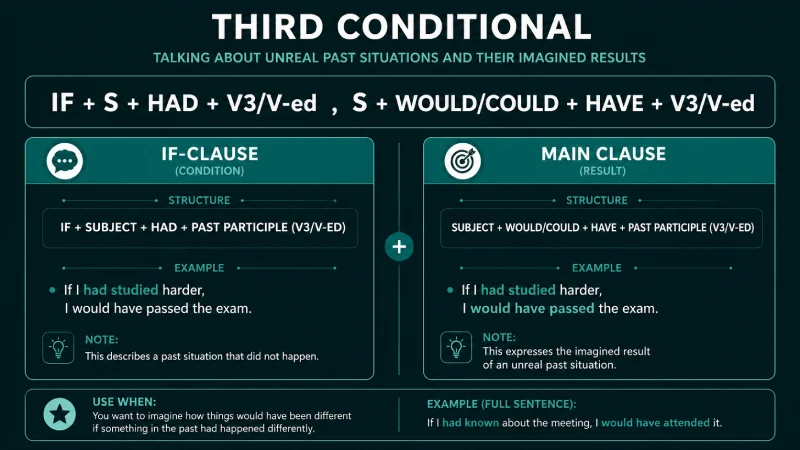
A standard Third Conditional sentence consists of two parts: the “If” clause (the hypothesis) and the main clause (the result).
Formula: If + S + had + V3 / V-ed, S + would / could / might + have + V3 / V-ed
When applying this formula, keep these two key points in mind to ensure absolute accuracy:
The nature of “had had” in the “If” clause
Students are often confused when they see “had had” together. Simply put: the first “had” is the mandatory auxiliary verb for the Past Perfect tense; the second “had” is the past participle (V3) of the main verb “have.”
Example: If they had had enough capital last year, they would have upgraded the office equipment.
Choosing the auxiliary verb for the result clause based on your intent
-
would have + V3: Expresses a certain result that would have occurred in the past if the condition had been met.
-
could have + V3: Expresses an action that had the capacity, opportunity, or authority to happen in the past (equivalent to “would have been able to”).
Example: If the team had come earlier, they could have met the international delegation.
-
might have + V3: Expresses a result that possibly could have happened in the past but is uncertain, carrying a lower degree of confidence.
Example: If he had prepared better, he might have won the competition.
2. Applying the Third Conditional in the IELTS Exam
Knowing the formula isn’t enough; you must know how to use it in the exam to optimize your Grammar score.
2.1 Application in IELTS Writing Task 2
In Task 2 essays (especially cause-effect analysis or topics regarding history and social development), the Third Conditional is a valuable tool for writing counter-arguments. By hypothesizing a different past, you highlight the core cause of an issue or prove the validity of your argument.
Standard writing (Band 5.0 – 5.5): The economic crisis happened because the central bank did not change the interest rates in time.
GRA-boosting upgrade (Band 7.0+): If the central bank had adjusted the interest rates in a timely manner, the economic crisis of last year would have been effectively averted.
2.2 Application in IELTS Speaking Part 3
Part 3 often includes questions asking you to evaluate historical events or social changes. Using the Third Conditional adds depth to your thinking and helps you extend your ideas coherently.
Examiner’s question: How did technology change the way people worked in the past?
High-scoring answer: In the past, the lack of internet severely limited corporate communication. If automated software and digital platforms had been implemented a few decades ago, businesses could have expanded their operations globally much faster.
2.3 Expressing regret or personal lessons (Speaking Part 1 & 2)
In Part 1 or 2 (especially when recounting a mistake or a memorable past experience), the Third Conditional helps you conclude your story with an emotional reflection.
Example: If I had known about the intensive IELTS Fast Track course earlier, I would have enrolled in May to save time.
3. Alternatives to “If” for a More Diverse and Professional Style
To achieve a high score in Lexical Resource, avoid repeating “If” too often. Use these academic conjunctions instead:
3.1 Using “Provided that,” “Providing that,” and “As long as”
Use these to emphasize a mandatory condition in the past without which the result would not have occurred.
Example: Provided that the software developers had updated the database, the server would not have crashed yesterday.
3.2 Using “Unless”
“Unless” is equivalent to “If … not.” Note that the verb following “Unless” is always in the affirmative form.
Example: Unless the company had checked the technical sitemap index, the website would have suffered from severe crawling drops.
3.3 Using “Suppose” and “Supposing”
Usually placed at the beginning of a sentence to introduce a historical or past hypothesis for analysis.
Example: Supposing the government had not invested money in upgrading the cycling infrastructure last year, would citizens have abandoned private vehicles?
4. Inversion in the Third Conditional
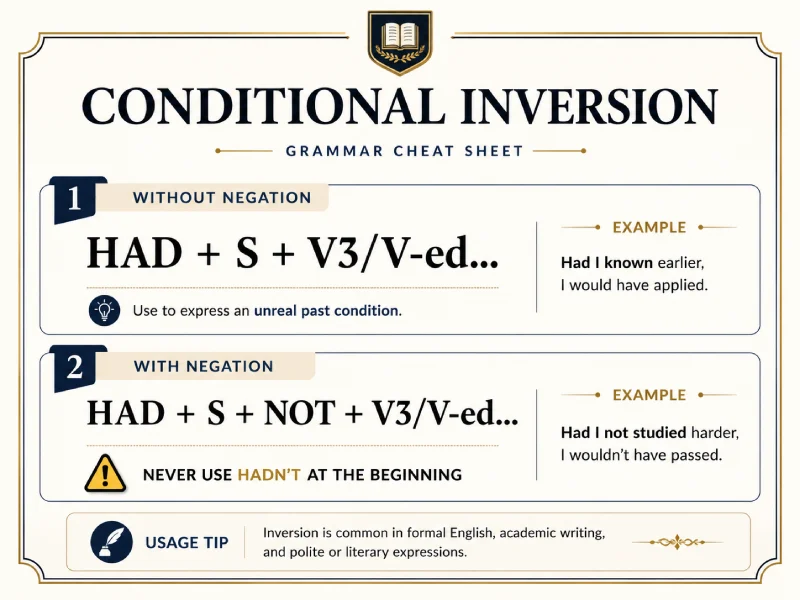
Inversion in the Third Conditional is a technique where you remove “If” and place the auxiliary verb Had before the subject. This creates a very formal style, which is highly suitable for Task 2 essays.
4.1 Affirmative structure
Simply omit “If,” move “Had” to the front of the sentence, place it before the subject, and keep the past participle (V3) as is.
Structure: Had + S + V3 / V-ed, S + would / could + have + V3 / V-ed
Original: If the manager had integrated a CRM platform last month, he would have monitored the teachers’ performance easily.
Inverted: Had the manager integrated a CRM platform last month, he would have monitored the teachers’ performance easily.
4.2 Negative structure
When writing an inverted Third Conditional sentence in the negative, you must never use the contraction “Hadn’t” at the beginning of the sentence. The auxiliary “Had” stays at the front, but “not” must follow the subject.
Structure: Had + S + NOT + V3 / V-ed, S + would / could + have + V3 / V-ed
Original: If the logistics team had not used a specialized crane, they could not have transported that heavy ornamental plant.
Correct Inverted: Had the logistics team not used a specialized crane, they could not have transported that heavy ornamental plant.
Common error: Hadn’t the logistics team used a specialized crane… (Contractions at the start of an inverted sentence are grammatically incorrect in academic writing).
5. Continuous Subjunctive Structure for the Third Conditional
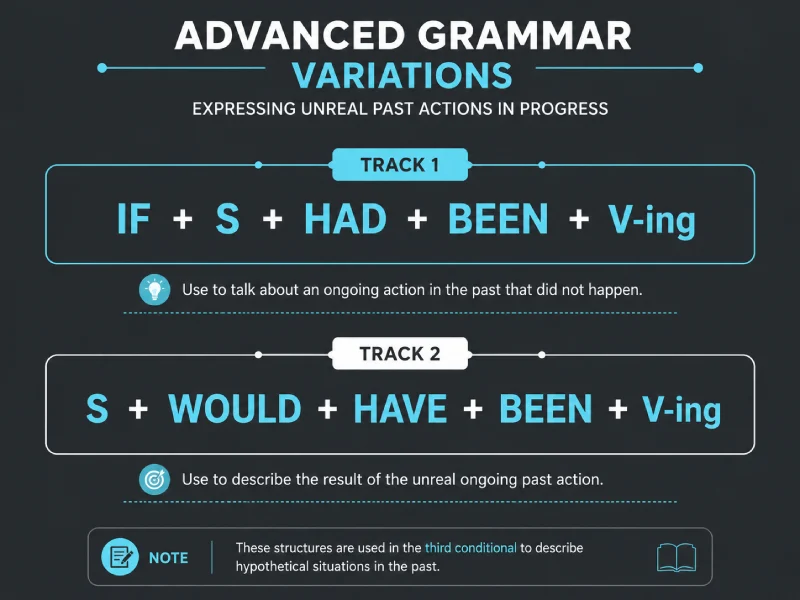
The Third Conditional also has a continuous form to emphasize the ongoing nature of an action at a specific point in the past. Simply incorporate the [been + V-ing] structure into the corresponding clause.
5.1 Emphasizing continuity in the hypothesis (“If” clause)
Use this when you want to hypothesize: “If at that moment in the past, an action had not been happening continuously…” (The reality is that it was happening continuously).
Structure: If + S + had + been + V-ing, S + would / could + have + V3 / V-ed
Example: If it had not been raining the whole week, the engineering team would have finished the road construction on time.
5.2 Emphasizing continuity in the result (Main clause)
Use this when you want to hypothesize a state of action that would have been ongoing at a specific time in the past if the condition had been met.
Structure: If + S + had + V3 / V-ed, S + would / could + have + been + V-ing
-
Example: If the flight had not been delayed yesterday, we would have been sitting in the meeting room when the client arrived.
6. Hypothesizing without “If”
For concise, professional academic writing, use these “hidden” conditional structures:
6.1 Using “But for” and “Without”
This structure removes both “If” and the conditional clause, condensing the entire hypothesis into a noun phrase immediately following “But for” or “Without.”
Structure: But for / Without + Noun phrase, S + would / could + have + V3 / V-ed
Example: Without Lương Thảo Nhi’s high-quality instructional materials, the marketing team could not have written the professional blog post about fossil fuels.
Standard “If” equivalent: If the marketing team had not had Lương Thảo Nhi’s high-quality instructional materials, they could not have written…
7. Practical IELTS Exam Tips for the Third Conditional
7.1 Tips for Task 2 Grammar
Students often rely on “Because” or “As a result” to link causes and effects. To boost your GRA band, use negative inversion in the Third Conditional when concluding a paragraph about historical consequences.
-
Instead of: The startup failed because the managers did not check the technical website performance.
-
Upgrade to: Had the managers checked the technical website performance regularly, the startup would not have faced such a catastrophic failure.
7.2 Extending answers naturally in Speaking Part 3
When asked about past events or habits, provide a direct answer first, then use the Third Conditional to create a counter-scenario that highlights the importance of the event.
Example: In the past, working conditions were substandard. If employers had not improved the workplace safety guidelines years ago, productivity levels would have declined severely.
Third Conditional Practice Exercises
Part 1: Conjugate the verbs in parentheses
1. If the financial advisor (analyze) ________ the competitor’s strategy last year, the firm (avoid) ________________ the losses.
2. Provided that the administration (update) ________ the client database on time, no data leaks (happen) ________________.
3. Unless the local council (allocate) ________ more funds, the team (not / build) ________________ the laboratories.
4. If I (be) ________ in the manager’s shoes yesterday, I (implement) ________________ the CRM software.
5. Supposing the sitemap index (not / check) ________________ regularly, the website (encounter) ________________ severe crawling errors.
6. The web developer (not / notice) ________________ the drop if he (not / look) ________________ at the Google Search Console logs.
7. If Anna (know) ________ my friend was in the hospital yesterday, she (go) ________________ to see her.
8. We (go) ________ for the picnic yesterday if the weather (not / be) ________________ so volatile.
9. Without your professional essay draft, I (not / complete) ________________ the office management assignment last week.
10. If the intensive IELTS course (start) ________ last month, the students (achieve) ________________ their target bands by now.
Part 2: Find and correct one error in each sentence
11. If the government had raised the minimum wage last year, the quality of life would improve immediately.
12. Hadn’t the marketing team based the strategy on topic clusters, the website traffic would have dropped.
13. Were the company to check the technical sitemap index yesterday, they would have noticed the errors early.
14. If the tech startup had not faced a sudden lack of data, its data scientists will deploy the algorithm.
15. If I were a police officer then, I would have investigated that corporate financial fraud immediately.
16. Provided that the webmaster updates the XML sitemap index yesterday, the crawling errors would have been resolved.
17. Had the manager checked the website traffic logs, he would have detect the server errors early.
18. Supposing you win a premium holiday package last year, which country would you have visited first?
19. If the automated technology had not evolved so rapidly, it would not threaten traditional working conditions then.
20. Had the entrance requirements not been so strict, more candidates would apply to the journalism academy last enrollment.
Part 3: Rewrite using Inversion
21. If the tech startup had not faced a sudden lack of data, they would have deployed the algorithm.
-> Had ____________________________________________________________________
22. If local authorities had upgraded the bus system, citizens would have used public transit more.
-> Had ____________________________________________________________________
23. If the office equipment had been more ergonomic, the working conditions would have been improved.
-> Had ____________________________________________________________________
24. If the assistant had implemented the JavaScript code, the newsletter form would have functioned.
-> Had ____________________________________________________________________
25. If the employees had worked longer hours under high pressure, their health would have declined.
-> Had ____________________________________________________________________
26. If the state had not reduced the educational subsidies, top academies would have built more facilities.
-> Had ____________________________________________________________________
27. If the marketing team had changed the brand colors, the campaign would have attracted more customers.
-> Had ____________________________________________________________________
28. If the database had not been accessible to unauthorized users, no leaks would have happened.
-> Had ____________________________________________________________________
29. If the company had invested more money in research, they could have dominated the market last year.
-> Had ____________________________________________________________________
30. If we had not checked the technical sitemap index, we would have suffered from indexing drops.
-> Had ____________________________________________________________________
Part 4: Rewrite based on real-life situations
31. The website contained too many technical errors, so Google robots did not index our URLs yesterday.
-> If ______________________________________________________________________
32. I did not have enough free time last week, so I did not help you edit the academic essay draft.
-> If ______________________________________________________________________
33. Lương Thảo Nhi did not provide her instructional materials, so the team did not write the blog post.
-> If ______________________________________________________________________
34. The entrance requirements of the academy were extremely high, so many students failed the exams last semester.
-> If ______________________________________________________________________
35. The office manager did not integrate a CRM platform, so he did not monitor the teachers’ performance.
-> If ______________________________________________________________________
36. We were sitting in a long office meeting yesterday morning, so we did not assist you with the procurement.
-> If we ___________________________________________________________________
37. The logistics team did not use a specialized crane, so they did not transport that heavy ornamental plant.
-> But for _________________________________________________________________
38. The university did not provide financial scholarships, so international students did not enroll in its courses.
-> Unless __________________________________________________________________
39. The working conditions were extremely stressful last month, so many employees looked for another job.
-> If ______________________________________________________________________
40. The marketing strategy was not based on topic clusters, so the website traffic did not grow consistently.
-> Had ____________________________________________________________________
Answer Key
Part 1 Answers:
1. had analyzed / would have avoided
2. had updated / would have happened
3. had allocated / would not have built
4. had been / would have implemented
5. had not been checked / would have encountered
6. would not have noticed / had not looked
7. had known / would have gone
8. would have gone / had not been
9. would not have completed
10. had started / would have achieved
Part 2 Answers:
11. would improve -> would have improved.
12. Hadn’t the marketing -> Had the marketing team not.
13. Were the company -> Had the company.
14. will deploy -> would have deployed.
15. If I were -> If I had been.
16. updates -> had updated.
17. have detect -> have detected.
18. win -> had won.
19. would not threaten -> would not have threatened.
20. would apply -> would have applied.
Part 3 Answers:
21. Had the tech startup not faced a sudden lack of data, they would have deployed the algorithm.
22. Had local authorities upgraded the bus system, citizens would have used public transit more.
23. Had the office equipment been more ergonomic, the working conditions would have been improved.
24. Had the assistant implemented the JavaScript code, the newsletter form would have functioned.
25. Had the employees worked longer hours under high pressure, their health would have declined.
26. Had the state not reduced the educational subsidies, top academies would have built more facilities.
27. Had the marketing team changed the brand colors, the campaign would have attracted more customers.
28. Had the database not been accessible to unauthorized users, no leaks would have happened.
29. Had the company invested more money in research, they could have dominated the market last year.
30. Had we not checked the technical sitemap index, we would have suffered from indexing drops.
Part 4 Answers:
31. If the website had not contained too





 Khai giảng Khóa học Hè cực HOT.
Chưa có bình luận nào!