
Tóm Tắt Nội Dung Bài Viết
Are you looking for a detailed IELTS study roadmap from scratch but don’t know where to start? You might be wondering, “What should I study first?”, “Which grammar and vocabulary should I focus on?”, or “How long will it take to reach my goal?”
Many beginners waste time studying aimlessly without a clear plan. This article from ECE is here to solve all those problems.
We will provide you with a detailed, step-by-step, 4-stage roadmap to take you from zero to a band score of 7.0+, including:
-
What to study: Core grammar, vocabulary, and pronunciation essentials for each stage.
-
How to study: Proven self-study methods and classic resources (Cambridge, Oxford, etc.) recommended by experts.
-
How long to study: Realistic time estimates for each phase.
What should you prepare before studying for IELTS?
Before diving in, these two preparation steps will help you save 50% of your time and effort.
1. Determine your current level
You cannot plan if you don’t know where you stand. Be honest about your current proficiency. Generally, there are two main groups:
-
Group 1: Absolute Beginner (0 – 3.0): Very limited knowledge, weak across all skills. You need to start from Stage 1.
-
Group 2: Foundation (3.5 – 4.5): You have a grasp of basic grammar and some vocabulary but are unfamiliar with the IELTS format. You can start from Stage 2.
Advice from ECE: You should take a Placement Test at a reputable center like ECE. This helps you accurately assess all four skills and receive advice on the most suitable roadmap.
2. Define clear goals and purposes
-
Purpose (Why?): Are you studying IELTS for study abroad (Academic), university admission (Academic), or immigration (General)?
-
Goal (Band score): Do you need a 6.5 or a 7.5? The higher the goal, the more time and effort required.
How long does it take to be ready for the IELTS exam?
The time required to prepare for IELTS depends entirely on the “gap” between your current level and your target score. It is estimated that you need about 200 hours of focused study to increase your band score by 1.0; therefore, a beginner usually needs 6–10 months of preparation to be ready for the exam. However, the “golden” time to register for the official test is when your scores in Mock Tests at ECE remain stable and are 0.5 bands higher than your target for two consecutive weeks. This ensures you have the right mindset and provides a buffer for any unexpected factors on test day.
4-Stage IELTS Preparation Roadmap from 0 to 7.5+
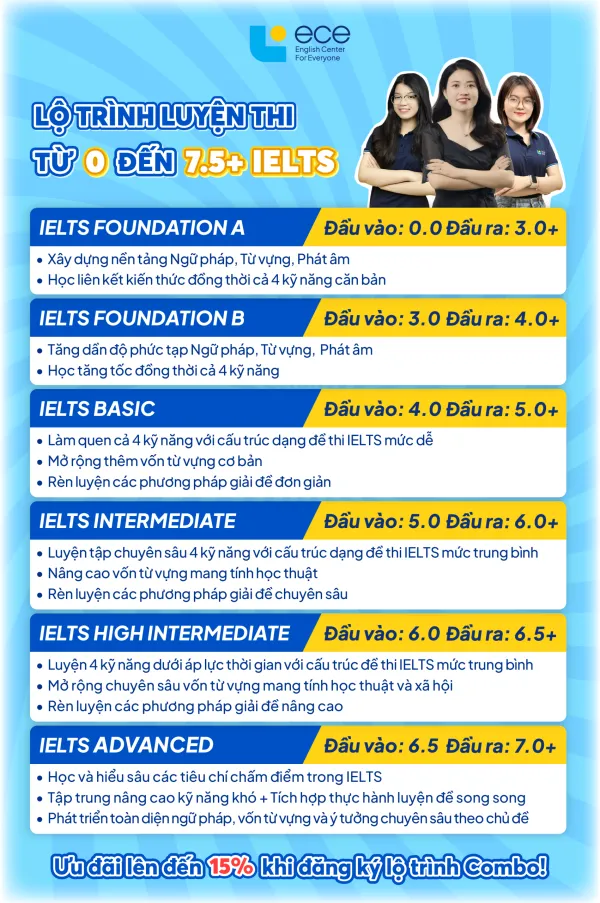
Stage 1: Building a Solid Foundation (Target: 0 – 3.5 IELTS)
This is the “foundation-laying” phase for beginners. Don’t rush into IELTS; focus on basic English first.
-
Estimated time: 2–3 months.
-
Main task: Master the 3 pillars: Pronunciation – Grammar – Basic Vocabulary.
1. Pronunciation:
-
What to study: Memorize the 44 sounds of the International Phonetic Alphabet (IPA). Learn word stress and intonation.
-
How to study: Use the “Shadowing” method (listen and mimic).
-
Recommended resources: Pronunciation in Use (Cambridge), ELSA Speak app.
2. Grammar:
-
What to study: Focus on the most core topics:
-
Basic tenses (Present Simple, Present Continuous, Present Perfect, Past Simple, Future Simple).
-
Parts of speech (Nouns, Verbs, Adjectives, Adverbs).
-
Basic sentence structures (Simple and compound sentences).
-
Passive Voice and basic Relative Clauses.
-
-
Recommended resources: English Grammar in Use (Raymond Murphy), Ngữ pháp tiếng Anh (Mai Lan Hương).
3. Vocabulary:
-
What to study: Learn about 500–1,000 basic words covering familiar topics (People, Home, School, Work, Leisure, Food, etc.).
-
Recommended resources: Oxford Word Skills (Basic), Vocabulary in Use (Elementary).
👉 Acceleration solution from ECE: Self-studying the foundation can be discouraging and prone to errors. To shorten your time and ensure a solid base, consider the IELTS Foundation (IFA) course at ECE.
Duration: 3 months (48 study hours).
Goal: Accurately complete Stage 1 objectives, building a strong foundation in vocabulary, grammar, and pronunciation before starting IELTS.
Stage 2: Approaching IELTS (Target: 3.5 – 5.0 IELTS)
This stage is when you start getting familiar with the IELTS format and basic question types.
-
Estimated time: 3–4 months.
-
Main task: Get to know the 4 skills, learn Skimming/Scanning strategies, and get familiar with Writing Task 1 and Speaking Part 1.
1. Listening & Reading Skills:
-
What to study: Get familiar with easier question types (Form/Table Completion, Sentence Completion, Multiple Choice, Labelling a Map).
-
How to study: Master the two core skills: Skimming (reading for gist) and Scanning (reading for specific information). Practice dictation.
-
Recommended resources: Basic IELTS Listening, Collins – Get Ready for IELTS, Complete IELTS Bands 4-5.
2. Speaking Skill:
-
What to study: Focus on “grinding” Speaking Part 1. Learn to answer using the A.R.E.A formula (Answer – Reason – Example – Alternative) to expand your answers.
-
Recommended resources: Refer to sample questions and answers on reputable websites (ielts-simon.com, ieltsliz.com).
3. Writing Skill:
-
What to study: Focus on Writing Task 1. Learn how to analyze and describe basic chart types (Line, Bar, Pie, Table).
-
Recommended resources: Collins – Writing for IELTS.
👉 Acceleration solution from ECE: This stage requires getting used to many question types. The IELTS Foundation Plus (IFB) and IELTS Basic courses at ECE (totaling about 4–5 months) are designed to help you:
Master all question types across the 4 skills.
Practice Skimming, Scanning, and Paraphrasing skills.
Get comfortable writing complete Writing Task 1 responses.
Stage 3: Breaking Through (Target: 5.0 – 6.5 IELTS)
This is an intensive practice phase, focusing on difficult question types and developing academic vocabulary.
-
Estimated time: 3–4 months.
-
Main task: Master Writing Task 2, Speaking Part 2 & 3, and handle difficult Listening & Reading tasks.
1. Listening & Reading Skills:
-
What to study: Focus on difficult types like Matching Headings, True/False/Not Given (the most “tricky” type), and long listening passages with various accents.
-
How to study: Practice under timed conditions. Analyze mistakes thoroughly after each exercise.
-
Recommended resources: Cambridge Practice Test for IELTS series (from book 10 onwards), Collins – Listening/Reading for IELTS.
2. Speaking Skill:
-
What to study: Intensive practice for Part 2 (2-minute monologue) and Part 3 (discussion questions). Learn to use “less common vocabulary” and idioms naturally.
-
Recommended resources: 31 High-scoring formulas to answer the IELTS speaking (IELTS Fighter).
3. Writing Skill:
-
What to study: Focus on “grinding” Writing Task 2. Master the writing approach for the 5 main essay types (Opinion, Discussion, Problem & Solution, Advantage & Disadvantage, 2-part Question).
-
How to study: Learn how to outline, write topic sentences, and use academic linking words.
-
Recommended resources: Sample essays by former examiner Simon, Write Right book.
👉 Acceleration solution from ECE: This stage requires error correction (especially for Writing and Speaking) from highly qualified teachers. The IELTS Intermediate (Inter) and IELTS Hi-Intermediate (Hi-Inter) courses at ECE (10 weeks each) will help you:
Practice Task 2 essays intensively.
Develop logical thinking and academic vocabulary.
Get detailed feedback on your Writing & Speaking to break through your band score.
Stage 4: Conquering the Goal (Target: 6.5 – 7.5+ IELTS)
The “finish line” phase, focusing on full practice tests, optimizing strategies, and maintaining mental composure.
-
Estimated time: 1–2 months (before the exam).
-
Main task: Continuous practice tests, error analysis, and getting used to exam-room pressure.
1. Practice Tests (Full Test):
-
How to study: Time yourself and complete all 4 skills as if in the real exam. Use the Cambridge IELTS series (from book 15 to the latest) as these are the most authentic tests.
-
Goal: Manage time effectively and maintain focus.
2. Error Analysis:
-
Keep a notebook (or file) to record all mistakes (vocabulary, grammar, pronunciation) and review them daily.
3. Refining Skills:
-
Writing: Improve writing speed, upgrade vocabulary (use collocations, C1-C2 level vocabulary).
-
Speaking: Practice speaking fluently, naturally, and using body language.
👉 Acceleration solution from ECE: This stage requires high-level exposure and advanced test-taking strategies. The IELTS Advanced courses or intensive preparation roadmaps at ECE will help you refine your skills to the highest level, familiarize yourself with complex topics, and optimize your score.
Intensive practice under timed pressure is the key to conquering a 6.5+ band score.
So, in summary, how long does it take to study for IELTS?
As analyzed above, there is no fixed answer. However, based on the 4-stage roadmap, we can estimate the total time as follows (assuming focused study and the right methods):
-
To reach 5.0 IELTS from scratch (0 points): You will need to go through Stage 1 and Stage 2, totaling about 6–7 months.
-
To reach 6.5 IELTS from scratch (0 points): You will need to go through Stages 1, 2, and 3, totaling about 10–12 months.
-
To increase from 5.0 to 6.5 IELTS: You will need to complete Stage 3, totaling about 3–4 months.
Of course, this time depends on key factors:
-
Current English level (The deciding factor): This is the most influential factor. Someone with a 3.0 foundation (starting from Stage 2) will certainly take much less time than a complete beginner (starting from Stage 1).
-
Time invested daily: You cannot expect the same results from someone studying 3–4 hours/week versus someone dedicating 3 hours/day. IELTS is a journey measured by the total number of quality study hours. The more focused time you invest, the shorter your total preparation time will be.
-
Target band score (The higher, the harder): The higher the goal, the longer the preparation. Specifically, the “battle” at higher band scores is fierce. Increasing from 6.0 to 7.0 is much harder and more time-consuming than increasing from 4.0 to 5.0.
-
Study method (The “acceleration” factor): This is the factor that either accelerates or hinders you. Self-studying aimlessly with the wrong method will cost you double or even triple the time without progress. Conversely, a smart study method with a “tailored” roadmap and experienced guidance – like at ECE – will help you optimize every hour of study, avoiding wasted effort on unnecessary tasks.
How to study for IELTS quickly and effectively?
-
Start in the right direction with a personalized roadmap: The biggest waste of time is studying without focus. Check your level carefully and stick to a suitable roadmap. At ECE, you will be carefully assessed to build a “tailored” roadmap, helping you focus on the exact knowledge you need.
-
Apply active learning methods: Instead of passive learning, be actively engaged. Master test-taking strategies (Skimming, Scanning, A.R.E.A…) and apply them. ECE classes always focus on practice and interaction so you understand deeply and remember longer.
-
Utilize quality environments and resources: Don’t study from unreliable sources. Stick to classic materials (Cambridge, Oxford, Collins) and leverage a practice-oriented environment. At ECE, you get access to updated materials and a continuous practice environment with teachers.
-
Maintain discipline and track progress: IELTS is a long journey. A clear roadmap and periodic tests at ECE will help you see your progress, identify weaknesses for timely adjustments, and maintain motivation.
Conclusion
To conquer IELTS, having a detailed roadmap (what to study, how to study) is more important than just asking “how long”. A clear roadmap, combined with standard materials and the right study method, is the key.
If you want to shorten the time spent figuring things out on your own and ensure you’re on the right track from the start, let ECE accompany you.
Don’t hesitate to contact ECE today for a free consultation on your level and to receive a fully personalized study roadmap!



 Khai giảng Khóa học Hè cực HOT.
Chưa có bình luận nào!