
Tóm Tắt Nội Dung Bài Viết
Are you racing against the clock to hit your target IELTS band score? With only one month left until test day, you might be feeling anxious and unsure of where to start. The pressure of deadlines—whether for university admissions, study abroad applications, graduation requirements, or career advancement—can feel overwhelming. However, while one month is an incredibly short and challenging timeframe, with a scientific study plan, smart strategies, and ironclad discipline, you can absolutely break through and achieve your goals.
Before diving into the details, it is crucial to understand that this 1-month intensive IELTS roadmap is not for beginners or those who are just starting to learn English/IELTS. Rebuilding your foundation in grammar, vocabulary, and pronunciation is a long-term process that typically takes anywhere from 3 months to a year, depending on your starting point.
This “express” roadmap is only truly effective for those who already have a relatively solid English foundation—at least an IELTS Overall band of 4.0—and are ready to dedicate the majority of their time and energy to high-intensity preparation. If you meet these criteria and are ready for a challenging yet rewarding journey, let’s explore this detailed guide to making the most of your precious 30 days.
Part 1: Who is the 1-month intensive IELTS roadmap for?

To ensure maximum efficiency and avoid wasting time and effort, it is vital to determine if you are truly suited for this “sprint” approach.
1. A solid English foundation (Minimum 4.0 IELTS Overall)
An intensive roadmap is not a magic wand that takes you from zero to a high band score. This is a phase for optimizing the knowledge and skills you already possess.
- An entry score of 4.0 IELTS Overall generally implies that you have grasped basic grammatical structures, have enough vocabulary for daily communication, and can understand the main ideas in simple texts or conversations.
- If you are at this level, intensive preparation will focus on consolidating, expanding your knowledge, and specifically mastering test-taking strategies to boost your score. You don’t need to rebuild your entire English “house”—you just need to “redecorate” and “touch up” the paint to make it sturdy and ready for the exam.
- Conversely, if you are a complete beginner, trying to reach a high target in one month is impossible. You will need more time to rebuild your vocabulary, grammar, and pronunciation from the ground up.
2. Urgent time constraints
This is the primary reason you are looking for an intensive roadmap. Common goals include:
- University Admissions: Many top-tier universities now require an IELTS certificate for direct admission or credit conversion.
- Study Abroad/Immigration Applications: An IELTS certificate is a mandatory requirement for studying or immigrating to English-speaking countries.
- Graduation Requirements: Some universities require students to achieve a specific IELTS score to graduate.
- Career Requirements: Improving English proficiency to meet job requirements or for promotion. This urgency will be a powerful motivator to maintain a high-intensity study schedule.
3. Willingness to commit to high intensity and ironclad discipline
This is the key factor that determines your success during this 1-month “sprint.”
- Demanding Schedule: You must be prepared to dedicate the majority of your day to IELTS study, potentially up to 6–8 hours or more per day, including class time (if applicable) and self-study.
- Self-Discipline: There is no room for procrastination. Every hour is precious, and you must strictly adhere to your set schedule.
- Resilience under pressure: An intensive roadmap is stressful. You need to be mentally prepared to face a large volume of information, constant exercises, and score pressure. The ability to self-motivate and maintain a positive mindset is crucial. If you meet these three criteria, step confidently into your 1-month IELTS conquest!
Part 2: Detailed 1-month intensive IELTS roadmap by week
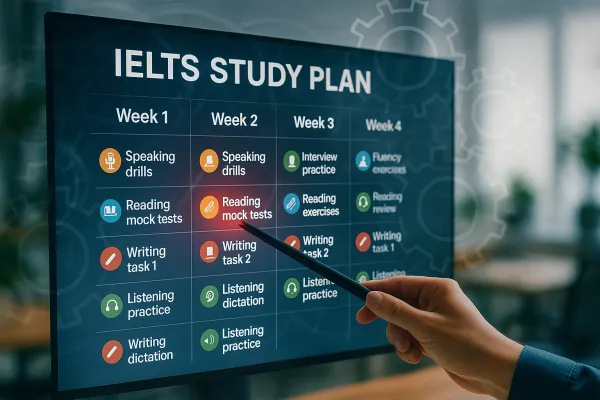
A clear, detailed roadmap broken down by week—and even by day—will help you optimize your time and ensure you don’t miss any critical knowledge or skills.
Week 1: Assessment, Foundation Consolidation & Familiarization
The first week is your “quick start” phase to define the strategy for your entire preparation process.
Goals:
- Clearly understand your current proficiency level.
- Consolidate core grammar and vocabulary.
- Familiarize yourself with the structure and basic question types of all 4 skills.
Detailed Activities:
Days 1–2: Full Mock Test (4 skills)
Materials: Use a complete test from the Cambridge IELTS Practice Tests series (Book 10 or later).
Execution: Take the test under the most realistic conditions possible (strict timing, quiet space, no dictionary).
Result Analysis:
- Listening & Reading: Grade yourself and record the number of correct/incorrect answers. Analyze the mistakes: Was it due to vocabulary, lack of strategy, or simple carelessness?
- Writing & Speaking: Record your Speaking and write full essays. If possible, have a teacher or experienced person grade and provide detailed feedback. If not, compare your work against the official IELTS band descriptors.
Set specific goals: Based on your mock test results, set realistic band score targets for each skill for the next month. For example: Reading from 5.0 to 6.0, Listening from 5.5 to 6.5.
Days 3–7: Consolidating Core Foundation & Question Types
Key Grammar:
Materials: English Grammar in Use (Intermediate/Advanced) or comprehensive IELTS grammar guides.
Content: Focus on structures frequently used and highly valued in IELTS, such as complex tenses (Present Perfect, Past Perfect), conditionals (Type 2, 3), passive voice, relative clauses, complex/compound sentences, and inversion (if aiming for a high band).
Practice: Do related grammar exercises and try to apply them immediately in simple Writing/Speaking sentences.
Topic-based Vocabulary:
Materials: IELTS topic-based vocabulary books (e.g., Vocabulary for IELTS) or compiled vocabulary from old Cambridge tests.
Content: Choose 5–7 of the most common IELTS topics (Education, Environment, Technology, Family, Work, Travel, Health, Art, Crime…). For each, learn academic vocabulary, collocations, idioms, and synonyms.
Effective Learning (No cramming):
- Learn in context: Read articles related to the topic to see how words are used.
- Create examples: Write sentences with new words for deeper retention.
- Use Flashcards: Apps like Quizlet are great for effective review.
- Listen & repeat: Listen to podcasts/videos containing those words and repeat them.
Foundational Pronunciation:
Materials: English Pronunciation in Use or YouTube channels like Rachel’s English, mmmEnglish.
Content: Focus on difficult sounds, ending sounds, and consonant clusters. Pay special attention to intonation and sentence stress. Correct intonation makes your speech natural and easier to understand, while also improving your listening accuracy.
Practice: Record yourself, compare with native speakers, and correct your errors. Practice reading long paragraphs to focus on pronunciation rather than juggling ideas and sounds simultaneously.
Familiarization with Format & Basic Strategies:
Reading: Get familiar with question types like Multiple Choice, Matching Headings, and True/False/Not Given. Practice skimming (reading for main ideas) and scanning (reading for specific information) quickly.
Listening: Get familiar with Gap Filling and Multiple Choice. Focus on listening to medium-speed conversations and practice basic note-taking to avoid missing key information.
Week 2: Accelerating Reading & Listening
This week, the focus shifts to more complex question types and increasing your speed for Listening and Reading.
Goals:
- Master more difficult question types in Reading & Listening.
- Improve speed and accuracy.
- Deeply analyze mistakes to prevent repetition.
Detailed Activities:
Daily: 1–2 Reading and 1–2 Listening tests (from Cambridge IELTS)
Reading:
- Materials: Cambridge IELTS tests 10–15.
- Focus on: Matching Information, Summary Completion, Sentence Completion.
- Advanced strategies: Deepen your Skimming & Scanning skills for long, complex passages.
- Deep error analysis: After each test, don’t just check the answers. Go back to the text/audio to understand why you were wrong.
If wrong due to vocabulary: Note the new word, learn its meaning, collocations, and usage.
If wrong due to misunderstanding the question: Re-analyze the question and keywords.
If wrong due to lack of strategy: Review the tips for that specific question type.
Expert Advice: If you get questions wrong because of vocabulary, it’s hard to improve in just one month. But if you get them wrong because you didn’t analyze the question carefully or missed easy points like Gap Filling, you can absolutely fix that. Focus heavily on never missing Gap Filling questions in both Listening and Reading.
Listening:
- Materials: Cambridge IELTS tests 10–15.
- Focus on: Matching, Plan/Map Labelling, Multiple Choice (Multiple Answers).
- Diverse listening practice: Beyond the books, listen to natural English programs like BBC Learning English, TED Talks, and podcasts (IELTS Podcast, The English We Speak) to get used to various accents and speeds.
- Note-taking skills: Practice quickly noting keywords, numbers, and proper nouns while listening to avoid missing information.
- Error analysis: Re-listen to the parts you got wrong, paying attention to the pronunciation of those words. Double-check spelling when filling in answers.
Week 3: Deep Dive into Writing & Speaking
This week is when you truly “surpass yourself” with the two skills that require thorough preparation in ideas, language, and structure.
Goals:
- Master structure, ideas, and academic language for Writing Task 1 & 2.
- Improve fluency, intonation, and idea development in Speaking.
- Apply “Re-write” and “Re-speak” strategies intensively.
Detailed Activities:
Writing (Write at least one Task 1 or Task 2 essay daily)
Writing Task 1:
- Content: Intensive review of Line, Bar, Pie, and Table charts. Master the essay structure (Overview, Body Paragraphs). Learn and apply phrases for trends, comparisons, and precise data (e.g., a sharp increase, fluctuate wildly, account for, remain stable).
- Advanced types: Spend 1–2 days getting familiar with Process Diagrams and Maps. Focus on language for describing steps/locations.
- “Re-write” strategy: Choose 2–3 Writing Task 1 prompts and write them repeatedly. After each draft, grade yourself, compare with sample essays, and fix grammar, vocabulary, and phrasing until the essay is as good as it can be. Quality over quantity!
- Time management: Practice writing Task 1 in no more than 20 minutes.
Writing Task 2:
- Content: Master the essay structure (Introduction, Body Paragraphs, Conclusion). Practice common types: Opinion (Agree/Disagree), Discussion (Discuss both views), Problem-Solution, Advantages-Disadvantages.
- Idea development: Learn to brainstorm quickly. Every point must have a main argument, explanation, and specific example. Use linking words/cohesive devices for coherence.
- Language: Upgrade your academic vocabulary and use a variety of complex and compound sentences.
- “Re-write” strategy: Choose 2–3 Writing Task 2 prompts and write them repeatedly. Focus on logical argument development, academic language, and sentence variety.
- Time management: Practice writing Task 2 in no more than 40 minutes.
Combining Writing & Speaking Part 3: Speaking Part 3 questions are abstract and require deep reasoning, very similar to brainstorming for Writing Task 2. Use this to train your thinking and idea development for both skills.
Speaking (Practice 1–2 new topics daily)
- Materials: Speaking prediction sets and common IELTS topics.
- Part 1 & 2: Continue practicing, expanding vocabulary and ideas for diverse topics.
- Part 3: This is the band-deciding section. Focus on developing ideas, arguing, providing specific examples, comparing, and contrasting. Learn how to “buy time” when stuck and how to paraphrase to avoid repetition.
- “Re-speak” strategy: Record your entire response, listen back, and correct yourself. Practice speaking the same answer until you achieve fluency, natural intonation, and confidence.
- Pronunciation & Intonation: Continuously improve intonation, sentence stress, and difficult sounds. This makes your speech more engaging and easier for the examiner to follow, while also boosting your Listening score.
- Practice with a partner/teacher: If possible, find a partner to practice Speaking. Dialogue helps improve reflexes and provides direct feedback.
Week 4: Sprint & Mock Exams
The final week is the peak phase, where you focus entirely on simulating the real exam and preparing your mindset.
Goals:
- Fully acclimate to time pressure and the exam room environment.
- Review all knowledge, especially past mistakes.
- Maintain a calm, confident mindset before test day.
Detailed Activities:
- Days 1–5: High-intensity Full Tests & Mock Exams
- Practice tests: Every day or every other day, take 1 full 4-skill test from the latest Cambridge IELTS books (16–19). This helps you get used to the difficulty and updated format.
- Strict time management: Always use a timer and try to finish within the allotted time. This trains your reflexes and ability to handle pressure.
- Mock exam at a reputable center: If possible, register for a mock exam at a reputable IELTS center (like ECE, The IELTS Workshop, IDP, or British Council). Prioritize places with facilities that simulate the real exam room.
- Benefits: Helps you get used to the atmosphere, procedures (registration, check-in, entering the room, using headphones, computer-based interface), reducing anxiety on the official day. You will also get an accurate assessment of your current level.
- Review mistakes: Spend every evening reviewing all mistakes made throughout the month. Focus on recurring errors, weak vocabulary, grammar, or pronunciation.
- Review test-taking tips: Review all strategies learned for each question type (e.g., underlining keywords in Listening/Reading, paraphrasing, time management in Writing, sample structures for Speaking Part 3).
- Days 6–7: Mindset & Final Preparation
- Reduce intensity: Don’t overstudy in the last 1–2 days. Your brain needs time to rest and consolidate knowledge.
- Relax: Do things you enjoy (watch movies, listen to music, take a light walk), but choose English content to maintain exposure.
- Eat & Sleep: Eat nutritious meals and get enough sleep (7–8 hours/day). A clear mind and good physical health will help you perform at your best.
- Final check: Double-check your ID (National ID/Passport), test confirmation slip, pencils, eraser… Ensure you arrive at the test venue on time or early.
Part 3: 5 strategies to accelerate your finish
Beyond a clear roadmap, applying smart strategies is the key to optimizing your study efficiency in this short month.
1. Optimize time with a scientific schedule
In this “sprint” phase, every minute is precious. A detailed schedule will keep you focused, prevent wasted time, and ensure you know exactly what to do at any given moment.
- Break down time: Don’t study one skill for hours on end. Divide your day into specific slots for each skill (e.g., morning for Listening, afternoon for Reading, evening for Writing/Speaking).
- Study during real exam hours: This is a very useful psychological trick. If your Listening test is in the morning, practice Listening tests in the morning. Once your brain is accustomed to processing similar information at the same time of day, your performance on the real test will be optimized.
- Include breaks: Intersperse study sessions with short breaks (5–10 minutes) to let your body relax, helping your brain “organize” knowledge and absorb it better. Don’t cram continuously; it only causes stress and reduces efficiency.
2. “Quality over quantity”: No cramming & apply “Re-write”, “Re-speak”
- No cramming: Trying to memorize hundreds of new words in a short time usually only yields temporary results. You might recognize the word, but you won’t be able to use it flexibly in Writing or Speaking. Instead, focus on:
- Topic-based vocabulary: Choose core IELTS topics and learn academic vocabulary, collocations, and synonyms deeply.
- Learn in context: Read articles and listen to podcasts to understand natural usage.
- Create examples: Write your own sentences to ensure retention and application.
- Apply “Re-write” and “Re-speak”:

-
- For Writing: Instead of writing many low-quality essays, choose a few Task 1 and Task 2 prompts and write them repeatedly. Each time, analyze errors, find better phrasing, and diversify your grammar and vocabulary. The goal is to turn an imperfect draft into your own model essay.
- For Speaking: Similarly, instead of practicing many topics superficially, choose common topics and “Re-speak” your answers until you feel confident, fluent, and accurate. Recording yourself, listening back, and correcting errors is an extremely effective method. This helps you shape your speaking style, improve reflexes, and control your language.
3. Master test-taking strategies & focus on error correction
Practice is important, but practicing correctly is even more important.
- Don’t just check answers: After every Reading or Listening test, spend time thoroughly analyzing your mistakes. Don’t just look at the correct answer. Ask yourself:
- Did I get it wrong because I didn’t know the vocabulary?
- Did I get it wrong because I didn’t know the strategy (e.g., fell for a True/False/Not Given trap)?
- Did I get it wrong because I misread/misheard information?
- Did I get it wrong because of a spelling error (in Gap Filling)?
- Focus on easy-to-score question types: In Listening and Reading, Gap Filling is often a “low-hanging fruit” for points. Ensure you don’t miss these by practicing thoroughly and watching your spelling.
- Strict time management: Practice under real time pressure. Learn to allocate time reasonably for each section; don’t spend too much time on one difficult question, especially in Reading.
4. Prioritize pronunciation and intonation
Pronunciation is the “golden key” to boosting your score in both Speaking and Listening.
- For Speaking: If you have good pronunciation, especially natural intonation, the examiner will easily understand you, even if your vocabulary isn’t overly “academic.” Correct intonation makes your speech fluent and confident, and significantly improves criteria like Lexical Resources and Grammatical Range & Accuracy because the examiner can easily receive your message.
- Practice tip: Instead of trying to “practice speaking” (juggling ideas and pronunciation), “practice reading” existing texts. This helps you focus entirely on pronouncing every sound, word, and sentence correctly, mimicking native intonation. Record and compare with the original audio.
- For Listening: Once you have formed correct pronunciation, your brain will also form reflexes for those words. When listening, you will easily recognize words accurately, even if you don’t know their meaning in a specific context.
5. Use official materials & take mock exams
Materials and the practice environment play a decisive role.
- Official materials: Only focus on textbooks and tests compiled by reputable organizations like Cambridge University Press, British Council, and IDP.
- Practice books: The Cambridge IELTS Practice Tests (10–19) are indispensable.
- General guides: The Official Cambridge Guide to IELTS.
- Skill-specific books: English Grammar in Use, English Pronunciation in Use, English Collocations in Use, Vocabulary for IELTS.
- Online sources: Official websites of the British Council, IDP, or reputable IELTS YouTube channels.
- Avoid materials with unknown origins or those that don’t follow the real exam structure, as they can be distracting and a waste of time.
- Mock exams: This is the final but crucial step. Registering for mock exams at reputable centers or real test venues will help you:
- Get used to the exam atmosphere: Reduce nervousness on the real day.
- Experience the process: Know the procedures (checking documents, receiving headphones, using the computer interface…), helping you feel more confident.
- Accurate assessment: Receive a mock score close to reality, allowing for last-minute adjustments or mental preparation for your expected score.
Conclusion
A 1-month intensive IELTS preparation is a challenging journey that requires determination, smart study strategies, and high-level discipline. It is not a path for everyone, but if you have a solid foundation and are ready to put in your best effort, breaking through your band score in a short time is entirely possible. Turn time pressure into motivation, believe in yourself, and stick to your roadmap.
However, if you are unsure about self-study or need professional guidance, joining an intensive IELTS course at a reputable center is also an optimal choice. With experienced teachers, personalized roadmaps designed scientifically (though ECE’s standard time is 1.5 months, it can be optimized to your goals), and small class sizes, these courses can help you reach your destination more effectively and safely, providing detailed feedback and personalized support throughout your preparation.
Good luck on your journey to conquering IELTS!





 Khai giảng Khóa học Hè cực HOT.
Chưa có bình luận nào!