


Tóm Tắt Nội Dung Bài Viết
Who actually invented the first television? The answer is far from simple, as it was a technological race involving many of the world’s greatest minds. The reading passage “The Invention of Television” takes you from John Logie Baird’s humble experiments with a tea chest to the sophisticated electronic systems developed by Philo Farnsworth. Explore our detailed translation and answer key below to master the vocabulary and strategies needed to “ace” this reading passage!
Reading Passage & Questions
THE INVENTION OF TELEVISION
The question “Who invented television?” is simple enough, but the answer is surprisingly controversial. No one person was responsible for producing what we think of as television today and the credit is due to various inventors.
The Scotsman, John Logie Baird, is considered by many to be the inventor of television. He showed early signs of his inventing ingenuity by setting up a telephone exchange to connect his house to those of his friends nearby. His first interest in television came in 1903, after he read a German book on the photoelectric properties of selenium. In 1873, this element was discovered to have the capacity to generate a current based on the amount of light applied to it. Working initially in Hastings, England, Baird famously created an apparatus using an old hatbox he bought in a used goods store, a pair of scissors, some needles, some bicycle light lenses and an old tea chest. Baird also used a Nipkow disk, created by German inventor, Paul Nipkow, and a lot of his work was based on the previous work by German, Arthur Korn. In February 1924, Baird demonstrated moving silhouette images on a ‘television’. Later that year, after nearly destroying the house and nearly killing himself with an electric shock, Baird moved to London, where he gave the first public display of his invention. On 2 October 1925, Baird used an office assistant, William Taynton, to move for his transmitted pictures, and Taynton became the first person to be televised moving and in full tonal range. Baird is also later credited with demonstrating the first images on colour television, on 3rd July 1928, although the credit for being the inventor of colour television is again disputed. Another first for Baird was transmitting the first television pictures across the Atlantic in 1928. Although Baird was well known for his invention, he also became famous for refusing an offer of £100,000 for the shares in his company, which was an enormous sum at that time. Baird famously said that he would not be able to sleep at night, knowing he had that much money.
Philo Farnsworth successfully demonstrated electronic television in San Francisco, in 1927, using a different system. Farnsworth realised that a picture could be dissected by a simple television camera into a series of lines of electricity. The lines would be transmitted so quickly that the eyes would merge the lines. Then, an image dissector, which Farnsworth created, would change those lines back into a picture. The Russian inventor, Vladimir Zworykin, built on this work and it was Zworykin’s designs that were eventually used by the BBC in the UK to replace Baird’s system.
Baird’s initial work would not have been successful without the previous work of Paul Nipkow. Nipkow came up with the idea of ‘scanning’ a television image by using a spinning disk with a spiral of small pinholes. When spun at a high rate of speed, each hole would allow light to fall on a selenium cell on the other side of the disk. The amount of voltage the cell generated would depend on the amount of light reflected from the object being photographed. One rotation of the disk equalled one frame of “video”. At the place where the signal was received, the process would be reversed. A similar disk spun in sync and a neon lamp reacted to the changes in voltage with the speed required to keep up with the spinning disk and projected the images onto a screen. Although Nipkow created the disk and acquired a patent for his invention, he did not create the apparatus to project images. The patent expired after 15 years, as no one was interested then in the work. Baird’s first practical television systems used an electro-mechanical picture scanning method, the method that Nipkow had helped create with his disk. Nipkow became a celebrated scientist in Germany for his work, but the mechanical nature of the Nipkow Disk caused the invention to fade to obscurity with the use of the cathode ray tube.
Arthur Korn was another German scientist working in the same field as Baird and Nipkow and it was his work that allowed the development of Nipkow’s work that in turn led to Baird’s breakthroughs. Korn’s early work was focused on the transmission of visual telegraphic transmission, using his developments in amplification tube technology. He sent a picture of the German Crown Prince 1800 kilometres in 1906 and sent a picture of the Pope across the Atlantic in 1923. Korn’s work was celebrated and, from 1928, the German police used his technology to send photographs and fingerprints.
Finally, another American, Charles Francis Jenkins, has a claim to be the inventor of television. Jenkins, who at the time was very well known for inventing the motion picture projector, first transmitted a silhouette picture from one room to another in 1922. Jenkins founded a broadcasting company in 1928, but the crash of 1929 forced him out of business. Most people agree that Baird gave his first public demonstration of television a couple years earlier than Jenkins, but this is disputed in some places.
It is plain to see why any claim to be the inventor of television is said to be controversial. In many cases, the answer to the question, “Who invented television?”, often just depends on from which country the person answering the question is.
Questions 1-7: Matching People to Roles
Match the significant people (1-7) to their roles (A-G).
1. John Logie Baird
2. William Taynton
3. Philo Farnsworth
4. Vladimir Zworykin
5. Paul Nipkow
6. Arthur Korn
7. Charles Francis Jenkins
List of Roles:
A. His work was adopted by the BBC for their broadcasting business.
B. His work was used to help fight crime.
C. He was the first person to move on television.
D. He used second hand parts in his invention.
E. His business was destroyed by a financial crisis.
F. He invented the image dissector.
G. His work was initially of no interest to anyone.
Questions 8-10: Label the Diagram
Write NO MORE THAN THREE WORDS from the text for each answer.
Transmitting an Image using a Nipkow Disk
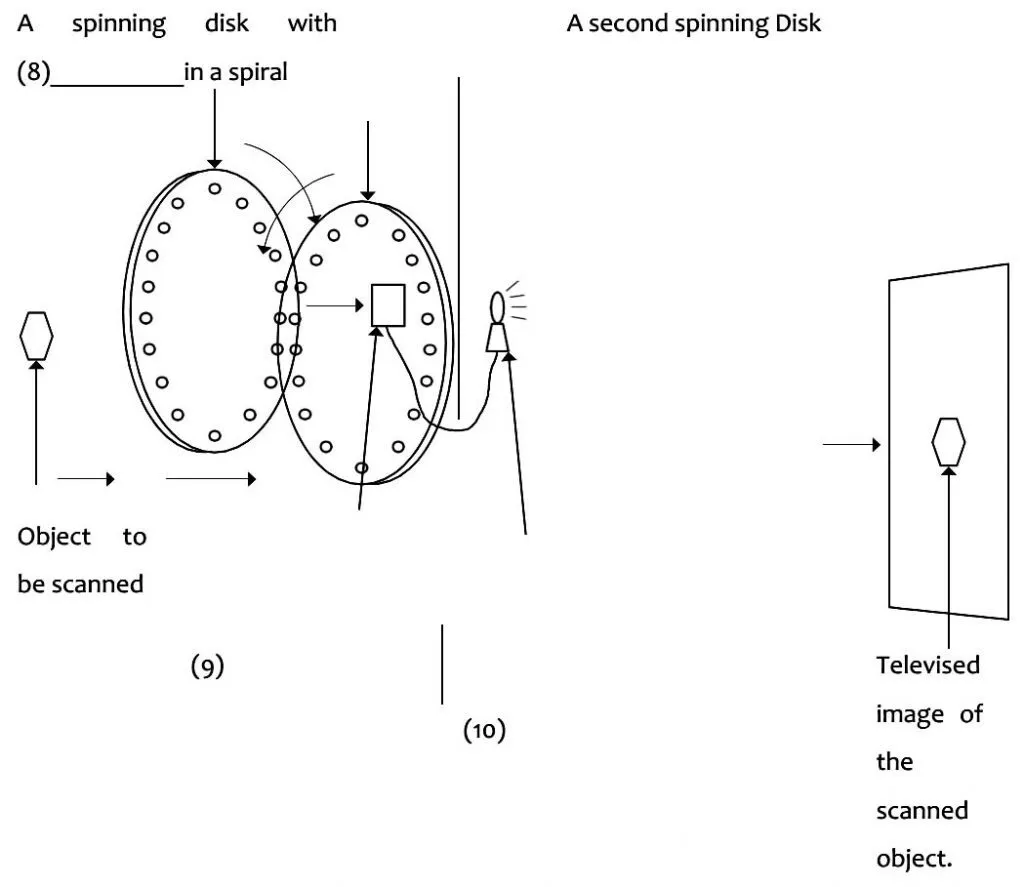
(8) A spinning disk with __________ in a spiral.
(9) Light falls on a __________ on the other side of the disk.
(10) A __________ reacted to the changes in voltage.
Questions 11-13: True/False/Not Given
Do the following statements agree with the information in the text?
11. Nipkow died without any of his work being widely recognized.
12. Korn and Nipkow often met to discuss their work.
13. Charles Francis Jenkins was already famous when he experimented with television.
Detailed Passage Translation
The Invention of Television
The question “Who invented television?” is quite simple, but the answer is surprisingly controversial. No single individual is responsible for creating what we consider television today; the credit belongs to various inventors.
The Scotsman, John Logie Baird, is considered by many to be the inventor of television. He showed early signs of his inventive talent by setting up a telephone exchange to connect his home with those of his nearby friends. His interest in television began in 1903 after reading a German book on the photoelectric properties of selenium. In 1873, this element was discovered to have the capacity to generate a current based on the amount of light applied to it. Initially working in Hastings, England, Baird created a famous apparatus using an old hatbox bought from a second-hand store, a pair of scissors, some needles, bicycle light lenses, and an old tea chest. Baird also used a Nipkow disk, created by German inventor Paul Nipkow, and much of his work was based on the previous research of Arthur Korn. In February 1924, Baird demonstrated moving silhouette images on a “television.” Later that year, after nearly destroying his house and nearly killing himself with an electric shock, Baird moved to London, where he held his first public exhibition. On October 2, 1925, Baird had his assistant, William Taynton, move in front of the lens, and Taynton became the first person to be televised moving in full tonal range. Baird was later credited with demonstrating the first colour television images in 1928, although the title of “inventor of colour television” remains disputed. Another achievement was his transmission of images across the Atlantic in 1928. Despite his fame, he also drew attention for refusing a £100,000 offer for his company shares—an enormous sum at the time—claiming he wouldn’t be able to sleep at night if he had that much money.
Philo Farnsworth successfully demonstrated electronic television in San Francisco in 1927 using a different system. He realized that a picture could be “dissected” by a simple television camera into a series of electrical lines transmitted so quickly that the human eye would naturally merge them. Then, an image dissector he created would convert those lines back into a picture. Russian inventor Vladimir Zworykin built upon this work, and it was Zworykin’s designs that were eventually used by the BBC to replace Baird’s system.
Baird’s work would not have succeeded without the research of Paul Nipkow. Nipkow came up with the idea of “scanning” an image using a spinning disk with small pinholes arranged in a spiral. When spun at high speed, each hole allowed light to fall onto a selenium cell on the other side of the disk. The amount of voltage generated depended on the light reflected from the object. At the receiving end, the process was reversed: a similar disk spun in sync, and a neon lamp reacted to the voltage changes to project the image onto a screen. Although he held a patent, Nipkow did not create a practical projection device. The patent expired after 15 years because no one was interested at the time. However, he later became a celebrated scientist in Germany, even though his mechanical disk was eventually replaced by the cathode ray tube.
Arthur Korn, another German scientist, focused on the transmission of visual telegraphy using amplification tube technology. He sent a picture of the German Crown Prince 1,800 km away in 1906 and transmitted a picture of the Pope across the Atlantic in 1923. From 1928, the German police used his technology to send photographs and criminal fingerprints.
Finally, there is the American Charles Francis Jenkins. Already famous for inventing the motion picture projector, he transmitted a silhouette image from one room to another in 1922. However, the 1929 economic crash forced his company into bankruptcy.
In conclusion, who invented the television depends heavily on which country you ask.
Academic Vocabulary Summary
-
Ingenuity (n): The quality of being clever, original, and inventive.
-
Apparatus (n): A technical piece of equipment or machinery.
-
Silhouette (n): The dark shape and outline of someone or something.
-
Dissect (v): To analyze something in minute detail.
-
Obscurity (n): The state of being unknown or forgotten.
-
Celebrated (adj): Greatly admired; famous.
-
Acquire a patent (v phr): To obtain an official right to be the only person to make, use, or sell an invention.
-
In sync (idiom): Operating at the same time or speed; synchronized.
Detailed Answer Explanations
Questions 1-7: Matching People
1. John Logie Baird – D: Paragraph 2 mentions he used “an old hatbox… a pair of scissors… old tea chest” (second-hand parts).
2. William Taynton – C: Paragraph 2 notes Taynton was “the first person to be televised moving.”
3. Philo Farnsworth – F: Paragraph 3 confirms he created “an image dissector.”
4. Vladimir Zworykin – A: Paragraph 3 states his designs were “eventually used by the BBC.”
5. Paul Nipkow – G: Paragraph 4 states “The patent expired after 15 years, as no one was interested then in the work.”
6. Arthur Korn – B: Paragraph 5 mentions the German police used his technology to send fingerprints (to help fight crime).
7. Charles Francis Jenkins – E: Paragraph 6 states “the crash of 1929 forced him out of business.”
Questions 8-10: Diagram Labeling
8. (small) pinholes: Paragraph 4 describes a spinning disk “with a spiral of small pinholes.”
9. (A) selenium cell: Paragraph 4 states light falls on “a selenium cell on the other side of the disk.”
10. (a) neon lamp: Paragraph 4 explains that at the receiving end, “a neon lamp reacted to the changes in voltage.”
Questions 11-13: True/False/Not Given
11. FALSE: Paragraph 4 states “Nipkow became a celebrated scientist in Germany.” Thus, he was widely recognized.
12. NOT GIVEN: The text mentions Korn built on Nipkow’s work but does not state whether they met in person.
13. TRUE: Paragraph 6 states Jenkins “at the time was very well known for inventing the motion picture projector” before experimenting with television.
Through this detailed analysis of The Invention of Television, we see that great inventions are often the result of inheritance and development across generations of scientists. To achieve a high score in Matching People or Labeling Diagram tasks, you need to practice your scanning skills and precise information matching. Don’t forget to record vocabulary related to Science and Invention to enrich your word bank. Good luck with your studies and achieving your target IELTS band score!




 Khai giảng Khóa học Hè cực HOT.
No comments yet!