


Tóm Tắt Nội Dung Bài Viết
Have you ever considered a stadium to be a “cathedral” or a “theatre of humanity”? The IELTS Reading passage “Stadium Australia” challenges the assumption that sports venues are merely utilitarian structures, while shedding light on the cutting-edge green architectural design of the Sydney 2000 Olympic Games. Below is the complete guide to decoding this passage from the ECE language center, featuring a detailed translation, vocabulary analysis, and step-by-step instructions for every question to help you secure that top score!
Reading Passage & Questions
STADIUM AUSTRALIA
A. You might ask, why be concerned about the architecture of a stadium? Surely, as long as the action is entertaining and the building is safe and reasonably comfortable, why should the aesthetics matter? This one question has dominated my professional life, and its answer is one I find myself continually rehearsing. If one accepts that sporting endeavour is as important an outlet for human expression as, say, the theatre or cinema, fine art or music, why shouldn’t the buildings in which we celebrate this outlet be as grand and as inspirational as those we would expect and demand in those other areas of cultural life? Indeed, one could argue that because stadiums are, in many instances, far more popular than theatres or art galleries, we should actually devote more, and not less, attention to their form. Stadiums have frequently been referred to as ‘cathedrals’. Football has often been dubbed ‘the opera of the people’. What better way, therefore, to raise the general public’s awareness and appreciation of quality design than to offer them the very best buildings in the one area of life that seems to touch them most? Could it even be that better stadiums might just make people better citizens?
B. But then maybe, as my detractors have labelled me in the past, I am a snob. Maybe I should just accept that sport, and its associated accoutrements and products, is an essentially tacky and ephemeral business, while stadium design is all too often driven by pragmatists and penny-pinchers. Certainly, when I first started writing about stadium architecture, one of the first and most uncomfortable truths I had to confront was that some of the most popular stadiums in the world were also amongst the least attractive or innovative in architectural terms. ‘Worthy and predictable’ has usually won more votes than ’daring and different’. Old Trafford football ground in Manchester, Yankee Stadium in New York, and Ellis Park in Johannesburg. The list is long and is not intended to suggest that these are necessarily poor buildings. Rather, each has derived its reputation more from the events that it has staged, from its associations, than from the actual form it takes. Equally, those stadiums whose forms have been revered – such as the Maracana in Rio, or the San Siro in Milan – have turned out to be rather poorly designed in several respects, once one analyses them not as icons but as functioning ‘public assembly facilities’ (to use the current jargon). Finding the balance between beauty and practicality has never been easy.
C. Homebush Bay was the site of the main Olympic Games complex for the Sydney Olympics of 2000. To put it politely, I am no great admirer of the Olympics as an event, or, rather, of the insane pressures its past bidding procedures have placed upon candidate cities. Nor, as a spectator, do I much enjoy the bloated Games programme and the consequent demands this places upon the designers of stadiums. Yet in my calmer moments, it would be churlish to deny that, if approached sensibly and imaginatively, the opportunity to stage the Games can yield enormous benefits in the long term (as well they should, considering the expenditure involved), if not for sport, then at least for the cause of urban regeneration. Following in Barcelona’s footsteps, Sydney undoubtedly set about its urban regeneration in a wholly impressive way. To an outsider, the 760-hectare site at Homebush Bay, once the home of an abattoir, a racecourse, a brickworks and light industrial units, seemed miles from anywhere – it was actually fifteen kilometres from the centre of Sydney and pretty much in the heart of the city’s extensive conurbation. Some £1.3 billion worth of construction and reclamation was commissioned, all of it, crucially, with an eye to post- Olympic usage. Strict guidelines, studiously monitored by Greenpeace, ensured that the 2000 Games would be the most environmentally friendly ever. What’s more, much of the work was good-looking, distinctive and lively. ‘That’s a reflection of the Australian spirit,’ I was told.
D. At the centre of Homebush lay the main venue for the Olympics, Stadium Australia. It was funded by means of a BOOT (Build, Own, Operate and Transfer) contract, which meant that the Stadium Australia consortium, led by the contractors Multiplex and the financiers Hambros, bore the bulk of the construction costs, in return for which it was allowed to operate the facility for thirty years, and thus, it hopes, recoup its outlay, before handing the whole building over to the New South Wales government in the year 2030.
E. Stadium Australia was the most environmentally friendly Olympic stadium ever built. Every single product and material used had to meet strict guidelines, even if it turned out to be more expensive. All the timber was either recycled or derived from renewable sources. To reduce energy costs, the design allowed natural lighting in as many public areas as possible, supplemented by solar-powered units. Rainwater collected from the roof ran off into storage tanks, where it could be tapped for pitch irrigation. Stormwater run-off was collected for toilet flushing. Wherever possible, passive ventilation was used instead of mechanical air conditioning. Even the steel and concrete from the two end stands, due to be demolished at the end of the Olympics, were to be recycled. Furthermore, no private cars were allowed on the Homebush site. Instead, every spectator was to arrive by public transport, and quite right too. If ever there was a stadium to persuade a sceptic like myself that the Olympic Games do, after all, have a useful function in at least setting design and planning trends, this was the one. I was, and still am, I freely confess, quite knocked out by Stadium Australia.
Questions
Questions 1-5 Choose the correct heading for each paragraph from the list of headings below.
List of Headings
i. A strange combination
ii. An overall requirement
iii. A controversial decision
iv. A strong contrast
v. A special set-up
vi. A promising beginning
vii. A shift in attitudes
viii. A strongly held belief
ix. A change of plan
x. A simple choice
1. Paragraph A
2. Paragraph B
3. Paragraph C
4. Paragraph D
5. Paragraph E
Questions 6-9 Do the following statements agree with the information given in the reading passage?
TRUE if the statement agrees with the information
FALSE if the statement contradicts the information
NOT GIVEN if there is no information on this
6. The public has been demanding a better quality of stadium design.
7. It is possible that stadium design has an effect on people’s behaviour in life in general.
8. Some stadiums have come in for a lot more criticism than others.
9. Designers of previous Olympic stadiums could easily have produced far better designs.
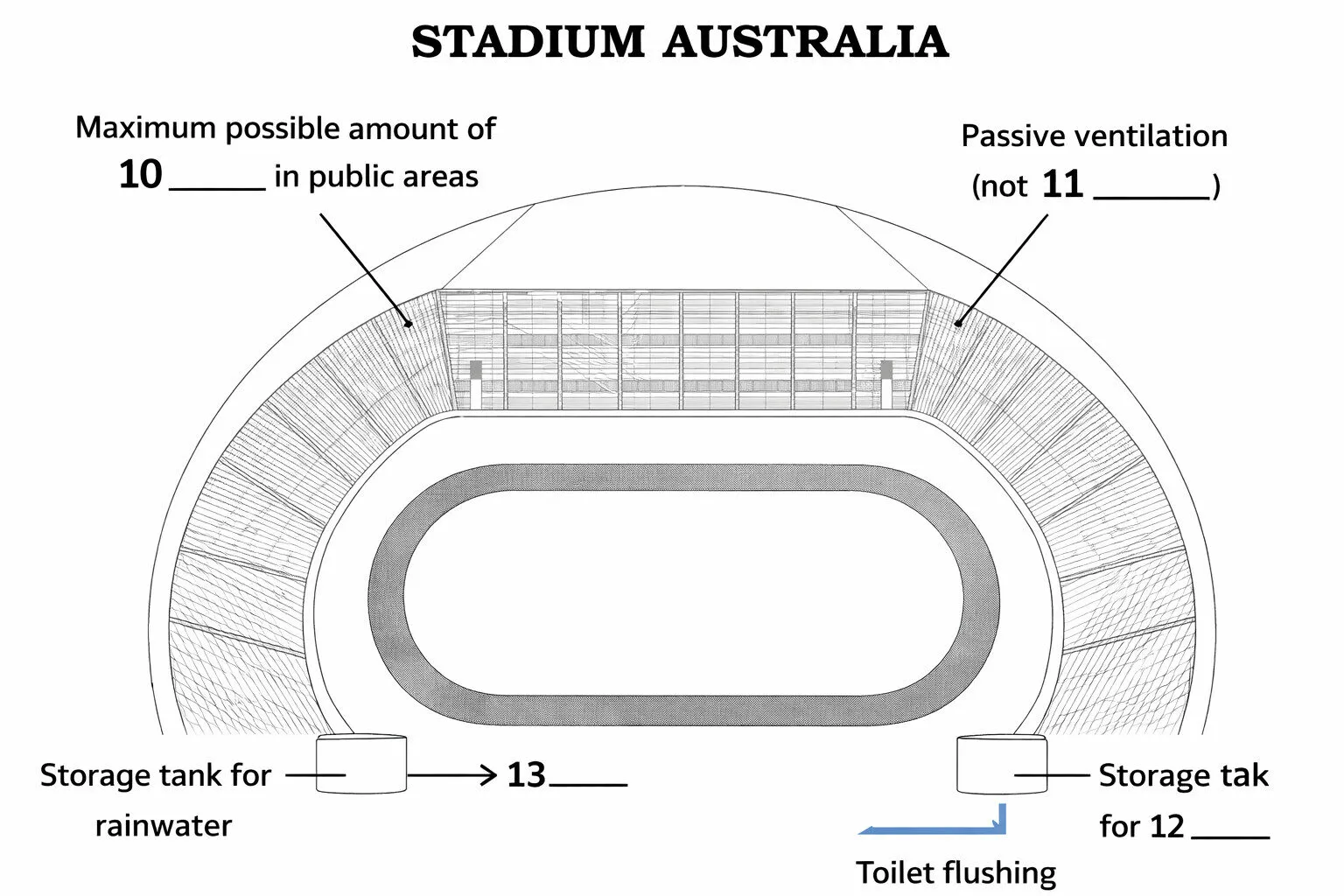
Questions 10-13 Label the diagram. Choose NO MORE THAN THREE WORDS from the reading passage for each answer.
Detailed Passage Translation
STADIUM AUSTRALIA
A. You might ask, why be concerned about the architecture of a stadium? Surely, as long as the action is entertaining and the building is safe and reasonably comfortable, why should the aesthetics matter? This one question has dominated my professional life, and its answer is one I find myself continually rehearsing. If one accepts that sporting endeavour is as important an outlet for human expression as, say, the theatre or cinema, fine art or music, why shouldn’t the buildings in which we celebrate this outlet be as grand and as inspirational as those we would expect and demand in those other areas of cultural life? Indeed, one could argue that because stadiums are, in many instances, far more popular than theatres or art galleries, we should actually devote more, and not less, attention to their form. Stadiums have frequently been referred to as ‘cathedrals’. Football has often been dubbed ‘the opera of the people’. What better way, therefore, to raise the general public’s awareness and appreciation of quality design than to offer them the very best buildings in the one area of life that seems to touch them most? Could it even be that better stadiums might just make people better citizens?
B. But then maybe, as my detractors have labelled me in the past, I am a snob. Maybe I should just accept that sport, and its associated accoutrements and products, is an essentially tacky and ephemeral business, while stadium design is all too often driven by pragmatists and penny-pinchers. Certainly, when I first started writing about stadium architecture, one of the first and most uncomfortable truths I had to confront was that some of the most popular stadiums in the world were also amongst the least attractive or innovative in architectural terms. ‘Worthy and predictable’ has usually won more votes than ’daring and different’. Old Trafford football ground in Manchester, Yankee Stadium in New York, and Ellis Park in Johannesburg. The list is long and is not intended to suggest that these are necessarily poor buildings. Rather, each has derived its reputation more from the events that it has staged, from its associations, than from the actual form it takes. Equally, those stadiums whose forms have been revered – such as the Maracana in Rio, or the San Siro in Milan – have turned out to be rather poorly designed in several respects, once one analyses them not as icons but as functioning ‘public assembly facilities’ (to use the current jargon). Finding the balance between beauty and practicality has never been easy.
C. Homebush Bay was the site of the main Olympic Games complex for the Sydney Olympics of 2000. To put it politely, I am no great admirer of the Olympics as an event, or, rather, of the insane pressures its past bidding procedures have placed upon candidate cities. Nor, as a spectator, do I much enjoy the bloated Games programme and the consequent demands this places upon the designers of stadiums. Yet in my calmer moments, it would be churlish to deny that, if approached sensibly and imaginatively, the opportunity to stage the Games can yield enormous benefits in the long term (as well they should, considering the expenditure involved), if not for sport, then at least for the cause of urban regeneration. Following in Barcelona’s footsteps, Sydney undoubtedly set about its urban regeneration in a wholly impressive way. To an outsider, the 760-hectare site at Homebush Bay, once the home of an abattoir, a racecourse, a brickworks and light industrial units, seemed miles from anywhere – it was actually fifteen kilometres from the centre of Sydney and pretty much in the heart of the city’s extensive conurbation. Some £1.3 billion worth of construction and reclamation was commissioned, all of it, crucially, with an eye to post-Olympic usage. Strict guidelines, studiously monitored by Greenpeace, ensured that the 2000 Games would be the most environmentally friendly ever. What’s more, much of the work was good-looking, distinctive and lively. ‘That’s a reflection of the Australian spirit,’ I was told.
D. At the centre of Homebush lay the main venue for the Olympics, Stadium Australia. It was funded by means of a BOOT (Build, Own, Operate and Transfer) contract, which meant that the Stadium Australia consortium, led by the contractors Multiplex and the financiers Hambros, bore the bulk of the construction costs, in return for which it was allowed to operate the facility for 30 years, and thus, it hopes, recoup its outlay, before handing the whole building over to the New South Wales government in the year 2030.
E. Stadium Australia was the most environmentally friendly Olympic stadium ever built. Every single product and material used had to meet strict guidelines, even if it turned out to be more expensive. All the timber was either recycled or derived from renewable sources. To reduce energy costs, the design allowed natural lighting in as many public areas as possible, supplemented by solar-powered units. Rainwater collected from the roof ran off into storage tanks, where it could be tapped for pitch irrigation. Stormwater run-off was collected for toilet flushing. Wherever possible, passive ventilation was used instead of mechanical air conditioning. Even the steel and concrete from the two end stands, due to be demolished at the end of the Olympics, were to be recycled. Furthermore, no private cars were allowed on the Homebush site. Instead, every spectator was to arrive by public transport, and quite right too. If ever there was a stadium to persuade a sceptic like myself that the Olympic Games do, after all, have a useful function in at least setting design and planning trends, this was the one. I was, and still am, I freely confess, quite knocked out by Stadium Australia.
Key Vocabulary Summary
-
Aesthetics (n): The study of beauty or artistic appreciation.
-
Ephemeral (adj): Lasting for a very short time.
-
Pragmatist (n): A person who is guided more by practical considerations than by ideals.
-
Revere (v): To feel deep respect or admiration for something.
-
Urban regeneration (n): The process of improving an urban area.
-
Abattoir (n): A slaughterhouse.
-
Conurbation (n): An extended urban area, typically consisting of several towns merging with the suburbs of a central city.
-
Recoup outlay (v + n): To recover the money spent on an investment.
-
Sceptic (n): A person inclined to question or doubt accepted opinions.
Answers and Detailed Explanations
1. Paragraph A: viii. A strongly held belief
Explanation: Throughout paragraph A, the author expresses a firm belief that stadiums deserve as much architectural and aesthetic attention as theatres or museums (“This one question has dominated my professional life…”).
2. Paragraph B: iv. A strong contrast
Explanation: Paragraph B highlights the sharp contrast between famous/popular stadiums that are ugly and utilitarian (like Old Trafford) and those revered for their beauty but which are inefficient in practice (like the Maracana).
3. Paragraph C: vi. A promising beginning
Explanation: Paragraph C describes the Homebush Bay area as formerly being a mess (slaughterhouse, brickworks), but Sydney began its “urban regeneration” in an impressive way, marking a promising start.
4. Paragraph D: v. A special set-up
Explanation: Paragraph D focuses on explaining the unique funding mechanism of the stadium through a BOOT (Build, Own, Operate and Transfer) contract between contractors and the government. This is a “special set-up.”
5. Paragraph E: ii. An overall requirement
Explanation: Paragraph E details the most stringent overall requirement of the project: environmental friendliness. “Every single product and material used had to meet strict guidelines” (an overall requirement).
6. NOT GIVEN
-
Statement: The public has been demanding a better quality of stadium design.
-
Explanation: In paragraph A, the author says, “What better way, therefore, to raise the general public’s awareness…” This implies the public’s awareness is not yet high, but the text does NOT confirm or deny that the public is actively “demanding” this.
7. TRUE
-
Statement: It is possible that stadium design has an effect on people’s behaviour in life in general.
-
Explanation: At the end of paragraph A, the author asks: “Could it even be that better stadiums might just make people better citizens?” This rhetorical question confirms the possibility.
8. NOT GIVEN
-
Statement: Some stadiums have come in for a lot more criticism than others.
-
Explanation: Paragraph B mentions several stadiums (Old Trafford, Maracana) and points out their weaknesses, but the author does NOT compare the “amount of criticism” between different stadiums.
9. NOT GIVEN
-
Statement: Designers of previous Olympic stadiums could easily have produced far better designs.
-
Explanation: In paragraph C, the author criticizes the “bloated Games programme and the consequent demands this places upon the designers.” However, the text does not state that previous designers could have “easily” done better.
Answers 10-13: Based on the cross-section diagram of Stadium Australia and the content of paragraph E, we have the following answers:
10. natural lighting
-
Diagram position: Arrow pointing to public areas with the note “Maximum possible amount of 10 ____ in public areas”.
-
Explanation: Paragraph E states: “…the design allowed natural lighting in as many public areas as possible…”
11. mechanical air conditioning
-
Diagram position: Arrow pointing to the roof/ventilation with the note “Passive ventilation (not 11 ____)”.
-
Explanation: Paragraph E states: “Wherever possible, passive ventilation was used instead of mechanical air conditioning.”
12. stormwater / stormwater run-off
-
Diagram position: Storage tank on the right (Storage tank for 12 ____) with an arrow leading to “Toilet flushing”.
-
Explanation: Paragraph E states: “Stormwater run-off was collected for toilet flushing.”
13. pitch irrigation
-
Chia sẻ:



 Khai giảng Khóa học Hè cực HOT.
No comments yet!