
Tóm Tắt Nội Dung Bài Viết
In the IELTS exam, Reading Passage 3 often focuses on abstract topics such as psychology, history, or philosophy. The reading passage “Source of Knowledge” is a classic example, using a medical lens to explore a philosophical question: “How do we know what we know?”.
A patient’s journey from feeling fatigued to receiving a pneumonia diagnosis is more than just a medical story; it is a vivid illustration of the intersection between Subjective knowledge and Expert knowledge. Mastering this passage will help you sharpen your ability to categorize information sources and refine your Keyword matching techniques. Join ECE as we explore the full translation and the standard answer analysis for this reading passage below.
Reading Passage
SOURCE OF KNOWLEDGE
A. What counts as knowledge? What do we mean when we say that we know something? What is the status of different kinds of knowledge? In order to explore those questions we are going to focus on one particular area of knowledge: medicine.
B. How do you know when you are ill? This may seem to be an absurd question. You know you are ill because you feel ill; your body tells you that you are ill. You may know that you feel pain or discomfort. But knowing you are ill is a bit more complex. At times, people experience the symptoms of illness, but in fact they are simply tired or overworked or they may just have a hangover. At other times, people may be suffering from a disease and fail to be aware of the illness until it has reached a late stage in its development. So how do we know we are ill, and what counts as knowledge?
C. Think about this example. You feel unwell. You have a bad cough and always seem to be tired. Perhaps it could be stress at work, or maybe you should give up smoking. You feel worse. You visit the doctor who listens to your chest and heart, takes your temperature and blood pressure, and then finally prescribes antibiotics for your cough.
D. Things do not improve but you struggle on thinking you should pull yourself together, perhaps things will ease off at work soon. A return visit to your doctor shocks you. This time the doctor, drawing on years of training and experience, diagnoses pneumonia. This means that you will need bed rest and a considerable time off work. The scenario is transformed. Although you still have the same symptoms, you no longer think that these are caused by pressure at work. You now have proof that you are ill. This is the result of the combination of your own subjective experience and the diagnosis of someone who has the status of a medical expert. You have a medically authenticated diagnosis and it appears that you are seriously ill; you know you are ill and have evidence upon which to base this knowledge.
E. This scenario shows many different sources of knowledge. For example, you decide to consult the doctor in the first place because you feel unwell – this is personal knowledge about your own body. However, the doctor’s expert diagnosis is based on experience and training, with sources of knowledge as diverse as other experts, laboratory reports, medical textbooks and years of experience.
F. One source of knowledge is the experience of our own bodies; the personal knowledge we have of changes that might be significant, as well as the subjective experience of pain and physical distress. These experiences are mediated by other forms of knowledge such as the words we have available to describe our experience and the common sense of our families and friends as well as those that drawn from popular culture. Over the past decade, for example, Western culture has seen a significant emphasis on stress-related illness in the media. Reference to being ‘stressed out’ has become a common response in daily exchanges in the workplace and has become a part of popular common-sense knowledge. It is thus not surprising that we might seek such an explanation of physical symptoms of discomfort.
G. We might also rely on the observations of others who know us. Comments from friends and family such as ‘you do look ill’ or ‘that’s a bad cough’ might be another source of knowledge. Complementary health practices, such as holistic medicine, produce their own sets of knowledge upon which we might also draw in deciding the nature and degree of our ill health and about possible treatments.
H. Perhaps the most influential and authoritative source of knowledge is the medical knowledge provided by the general practitioner. We expect the doctor to have access to expert knowledge. This is socially sanctioned. It would not be acceptable to notify our employer that we simply felt too unwell to turn up for work or that our faith healer, astrologer, therapist or even our priest thought it was not a good idea. We need an expert medical diagnosis in order to obtain the necessary certificate if we need to be off work for more than the statutory self-certification period. The knowledge of the medical sciences is privileged in this respect in contemporary Western culture. Medical practitioners are also seen as having the required expert knowledge that permits them legally to prescribe drugs and treatment to which patients would not otherwise have access. However, there is a range of different knowledge upon which we draw when making decisions about our own state of health.
I. However, there is more than existing knowledge in this little story; new knowledge is constructed within it. Given the doctor’s medical training and background, she may hypothesize ‘is this now pneumonia?’ and then proceed to look for evidence about it. She will use observations and instruments to assess the evidence and—critically—interpret it in the light of her training and new experience both for you and for the doctor. This will then be added to the doctor’s medical knowledge and may help in future diagnosis of pneumonia.
Questions
Questions 27-34
Reading Passage 3 has nine paragraphs, A-I.
Which paragraph contains the following information?
Write the correct letter, A-I, in boxes 27-34 on your answer sheet.
NB You may use any letter more than once.
27. the contrast between the nature of personal judgment and the nature of doctor’s diagnosis
28. a reference to cultural attitudes regarding pressure
29. sick leave will not be permitted without professional diagnosis
30. how doctors’ opinions are regarded in society
31. how patient illness can contribute to new knowledge
32. a description of knowledge drawn from non-specialized sources other than personal knowledge
33. an example of collective judgment from personal experience and a professional doctor
34. a reference to the fact that some people do not realize they are ill
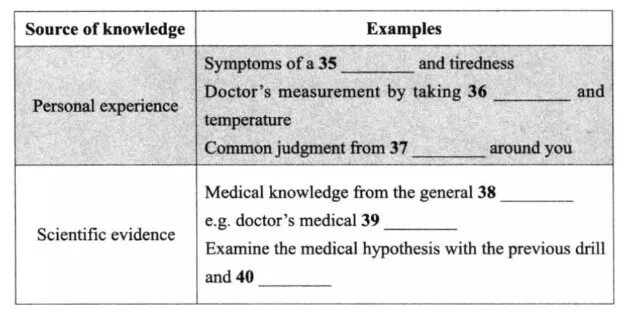
Questions 35-40
Complete the notes below.
Choose NO MORE THAN THREE WORDS from the passage for each answer.
Write your answers in boxes 35-40 on your answer sheet.
Full Reading Translation
A. What counts as knowledge? What do we mean when we say that we know something? What is the status of different kinds of knowledge? To explore these questions, we will focus on one specific area: medical knowledge.
B. How do you know when you are ill? This may seem like an absurd question. You know you are ill because you feel ill; your body tells you that you are ill. You may know that you feel pain or discomfort, but knowing you are ill is a bit more complex. At times, people experience symptoms of illness, but in fact, they are simply tired, overworked, or perhaps just feeling hungover. At other times, they may be suffering from a disease and fail to be aware of it until it has reached a late stage. Therefore, how do we know we are ill, and what counts as knowledge?
C. Consider this example. You feel unwell. You have a bad cough and always seem to be tired. Perhaps it is due to work stress, or maybe you should quit smoking. You feel worse. You visit the doctor, who listens to your chest and heart, takes your temperature and blood pressure, and finally prescribes antibiotics for your cough.
D. Things do not improve, but you struggle on, thinking you should pull yourself together, perhaps hoping the work burden will soon ease. A return visit to the doctor shocks you. Drawing on years of training and experience, this time the doctor diagnoses you with pneumonia. This means you need bed rest and a significant break from work. The scenario is transformed. Although you still have the same symptoms, you no longer think they are caused by work pressure. Now you have proof of your illness. This is the result of combining your own subjective experience with the diagnosis of a medical expert. You have a medically authenticated diagnosis and it appears you are seriously ill; you know you are ill and have evidence upon which to base this knowledge.
E. This scenario highlights many different sources of knowledge. For example, you decide to consult a doctor in the first place because you feel unwell—this is your personal knowledge about your own body. However, the doctor’s expert diagnosis is based on training and experience, drawing on diverse sources such as other experts, laboratory reports, medical textbooks, and their own years of practice.
F. One source of knowledge is the experience of our own bodies. We have significant personal insight into changes in our bodies, as well as subjective experiences of pain and physical distress. These experiences are mediated by other forms of knowledge, such as the words we have available to describe our experience and the common sense of our families and friends, as well as influences from popular culture. For example, over the past decade, Western culture has seen a significant emphasis on stress-related illness in the media. Reference to being “stressed out” has become a common response in daily workplace exchanges and has become part of popular common-sense knowledge. Thus, it is not surprising that we might seek such an explanation for physical symptoms of discomfort.
G. We might also rely on the observations of others who know us. Comments from friends and family such as “you look ill” or “that’s a bad cough” can be another source of knowledge. Complementary health practices, such as holistic medicine, produce their own sets of knowledge upon which we might draw when deciding the nature and degree of our ill health and appropriate treatments.
H. Perhaps the most influential and authoritative source of knowledge is the medical knowledge provided by general practitioners. We expect the doctor to have access to expert knowledge. This is socially sanctioned. It would not be acceptable to notify our employer that we simply felt too unwell to come to work, or that our faith healer, astrologer, therapist, or even our priest thought it was not a good idea. We need an expert medical diagnosis to obtain the necessary certificate if we need to be off work for longer than the statutory self-certification period. Medical science knowledge is privileged in this respect in contemporary Western culture. Medical practitioners are also seen as having the required expert knowledge that legally permits them to prescribe drugs and treatments to which patients would not otherwise have access. However, there is a range of different knowledge upon which we draw when making decisions about our own health status.
I. However, there is more than existing knowledge in this little story; new knowledge is constructed within it. Given the doctor’s medical training and background, she may hypothesize, “Is this pneumonia?” and then proceed to look for evidence. She will use observations and instruments to assess the evidence and—critically—interpret it in light of her training and new experience, both for you and for the doctor. This will then be added to the doctor’s medical knowledge and may help in future diagnoses of pneumonia.
Academic Vocabulary Summary
| Word | Part of Speech | Meaning |
| Absurd | Adjective | Ridiculous, illogical |
| Pneumonia | Noun | A lung infection |
| Subjective | Adjective | Based on personal feelings |
| Authenticated | Verb (P2) | Verified, proven genuine |
| Mediated | Verb (P2) | Influenced or conveyed through |
| Authoritative | Adjective | Reliable, official |
| Sanctioned | Adjective | Approved, accepted |
| Statutory | Adjective | Required by law |
| Privileged | Adjective | Having special rights or status |
| Hypothesize | Verb | To propose a theory |
Answer Analysis
27. Answer E: Contrast between personal judgment and doctor’s diagnosis.
Location: “For example, you decide to… feel unwell – this is personal knowledge… However, the doctor’s expert diagnosis is based on experience and training…”
Explanation: Paragraph E clearly distinguishes between the patient’s source of knowledge (bodily sensation) and the doctor’s (professional training).
28. Answer F: Cultural reference to pressure.
Location: “…Western culture has seen a significant emphasis on stress-related illness… Reference to being ‘stressed out’ has become a common response…”
Explanation: Paragraph F discusses how Western culture has integrated the concept of “stress” into common knowledge.
29. Answer H: Sick leave not permitted without professional diagnosis.
Location: “We need an expert medical diagnosis in order to obtain the necessary certificate if we need to be off work for more than the statutory self-certification period.”
Explanation: Paragraph H confirms the legal necessity of a doctor’s diagnosis for taking time off work.
30. Answer H: How doctors’ opinions are regarded in society.
Location: “…influential and authoritative source of knowledge… This is socially sanctioned.”
Explanation: Paragraph H highlights the “authoritative” status and “socially sanctioned” nature of the doctor’s opinion.
31. Answer I: Patient illness contributing to new knowledge.
Location: “This will then be added to the doctor’s medical knowledge and may help in future diagnosis…”
Explanation: Paragraph I describes the process of the doctor learning from an actual case.
32. Answer G: Knowledge from non-specialized sources other than personal knowledge.
Location: “Comments from friends and family… Complementary health practices, such as holistic medicine…”
Explanation: Paragraph G lists sources from relatives and alternative medicine (neither mainstream medical nor purely subjective).
33. Answer D: Example of collective judgment from personal experience and professional doctor.
Location: “This is the result of the combination of your own subjective experience and the diagnosis of someone who has the status of a medical expert.”
Explanation: Paragraph D describes the moment the patient “knows” they are ill thanks to both their own symptoms and the doctor’s results.
34. Answer B: Reference to some people not realizing they are ill.
Location: “…people may be suffering from a disease and fail to be aware of the illness until it has reached a late stage…”
Explanation: Paragraph B points out the paradox of being ill without being aware of it.
35. bad cough: Paragraph C describes the patient’s initial symptoms: “You have a bad cough and always seem to be tired.”
36. blood pressure: Paragraph C lists the doctor’s examinations: “…takes your temperature and blood pressure.”
37. friends and family: Paragraph G mentions general judgment from loved ones: “Comments from friends and family… might be another source of knowledge.”
38. practitioner: Paragraph H mentions the most trusted source: “…medical knowledge provided by the general practitioner.”
<





 Khai giảng Khóa học Hè cực HOT.
Chưa có bình luận nào!