
Tóm Tắt Nội Dung Bài Viết
In your English learning journey, the Simple Future tense is one of the most fundamental tools for expressing actions and events that will happen in the future. Mastering this tense is not only the foundation for discussing plans, intentions, and predictions, but it is also key to demonstrating your ability to use English flexibly across various contexts.
A clear understanding of the definition, usage, and structure of the Simple Future helps you express your ideas about the future accurately and avoid common mistakes. Furthermore, this is essential foundational knowledge if you aim to conquer standardized English tests like IELTS. In IELTS, proficient use of the Simple Future (both “will” and “be going to”) will help you demonstrate variety and precision in your grammar (Grammatical Range and Accuracy), one of the four critical scoring criteria.
What is the Simple Future?
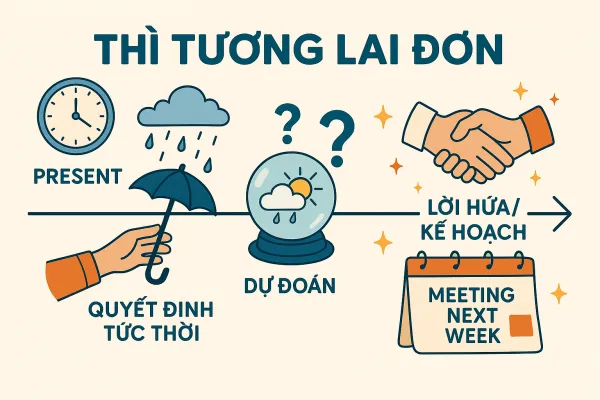
The Simple Future tense is used to express:
-
A spontaneous decision: A decision made at the very moment of speaking.
Example: Oh, it’s raining. I will take an umbrella.
Example: I’m tired. I think I will go to bed.
-
A prediction based on personal opinion or belief, without clear evidence: Often accompanied by phrases such as I think, I believe, I hope, perhaps, probably, maybe…
Example: I think she will pass the exam.
Example: It will probably rain tomorrow.
A promise, offer, invitation, or warning:
Example: I will help you with your homework. (Promise)
Example: You will regret this! (Warning)
Example: She will pick you up at the station. (Offer/Arrangement)
A certain future fact:
Example: The sun will rise tomorrow morning.
-
An action or event planned or intended in advance (using “be going to”): This intention usually has clear evidence or a basis.
Example: I am going to visit my aunt next week. (Planned)
Example: Look at those dark clouds! It’s going to rain. (Evidence-based)
Formulas
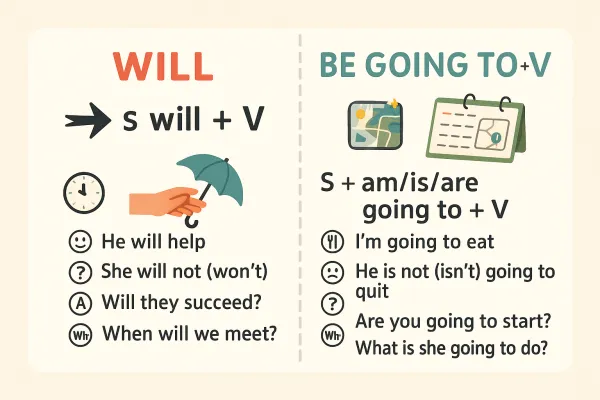
The Simple Future has two main structures: will + V and be going to + V. The choice depends on the context and the meaning you wish to convey.
Using “Will”
| Sentence Type | General Formula | Example |
|---|---|---|
| Affirmative | S + will + V + (O/A) | She will arrive soon. I will help you. |
| Negative | S + will + not + V + (O/A) | He won’t come to the party. We will not finish on time. |
| Interrogative | Will + S + V + (O/A)? | Will you be there? Will they accept the offer? |
| Wh- Question | Wh- + will + S + V + (O/A)? | Where will she go? What will you do tomorrow? |
(Note: S: Subject, V: Base verb, O: Object, A: Adverbial)Contraction: will not = won’t
Using “Be going to”
| Sentence Type | General Formula | Example |
|---|---|---|
| Affirmative | S + am/is/are + going to + V + (O/A) | I am going to study tonight. They are going to build a new house. |
| Negative | S + am/is/are + not + going to + V + (O/A) | She isn’t going to call him. We are not going to wait for them. |
| Interrogative | Am/Is/Are + S + going to + V + (O/A)? | Are you going to join us? Is he going to buy a new car? |
| Wh- Question | Wh- + am/is/are + S + going to + V + (O/A)? | When are you going to leave? What is she going to say? |
(Note: S: Subject, V: Base verb, O: Object, A: Adverbial) Contractions: is not = isn’t, are not = aren’t
Detailed Usage
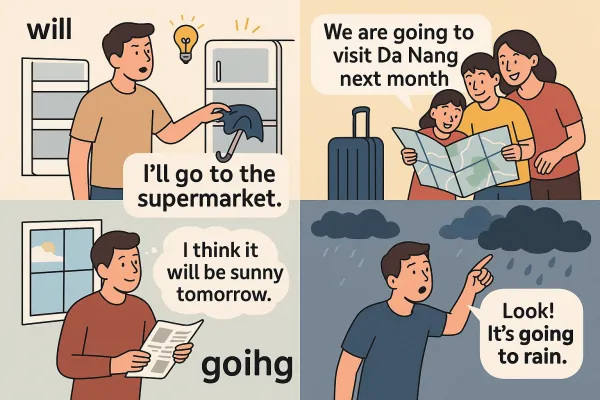
Understanding the subtle differences between “will” and “be going to” is key to using this tense accurately and naturally.
Cases for “Will”
-
Spontaneous decisions at the time of speaking: No prior preparation or plan.
Example: (Phone rings) “I’ll get it.”
Example: (Seeing someone trip) “Oh, I’ll help you pick that up.”
Application: Common in natural conversation when reacting quickly to situations.
-
Predictions without evidence or based on personal opinion/belief:
Example: I believe artificial intelligence will change the world significantly.
Example: Scientists will probably find a cure for cancer someday.
Application: In IELTS Speaking Part 3 when discussing future trends or personal opinions on social issues.
-
Promises, offers of help, invitations, threats/warnings:
Example: Don’t worry, I will call you as soon as I arrive. (Promise)
Example: That box looks heavy. I will help you carry it. (Offer)
Example: Will you marry me? (Proposal)
Example: If you touch that, you will get an electric shock. (Warning)
Application: Common in daily communication and IELTS Speaking Part 1 when discussing intentions and commitments.
-
Requests (in interrogative form):
Example: Will you please close the door?
Application: Polite communication.
-
Future facts:
Example: Christmas will be on a Friday this year.
Application: Expressing scheduled events or natural laws.
Cases for “Be going to”
-
Plans or intentions made before speaking: Actions that have been thought out and decided upon.
Example: We are going to buy a new car next month. (Planned)
Example: She is going to start a new job in July. (Confirmed)
Application: Common when discussing personal plans in IELTS Speaking Part 1, or organizational/governmental plans in IELTS Writing Task 2.
-
Predictions with clear present evidence: Signs that can be seen, heard, or felt.
Example: Look at those dark clouds! It’s going to rain. (Evidence: dark clouds)
Example: He’s driving too fast. He’s going to have an accident. (Evidence: reckless driving)
Application: Describing situations likely to happen based on current observations.
Comparing “Will” and “Be going to”
| Criteria | WILL | BE GOING TO |
|---|---|---|
| Decision | Spontaneous, at the time of speaking. | Planned/intended before speaking. |
| Prediction | No clear evidence, based on opinion. | Clear evidence in the present. |
| Promise/Offer | Used | Not used |
| Certainty | May be less certain than a fixed plan. | Implies a fixed plan or high probability. |
| Communication | Common in speech, quick reactions. | Used in speech and writing for plans. |
IELTS Application: Using “will” and “be going to” correctly shows flexibility and grammatical control. Avoid using them interchangeably or defaulting to “will” for every future context.
Identifying the Simple Future
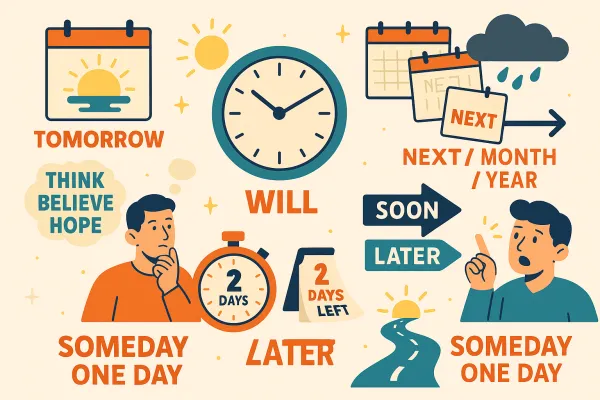
The Simple Future is often accompanied by adverbs and time phrases that indicate an action or event will occur after the present moment.
Future Time Adverbs and Phrases
- Tomorrow
Example: I will meet her tomorrow.
- Next + time (week/month/year/Monday/weekend…)
Example: They are going to move to a new house next month.
- In + time period
Example: The results will be announced in two days.
- Soon
Example: She will arrive soon.
- Later
Example: I’ll call you later.
- Tonight
Example: We are going to have dinner out tonight.
- This + time (morning/afternoon/evening/week/month/year…)
Example: I will finish this report this afternoon.
- Someday/One day
Example: He hopes he will become a doctor someday.
Verbs and phrases expressing prediction/opinion (usually with “will”)
- Think, believe, hope, expect, suppose, assume
Example: I think it will be sunny tomorrow.
- Probably, perhaps, maybe, possibly
Example: They will probably win the match.
- Be sure, be afraid, be certain
Example: I’m sure he will help us.
Signs of plans/intentions (usually with “be going to”)
- Look out! / Watch out!
Example: Look out! You’re going to hit that tree!
- Present evidence: Dark clouds, stains, signs of fatigue…
Example: She looks pale. She’s going to faint.
Conjugation Rules
Conjugating the Simple Future is straightforward because the main verb is always in its base form, regardless of the subject. However, choosing between “will” and “be going to” remains crucial.
With “Will” – Structure: S + will + V (base form)
Main verb does not change: Whether the subject is first, second, or third person, singular or plural, the main verb after “will” remains in its base form.
Example: I will go.
Example: She will go.
Example: They will go.
No special irregular verbs after “will”: All verbs remain in their base form.
Example: He will be here.
Example: We will have dinner.
With “Be going to” – Structure: S + am/is/are + going to + V (base form)
Conjugate “to be” according to the subject: This is the key point to note.
- I + am going to…
- He/She/It/Singular noun/Uncountable noun + is going to…
- You/We/They/Plural noun + are going to…
Main verb is always in base form: Similar to “will”, the main verb after “going to” remains unchanged.
Example: I am going to read a book.
Example: She is going to visit her parents.
Example: They are going to buy a new car.
Contextual Usage
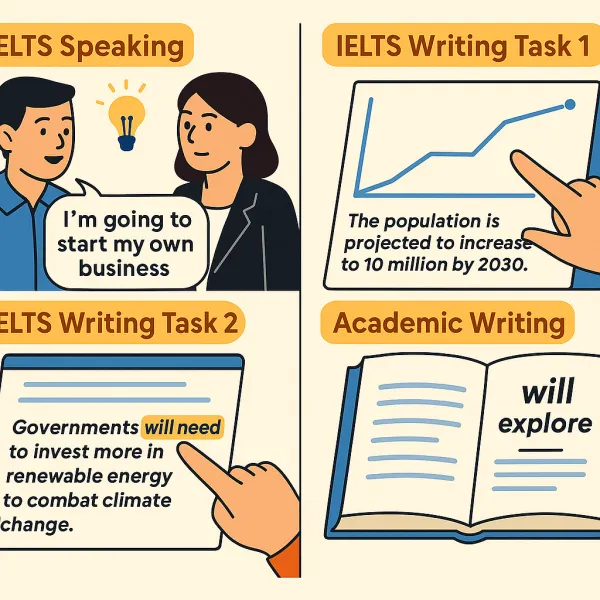
General Academic Writing
The Simple Future (usually “will” for predictions and “be going to” for research goals/plans) is used to:
- State the objectives and scope of future research: Often appears in introductions or conclusions.
Example: This research will explore the long-term effects of climate change.
Example: The subsequent chapters are going to present a detailed analysis of the data.
- Predict trends or potential results:
Example: It is anticipated that artificial intelligence will play an increasingly vital role in various industries.
Example: The current economic policies are likely to lead to a decline in unemployment.
- Propose further research directions:
Example: Further studies will be needed to confirm these findings.
IELTS Writing Task 1 (Academic – Describing charts, maps, processes)
The Simple Future is used to predict trends or describe future stages of a process.
- Predicting future trends (if the chart has forecast data):
Example: The number of elderly people is projected to increase significantly by 2050.
Example: After a slight drop, sales will likely recover in the coming years.
- Describing future stages of a process:
Example: In the next stage, the product will be tested for quality control.
Example: New residential areas are going to be built on the western side of the river.
IELTS Writing Task 1 (General Training – Letter writing)
The Simple Future is common when stating plans, proposals, or promises.
- Stating personal plans or intentions:
Example: I am going to arrive at the airport at 5 PM, so I will need a ride.
Example: We are going to hold a meeting next Tuesday to discuss the issue.
- Offering help or making promises:
Example: I will ensure that the matter is resolved promptly.
Example: I will send you the documents tomorrow.
- Giving advice or suggestions:
Example: I suggest you will find it helpful to visit the local library.
IELTS Writing Task 2 (Essay writing)
The Simple Future is used extensively when making predictions, proposing solutions, or analyzing the future impact of an issue.
- In introductions/conclusions, when predicting the future of an issue:
Example: It is widely believed that technology will continue to shape our lives in profound ways.
- In body paragraphs, when proposing solutions or predicting their outcomes:
Example: If governments invest more in renewable energy, pollution levels will significantly decrease.
Example: Educational reforms are going to play a crucial role in preparing students for future challenges.
- When discussing potential social changes:
Example: The increasing automation of jobs will undoubtedly lead to a shift in the labor market.
IELTS Speaking Part 1 (Personal questions)
Use the Simple Future when talking about plans, intentions, or personal predictions.
- Personal plans in the near/distant future:
Q: What are you going to do this weekend? A: I’m going to visit my parents. We’re going to have a family dinner.
Q: What do you hope to do in the future? A: I hope I will have the opportunity to travel around the world.
- Personal predictions:
Q: Do you think you’ll still live in this city in 10 years? A: I’m not sure, but I probably won’t.
- Quick offers/promises:
Q: Can you help me with this? A: Sure, I


 Khai giảng Khóa học Hè cực HOT.
Chưa có bình luận nào!