


Tóm Tắt Nội Dung Bài Viết
In the IELTS exam, the Second Conditional is an essential structure that helps you boost your score for the Grammatical Range and Accuracy criterion. Mastering this structure allows you to build sharp, counter-factual arguments in Task 2 essays and naturally extend your answers in Speaking Part 3.
This guide from ECE English breaks down the formulas, advanced usages, inversion tips, and provides a comprehensive set of practice exercises ranging from basic to advanced levels.
1. Definition and Formula of the Second Conditional
1.1 What is the Second Conditional?
The second conditional is used to describe hypothetical situations or actions that are unreal in the present or future. The condition set is entirely contrary to objective reality at the time of speaking.
-
Real-life context: You do not have much money right now.
-
Second conditional hypothesis: If I had a lot of money, I would buy a new car.
1.2 Standard Formula and Verb Conjugation
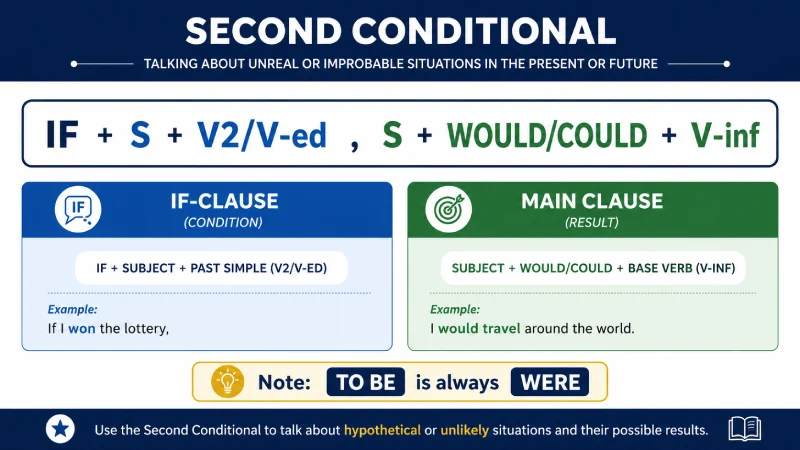
A conditional sentence consists of two clauses: the If clause (the hypothesis) and the Main clause (the result).
Formula: If + S + Past Simple / V2 / V-ed, S + would / could / might + bare infinitive (V-inf)
-
Special note on the verb “To be”: In academic English, the verb “To be” in the If clause is always conjugated as WERE for all subjects, including singular pronouns like I, he, she, and it.
-
Example: If I were you, I would look for another job.
-
-
Choosing the modal verb in the result clause:
-
would: Expresses a definitive, expected outcome.
-
could: Emphasizes capability or ability (what someone could do).
-
might: Expresses a possible but less certain outcome, showing speculation.
-
2. Applying the Second Conditional to the IELTS Exam
Grammar is not just a set of dry formulas to memorize, but a direct tool to elevate your band score. In the IELTS test, the second conditional is your “secret weapon” for building sharp counter-arguments and naturally extending your speaking responses.
2.1 Application in IELTS Writing Task 2
In Task 2 essays (especially Problem & Solution questions), instead of simply stating solutions monotonously, use the second conditional to paint a picture of a positive outcome if the solution is implemented, or to warn of consequences if the issue is ignored. This counter-factual line of reasoning is highly praised by examiners for its logical depth.
-
Basic sentence (Band 5.0 – 5.5): The government should upgrade public transport. This makes more people use buses.
-
Advanced GRA upgrade (Band 7.0+): If local authorities invested more budgets into modernizing public transport systems, a massive reduction would be seen in the volume of private vehicles.
2.2 Application in IELTS Speaking Part 3
Part 3 questions are typically macro-level, requiring you to discuss societal issues or make future predictions. When facing prompts like “What should governments do…” or “What would happen if…”, the second conditional acts as a springboard to help you extend your answers smoothly.
-
Examiner’s question: How can schools encourage children to read more books?
-
Band-scoring second conditional response: From my perspective, schools should integrate interactive storytelling sessions into the main curriculum. If educational institutions did not force young students to memorize boring texts, children would develop a genuine passion for reading naturally.
2.3 Giving Advice or Expressing Personal Opinions (Speaking Parts 1 & 2)
When discussing personal hobbies or experiences, you can use phrases like “If I were you” or “If I were in the government’s shoes” to roleplay and deliver nuanced perspectives.
Example: If I were in the manager’s shoes, I would implement modern CRM software to monitor the teachers’ weekly performance more effectively.
3. Advanced Connectors to Replace “If”
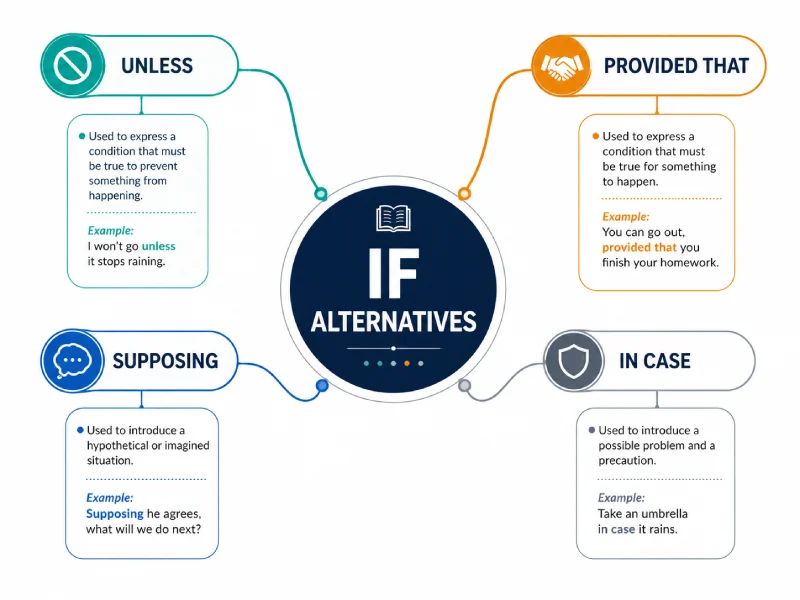
In IELTS Writing, overusing the word “If” makes your writing repetitive and caps your Lexical Resource score. To give your writing more depth and academic flair, you can flexibly replace “If” with these advanced conjunctions:
3.1 Provided that, Providing that, or As long as
This group of connectors is used when you want to emphasize a mandatory and prerequisite condition. The resulting outcome in the main clause can only occur if the prior condition is absolutely met.
Usage: Simply substitute them directly into the position of “If”. The verb in the following clause remains in the past simple tense according to standard second conditional rules.
Example: Provided that the company maintained its technical infrastructure, it would not suffer from severe data breaches.
3.2 Unless (Equivalent to “If … not”)
Unless inherently carries a negative meaning. Therefore, an immutable rule is that the verb immediately following Unless must always be in the affirmative, while the overall meaning of the sentence remains negative.
Usage: When converting a sentence containing If… not to one using Unless, drop the word not (or the negative auxiliary did not) and change the main verb to the past simple tense.
Original sentence with If: If local citizens did not separate their waste, the recycling system would be ineffective.
Converted with Unless: Unless local citizens separated their waste, the recycling system would be ineffective.
3.3 Suppose or Supposing
These connectors are usually placed right at the beginning of a sentence to introduce a hypothetical scenario for exploration, discussion, or debate. This structure scores very high when used to open your answers in IELTS Speaking Part 3.
Usage: Usually turns the clause into a hypothetical question phrasing.
Example: Supposing you were given a chance to study abroad for free, which country would you choose?
3.4 In case
This structure is used to express an action or preparation made in the main clause to deal with or handle a hypothetical situation introduced in the subsequent clause.
Usage: The clause containing In case acts as the potential hypothetical event.
Example: In case the global economic recession worsened, the central bank would deploy an emergency financial package.
Inversion in Second Conditional Sentences
Simply put, Inversion is the process of completely dropping the word “If” and moving the auxiliary verb before the subject. In IELTS Writing Task 2, masterfully using inversion is the fastest way to prove to examiners that you can handle advanced and formal sentence structures.
For the second conditional, you need to divide inversion into two specific cases to avoid losing unnecessary points:
4.1 Inversion with the Verb “To be” (Were)
If your original conditional sentence already contains the verb Were, inversion is extremely straightforward: simply drop “If”, move Were to the beginning of the sentence (before the subject), and keep the rest unchanged.
-
Affirmative Structure: Were + S + Noun / Adj, S + would / could + V-inf
Original sentence: If the new training program were successful, the employees’ performance would improve.
Inverted sentence: Were the new training program successful, the employees’ performance would improve.
⚠️ Crucial Rule (Negative Form): When writing negative inverted sentences, you must never contract it to “Weren’t” at the beginning of the sentence. The word “not” must be separated and placed after the subject.
-
Negative Structure: Were + S + NOT + Noun / Adj, S + would / could + V-inf
Correct inverted sentence: Were the marketing strategy not effective, the company would waste a massive budget.
Common error to avoid: Weren’t the marketing strategy effective, the company would… (This will be marked as a grammatical error).
4.2 Inversion with Ordinary Verbs (Using “Were S to V”)
If your original conditional sentence uses an ordinary verb in the past simple tense (e.g., took, invested, changed), you cannot pull that verb directly to the front. Instead, you must apply the auxiliary Were structure according to this formula:
-
Affirmative Structure: Were + S + to + V-inf, S + would / could + V-inf
Original sentence: If the company changed its target audience, it would attract more potential clients.
Inverted sentence: Were the company to change its target audience, it would attract more potential clients.
-
Negative Structure: Were + S + not + to + V-inf, S + would / could + V-inf
Original sentence: If you did not update the database weekly, you would lose important client records.
Inverted sentence: Were you not to update the database weekly, you would lose important client records.
Continuous Hypothetical Structures in the Second Conditional
Beyond the basic formula, the second conditional features an advanced variant known as the continuous hypothetical. You use this structure when you want to hypothesize a situation contrary to an action currently happening at the moment of speaking.
To make it easy to remember, simply add [be + V-ing] to the clause where you want to emphasize continuous action.
5.1 Emphasizing an Ongoing Action in the Hypothesis (If Clause)
Used when you want to hypothesize: “If right now something were not happening…”
Formula: If + S + were + V-ing, S + would / could + V-inf (bare infinitive)
-
Current reality: You are sitting in an exam room right now, so you cannot go out.
-
Continuous hypothetical sentence: If I were not sitting in the exam room right now, I would travel with my family.
5.2 Emphasizing an Ongoing Action in the Result (Main Clause)
Used when you want to hypothesize: “If the prior condition happened, right now I would be doing something else…”
Formula: If + S + Past Simple, S + would + be + V-ing
-
Current reality: Today is Tuesday, and you have to work in the office.
-
Continuous hypothetical sentence: If today were Sunday, I would be relaxing at home.
Advanced Hypothetical Structures with “Without”, “But for”, and “As if”
6.1 Implied Conditionals (“But for” and “Without”)
This structure does not use “If”, instead embedding the hypothesis into a noun phrase following “But for” or “Without”.
-
Formula: But for / Without + Noun Phrase, S + would / could + V-inf
-
Example: Without your advice, our company would face severe financial losses.
6.2 Hypothetical Structures with “As if” and “As though”
Used to describe an action or gesture that looks like a hypothetical reality, though the present truth is completely opposite.
-
Formula: S1 + Present Simple + as if / as though + S2 + Subjunctive Past (To be is conjugated as WERE)
-
Example: He talks as if he were the boss of this company.
7. Practical IELTS Exam Guide for the Second Conditional
7.1 Scoring Grammar Points in Task 2 Writing
Instead of writing basic sentences, apply second conditional inversion when writing your solution paragraphs to make your writing sound more professional.
-
Basic sentence: The government should upgrade public transport. This helps reduce air pollution.
-
Band-boosting version: Were local authorities to modernize public transport systems, a massive reduction would be seen in air pollution.
7.2 Extending Answers Naturally in Speaking Part 3
When tackling social discussion questions or future predictions, use the second conditional to sketch out a hypothetical scenario, making your answer longer and more coherent.
-
Example: If schools were not forcing children to memorize facts right now, young students would develop a genuine passion for learning.
Second Conditional Practice Exercises
Part 1: Provide the Correct Form of the Verbs in Brackets
1. If the digital marketing campaign (be) ________ effective, the firm’s sales (rise) ________.
2. Provided that the staff (update) ________ the database weekly, no security errors (occur) ________.
3. Unless the local government (impose) ________ heavier taxes on emissions, pollution (worsen) ________.
4. If I (be) ________ in your shoes, I (allocate) ________ more funds to research.
5. Supposing a data breach (take) ________ place tomorrow, how (the company / respond) ________________?
6. The website (be) ________ crawled faster if the webmaster (optimize) ________ the technical errors.
7. If the intensive IELTS course (not start) ________ next week, our teachers (not prepare) ________________ the materials now.
8. Many employees (work) ________ from home productively if the policy (be) ________ more flexible.
9. Without the new software, the director (not be) ________________ able to monitor the performance.
10. If today (be) ________ Saturday, thousands of workers (enjoy) ________ a relaxing day.
Part 2: Spot and Correct the Errors
11. If I was the director of the English center, I would upgrade the office equipment immediately.
12. Weren’t the company’s financial budget so limited, the manager would recruit more employees.
13. Were the local council to built a modern cycling lane, the city’s air quality would improve.
14. If the tech startup did not face a lack of data, its data scientists will deploy the algorithm.
15. If I were a police, I would investigate this corporate financial fraud as soon as possible.
16. Provided that the webmaster updates the sitemap index yesterday, the errors would be resolved now.
17. Were the manager to checking the website performance every morning, he would detect errors early.
18. Supposing you win a premium holiday package next year, which country would you visit first?
19. If the automated technology were not evolving so rapidly, it will not threaten working conditions.
20. Weren’t the international entrance requirements so strict, more candidates would apply to this academy.
Part 3: Rewrite the Sentences Using Inversion
21. If the financial advisor analyzed the competitor’s strategy, the firm would avoid the losses.
-> Were ____________________________________________________________________
22. If the company did not experience severe crawling drops, the website ranking would stay stable.
-> Were ____________________________________________________________________
23. If the office equipment were more ergonomic, the working conditions would be better.
-> Were ____________________________________________________________________
24. If local authorities did not ignore the traffic congestion problem, they would upgrade the bus system.
-> Were ____________________________________________________________________
25. If the intensive training curriculum were transparent, the students would follow the lessons easily.
-> Were ____________________________________________________________________
26. If the marketing team changed the brand identity colors, the campaign would attract more customers.
-> Were ____________________________________________________________________
27. If the state did not reduce the educational subsidies, top academies would build more laboratories.
-> Were ____________________________________________________________________
28. If the database were not accessible to unauthorized users, no data leaks would happen.
-> Were ____________________________________________________________________
29. If the employees worked longer hours under high pressure, their health would decline.
-> Were ____________________________________________________________________
30. If the web developer did not implement the JavaScript code, the newsletter form would not function.
-> Were ____________________________________________________________________
Part 4: Sentence Transformations Based on Real Situations
31. The website contains too many technical errors, so Google cannot index our URLs.
-> If ______________________________________________________________________
<p data-path-




 Khai giảng Khóa học Hè cực HOT.
No comments yet!