
Tóm Tắt Nội Dung Bài Viết
The SAT and ACT are two widely recognized standardized tests used to evaluate a student’s academic readiness for college, particularly for universities in the United States. Both exams play a significant role in the college admissions process, though they serve different purposes and carry different levels of importance.
Recently, the ECE language center has received many inquiries from students asking whether they should take the SAT or the ACT. This article provides an overview to help you choose the test that best suits your needs. Let’s dive in!
* One important change students should be aware of is that as of March 2023, the traditional SAT has been completely replaced by the Digital SAT for international test-takers, and as of spring 2024, within the U.S. as well. This transition was implemented to offer more benefits to students, including a shorter test duration, increased interactivity through a digital platform, and greater flexibility during the exam.
Overview: Comparing the SAT and ACT
1. Test Structure
- Digital SAT (DSAT) consists of two main sections: Reading & Writing and Math. Each section is divided into two modules, and the test adapts to your performance. The total test time is 2 hours and 14 minutes.
You can visit the following link for a detailed article on the Digital SAT structure.
- ACT consists of four sections: English, Math, Reading, and Science, plus an optional writing section. The total time is 2 hours and 55 minutes, excluding the essay.
1. English
- Number of questions: 75 multiple-choice questions.
- Time: 45 minutes.
- Content: Tests your command of grammar, expression, and editing skills. You will work with short passages and choose the best way to correct errors in grammar, punctuation, syntax, and word usage. Additionally, you will be tested on your understanding of rhetorical skills and writing style.
2. Math
- Number of questions: 60 multiple-choice questions.
- Time: 60 minutes.
- Content: Evaluates your ability to solve problems across various fields, including algebra, geometry, and trigonometry. This section includes questions ranging from basic to complex calculations, with approximately 14 questions focused on trigonometry.
3. Reading
- Number of questions: 40 multiple-choice questions.
- Time: 35 minutes.
- Content: Assesses reading comprehension through passages from various genres, including fiction, social studies, natural sciences, and the arts. Questions test your ability to identify main ideas, infer meaning from context, and analyze information from the text.
4. Science
- Number of questions: 40 multiple-choice questions.
- Time: 35 minutes.
- Content: Focuses on interpreting and analyzing scientific data. This section does not require deep scientific knowledge; rather, it tests your ability to understand charts, graphs, data tables, and experimental descriptions. Topics include biology, chemistry, physics, and earth science.
5. Writing (Optional Essay)
- Number of questions: 1 essay.
- Time: 40 minutes.
- Content: You are asked to write an essay based on a specific prompt. This section evaluates your analytical skills, critical thinking, and ability to present a coherent argument. While optional, some universities may require it.
The ACT includes a science section focused on data interpretation and scientific reasoning, which the Digital SAT does not have. If you excel in science, this could be an advantage.
2. Test Difficulty
- Digital SAT is an adaptive test, meaning the difficulty of the questions in the second module depends on your performance in the first. This can be stressful for some students as the test adjusts based on how well you perform.
- ACT has a fixed structure, with questions increasing in difficulty within each section. This may be less stressful if you prefer a predictable test format.
- Digital SAT features shorter passages with only one question per passage, reducing pressure compared to the ACT, which uses longer passages with multiple questions.
- ACT requires reading long passages and answering multiple questions, which can be challenging for students who struggle with time management or retaining information accurately.
3. Time per Question
- In the Digital SAT, students have more time per question (approximately 65 seconds), allowing for a more measured pace. This is helpful for students who need extra time to think through difficult questions.
- The ACT is faster-paced, with about 45 seconds per question, which can put pressure on students who do not manage their time well.
4. Test Format and Score Reporting

- Digital SAT is taken entirely on a computer using the Bluebook application. This format provides built-in tools like a countdown timer, calculator, and annotation features.
- ACT is primarily paper-based, though it is being rolled out online at some locations. If you are more comfortable with paper-based testing, the ACT might be a better fit.
For the ACT, you will receive your scores approximately 18 days after the test date if you take the four core sections. If you take the optional essay, scores are available after 2 weeks. For tests held in October and February, scores are released in 3–8 weeks due to higher test volumes. Once scores are available, the ACT will send your score report to your chosen universities (the first 4 are free; each additional report costs $15).
For the SAT, you will receive your results in about 2 weeks. For students taking the test in June, the wait time may be slightly longer due to high volume.
Summary Comparison Table: SAT vs. ACT
|
Criteria
|
SAT
|
ACT
|
|
Test Format
|
Computer-adaptive test
|
Primarily paper-based; computer-based testing piloted since late 2023
|
|
Duration
|
2 hours 14 minutes
|
2 hours 55 minutes
|
|
Total Questions
|
98 questions
|
215 or 216 questions (with optional essay)
|
|
Sections
|
|
|
|
Questions per Section
|
|
|
|
Time per Section
|
|
|
|
Time per Question
|
Approx. 65 seconds
|
Approx. 45 seconds
|
|
Guessing Penalty
|
None
|
None
|
|
Score Range
|
400–1600 (Reading/Writing and Math sections are 200–800 each)
|
– 1–36 (average of the 4 sections: English, Math, Reading, and Science)
– Optional essay is scored 2–12 with examiner comments.
– Essay scores do not affect other section scores; however, not taking it means you will not receive an ELA score.
Note: The English Language Arts (ELA) score is a composite measure of your overall language skills.
|
|
Allowed Items
|
|
Allowed to bring: Calculator, scratch paper, pencils, watch, snacks |
Things to Consider When Choosing Between the ACT and DSAT
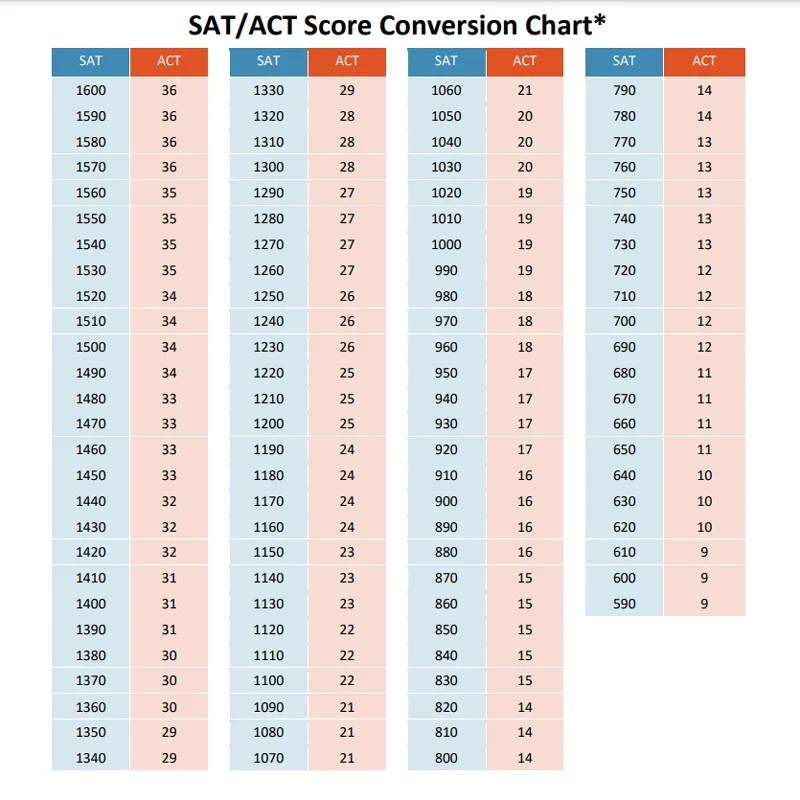
Universities in Vietnam and the U.S. typically require only one of these two certificates alongside other admission criteria for university entrance or scholarships. Therefore, you should consider which test aligns better with your strengths. Choose the one where you are confident you can achieve a higher score and start building your study plan immediately.
You can refer to the conversion table between the two tests below.
Additionally, the following factors can help you choose the right test:
Advantages of the SAT
- The Digital SAT is held entirely on a computer using the Bluebook software, which is ideal for those comfortable with a digital learning environment.
- The Digital SAT provides more time per question (65 seconds), reducing time-related pressure compared to the ACT.
- The SAT does not have a science section, so if you are not confident in your scientific knowledge, the SAT may be the better choice.
- The Digital SAT lasts just over 2 hours, whereas the ACT is longer (2 hours 55 minutes).
Advantages of the ACT
- The ACT has a dedicated science section, suitable for those confident in data analysis and scientific reasoning.
- In Vietnam, the ACT is still typically held on paper, so if you are accustomed to this format and prefer not to test on a computer, the ACT may be a better fit.
- ACT questions are arranged from easiest to hardest and do not change during the test, allowing you to know the structure and difficulty level in advance.
- If you want a more comprehensive test: The ACT covers more skills (English, Math, Reading, Science, and optional Writing), allowing you to showcase your abilities across a wider range of fields.
These are the detailed insights ECE wanted to share regarding the DSAT and ACT. We hope this article helps you evaluate and choose the test that is best for you.





 Khai giảng Khóa học Hè cực HOT.
Chưa có bình luận nào!