
Tóm Tắt Nội Dung Bài Viết
The IELTS Reading test from August 3, 2024, featured a particularly engaging passage on the topic of Renewable Energy – a subject that is both academic and highly relevant to current events. In the passage titled “An insight into the progress in renewable energy research,” candidates were introduced to emerging technologies such as wind and solar power, wave energy, and even steam generated from hot rocks deep underground.
This ECE English guide provides you with:
-
A comprehensive, step-by-step analysis of every question in the test.
-
A collection of academic vocabulary and useful structures applicable to IELTS Writing and Speaking.
-
Accurate answers with detailed explanations to help you understand not just the “what,” but the “why” behind each correct choice.
If you are aiming for an IELTS Reading band score of 6.5–8.0+, this is an essential resource to save for your study sessions.
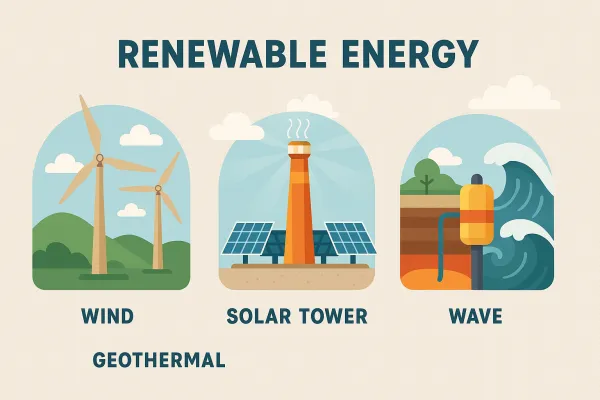
Reading Passage: An insight into the progress in renewable energy research
A
The race is on for the ultimate goal of renewable energy: electricity production at prices that are competitive with coal-fired power stations, but without coal’s pollution. Some new technologies are aiming to be the first to push coal from its position as Australia’s chief source of electricity.
B
At the moment the front-runner in renewable energy is wind technology. According to Peter Bergin of Australian Hydro, one of Australia’s leading wind energy companies, there have been no dramatic changes in windmill design for many years, but the cumulative effects of numerous small improvements have had a major impact on cost. ‘We’re reaping the benefits of 30 years of research in Europe, without having to make the same mistakes that they did,’ Mr Bergin says.
C
Electricity can be produced from coal at around 4 cents per kilowatt-hour, but only if the environmental costs are ignored. ‘Australia has the second cheapest electricity in the world, and this makes it difficult for renewables to compete,’ says Richard Hunter of the Australian Ecogeneration Association (AEA). Nevertheless, the AEA reports: ‘The production cost of a kilowatt-hour of wind power is one-fifth of what it was 20 years ago,’ or around 7 cents per kilowatt-hour.
D
Australian Hydro has dozens of wind monitoring stations across Australia as part of its aim to become Australia’s pre-eminent renewable energy company. Despite all these developments, wind power remains one of the few forms of alternative energy where Australia is nowhere near the global cutting edge, mostly just replicating European designs.
E
While wind may currently lead the way, some consider a number of technologies under development have more potential. In several cases, Australia is at the forefront of global research in the area. Some of them are very site-specific, ensuring that they may never become dominant market players. On the other hand, these newer developments are capable of providing more reliable power, avoiding the major criticism of windmills – the need for back-up on a calm day.
F
One such development uses hot, dry rocks. Deep beneath South Australia, radiation from elements contained in granite heats the rocks. Layers of insulating sedimentation raise the temperatures in some locations to 250°C. An Australian firm, Geoenergy, is proposing to pump water 3.5 kilometres into the earth, where it will travel through tiny fissures in the granite, heating up as it goes until it escapes as steam through another drilled hole.
G
No greenhouse gases are produced, but the system needs some additional features if it is to be environmentally friendly. Dr Prue Chopra, a geophysicist at the Australian National University and one of the founders of Geoenergy, notes that the steam will bring with it radon gas, along through a heat exchanger and then sent back underground for another cycle. Technically speaking, hot dry rocks are not a renewable source of energy. However, the Australian source is so large it could supply the entire country’s needs for thousands of years at current rates of consumption.
H
Two other proposals for very different ways to harness sun and wind energy have surfaced recently. Progress continues with Australian company EnviroPower’s plans for Australia’s first solar chimney near Mildura, in Victoria. Under this scheme, a tall tower will draw hot air from a greenhouse built to cover the surrounding 5 km². As the air rises, it will drive a turbine to produce electricity. The solar tower combines three very old technologies – the chimney, the turbine and the greenhouse – to produce something quite new. It is this reliance on proven engineering principles that led Enviropower’s CEO, Richard Davies, to state: ‘There is no doubt this technology will work, none at all.’
I
This year, Enviropower recognized that the quality of sunlight in the Mildura district will require a substantially larger collecting area than was previously thought. However, spokesperson Kay Firth says that a new location closer to Mildura will enable Enviropower to balance the increased costs with extra revenue. Besides saving in transmission costs, the new site ‘will mean increased revenue from tourism and use of power for telecommunications. We’ll also be able to use the outer 500 metres for agribusiness.’ Wind speeds closer to the tower will be too high for farming.
J
Another Australian company, Wavetech, is achieving success with ways of harvesting the energy in waves. Wavetech’s invention uses a curved surface to push waves into a chamber, where the flowing water column pushes air back and forth through a turbine. Wavetech was created when Dr Tim Devine offered the idea to the world leader in wave generator manufacturers, who rather surprisingly rejected it. Dr Devine responded by establishing Wavetech and making a number of other improvements to generator design. Wavetech claims that, at appropriate sites, ‘the cost of electricity produced with our technology should be below 4 cents per kilowatt-hour.’
K
The diversity of forms of greenhouse-friendly energy under development in Australia is remarkable. However, support on a national level is disappointing. According to Richard Hunter of the AEA, ‘Australia has huge potential for wind, sun and wave technology. We should really be at the forefront, but the reality is we are a long way behind.’
Questions 1–7: TRUE / FALSE / NOT GIVEN
Do the following statements agree with the information given in Reading Passage?
In boxes 1–7 on your answer sheet, write:
-
TRUE – if the statement agrees with the information
-
FALSE – if the statement contradicts the information
-
NOT GIVEN – if there is no information on this
-
In Australia, alternative energies are less expensive than conventional electricity.
-
Geoenergy needs to adapt its system to make it less harmful to the environment.
-
Dr Prue Chopra has studied the effects of radon gas on the environment.
-
Hot, dry rocks could provide enough power for the whole of Australia.
-
The new Enviropower facility will keep tourists away.
-
Wavetech was established when its founders were turned down by another company.
-
According to AEA, Australia is a world leader in developing renewable energy.
Questions 8–13: Matching Statements to Companies
Look at the following statements (Questions 8–13) and the list of companies below.
Match each statement with the correct company, A–D.
Write the correct letter, A–D, in boxes 8–13 on your answer sheet.
NB: You may use any letter more than once.
List of Companies:
A. Australian Hydro
B. Geoenergy
C. Enviropower
D. Wavetech
8. During the process, harmful substances are prevented from escaping.
9. Water is used to force air through a special device.
10. Techniques used by other countries are being copied.
11. The system can provide services other than energy production.
12. It is planned to force water deep under the ground.
13. Original estimates for part of the project have been revised.
Academic Vocabulary & Useful Structures
| Vocabulary | Type | Meaning |
|---|---|---|
| cumulative | adj | accumulated |
| cutting edge | n/adj | advanced, modern |
| site-specific | adj | specific to a location |
| fissure | n | crack/crevice |
| exchanger | n | heat exchanger |
| harness | v | utilize (energy, resources) |
| proven engineering principles | collocation | established technical principles |
| revise estimates | v + n | adjust predictions |
| front-runner | n | leader |
| at the forefront | idiom | at the leading edge |
1. “The race is on for the ultimate goal of…”: A structure emphasizing a current goal or trend.
📌 Example: “The race is on for the ultimate goal of renewable energy: electricity production at prices that are competitive with coal…”
2. “reaping the benefits of…”: An advanced collocation replacing “benefiting from.”
📌 Example: “We’re reaping the benefits of 30 years of research in Europe…”
3. “without having to…”: A concise way to express “without the need to” – natural and academic.
📌 Example: “…without having to make the same mistakes…”
4. “ensuring that…”: A strong structure that emphasizes the result of an action.
📌 Example: “…ensuring that they may never become dominant market players…”
5. “It is this reliance on…that led to…”: A structure emphasizing cause and effect.
📌 Example: “It is this reliance on proven engineering principles that led Enviropower’s CEO to state…”
6. “Technically speaking,…”: Used to introduce a professional or technical aspect – excellent for Academic Writing.
📌 Example: “Technically speaking, hot dry rocks are not a renewable source…”
7. “remarkable diversity of…”: An advanced expression replacing “many kinds of.”
📌 Example: “The diversity of forms of greenhouse–friendly energy… is remarkable.”
8. “According to [expert],…”: A standard way to cite experts – perfect for IELTS Writing Task 2.
📌 Example: “According to Richard Hunter of the AEA…”
Answer Key
✅ QUESTIONS 1–7: TRUE / FALSE / NOT GIVEN
1. In Australia, alternative energies are less expensive than conventional electricity. → FALSE
🔍 Keywords: “alternative energies”, “less expensive”, “conventional electricity”
📌 Evidence (Paragraph C):
“Electricity can be produced from coal at around 4 cents per kilowatt-hour… wind power… around 7 cents…”
📌 Explanation:
-
4 cents (coal) < 7 cents (wind). The statement contradicts the passage, as alternative energy is more expensive than coal power.
✅ Answer: FALSE
2. Geoenergy needs to adapt its system to make it less harmful to the environment. → TRUE
🔍 Keywords: “Geoenergy”, “adapt”, “less harmful”
📌 Evidence (Paragraph G):
“…needs some additional features if it is to be environmentally friendly.”
📌 Explanation:
-
The text indicates the system requires further adjustments to meet environmental standards. This aligns with “adapt… less harmful.”
✅ Answer: TRUE
3. Dr Prue Chopra has studied the effects of radon gas on the environment. → NOT GIVEN
🔍 Keywords: “studied”, “effects”, “radon gas”, “environment”
📌 Evidence (Paragraph G):
“…the steam will bring with it radon gas… Dr Prue Chopra…”
📌 Explanation:
-
The text mentions radon and Dr. Chopra, but does not state that she studied its environmental effects.
✅ Answer: NOT GIVEN
4. Hot, dry rocks could provide enough power for the whole of Australia. → TRUE
🔍 Keywords: “Hot, dry rocks”, “enough power”, “whole of Australia”
📌 Evidence (Paragraph G):
“…so large it could supply the entire country’s needs for thousands of years…”
📌 Explanation:
-
The claim Chia sẻ:


 Khai giảng Khóa học Hè cực HOT.
Chưa có bình luận nào!