
Tóm Tắt Nội Dung Bài Viết
Among English verb tenses, the Present Simple is the most fundamental and frequently used. Mastering this tense is the first and most important step toward building a solid grammatical foundation, enabling you to communicate clearly and effectively in both writing and speech.
A clear understanding of the definition, usage, and structure of the Present Simple helps you express your ideas accurately and avoid basic errors. Furthermore, it is essential foundational knowledge if you aim to conquer standardized English tests like IELTS, where grammatical accuracy is a critical assessment criterion.
1. What is the Present Simple?
The Present Simple is used to express:
- General truths and facts: Things that are always true.
Example: The sun rises in the East.
Example: Water boils at 100 degrees Celsius.
- Habits and repeated actions: Activities that happen regularly.
Example: I drink coffee every morning.
Example: She often visits her grandparents on weekends.
- Fixed schedules and timetables: Train, bus, or flight schedules, TV programs, class timetables, etc. (often implying the near future).
Example: The train to Hai Phong leaves at 6:00 AM.
Example: The meeting starts in ten minutes.
- Current states, feelings, thoughts, and possession: Often used with state verbs such as be, seem, know, believe, like, want, need, understand, have…
Example: He seems tired today.
Example: They have two children.
Example: I understand the problem now.
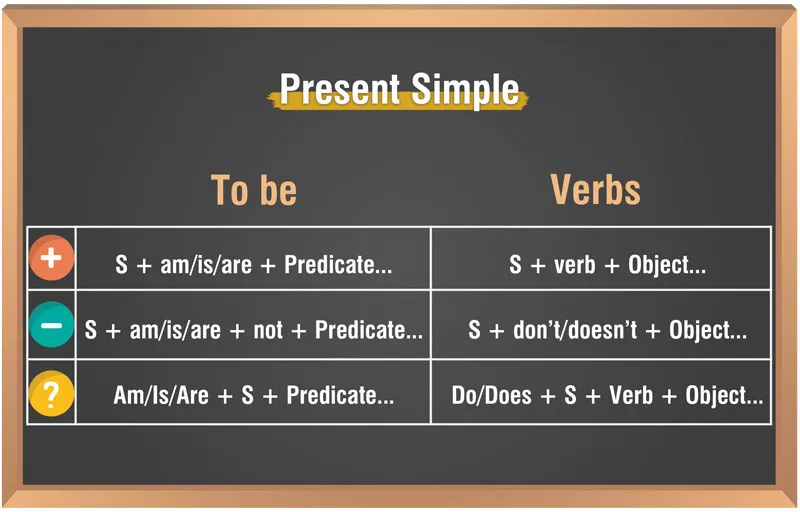
2. Present Simple Formulas
Mastering these formulas helps you construct grammatically correct sentences.
3. Detailed Usage of the Present Simple
Understanding these specific cases helps you apply this tense flexibly:
- Habits and repeated actions: The most common usage, often accompanied by adverbs of frequency.
Example: My brother plays football every Saturday.
Application: When talking about your daily routines (e.g., in IELTS Speaking Part 1), the Present Simple is the correct choice.
- General truths and scientific facts: Things that do not change over time.
Example: The Moon goes around the Earth.
Application: Frequently found in scientific texts and news (e.g., in IELTS Reading).
- Schedules and timetables: Used for public events that have been scheduled.
Example: The supermarket closes at 10 PM.
Application: Useful when listening to announcements about schedules (e.g., in IELTS Listening).
- States, feelings, thoughts, and possession: Used with state verbs.
Example: I prefer tea to coffee. / She knows the answer.
Important Note: These verbs are generally not used in continuous forms (V-ing). Using them correctly is a sign of grammatical mastery.
- Instructions and directions: Often used in the imperative form.
Example: Open your books to page 50. / Turn left at the traffic lights.
- In Zero and First Conditionals:
Zero Conditional (General truths): If you heat ice, it melts.
First Conditional (Possible future events): If it rains tomorrow, we will stay home.
- In newspaper headlines: To create a sense of immediacy and vividness.
Example: Earthquake hits California.
- Summarizing books, films, or plays:
Example: In this chapter, the main character discovers a secret.
4. Identifying the Present Simple
Correctly identifying verb tenses is crucial for understanding the exact meaning of a sentence, especially when reading or listening to dialogues. The Present Simple is often accompanied by specific adverbs and phrases that help us determine that the action or state is a habit, a general truth, or a fixed schedule. Below are the common groups of indicators and details on how they are used:
Adverbs of Frequency
These are the clearest indicators of the Present Simple when describing habits or how often an action occurs.
-
Common adverbs:
- always (100%)
- usually, generally, frequently, often (70-90%)
- sometimes, occasionally (30-50%)
- seldom, rarely, hardly ever (5-10%)
- never (0%)
-
Position in the sentence:
- Before ordinary verbs: This is the most common position.
- Example: She often visits her parents at weekends.
- Example: I never eat fast food because it’s unhealthy.
- Example: They sometimes play chess in the evening.
- After the verb “to be” (am/is/are):
- Example: He is always late for class.
- Example: The weather in Hanoi is usually hot in summer.
- Between the auxiliary verb (do/does) and the main verb (in negative or interrogative sentences, less common but still encountered):
- Example: She doesn’t often go out.
- Example: Do you usually walk to school?
- Before ordinary verbs: This is the most common position.
-
Meaning: These adverbs indicate the frequency of an action, helping the reader/listener visualize the habit or frequency being discussed.
Expressions of Frequency/Repetition
Besides single adverbs, many phrases are used to indicate repetition according to a specific cycle.
-
Common phrases:
- every day/week/month/year/morning/Sunday…
- once/twice/three times a day/week/month/year…
- daily, weekly, monthly, quarterly, yearly 1
1. binggo.edu.vn
- on Mondays/Tuesdays… – indicating a habit repeated on that day.
- at weekends/at night – indicating a habit.
- in the morning/afternoon/evening – indicating a habit.
-
Position in the sentence: These phrases usually stand at the end of the sentence or at the beginning (for emphasis).
- Example: We visit our grandparents once a month.
- Example: Every morning, my father reads the newspaper.
- Example: The shop closes at 7 PM daily.
Implicit Context
Sometimes, without adverbs or frequency phrases, the context of the sentence is enough to indicate the Present Simple. This usually occurs when the sentence expresses:
- Scientific facts or universal truths:
Example: The human body contains a large amount of water. – No adverb needed; this is a fact.
- Definitions or inherent characteristics:
Example: A dictionary provides definitions of words.
- Fixed states or beliefs:
Example: She believes in honesty.
- Established schedules:
Example: The academic year begins in September.
5. Rules for Conjugating Verbs in the Present Simple
Conjugating verbs correctly according to the subject is one of the most fundamental pillars of English grammar. Mastering these rules not only helps you express yourself clearly and avoid misunderstandings but also demonstrates care and professionalism in both writing and speech.
In particular, Subject-Verb Agreement (SVA) is a grammatical aspect emphasized in language proficiency tests like IELTS, where accuracy is a key assessment criterion. Errors in this area, however small, can affect your score.
Let’s explore the detailed rules for conjugating verbs in the Present Simple:
A. Basic Rules for Ordinary Verbs
Verb conjugation depends on the person and number of the subject.
-
Rule 1: Base Form
When the subject is I, You, We, They or a plural noun, the ordinary verb is kept in its base form (infinitive without ‘to’).
-
-
- Example: I read books every day.
- Example: You speak English very well.
- Example: We live in Hanoi. (Data updated as of April 24, 2025).
- Example: They work in the same office.
- Example: The students understand the lesson.
-
-
Rule 2: Adding “-s” to the verb
This is the most common rule when the subject is the third-person singular (He, She, It) or a singular noun.
-
-
- Example: He reads the newspaper every morning.
- Example: She works as a doctor.
- Example: It rains a lot in the summer.
- Example: My dog sleeps under the table.
- Example: The company provides excellent service.
-
-
Rule 3: Adding “-es” to the verb
When the verb ends in the sounds or letters -s, -ss, -sh, -ch, -x, -z, -o, we add “-es” instead of just “-s”. Adding “-es” usually creates an extra syllable /ɪz/, making pronunciation easier.
-
-
- Example: miss -> misses
- Example: wash -> washes
- Example: watch -> watches
- Example: teach -> teaches
- Example: fix -> fixes
- Example: buzz -> buzzes
- Example: go -> goes
- Example: do -> does
-
-
Rule 4: Verbs ending in “-y”
Consonant + y: If the verb ends in a consonant followed by “-y”, change “-y” to “-i” and add “-es”.
-
-
- Example: study -> studies
- Example: try -> tries
- Example: cry -> cries
- Example: carry -> carries
- Example: fly -> flies
-
Vowel + y: If the verb ends in a vowel (a, e, i, o, u) followed by “-y”, just add “-s”.
-
-
- Example: play -> plays
- Example: enjoy -> enjoys
- Example: stay -> stays
- Example: buy -> buys
- Example: say -> says
-
-
Rule 5: Irregular Verbs
Some very common verbs have special conjugations in the Present Simple that you need to memorize:
-
-
- to be: I am / You are / He/She/It is / We are / They are
- to have: I/You/We/They have / He/She/It has
- (Auxiliary) to do: I/You/We/They do / He/She/It does
-
B. Subject-Verb Agreement (SVA)
This is the core and most confusing part. The basic principle is: Singular subjects take singular verbs (-s/-es), and plural subjects take plural verbs (base form). However, identifying the correct subject and corresponding verb form can sometimes be complex.
-
Identifying the correct Subject: Do not be misled by words or phrases between the subject and the verb.
- Prepositional phrases: The verb agrees with the main subject, not the noun in the prepositional phrase.
- Example: The quality of these apples is excellent. (Subject is “quality”, singular).
- Example: The students in my class work very hard. (Subject is “students”, plural).
- Relative clauses: Similarly, the verb agrees with the main subject.
- Example: The man who called you earlier is waiting outside. (Subject is “man”, singular).
- Prepositional phrases: The verb agrees with the main subject, not the noun in the prepositional phrase.
-
Compound subjects joined by “and”: Usually take a plural verb.
- Example: My brother and sister live abroad.
- Exception: When two nouns joined by “and” refer to a single dish, concept, or person, use a singular verb. Example: Bread and butter is a simple breakfast. / My best friend and advisor is Mr. Smith.
-
Compound subjects joined by “or”, “nor”, “either…or”, “neither…nor”: The verb agrees with the subject closest to it.
- Example: Neither the plates nor the bowl goes on that shelf. (Bowl is closer
Chia sẻ:
- Example: Neither the plates nor the bowl goes on that shelf. (Bowl is closer





 Khai giảng Khóa học Hè cực HOT.
Chưa có bình luận nào!