
Tóm Tắt Nội Dung Bài Viết
In the English tense system, the Present Continuous plays a vital role in describing actions or events happening right at the moment of speaking or around that time. Mastering this tense not only helps you describe situations vividly and accurately but is also a key factor in communicating naturally and effectively, especially in everyday situations and language proficiency exams.
Understanding the definition, diverse usage, and structure of the Present Continuous will help you avoid confusion with other tenses, particularly the Present Simple, and allow you to express your ideas with flexibility. This is also foundational grammar knowledge that frequently appears in standardized English exams like IELTS, where precision and the ability to use a wide range of language are critical assessment criteria.
1. What is the Present Continuous?
The Present Continuous Tense, also known as the Present Progressive Tense, is used to describe:
- Actions happening at the moment of speaking: This is the most common usage, emphasizing events currently in progress as they are being mentioned.
Example: I am studying English right now.
Example: Look! The children are playing in the yard.
- Actions happening around the time of speaking (not necessarily at the exact moment): Describing a temporary action or situation currently in progress over a period of time in the present.
Example: She is working on a new project this month.
Example: We are reading an interesting book at the moment.
- Events or plans that are certain to happen in the near future (already arranged): Often accompanied by future time adverbs.
Example: They are flying to Da Nang tomorrow morning.
Example: I am meeting my friends for dinner tonight.
- Ongoing changes or developments: Describing trends or progress.
Example: The climate is getting warmer.
Example: Your English is improving a lot.
- Repeated actions that cause annoyance or frustration: Often used with “always,” “constantly,” or “continually.”
Example: He is always losing his keys!
Example: She is constantly complaining about her job.
2. Present Continuous Formulas
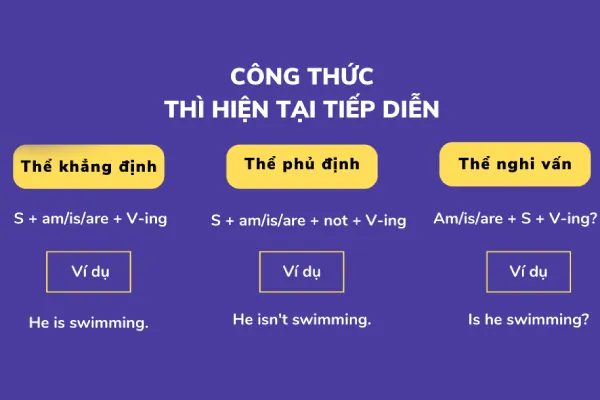
Mastering these formulas helps you construct grammatically correct sentences and express your ideas accurately.
(Note: S: Subject, V-ing: Verb + -ing, O: Object, A: Adverbial)
3. Detailed Usage of the Present Continuous
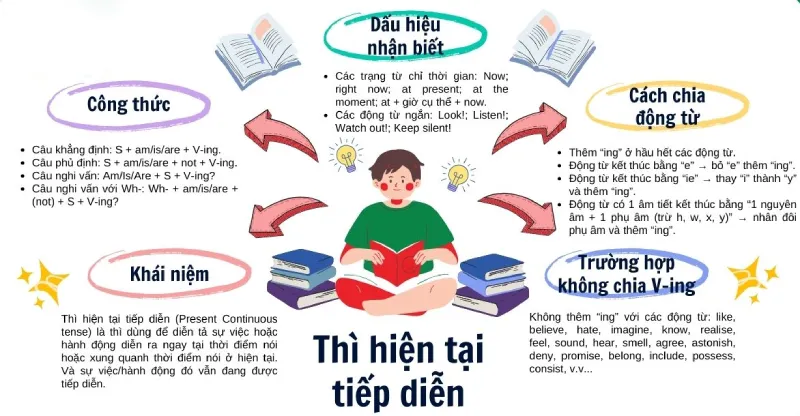
Understanding these specific cases helps you apply this tense flexibly and accurately:
- Describing actions happening at the moment of speaking:
Often accompanied by adverbs like “now,” “right now,” “at the moment,” “at present,” or imperative phrases like “Look!”, “Listen!”, “Be quiet!”.
Example: Listen! Someone is crying.
Application: Very common in daily communication, describing what is happening directly (e.g., in IELTS Speaking Part 1 when asked what you are doing, or Part 2 when telling a story and wanting to describe an action at a specific moment).
- Describing temporary actions or situations around the present:
These actions may not be happening at the exact moment of speaking but are in progress over a certain period (e.g., this week, these days, this semester).
Example: I am living with my aunt for a few months.
Example: He is learning to play the guitar.
Application: Helps distinguish from long-term habits or states (which use the Present Simple).
- Describing definite plans or arrangements in the near future:
A common way to talk about scheduled or arranged events.
Example: What are you doing next weekend?
Example: We are having a party on Saturday.
Application: Often used in IELTS Speaking Part 1 when talking about personal plans, or in Listening when hearing about schedules.
- Describing changes, developments, or trends:
Often used with verbs like “get,” “become,” “change,” “increase,” “decrease,” “improve,” “grow.”
Example: The number of students using online resources is increasing.
Application: Important in IELTS Writing Task 1 (Academic) when describing chart trends, or in Writing Task 2 and Speaking Part 3 when discussing changing social issues.
- Describing repeated actions that cause annoyance (with “always,” “constantly,” “continually”):
Conveys a negative, complaining tone.
Example: My neighbour is always playing loud music at night!
Note: Different from “always” in the Present Simple, which describes a regular habit.
Important Note on State Verbs: Certain verbs indicating states, perception, emotions, or possession are generally not used in the Present Continuous. Instead, they are used in the Present Simple even when describing a current state. Common state verbs include:
- Senses/Perception: see, hear, smell, taste, feel, notice, recognize
- Thoughts/Opinions: think (believe), believe, know, understand, remember, forget, doubt, mean, suppose, realize
- Emotions: like, love, hate, prefer, want, wish, need, desire
- Possession: have (possess), own, possess, belong to
- Other states: be, seem, appear, cost, weigh, consist of, contain, look (seem)
Example:
- INCORRECT: I am knowing the answer. CORRECT: I know the answer.
- INCORRECT: She is wanting a new phone. CORRECT: She wants a new phone.
However, some verbs can function as both state verbs and action verbs, depending on their meaning in the sentence:
- think:
I think this is a good idea. (opinion – Present Simple)
What are you thinking about? (the act of thinking – Present Continuous)
- have:
She has blue eyes. (possession – Present Simple)
They are having dinner now. (experience/the act of eating – Present Continuous)
- see:
I see a bird in the tree. (perceiving with eyes – Present Simple)
I am seeing my doctor tomorrow. (meeting by appointment – Present Continuous)
- taste/smell/feel:
This soup tastes delicious. (state of flavor – Present Simple)
The chef is tasting the soup. (the act of tasting – Present Continuous)
4. Identifying the Present Continuous
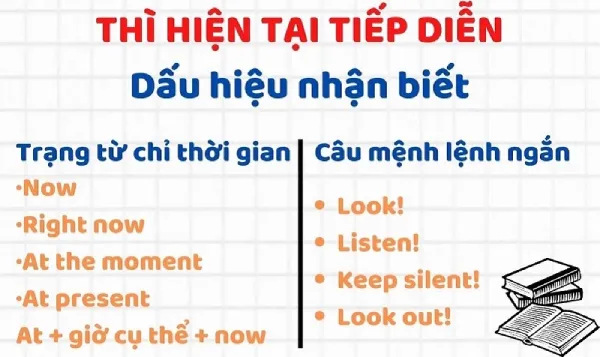
Correctly identifying the tense helps you understand the exact meaning of a sentence, especially in reading and listening. The Present Continuous is often accompanied by the following adverbs and phrases:
- Indicating the present moment:
- now
- right now
- at the moment
- at present
- currently
- Example: She is working on her computer at the moment.
- Immediate imperative sentences:
- Look!
- Listen!
- Be quiet! / Keep silent!
- Hurry up!
- Example: Look! It is raining.
- Indicating a temporary period around the present:
- today
- this week/month/year/semester…
- these days
- Example: He is staying with his grandparents this week.
- Indicating the near future (when expressing plans):
- tomorrow
- next week/month/year…
- tonight
- Example: We are visiting our relatives next Sunday.
- Expressing annoyance (with specific frequency adverbs):
- always
- constantly
- continually
- Example: You are always interrupting me!
Placement: These adverbs usually appear at the end of the sentence or at the beginning (for emphasis). Imperative sentences usually stand at the beginning. “Always,” “constantly,” and “continually,” when used to complain, typically appear between “to be” and “V-ing.”
5. Rules for adding “-ing” to verbs
Adding “-ing” to verbs correctly is essential for proper grammar and spelling.
- General rule: Add “-ing” to the base form of the verb.
Example: work -> working, read -> reading, go -> going, study -> studying
- Verbs ending in a silent “e”: Drop the “e” and add “-ing”.
Example: write -> writing, make -> making, come -> coming, dance -> dancing
Exceptions: dye -> dyeing, see -> seeing, be -> being, age -> ageing
- One-syllable verbs ending in a single consonant preceded by a single vowel: Double the final consonant and add “-ing”.
(Vowels: u, e, o, a, i)
Example: stop -> stopping, run -> running, get -> getting, put -> putting, plan -> planning
Note: Do not double the final consonant if it is -w, -x, or -y.
Example: fix -> fixing, snow -> snowing, play -> playing
- Verbs with two or more syllables ending in a single consonant preceded by a single vowel, with the stress on the final syllable: Double the final consonant and add “-ing”.
Example: begin -> beginning, prefer -> preferring, permit -> permitting, admit -> admitting
If the stress is not on the final syllable, do not double the final consonant.
Example: listen -> listening (stress on ‘lis’), open -> opening (stress on ‘o’), visit -> visiting
Special note for British English: Verbs ending in -l after a single vowel are usually doubled, regardless of stress.
Example: travel -> travelling (UK), traveling (US); cancel -> cancelling (UK), canceling (US)
- Verbs ending in “-ie”: Change “-ie” to “-y” and add “-ing”.
Example: lie -> lying, die -> dying, tie -> tying
- Verbs ending in “-c”: Add “-k” before adding “-ing”.
Example: panic -> panicking, mimic -> mimicking, traffic -> trafficking
6. Distinguishing Present Continuous vs. Present Simple
These are two basic tenses that are often confused. Below is a detailed comparison table:
7. Present Continuous in Specific Contexts
General Academic Writing
- Describing ongoing trends: When analyzing data or social phenomena that are changing.
Example: The global temperature is currently rising at an alarming rate.
- Referring to ongoing research:
Example: Researchers are investigating new methods to combat the disease.
IELTS Writing Task 1 (Academic – Describing charts, maps, processes)
- Describing trends: If the chart shows data points up to the “present” and indicates an ongoing change.
Example: From 2020 onwards, the percentage of renewable energy consumption is showing a steady increase.
- Describing near-future projections presented as an ongoing process:
Example: It is projected that the population will be reaching 10 million by 2030.
IELTS Writing Task 1 (General Training – Letter Writing)
- Explaining current situations:
Example: I am writing to inform you that I am currently experiencing some issues with my internet connection.
- Talking about plans and arrangements:
Example: I am arriving on Monday morning and am planning to stay for three days.
IELTS Writing Task 2 (Essay Writing)
Describing current social issues or trends:
Example: Many urban areas are currently facing challenges related to overpopulation and traffic congestion.
Example: The way people communicate is constantly changing due to technological advancements.
IELTS Speaking Part 1 (Answering personal questions)
Talking about what you are doing (currently or temporarily):
Q: What are you doing these days? A: I am preparing for my IELTS exam. / I am working part-time at a cafe.
Talking about near-future plans:
Q: What are you doing this weekend? A: I am visiting my grandparents.
IELTS Speaking Part 2 (Describing a topic)
Setting the scene for a story: When you want to describe an action in progress at a specific moment in the past (using Past Continuous), but if the story relates to the present or near future, the Present Continuous can be used.
Describing what is happening in a picture/video:
Example: In this picture, a group of people are sitting around a table and they are laughing.
Describing plans related to the topic:
Example (Describing a goal): My goal is to become a doctor, and I am currently studying biology very hard.
IELTS Speaking Part 3 (In-depth discussion)
Discussing trends and changes in society:
Example: How is technology changing the way we work?
Example: I think more and more people are becoming aware of environmental issues.
Making predictions or talking about future plans (based on the current situation):
Example: Governments are planning to invest more in renewable energy.
Other Contexts
Describing pictures: The sun is shining, and birds are singing.
Storytelling (adding vividness to the present): “So, I am walking down the street, and suddenly…”
Live commentary (sports, events): He is passing the ball to his teammate!
8. Upgrading your expression with the Present Continuous in IELTS
To enrich your speaking and writing, you can use more diverse phrases and structures instead of just using “is/are + V-ing” repetitively.
- Describing ongoing actions/trends:
Instead of: “The number of people is increasing.”
Use: “The number of people is currently experiencing a significant rise/upturn.”
Instead of: “The company is changing.”
Use: “The company is undergoing a major transformation/a period of transition.”
“X is steadily growing/declining.”
“We are witnessing a shift towards…”
-
<




 Khai giảng Khóa học Hè cực HOT.
Chưa có bình luận nào!