
Tóm Tắt Nội Dung Bài Viết
In English, prepositions are fundamental words used to link nouns, pronouns, or noun phrases to other parts of a sentence. They help express relationships involving time, place, direction, cause, manner, and more. Mastering prepositions is essential for constructing sentences that are clear, precise, and as natural as those of a native speaker.
Furthermore, a solid grasp of definitions, usage, and collocations not only helps you avoid basic communication errors but is also a core requirement for achieving high scores in standardized English tests like IELTS. Specifically, in sections such as IELTS Writing Task 1 (describing charts, e.g., a rise **in** sales, peaked **at** 50%) or IELTS Writing Task 2 (using academic phrases, e.g., a solution **to** this problem, in spite **of** the drawbacks), the accurate use of prepositions is a key factor in demonstrating Grammatical Accuracy and Coherence.
What are Prepositions?
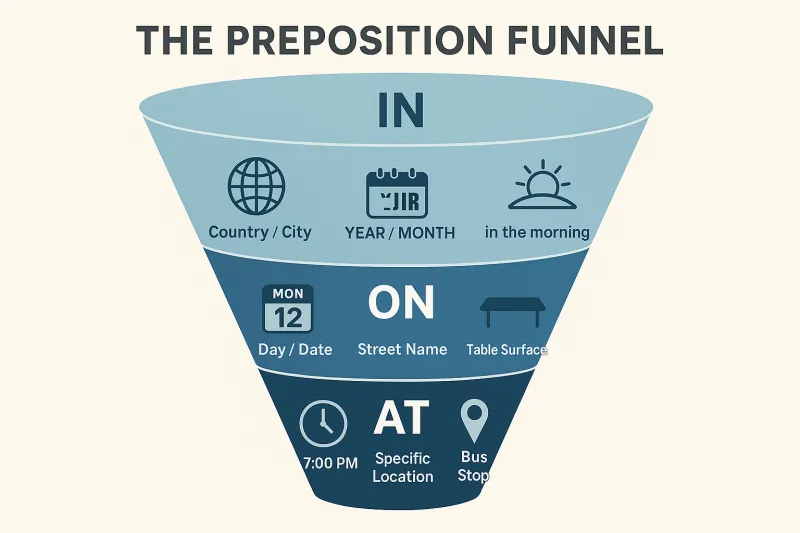
A preposition (abbreviated as prep) is a word or group of words typically placed before a noun, pronoun, or gerund (V-ing) to indicate its relationship with other words in a sentence.
Prepositions are used to express:
- Time:
- Example: I will meet you at 5 PM.
- Example: She was born in 1995.
- Place:
- Example: The book is on the table.
- Example: He lives in Hanoi.
- Direction/Movement:
- Example: She walked towards the door.
- Example: The cat jumped over the fence.
- Manner/Means:
- Example: He goes to school by bus.
- Example: Please write with a pen.
- Reason/Purpose:
- Example: He studies hard for the exam.
- Example: We canceled the trip because of the rain.
- Possession/Origin:
- Example: He is a friend of mine.
- Example: This table is made of wood.
Position of Prepositions
Understanding their placement helps you identify and use them correctly.
- After a verb: Often forming phrasal verbs or verbs with fixed prepositions.
- Example: We are waiting for the bus.
- Example: You should listen to your teacher.
- After an adjective: Forming fixed “Adjective + Preposition” collocations.
- Example: She is afraid of spiders.
- Example: I am interested in history.
- After a noun: Forming fixed “Noun + Preposition” collocations.
- Example: There is no reason for his behavior.
- Example: What is the solution to this problem?
- At the end of Wh- Questions:
- Example: What are you looking at?
- Example: Who did you go with?
Classification and Detailed Usage of Common Prepositions
English prepositions are highly diverse. The best way to master them is to categorize them by function.
1. Prepositions of Time
This is the most fundamental and important group, often causing confusion.
| Preposition | Detailed Usage | Example |
| IN | (General / Longer periods)
* Used for centuries, decades, years, seasons, months. * Used for parts of the day. |
in the 21st century
|
| ON | (Specific / Surfaces)
* Used for days of the week. * Used for dates (Day + Month). * Used for holidays containing “Day” or “Eve”. |
on Monday / on weekdays
|
| AT | (Very specific / A point in time)
* Used for precise clock times. * Used for fixed moments of the day. * Used for holidays (general, without “Day”). |
at 7:30 PM / at 8 o’clock
|
Other important prepositions of time:
- For: Indicates a duration (how long an action lasts).
- Example: He lived there for ten years.
- Since: Indicates a starting point (when an action began).
- Example: He has lived here since 2010.
- During: Indicates throughout an event or holiday.
- Example: Please stay silent during the meeting.
- By: Indicates a deadline, before or at a specific time.
- Example: You must submit the report by 5 PM.
- Before / After: Before / After a point in time.
- Example: Brush your teeth before you go to bed.
2. Prepositions of Place
Similar to time, this group often uses IN, ON, AT following the “funnel” rule.
| Preposition | Detailed Usage | Example |
| IN | (3D space / Inside)
* Used for countries, cities, regions. * Used for enclosed spaces (rooms, boxes, cars). |
in Vietnam / in London
|
| ON | (2D space / On a surface)
* Used for flat surfaces (tables, floors, walls). * Used for streets (without house numbers). * Used for public transport (buses, trains). |
on the table / on the floor
|
| AT | (1D space / At a point)
* Used for specific addresses (with house numbers). * Used for public locations (bus stops, airports). |
at 123 Le Loi Street
|
Other important prepositions of place:
- Above / Over: Higher than (usually without contact).
- Example: The picture is above the sofa.
- Under / Below: Lower than.
- Example: The cat is hiding under the table.
- Next to / Beside: Immediately next to.
- Example: He sits next to me.
- Between: Between two objects.
- Example: She sat between her two friends.
- Among: Among a group of 3+ objects.
- Example: He is popular among his classmates.
- In front of: In front of.
- Behind: Behind.
3. Prepositions of Movement
- To: Moving toward a destination.
- Example: I am going to the library.
- From: Moving from a starting point.
- Example: He just came back from Japan.
- Into: Moving inside.
- Example: He walked into the room.
- Out of: Moving out.
- Example: She got out of the car.
- Onto: Moving onto a surface.
- Example: The cat jumped onto the roof.
- Across: Crossing a flat surface (like a road or river).
- Example: Be careful when you walk across the street.
- Through: Moving through a 3D space (like a tunnel or forest).
- Example: We drove through a long tunnel.
- Towards: Moving in the direction of (not necessarily reaching).
- Example: He walked towards the park.
4. Other Functional Preposition Groups
| Type | Prepositions | Example |
| Agent | by | The book was written by Hemingway. |
| Instrument | with | She cut the paper with scissors. |
| Manner/Means | by, on | We travel by car. / I go to school on foot. |
| Reason | because of, due to, on account of | The game was canceled due to bad weather. |
| Purpose | for, to | This tool is for cutting. / I study to pass. |
| Origin/Material | from, of | Wine is made from grapes. / The house is made of brick. |
Important Notes and Common Mistakes
Mastering these rules helps you avoid avoidable errors and demonstrates grammatical precision.
A. Distinguishing Movement Prepositions
Confusing static states with movement is a very common error.
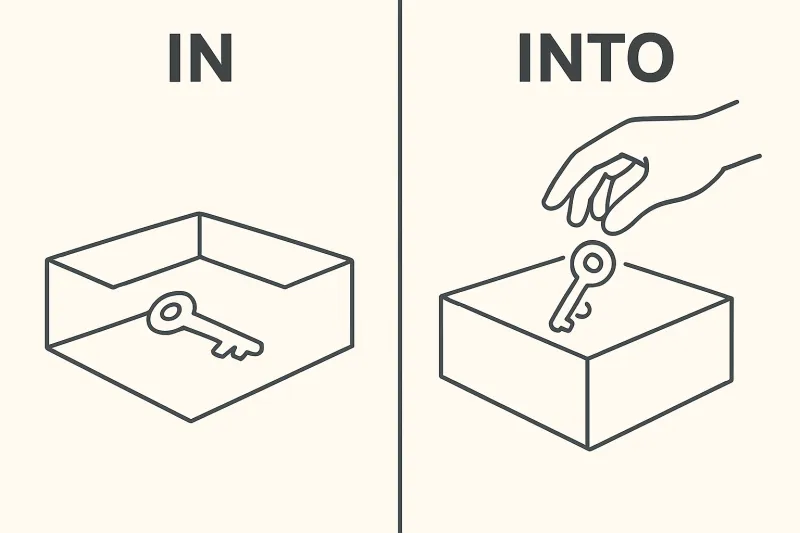
- In (Static) vs. Into (Movement)
In: Indicates a static position (already inside).- Example: The keys are in the drawer.
Into: Indicates an action (moving from outside to inside).- Example: He put the keys into the drawer.
- On (Static) vs. Onto (Movement)
On: Indicates a static position (already on a surface).- Example: The cat is on the table.
Onto: Indicates an action (moving onto a surface).- Example: The cat jumped onto the table.
B. Distinguishing Confusing Phrases
- On time vs. In time
On time: Punctual (according to schedule).- Example: The 9:00 AM train left on time.
In time: Just before it’s too late.- Example: We arrived just in time to catch the train.
- In the end vs. At the end (of)
In the end: Finally (indicating a result).- Example: We argued a lot, but in the end, we reached an agreement.
At the end (of): At the terminal point (position or time).- Example: Please sign your name at the end of the document.
- Beside vs. Besides
Beside: Next to (position).- Example: He sat beside me.
Besides: In addition to (adding information).- Example: Besides English, he also speaks French.
Prepositions in Academic Contexts and IELTS
This advanced section focuses on maximizing your IELTS score through preposition usage.
IELTS Writing Task 1 (Academic – Describing Charts)
The past simple is the primary tense when describing historical data.
- Describing trends (from Nouns):
- Use
into indicate the subject/field of change.- Example: There was a significant increase in the number of tourists.
- Use
ofto indicate the amount of change.- Example: There was an increase of 20% in the number of tourists.
- Use
- Describing trends (from Verbs):
- Use
byto indicate the amount of change.- Example: The number of tourists increased by 20%.
- Use
toto indicate the final point.- Example: The number of tourists increased to 1,200 people.
- Use
- Describing specific points:
- Use
atfor fixed points (peak, low, stable).- Example: Sales peaked at 500 units in 2005.
- Example: The figure remained stable at 30%.
- Use
- Describing proportions:
- Use
forto indicate the subject.- Example: The figure for Germany was 50%.
- Example: Cars accounted for 40% of total transport.
- Use
- Comparison:
- Use
with/to.- Example: Compared with 2000, the figures in 2010 were much higher.
- Example: The rate was 10%, in comparison to only 5% in the previous year.
- Use
IELTS Writing Task 2 (Essay Writing)

In Task 2, prepositions are key to Lexical Resource and Coherence & Cohesion.
- Using accurate Collocations:
- Examiners look for academic “Noun + Preposition” and “Adjective + Preposition” combinations.
- Noun + Preposition:
a solution **to**...an advantage / disadvantage **of**...a reason **for**...an impact / effect **on**...access **to**...an increase / decrease **in**...
- Adjective + Preposition:
aware **of**...responsible **for**...relevant **to**...beneficial **to / for**...dependent **on**...
- Using Complex Prepositions for Cohesion:
- These help increase academic tone and connectivity.
In spite of / Despite(+ Noun/V-ing):- Example: Despite its high cost, space exploration is a necessary investment.
Due to / Owing to / On account of(+ Noun):- Example: Due to the rapid development of technology, many jobs are becoming obsolete.
In addition to(+ Noun/V-ing):- Example: In addition to causing health problems, pollution also harms the economy.
With regard to / In terms of(+ Noun):- Example: With regard to environmental protection, governments must take immediate action.
IELTS Speaking (Part 1, 2, 3)
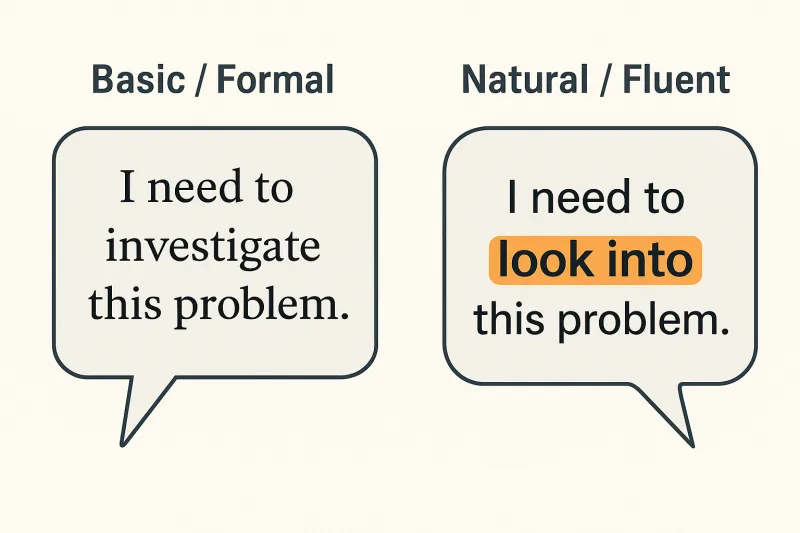
In Speaking, using Phrasal Verbs (Verb + Preposition) naturally is a great way to boost your Lexical Resource score.
- Use Phrasal Verbs instead of single academic words:
- Instead of
cause→ Usebring **about**- Example: The new law brought about many changes.
- Instead of
investigate→ Uselook **into**- Example: The police are looking into the case.
- Instead of
start a hobby→ Usetake **up**- Example: I recently took up photography.
- Instead of
quit→ Usegive **up**- Example: He gave up smoking last year.
- Instead of
mention→ Usepoint **out**- Example: I’d like to point out that…
- Instead of
IELTS Reading
Prepositions act as “signposting language,” helping you identify relationships between ideas and increasing reading speed.
- Contrast signals: When you see
despite,in spite of, orin contrast to, you know the following clause will contradict the previous one. - Cause-Effect signals: When you see
due to,because of, oras a result of, you immediately recognize a causal relationship.
Practice Exercises and Answer Key
Exercise 1: Fill in the prepositions of time and place (In, On, At)
- My flight departs ______ 6:00 PM.
- I was born ______ 1998.
- The cat is sleeping ______ the sofa.
- He lives ______ a small apartment ______ 50 Nguyen Trai Street.
- We usually have a big party ______ New Year’s Eve.
- I saw him ______ the bus stop.
- It rains a lot ______ spring.
- I will finish the project ______ the end of this week.
Exercise 2: Choose the correct preposition
- She sat (beside / besides) her best friend during the ceremony.
- (Beside / Besides) studying English, she also learns French.
- He put the letter (in / into) the envelope.
- My keys are (in / into) my pocket.
- We arrived just (on time / in time) to catch the bus.
- The result will be announced (at the end / in the end) of the month.
- We argued for hours, but (at the end / in the end), we agreed.
- The cat jumped (on / onto) the roof.
Exercise 3: Academic Prepositions (IELTS)
- Governments must find a solution ______ the problem of unemployment.
- The heavy use of plastic has a terrible impact ______ the environment.
- The graph shows a sharp decrease ______ the production of oil.
- The number of visitors peaked ______ 10,000 in 2015.
- ______ its clear benefits, globalization also has some drawbacks. (Use Despite or Because of)
Conclusion
Prepositions are a basic yet vital part of grammar for building accurate, coherent, and natural sentences. Mastering their usage, collocations, and distinguishing easily confused pairs is the key to fluent English communication.
For those preparing for IELTS, the ability to use prepositions flexibly and accurately will boost your score across all four skills. From describing charts in Task 1 (increased **by**...), to arguing in Task 2 (a solution **to**...), to speaking naturally (take **up**...), prepositions are everywhere.
To consolidate your grammar and optimize your skills for the IELTS exam, don’t hesitate to check out the intensive IELTS courses at ECE Language Center. We are committed to providing an effective learning path to help you confidently conquer your goals!
Answer Key:
Exercise 1:
- at
- in
- on
- in / at
- on
- at
- in
- at
Exercise 2:
- beside
- Besides
- into
- in
- in time
- at the end
- in the end
- onto
Exercise 3:
- to
- on
- in
- at
- Despite





 Khai giảng Khóa học Hè cực HOT.
Chưa có bình luận nào!