
Tóm Tắt Nội Dung Bài Viết
In English, the Past Continuous Tense plays a vital role in describing actions that were in progress at a specific moment in the past, or actions occurring simultaneously. This tense helps you “paint a picture” of a past setting, making your storytelling more vivid and detailed.
Understanding the definition, usage, and structure of the Past Continuous is not only essential for avoiding basic errors but also serves as a foundational skill if you are aiming to conquer standardized English exams like IELTS. Especially in sections such as IELTS Speaking Part 2 (describing an event or a memorable day) or IELTS Writing Task 1 (when describing a past situation in a diagram or process), mastering this tense will demonstrate your flexibility and precision in Grammatical Range and Accuracy—one of the four key assessment criteria.
What is the Past Continuous Tense?
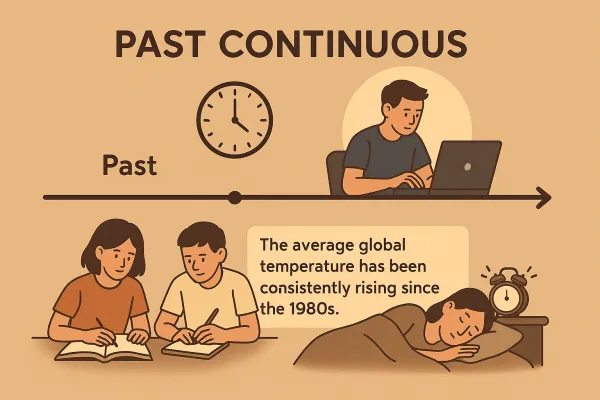
The Past Continuous Tense is used to describe:
-
An action in progress at a specific time in the past: The action was not yet finished at the mentioned time.
Example: At 8 PM last night, I was watching TV.
Example: This time yesterday, they were flying to New York.
-
Two or more actions happening simultaneously in the past: These actions occurred at the same time.
Example: While I was reading a book, my sister was listening to music.
Example: He was cooking dinner while his wife was working on her laptop.
-
An action in progress that was interrupted by a shorter action: The ongoing action (Past Continuous) is interrupted by a sudden, shorter action (Past Simple).
Example: I was having a shower when the phone rang.
Example: She was walking in the park when she met an old friend.
-
Repeated or annoying actions in the past: Often used with always, constantly, or continually.
Example: He was always complaining about his work.
Example: My old car was constantly breaking down.
-
Describing the background or atmosphere of a past story:
Example: The birds were singing, the sun was shining, and people were enjoying the beautiful day.
Past Continuous Formulas
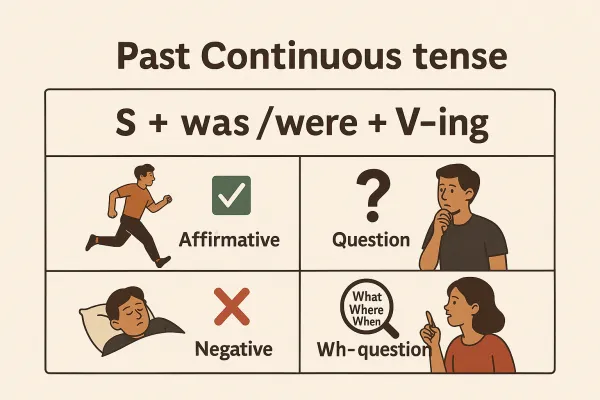
Mastering the formula helps you construct grammatically correct sentences, especially by using the “was/were + V-ing” structure correctly.
(Note: S: Subject, V-ing: Verb + -ing (present participle), O: Object, A: Adverbial) Contractions: was not = wasn’t, were not = weren’t
“Was/were” usage:
- Was: Used with I, He, She, It, singular nouns, and uncountable nouns.
- Were: Used with You, We, They, and plural nouns.
Detailed Usage of the Past Continuous
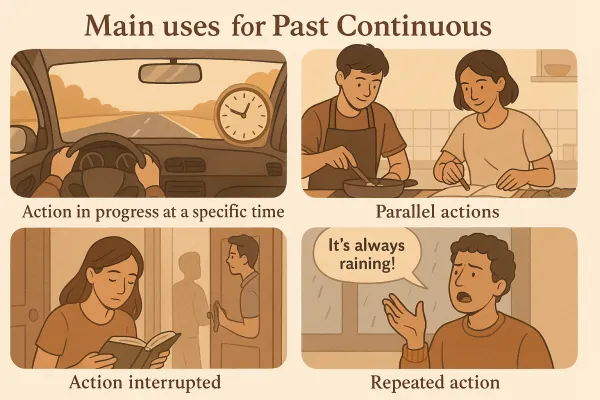
Understanding these scenarios helps you apply this tense flexibly and accurately, especially when describing continuity, parallel actions, or the background of past events.
Actions in progress at a specific time in the past
- Emphasizes that the action was ongoing and incomplete at a specific point in the past.
Example: At 7 AM, I was eating breakfast.
Example: This time last year, I was living in London.
- Distinction from Past Simple:
- Past Continuous (focuses on the process at that moment): I was reading a book at 9 PM last night. (The act of reading was in progress.)
- Past Simple (focuses on the completed action): I read a book last night. (The action was completed; no specific time of progress is implied.)
- Application in IELTS Speaking Part 1 & 2: When asked about what you were doing at a specific time in the past, or when setting the scene for an event.
Two or more parallel actions in the past
- Use “while” or “as” to connect clauses describing parallel actions.
Example: While my mother was cooking, my father was watching TV.
Example: As the children were playing, their parents were relaxing in the garden.
Application: Commonly used in storytelling and scene description.
An ongoing action interrupted by another
- The longer action uses Past Continuous (background action).
- The shorter, interrupting action uses Past Simple.
- Usually connected by “when”.
Example: She was sleeping when the earthquake happened.
Example: We were walking home when we saw an accident.
- Application in IELTS Speaking Part 2: When recounting a memorable event, you often use this structure to describe the background before the main incident occurred.
Repeated or annoying actions in the past
- Often accompanied by frequency adverbs like always, constantly, or continually to express annoyance or past habits.
Example: He was always interrupting me during meetings. (Expresses annoyance.)
Example: Before I bought a new phone, my old one was constantly running out of battery.
- Application: Expressing complaints or negative past habits.
Describing the background or atmosphere of a story
- Helps the reader/listener visualize the scene and developments at a specific moment in the past.
Example: The rain was falling heavily, the wind was blowing, and the street lights were flickering as I walked home.
Application in IELTS Writing Task 1 & 2: When describing a map with events occurring at a specific time, or setting the scene for an example in an essay.
Identifying the Past Continuous
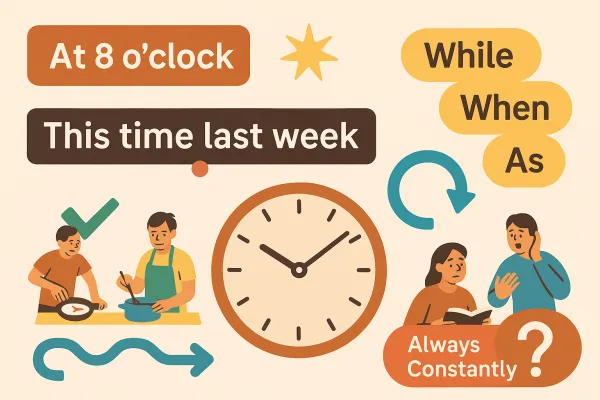
Correctly identifying verb tenses is crucial for understanding the exact meaning of a sentence. The Past Continuous is often accompanied by specific time adverbs, phrases, or conjunctions connecting actions.
-
Specific time in the past:
- At + time + (past reference): at 7 PM yesterday, at 9 o’clock last night…
Example: I was studying at 8 PM last night.
-
- This time + (past reference): this time yesterday, this time last week…
Example: He was travelling to Hanoi this time last year.
-
- From… to… in the past.
Example: They were working from 9 AM to 5 PM yesterday.
-
Conjunctions connecting clauses:
- While / As: Used to connect two parallel actions.
Example: While she was cooking, he was reading.
-
- When: Used to connect an ongoing action with an interrupting one.
Example: I was sleeping when the doorbell rang.
-
Frequency adverbs (for repeated, annoying actions):
- Always, constantly, continually.
Example: She was always losing her keys.
-
Implicit Context: Sometimes, the context of the sentence is enough to imply the Past Continuous, especially when telling a story.
Example: The sun was shining and the birds were singing when I woke up. (Implies background description).
Rules for Conjugating the Past Continuous
Accurately conjugating the Past Continuous requires combining the auxiliary verb “was/were” with the main verb in “-ing” form.
Main verb + “-ing” (V-ing)
This is a crucial rule. Most verbs simply add -ing to the end. (The rules for adding -ing are similar to the Present Continuous and Present Perfect Continuous; you can refer to those sections for more details).
-
Basic rule: Add
-ingto the base form of the verb.- work → working
- play → playing
- study → studying
-
Verbs ending in “-e”: Drop the “-e” and add “-ing”.
- make → making
- write → writing
- live → living
-
One-syllable verbs ending in a consonant preceded by a vowel: Double the final consonant and add “-ing”.
- run → running
- stop → stopping
- swim → swimming
-
Two-syllable verbs ending in a consonant preceded by a vowel, with the stress on the final syllable: Double the final consonant and add “-ing”.
- begin → beginning
- prefer → preferring
Subject-Verb Agreement with “was/were”
The basic rule is: Singular subjects take “was,” and plural subjects take “were.”
-
Subjects I, He, She, It, singular nouns, or uncountable nouns: Use was + V-ing.
- Example: I was sleeping.
- Example: He was reading a book.
- Example: The rain was falling.
-
Subjects You, We, They, or plural nouns: Use were + V-ing.
- Example: You were waiting for me.
- Example: They were talking loudly.
- Example: The birds were singing.
-
Special cases to note:
- Prepositional phrases between the subject and verb: The auxiliary verb must agree with the main subject.
Example: The students in the library were studying quietly. (Subject is “students,” which is plural).
-
- Compound subjects connected by “and”: Usually take were (plural).
Example: My brother and sister were playing chess.
-
- Indefinite pronouns: (e.g., everyone, somebody) usually take was, though they are rarely used in continuous tenses.
Past Continuous in Specific Contexts
In General Academic Writing
The Past Continuous can be used to:
- Describe a process in progress at a specific time in the past when presenting methodology:
Example: While data was being collected from the first group, the researchers were preparing for the next phase of the experiment.
- Describe a historical background or a developmental stage:
Example: During the 1990s, the internet was rapidly evolving, laying the groundwork for the digital age.
In IELTS Writing Task 1 (Academic – Describing charts, maps, processes)
This tense is less common than the Past Simple but can be used to:
- Describe a situation in progress or developing on a map at a specific time in the past:
Example: In 2005, a new road was being constructed in the northern part of the city, connecting the industrial zone to the residential areas.
- Describe a stage in a process currently being performed (usually in passive voice):
Example: At this stage, the raw materials were being heated in a large furnace.
In IELTS Writing Task 1 (General Training – Letter writing)
The Past Continuous is often used to recount details of an event or setting.
- Recounting an event in progress when something else happened:
Example: I was walking through the park yesterday when I noticed a broken bench.
- Describing a situation in progress at a specific time in the past:
Example: At 8 PM last night, I was trying to send an important email when my internet connection suddenly went down.
In IELTS Writing Task 2 (Essay writing)
The Past Continuous can be used to:
- Set the scene for an example or argument in the past:
Example: During the industrial revolution, cities were rapidly expanding, leading to significant social and environmental challenges.
- Describe a trend occurring during a historical period:
Example: In the late 20th century, the global economy was undergoing a major transformation, driven by technological advancements.
In IELTS Speaking Part 1 (Answering personal questions)
You will use the Past Continuous when asked about what was happening at a specific time in the past.
- Activities in progress at a specific time:
- Q: What were you doing at 7 AM this morning? A: At 7 AM, I was having breakfast with my family.
- Q: Were you studying at this time yesterday? A: No, I was watching a movie.
- Explaining the background when something happened:
- Q: What happened last weekend? A: Well, I was planning to go camping, but then it started raining heavily.
In IELTS Speaking Part 2 (Long Turn)
This is where the Past Continuous is very useful for “painting” a scene and describing details of an event or memorable day.
- Describing the background of an event/memory:
Example: (Describe a memorable trip) I’d like to talk about my trip to Ha Long Bay. When we were cruising through the karsts, the sun was shining brightly, and the water was sparkling.
- Describing what you were doing when something happened:
Example: (Describe a time you were late) I remember one time I was driving to an important meeting, and suddenly my car broke down.
- Describing parallel activities during a day:
Example: (Describe a typical day in your childhood) Every morning, my mom was preparing breakfast while my dad was reading the newspaper





 Khai giảng Khóa học Hè cực HOT.
Chưa có bình luận nào!