


Tóm Tắt Nội Dung Bài Viết
Dragonflies, with their delicate wings and vibrant colors, are a familiar and beautiful sight. Yet, behind that appearance lies a world of formidable predators. The IELTS reading passage **”Odonata”** takes us on a journey to discover fascinating scientific facts about the order Odonata, which includes both dragonflies and damselflies. In this article, the ECE language center provides an in-depth analysis of the entire passage, offering detailed explanations for the answers and a summary of key vocabulary to help you master the various question types found in this reading.
Detailed Reading Passage and Questions: Odonata
Reading Content
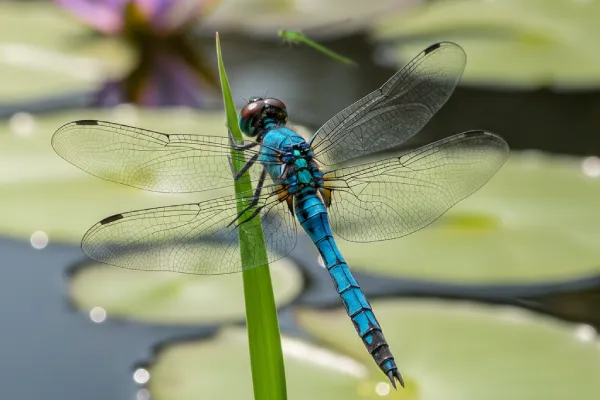
(1) Odonata is the insect order that contains dragonflies and damselflies. Their brilliant colors and delicate-looking wings make them aesthetically pleasing to the human eye. In the wild, though, they are terrifying predators. Dragonflies and damselflies are named for their formidable, serrated jaws, which they employ to rip apart their prey. The word Odonata means “toothed jaw.”
(2) Dragonflies and damselflies are frequently mistaken for one another due to their similarity. Close observation reveals the differences between them. The most noticeable distinction is how they hold their wings at rest. Damselflies fold their wings back, whereas dragonflies hold their wings out to the side. Due to their proximity, dragonfly eyes appear to encompass the entire face. There is a gap between the tiny eyes of damselflies. Dragonflies are bigger, stronger, and more capable fliers than damselflies. Consequently, they inhabit forests and areas away from water. Since they do not often fly far from the water, damselflies are typically observed along the margins of ponds and streams.
(3) The biggest living odonata are the Hawaiian endemic dragonfly and the Central American damselfly, each of which has a 19-centimeter wing span. The smallest is the libellulidae dragonfly, which is endemic to East Asia and has a 20-millimeter wing span. It has been shown via the discovery of fossils that dragonflies have existed for over 300 million years. The biggest dragonfly fossil ever discovered belonged to the extinct meganeura monyi, which had a wingspan of 75 cm and lived 300 million years ago. This enormous predator fed on little amphibians in addition to other insects.
(4) In a pond or stream, dragonflies and damselflies both deposit their eggs on or just beneath the surface of the water. Some species deposit their eggs on the stems of aquatic plants. The hatchlings emerge from the eggs as nymphs. They breathe through their gills and feed on aquatic insects, tadpoles, tiny fish, and even other nymphs. They hunt by lurking at the bottom of a pond or stream and waiting for their victim to swim along. When their prey comes close, they may extend a specialized lip to seize it. Depending on the species, they may exist in this state for months or even years. Several times, as the nymph matures, it sheds its skin. It exits the sea and loses its skin for the final time. The adult emerges, prepared to survive on land and in the air for the next several weeks or months. The adults do not survive more than four months, and many species barely live a few weeks as adults.
(5) Dragonflies and damselflies are highly proficient hunters due to their remarkable vision and flying ability. Their specialized eyes provide them with a nearly 360-degree range of vision… They possess two sets of wings that are capable of moving independently of one another. This provides them with excellent aerial maneuverability… They are able to hover, execute fast turns, and fly in reverse.
(6) As bloodthirsty predators, dragonflies and damselflies are, in turn, prey for other creatures. Fish, frogs, toads, and other water species consume the nymphs. Adults are preyed upon by birds, frogs, as well as bigger dragonflies and damselflies. They might potentially become entangled in a spider’s web. What you give you will receive the same.
Questions
Questions 1-6 (Matching Features) Which of the facts below are true of dragonflies, and which are true of damselflies according to the information in the passage? Write:
- A if it is a fact about dragonflies only
- B if it is a fact about damselflies only
- C if it is a fact about both dragonflies and damselflies
- They have saw-like jaws.
- They hold their wings on their backs while resting.
- Their eyes have a gap between them.
- They can be seen in fields at a distance from ponds and streams.
- The largest species has a wingspan of 19 centimeters.
- The largest fossil has a wingspan of 75 centimeters.
Questions 7-12 (Note Completion) Complete the notes about the life cycle of odonata below. Choose your answers from the box below and write the correct letters, A-K.
The eggs are laid 7 ______. The young dragonflies and damselflies, called 8 _____, live underwater for a few 9 _______. They eat small water animals, catching their food 10 ______. When they are almost fully grown, they leave the water. The adults live for only a few 11 ______ . They are skillful 12 ________ and catch their prey in the air.
Question 13 (Short Answer Question) Write NO MORE THAN TWO WORDS from the passage for your answer.
What does the word “Odonata” mean?
Reading Summary
The passage provides scientific information about the order Odonata, which includes dragonflies and damselflies.
- Definitions & Differences: Both are predators with formidable, serrated jaws. They can be distinguished by how they hold their wings at rest, eye placement, size, and habitat.
- History & Size: The passage mentions the largest and smallest living Odonata, as well as giant dragonfly fossils from 300 million years ago.
- Life Cycle: Eggs are laid near water, hatching into nymphs that live underwater for months or years, before undergoing a final molt to become adults that live on land for a few weeks or months.
- Hunting Skills: They are expert aerial hunters thanks to their nearly 360-degree vision and superior flying capabilities.
- Natural Enemies: They are also prey for other creatures such as fish, birds, frogs, and spiders.
Key Vocabulary and Structures
- Aesthetically pleasing (adjective phrase): Visually attractive.
- Formidable / serrated jaws (noun phrase): Powerful jaws with a saw-like edge.
- Distinction (noun): A difference or point of contrast.
- Endemic (adjective): Native and restricted to a certain place.
- Nymphs (noun): The immature form of certain insects.
- Aerial maneuverability (noun phrase): The ability to move and turn skillfully in the air.
- Bloodthirsty predators (noun phrase): Fierce, aggressive hunters.
Answer Key and Detailed Explanations
Questions 1-6
1. C (both)
- Evidence (Paragraph 1): “Dragonflies and damselflies are named for their formidable, serrated jaws…”
- Explanation: The text confirms this feature applies to both dragonflies and damselflies.
2. B (damselflies only)
- Evidence (Paragraph 2): “Damselflies fold their wings back, whereas dragonflies hold their wings out to the side.”
- Explanation: The text specifies this as a characteristic of damselflies, contrasting it with dragonflies.
3. B (damselflies only)
- Evidence (Paragraph 2): “There is a gap between the tiny eyes of damselflies.”
- Explanation: This is a specific trait of damselflies.
4. A (dragonflies only)
- Evidence (Paragraph 2): “[Dragonflies] inhabit forests and areas away from water.”
- Explanation: Only dragonflies are noted for living in areas away from water.
5. C (both)
- Evidence (Paragraph 3): “The biggest living odonata are the Hawaiian endemic dragonfly and the Central American damselfly, each of which has a 19-centimeter wing span.”
- Explanation: The 19cm wingspan applies to the largest species of both groups.
6. A (dragonflies only)
- Evidence (Paragraph 3): “The biggest dragonfly fossil ever discovered…”
- Explanation: The text specifically identifies this as a dragonfly fossil.
Questions 7-12
7. E. near the water’s surface
- Evidence (Paragraph 4): “…deposit their eggs on or just beneath the surface of the water.”
- Explanation: This phrase corresponds to “near the water’s surface.”
8. F. nymphs
- Evidence (Paragraph 4): “The hatchlings emerge from the eggs as nymphs.”
- Explanation: The young are referred to as “nymphs.”
9. H. months or years
- Evidence (Paragraph 4): “…they may exist in this state for months or even years.”
- Explanation: The underwater nymph stage lasts for “months or years.”
10. B. with their lips
- Evidence (Paragraph 4): “…they may extend a specialized lip to seize it.”
- Explanation: They catch prey using a specialized “lip.”
11. I. weeks or months
- Evidence (Paragraph 4): “…survive on land and in the air for the next several weeks or months.”
- Explanation: The adult stage lasts for “weeks or months.”
12. D. fliers
- Evidence (Paragraph 2 & 5): “Dragonflies are bigger, stronger, and more capable fliers…” and “…remarkable vision and flying ability.”
- Explanation: The text emphasizes their flying skills, making “skillful fliers” the most appropriate term.
Question 13
13. toothed jaw
- Evidence (Paragraph 1): “The word Odonata means “toothed jaw.”“
- Explanation: The final sentence of paragraph 1 explicitly defines the meaning of Odonata.
Conclusion
The “Odonata” passage is a classic example of an IELTS biology-themed text, testing your ability to categorize information (Matching Features) and follow a process (Note Completion). For matching tasks, the key is to look for comparative and contrastive language like ‘whereas’, ‘in contrast’, or specific descriptions for each subject. We hope this detailed analysis from ECE helps you gain valuable experience in effectively handling scientific reading passages.




 Khai giảng Khóa học Hè cực HOT.
No comments yet!