


Tóm Tắt Nội Dung Bài Viết
In a world that never stops moving, sleep is often undervalued—or even dismissed as a sign of weakness. However, Matthew Walker, director of the Center for Human Sleep Science at the University of California, argues the exact opposite: we are facing a “catastrophic sleep-loss epidemic,” and sleep should be “prescribed” as a vital remedy.
The IELTS reading passage “Sleep Should Be Prescribed” not only exposes the alarming truths about sleep deprivation but also provides deep insights and practical advice. Join ECE as we dive into each argument, analyze the question types, and equip you with the essential vocabulary to conquer this passage. Let’s get started!
Reading Content & Questions
SLEEP SHOULD BE PRESCRIBED: WHAT THOSE LATE NIGHTS OUT COULD BE COSTING YOU
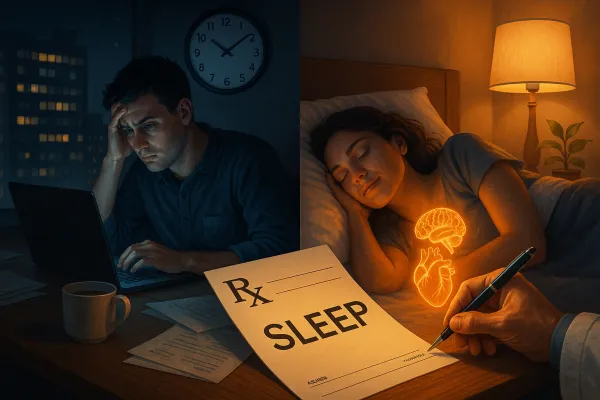
(A) Matthew Walker dreads the question ‘What do you do?’ On an aeroplane, it usually means that he will find himself giving a talk. Walker is the director of the Center for Human Sleep Science at the University of California. It is Walker’s conviction that we are in the midst of a ‘catastrophic sleep-loss epidemic.’ He has now written Why We Sleep, the idea being that once people know of the powerful links between sleep loss and poor health, they will try harder to get the recommended eight hours a night. It needs to be prioritized.
(B) Why are we so sleep-deprived in this century? In 1942, less than 8% of the population was trying to survive on six hours or less of sleep a night; in 2017, almost one in two people were. Some reasons are obvious, but Walker also believes that in the developed world, sleep is strongly associated with weakness. ‘We want to seem busy, and one way we express that is by proclaiming how little sleep we’re getting. When I give lectures, people wait behind until there is no one around and then tell me quietly: “I seem to be one of those people who need eight or nine hours’ sleep.” It’s embarrassing to say it in public.’
(C) Walker has found clear evidence that without sleep, there is lower energy and disease, and with sleep, there is vitality and health. More than 20 studies all report the same relationship: the shorter your sleep, the shorter your life. For example, adults aged 45 years or older who sleep less than six hours a night are 200% more likely to have a heart attack. This is because even one night of sleep reduction will affect a person’s heart and significantly increase their blood pressure as a result. Walker also points out that when your sleep becomes short, you are susceptible to weight gain. Among the reasons for this is the fact that inadequate sleep increases levels of the hunger-signalling hormone, ghrelin. ‘I’m not going to say that the obesity crisis is caused by the sleep-loss epidemic alone,’ says Walker. ‘However, processed food and sedentary lifestyles do not adequately explain its rise. It’s now clear that sleep is that third ingredient.’
(D) Sleep also has a powerful effect on the immune system, which is why, when we have the flu, our first instinct is to go to bed. If you are tired, you are more likely to get sick. The well-rested also respond better to the flu vaccine. Walker’s book also includes a long section on dreams. Here, he details how important deep sleep is to young children. If they don’t get enough, managing aggressive behaviour becomes harder and harder. Does Walker take his own advice when it comes to sleep? ‘Yes. I give myself a non-negotiable eight-hour sleep opportunity every night, and I keep very regular hours. I take my sleep incredibly seriously because I have seen the evidence.’
(E) Sleep research shows that we sleep in 90-minute cycles. Each cycle comprises NREM sleep (non-rapid eye movement sleep), followed by REM (rapid eye movement) sleep. ‘During NREM sleep… your body settles into this lovely low state of energy,’ Walker explains. ‘REM sleep, on the other hand, is… an incredibly active brain state. Your heart and nervous system go through spurts of activity.’ Because we need four or five of these cycles to stay healthy, it’s important for people to break bad sleep habits. For example, they should not be regularly working late into the night as this affects cognitive functioning. Depending on sleeping pills is also not a good idea, as it can have a damaging effect on memory.
(F) So what can individuals do to ensure they get the right amount of sleep? Firstly, we could think about getting ready for sleep in the same way we prepare for the end of a workout. ‘So why don’t we have a bedtime alarm to tell us we’ve got half an hour, that we should start cycling down?’ Companies should think about rewarding sleep. Productivity will rise and motivation will be improved. We can also systematically measure our sleep by using personal tracking devices. While some researchers recommend banning digital devices from the bedroom, Walker believes that technology will eventually be an aid to sleep, as it helps us discover more about the way we function.
Question 1 – 5
Reading Passage 2 has six paragraphs, A-F. Which paragraph contains the following information? Write the correct letter, A-F, in boxes 1-5 on your answer sheet. NB You may use any letter more than once.
- a comparison between two different types of sleep that people experience
- an explanation for some people not wanting to admit the amount of sleep they require
- examples of different behaviours that have a negative impact on mental performance
- a suggestion that medical professionals are not taking the right approach
- a reference to changing trends in the average amount of sleep people get
Question 6 – 9
Complete the sentences below. Choose NO MORE THAN TWO WORDS from the passage for each answer. Write your answers in boxes 6-9 on your answer sheet.
6. Over 20 studies have shown a person’s __________ goes up when they are sleep deprived.
7. Insufficient sleep is one of the three factors which explain the __________.
8. People who are given the __________ by doctors find it more effective if they sleep properly.
9. Walker has described how a lack of deep sleep is linked to __________ in young children.
Question 10 – 11
The list below mentions some things that individuals can do to ensure they get the right amount of sleep. Which TWO of these things are recommended by Matthew Walker? Write the correct letters in boxes 10 and 11 on your answer sheet.
A. taking a natural product that encourages sleep
B. avoiding looking at brightly lit screens after dark
C. negotiating later start times for work with employers
D. keeping a regular record of hours spent sleeping
E. reducing your activity level at a set time of day
Question 12 – 13
Which TWO of the following statements are true of Matthew Walker? Write the correct letters in boxes 12 and 13 on your answer sheet.
A. He is sometimes reluctant to admit what his profession is.
B. He has based his new book on a series of lectures.
C. He has experienced significant improvements in his health.
D. He has carried out research into the meaning of dreams.
E. He always makes sure he gets enough sleep each night.
Overview of the Reading Passage
The passage revolves around the importance of sleep through the perspective of Matthew Walker, a leading expert in sleep science.
- The alarming reality: Modern society is experiencing a “sleep-loss epidemic,” with more and more people sleeping less than 6–7 hours per night.
- Causes: Sleep deprivation stems from many reasons, including work pressure, a busy lifestyle, and the misconception that sleeping little is a sign of “busyness” and “success” rather than “weakness.”
- Serious consequences:
- Physical health: Increased risk of heart attack, high blood pressure, weight gain (due to increased ghrelin levels), and a weakened immune system.
- Mental health: Affects cognitive functioning and memory; in young children, a lack of deep sleep can lead to aggressive behaviour.
- Two types of sleep: NREM (non-rapid eye movement) is a state where the body relaxes and consumes less energy; REM (rapid eye movement) is a state where the brain is incredibly active. We need 4–5 of these 90-minute cycles to stay healthy.
- Individual & societal solutions:
- Individual: Reduce activity levels before bed (like “cycling down”), track sleep hours, and avoid working late or relying on sleeping pills.
- Societal: Companies should encourage and reward sleep, as it boosts productivity and motivation. Medical professionals should prioritize “prescribing” sleep rather than just sleeping pills.
- View on technology: Walker believes technology will eventually be a sleep aid, helping us understand how our bodies function, even though some researchers recommend keeping digital devices out of the bedroom.
Essential Vocabulary
- Dreads (verb): To anticipate with great apprehension or fear.
- Catastrophic sleep-loss epidemic (noun phrase): A disastrous widespread shortage of sleep.
- Prioritized (verb): To treat something as more important than other things.
- Proclaiming (verb): To announce or declare publicly.
- Susceptible (adjective): Likely to be influenced or harmed by a particular thing.
- Sedentary lifestyles (noun phrase): A way of life that involves little physical activity.
- Cognitive functioning (noun phrase): Mental processes such as thinking, reasoning, and memory.
- Cycling down (verb phrase, figurative): To gradually reduce activity and relax.
For more IELTS Reading practice samples curated by ECE, check out:
Sport Science in Australia IELTS Reading
Does class size matter IELTS Reading
Suggested Answers & In-depth Analysis
1. E
- Evidence (Paragraph E): “During NREM sleep … your body settles into this lovely low state of energy,’ Walker explains. ‘REM sleep, on the other hand is … an incredibly active brain state.”
- Explanation: Paragraph E clearly compares the two sleep types, NREM and REM.
2. B
- Evidence (Paragraph B): “It’s embarrassing to say it in public.”
- Explanation: Paragraph B explains that people are embarrassed to admit they need more sleep because it is “strongly associated with weakness” in society.
3. E
- Evidence (Paragraph E): “…working late into the night as this affects cognitive functioning. Depending on sleep pills is also not a good idea, as it can have a damaging effect on memory.”
- Explanation: Working late and using sleeping pills are behaviours that negatively impact “cognitive functioning” and “memory.”
4. A
- Evidence (Paragraph A): “When did a doctor prescribe, not sleeping pills, but sleep itself? It needs to be prioritized.”
- Explanation: The author suggests that medical professionals are not taking the right approach by failing to “prescribe” sleep.
5. B
- Evidence (Paragraph B): “In 1942, less than 8% of the population was trying to survive on six hours or less sleep a night; in 2017, almost one in two people was.”
- Explanation: Paragraph B provides statistics on the changing trends in average sleep duration over the years.
6. blood pressure
- Evidence (Paragraph C): “…significantly increase their blood pressure as a result.”
7. obesity crisis
- Evidence (Paragraph C): “Insufficient sleep is that third ingredient” contributing to “the obesity crisis.”
8. flu vaccine
- Evidence (Paragraph D): “The well-rested also respond better to the flu vaccine…”
9. aggressive behaviour
- Evidence (Paragraph D): “If they don’t get enough [deep sleep], managing aggressive behavior becomes harder and harder.”
10-11. D & E
- Evidence (Paragraph F):
- E: “have a bedtime alarm to tell us… we should start cycling down” (reducing activity).
- D: “systematically measure our sleep by using personal tracking devices” (keeping a record).
- Explanation: The other options are not directly recommended by Matthew Walker in the text.
12-13. A & E
- Evidence:
- A (Paragraph A): “Matthew Walker dreads the question ‘What do you do?’” (He is sometimes reluctant to talk about his profession).
- E (Paragraph D): “I give myself a non-negotiable eight-hour sleep opportunity every night, and I keep very regular hours.” (He ensures he gets enough sleep).
- Explanation:
- B: There is no information that his book is based on a series of lectures.
- C: There is no information about his personal health improvements.
- D: He researches the role of sleep, not the “meaning of dreams” in general.
The IELTS reading passage “Sleep Should Be Prescribed” is a highly relevant and practical text, serving as an excellent exercise for deep reading comprehension skills. It not only provides valuable knowledge about sleep but also challenges your ability to identify main ideas, specific details, and the author’s perspective.
Through this thorough analysis of each question and answer, ECE hopes you have strengthened your test-taking strategy and expanded your vocabulary, ready to conquer any challenge in your upcoming IELTS exam.





 Khai giảng Khóa học Hè cực HOT.
No comments yet!