
Tóm Tắt Nội Dung Bài Viết
The IELTS exam is designed to test your English proficiency under strict time constraints. This time pressure is a significant challenge for many candidates, often leading to missed questions, rushed answers that result in errors, or even failing to finish the test on time. However, time management is not just about racing against the clock; it is about allocating your time strategically, knowing when to pause, when to pick up the pace, and how to make the most of every precious minute.
In this article, ECE will dive deep into the time structure of each IELTS section (Listening, Reading, Writing, Speaking) and provide you with specific tips and effective strategies to master your time in the exam room, thereby optimizing your chances of achieving a high band score.
Note: The time management strategies for each skill in this ECE article are tailored for the computer-delivered IELTS format.
Overview of Time Management in the IELTS Exam
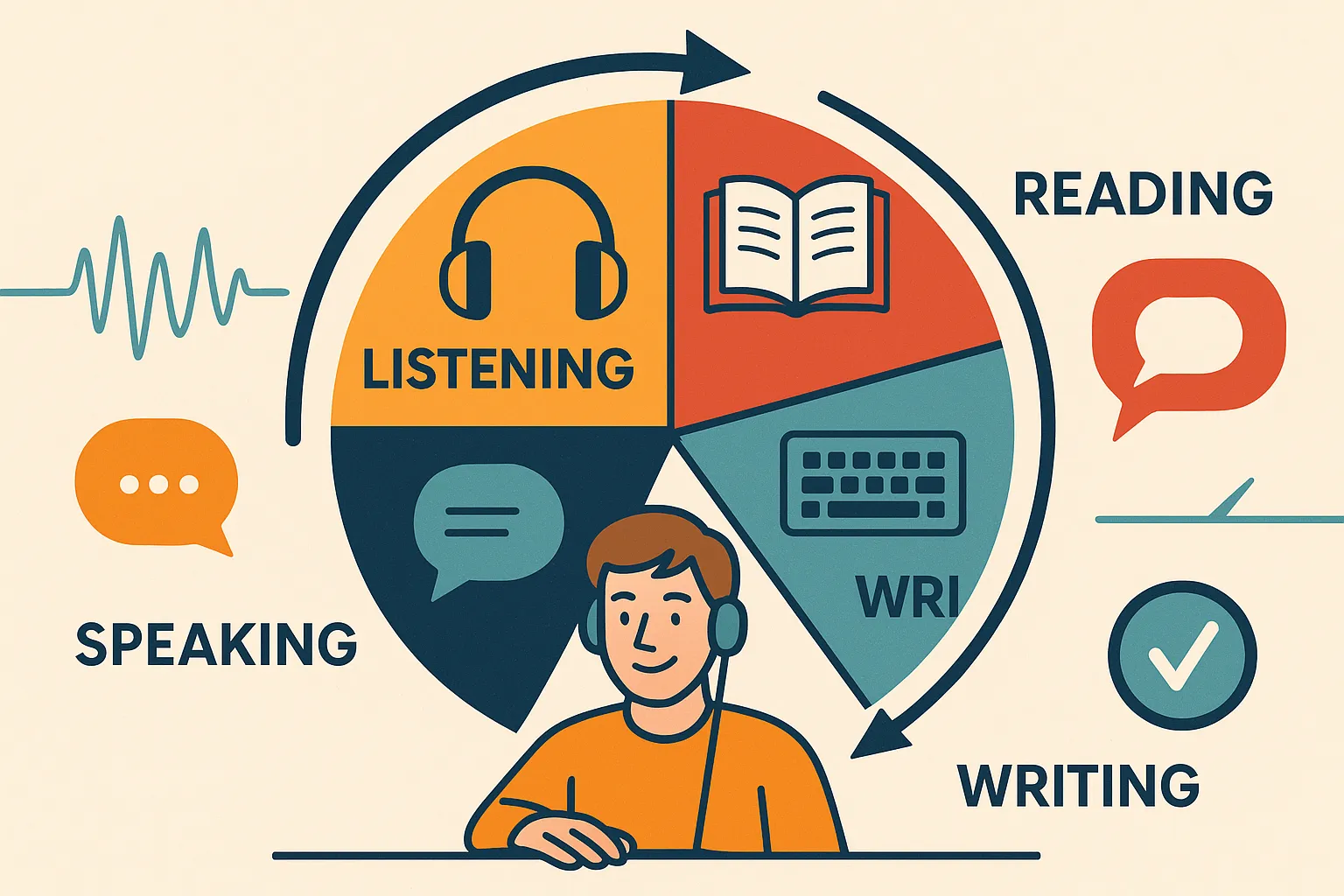
To manage your time effectively, you first need to master the time structure of each skill:
- Listening: Approximately 30 minutes for the audio, including transition time between sections. After the audio ends, you have an additional 2 minutes to review your answers.
- Reading: A total of 60 minutes for all 3 reading passages (Academic or General Training) and 40 questions. This time includes reading the texts, finding answers, and inputting them. There is no separate time allocated for transferring answers after the time is up.
- Writing: A total of 60 minutes to complete both tasks (Task 1 and Task 2). You will type your response directly.
- Speaking: The test lasts between 11 and 14 minutes and is conducted face-to-face with an examiner.
Given this structure, it is clear that Reading and Writing are the two skills that require the most proactive time management from candidates.
1. Time Management in IELTS Listening
In the Listening section, the audio timing is fixed, but you must effectively manage the time spent reading questions and performing your final review.
-
Time Structure: Approximately 30 minutes of audio + 2 minutes for final review.
-
Challenges:
- You only hear the audio once.
- The speaking speed cannot be adjusted.
- You must read questions and input answers while listening.
-
Effective Time Management Strategies:
-
Utilize Question-Reading Time Between Sections:
- Use the short breaks between sections to quickly read the questions for the next section. Underline or jot down (on scratch paper) key information such as names, numbers, locations, dates, or the type of information required.
- Focus specifically on reading all questions for Section 4 during the initial allotted time, as it is the longest and usually the most difficult part.
-
While Listening:
- Input Answers Directly: As soon as you hear the necessary information, input your answer into the blank or select it on the screen. Quick action prevents you from missing information for subsequent questions.
- Temporary Notes: If needed, use the provided scratch paper to quickly jot down complex information (e.g., long names, strings of numbers) before entering them officially.
- Don’t Dwell on Missed Questions: If you don’t hear or miss a question, “flag” it and immediately focus on the next part of the audio to avoid losing more points.
-
Effectively Using the 2-Minute Final Review:
- When the audio ends, you have 2 minutes. Use this time to review the answers you have already entered.
- Focus on checking the questions you flagged.
- Check for spelling errors (especially important for fill-in-the-blank questions) and other basic mistakes.
- Note that 2 minutes is very short, so inputting accurate answers while listening remains the top priority.
-
-
Tips for Practicing Listening Time Management:
- Always practice listening under standard exam conditions, including the time for reading questions and the 2-minute review.
- Practice on platforms that simulate the actual test interface to get comfortable with inputting answers and using support features.
- Build your ability to read questions quickly during breaks.
2. Time Management in IELTS Reading
The Reading section is a true race against time. You have 60 minutes to complete 3 long passages, answer 40 questions, and input your answers directly.
-
Time Structure: 60 minutes for 3 passages and 40 questions.
-
Challenges:
- Increasing length and complexity of passages.
- Various question types requiring different processing skills.
- Need to read, understand, find information, and input answers within 60 minutes.
-
Effective Time Management Strategies:
-
Allocate Fixed Time for Each Passage:
- Spend approximately 20 minutes on each passage (including answering and inputting).
- Consider spending less time on Passage 1 (15-18 minutes) to allow more time for Passage 3 (22-25 minutes), as it is usually the most difficult.
- STRICT ADHERENCE: When the allotted time for a passage is up, stop immediately. Mark or guess the remaining answers for that passage (do not leave them blank!) and move on to the next one. Do not get “stuck” on one passage for too long.
-
Approach Strategy for Passages and Questions:
- Read questions first, scan the passage later: Skim the entire passage to grasp the main idea. Then, read the questions for a specific group, underline keywords (using the highlight feature), and scan the passage to locate relevant information.
- Input answers as soon as you find them: Once you locate the information and determine the answer, input it immediately into the blank or select it on the screen.
-
During the Test:
- Keep an eye on the clock: The countdown timer is clearly displayed. Check it frequently to adjust your pace.
- Use support features: Utilize the highlight tool to mark keywords or important paragraphs. Use the “flag” feature for difficult questions to return to later.
- Don’t dwell on difficult questions: If a question takes too long to find or infer, flag it and move on. Return to it if you have time left.
-
-
Tips for Practicing Reading Time Management:
- Always practice Reading within the 60-minute limit and aim for 20 minutes per passage.
- Practice on a simulated interface to get used to scrolling, viewing questions and passages simultaneously, using highlight/flag features, and inputting answers directly.
- Improve your Skimming and Scanning skills.
3. Time Management in IELTS Writing
The Writing section requires you to complete two tasks in 60 minutes by typing directly. The ability to manage time, allocate it reasonably for each task and each stage (brainstorming, writing, reviewing) is crucial. Your typing speed is also a direct factor.
-
Time Structure: 60 minutes for Task 1 (≥ 150 words) and Task 2 (≥ 250 words). Task 2 accounts for 2/3 of the total score.
-
Challenges:
- Tight time to complete both tasks, especially Task 2.
- Need to brainstorm, outline, type, and review.
- Typing speed affects your ability to finish the test.
- Need to meet the minimum word count for each task.
-
Effective Time Management Strategies:
-
Allocate Time for Each Task:
- Recommended strategy: Spend about 20 minutes on Task 1 and 40 minutes on Task 2.
- ADHERE: Keep an eye on the clock and move on to Task 2 after 20 minutes, even if Task 1 isn’t perfect. Task 2 is more important for your score.
-
Allocate Time Within Each Task:
- Task 1 (~20 minutes):
- Analyze the prompt, chart/map/process, select key information: ~3-5 minutes.
- Drafting the report: ~12-15 minutes.
- Review for errors (grammar, spelling, vocabulary) and word count: ~2-3 minutes.
- Task 2 (~40 minutes):
- Analyze the prompt, brainstorm, create a detailed outline (Introduction, Body, Conclusion): ~7-10 minutes. (A good outline helps you type faster and more coherently).
- Drafting the essay: ~25-28 minutes. Focus on developing ideas based on your outline.
- Thorough review (grammar, spelling, vocabulary, coherence, word count): ~5-7 minutes. (This review time is crucial for improving the quality of your writing).
- Task 1 (~20 minutes):
-
While Writing:
- Stick to your outline: Write based on the plan you created.
- Monitor word count: The test interface usually displays your word count. Keep an eye on this to ensure you meet the minimum requirement.
- Prioritize finishing: Don’t get too bogged down in using complex vocabulary or “fancy” sentence structures if it slows you down and prevents you from finishing or reviewing.
- Save time for review: Always ensure you have at least 5 minutes left for Task 2 to read through and fix errors.
-
-
Tips for Practicing Writing Time Management:
- Practice Typing: Regularly practice typing to improve speed and accuracy.
- Always practice writing both Task 1 and Task 2 within 60 minutes, allocating 20-40 minutes accordingly.
- Practice creating outlines quickly under time pressure.
- Use a word processor with a word count feature for practice.
4. Time Management in IELTS Speaking
The Speaking section has a fixed duration managed by the examiner. Time management here means knowing how to effectively use the allotted time to develop your ideas and showcase your best speaking ability in each part.
-
Time Structure: 11-14 minutes, divided into 3 fixed parts.
-
Challenges:
- Need to answer fluently, coherently, and develop ideas within the examiner’s time limits.
- Part 2 requires speaking continuously for 1-2 minutes.
-
Effective Time Management Strategies:
-
Part 1 (~4-5 minutes): Direct Answers and Brief Expansion:
- Listen carefully to the question and answer directly.
- Expand your answer by 1-2 sentences to explain or add details, making your speech sound more natural.
-
Part 2 (~3-4 minutes): Utilize the 1-Minute Prep and Speak for 1-2 Minutes:
- 1-minute preparation: Read the cue card, jot down key ideas, keywords, and phrases you want to use on your scratch paper. Create a simple outline with bullet points to ensure you have enough to say for 1-2 minutes.
- 1-2 minutes speaking: Use your notes to speak fluently and develop your points. Try to speak for the full 2 minutes if possible. The examiner will stop you when time is up.
-
Part 3 (~4-5 minutes): In-depth Discussion and Extended Arguments:
- Listen to the question and answer directly.
- Immediately expand your answer by explaining reasons, providing examples, comparing, contrasting, or analyzing cause/effect.
- Monitor the examiner’s reactions and respond to follow-up questions.
-
-
Tips for Practicing Speaking Time Management:
- Practice each part under time pressure just like the real test, using a stopwatch or asking someone to help you.
- Record your speaking to check your timing and content.
- Practice using the 1-minute preparation time for Part 2 effectively.
- Practice expanding your answers in Part 1 and Part 3 naturally and with depth.
General Advice on Time Management for IELTS Preparation

- Always practice under time pressure: For any skill, always use a stopwatch and adhere to the time limits.
- Take full mock tests regularly: Complete full 4-skill mock tests under simulated exam conditions to get used to the overall pressure.
- Analyze your time after practice: Review how much time you spent on each section, question type, and stage to identify weaknesses and adjust your strategy.
- Get familiar with the test interface: Practice on platforms that simulate the official test interface to operate faster and more confidently.
- Improve typing speed (for Writing): If necessary, dedicate specific time to practice typing.
- Stay calm and flexible: If you fall behind in one section, accept it and quickly adjust for the remaining parts.
- Don’t leave answers blank (unless absolutely necessary): In Reading and Listening, always try to fill in or select an answer, even if you have to guess.
Conclusion
Time management is not just a test-taking skill; it is also part of the psychological preparation for the IELTS exam. By clearly understanding the time structure of each skill, applying specific allocation strategies for each part, and practicing regularly under time pressure, you will gradually master the pace of the exam.
This helps you stay calm, confident, avoid mistakes caused by rushing, and most importantly, fully demonstrate your knowledge and skills within the allowed time, thereby achieving the best possible results. Consider mastering time management an essential part of your IELTS journey.





 Khai giảng Khóa học Hè cực HOT.
Chưa có bình luận nào!