
Tóm Tắt Nội Dung Bài Viết
The Two-part Question (also known as a Direct Question or Double Question) is one of the most common formats in IELTS Writing Task 2. The defining characteristic of this task is that the prompt presents a situation or statement and then asks you to answer two distinct questions related to it. The main challenge lies in providing a complete, balanced, and coherent response to both questions within a single essay.
This article by ECE English provides a comprehensive strategy—from identifying the prompt and analyzing the questions to developing logical ideas, structuring your essay, and avoiding common pitfalls—to help you confidently conquer the Two-part Question.
I. Overview & Identifying Two-part Questions in Writing Task 2
1. Definition and Core Requirements
A Two-part Question requires you to:
- Clearly understand the context or statement provided.
- Answer both questions directly and thoroughly.
- Develop ideas for each question logically, with depth, and maintain a balanced length between the two parts.
- Ensure coherence and strong cohesion between paragraphs.
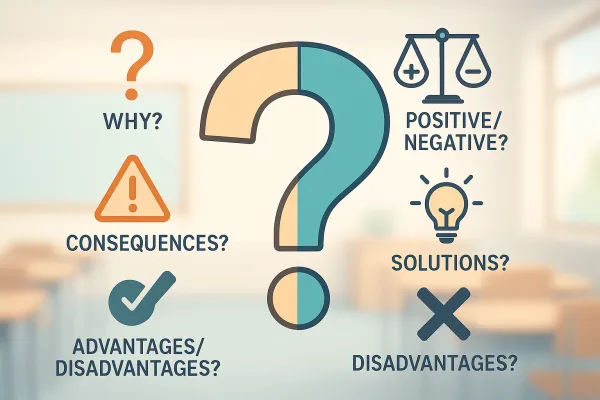
2. Common Types of Two-part Questions
While there are many variations, Two-part Questions generally fall into these main categories:
- Type 1: Why / What are the reasons? + Is it a positive or negative development?
- Example: “Fewer and fewer people today write by hand using a pen or pencil. What are the reasons for this? Is this a positive or a negative development?”
- Requirement: State the reasons and provide your opinion (positive/negative).
- Type 2: Why / What are the reasons? + What are the consequences / effects?
- Example: “Many young people today know more about international pop or movie stars than about famous people in the history of their own country. Why is this? What problems can it cause?”
- Requirement: State the reasons and the resulting problems/consequences.
- Type 3: Why / What are the reasons? + What can be done / What measures should be taken?
- Example: “In some countries, there are fewer young people who listen to or play classical music these days. Why is this? Should young people be encouraged to play or perform classical music?”
- Requirement: State the reasons and propose solutions.
- Type 4: Advantages / Disadvantages + Opinion (e.g., Do the advantages outweigh the disadvantages?)
- Example: “Some people choose to have their first child at an older age. What are the reasons? Do the advantages outweigh the disadvantages?”
- Requirement: State the reasons and compare the pros/cons to provide an opinion.
Identification Tip: Always underline the two specific questions in the prompt. This helps you stay focused on answering both parts fully.
II. A 5-Step Strategy to Conquer Two-part Questions
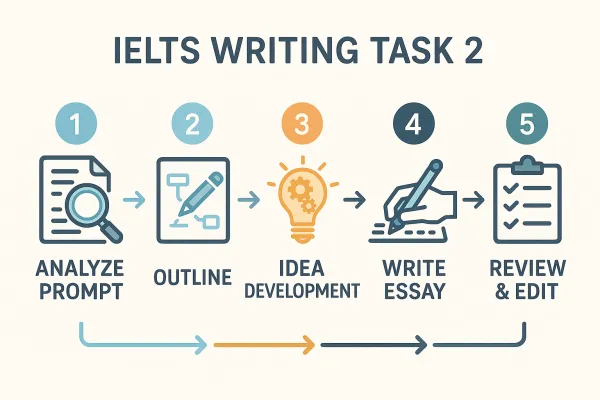
To write an effective Two-part Question essay, follow this 5-step process:
Step 1: Analyze the Prompt (5 minutes)
This is the most critical step, determining whether you stay on track and fulfill all requirements.
- Identify the context/statement: What is the topic? (e.g.,
Fewer people write by hand). - Underline and analyze the two questions:
- Question 1: What is required? (e.g.,
reasons for this). - Question 2: What is required? (e.g.,
positive or negative development).
- Question 1: What is required? (e.g.,
- Identify Keywords & Micro Keywords:
Keywords: The broad topic (e.g.,writing by hand).Micro Keywords: Specific boundaries, subjects, or aspects (e.g.,fewer and fewer people,today).
- Determine the Two-part Question type: Based on the questions, which category does it fall into? This will shape your structure and content.
Step 2: Detailed Outline (7 – 10 minutes)
A clear outline is the backbone of your essay. A 4-paragraph structure is most common, though 5 paragraphs can be used if you need to develop one question in greater depth.
Common 4-Paragraph Structure:
- Paragraph 1: Introduction
- Sentence 1 (Paraphrase): Restate the prompt’s context using different vocabulary and structures. Note: Avoid phrases like “Some people believe that…” if the prompt describes a factual trend.
- Sentence 2 (Thesis Statement): Clearly state the purpose of the essay, outlining how you will address both questions. This acts as a “roadmap” for the examiner.
- Example for “Why + Positive/Negative”: “This essay will explore the underlying reasons for this trend and argue that it represents a largely positive development.”
- Example for “Why + Solutions”: “This essay will delve into the causes of this phenomenon and propose some practical measures to address it.”
- Paragraph 2: Body 1 (Answering Question 1)
- Topic Sentence: State the main idea answering the first question.
- Explanation/Expansion: Develop the main idea by explaining, providing reasons, or analyzing further.
- Example/Evidence: Illustrate with a specific example (real or logically hypothetical).
- Result/Impact (if applicable): State the consequences or effects.
- Note: Focus on developing 1-2 main points deeply rather than listing too many superficial ones.
- Paragraph 3: Body 2 (Answering Question 2)
- Topic Sentence: State the main idea answering the second question.
- Explanation/Expansion: Develop the main idea.
- Example/Evidence: Illustrate.
- Result/Impact (if applicable): State the consequences or effects.
- Note: Ensure balance in length and depth between Body 1 and Body 2.
- Paragraph 4: Conclusion
- Sentence 1 (Summary): Summarize the main points from Body 1 and Body 2 (using different wording).
- Sentence 2 (Optional): Provide a final thought, prediction, or brief recommendation. Never introduce new ideas in the conclusion.
Step 3: Develop Logical Ideas with Linearthinking (10 – 12 minutes)
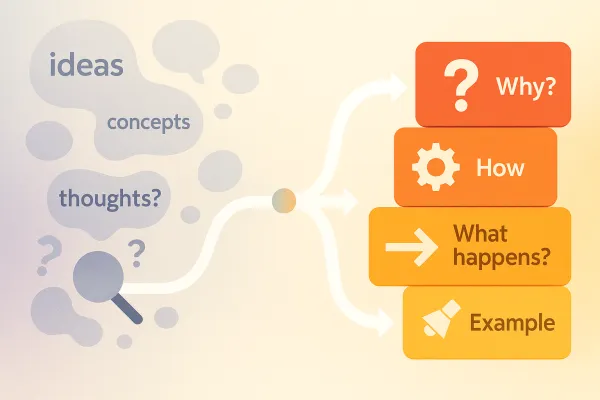
This step turns raw ideas into tight, persuasive arguments.
- Specify the question:
- Once you have an initial idea, ask yourself: “Is this specific enough?”
- Example: If the prompt asks “Why do people spend long hours at work?”, an initial idea might be “to earn money.” Make it specific: “Earn money for what? To meet the high cost of living.”
- This helps you dig into specific aspects (economic, social, personal, technological, etc.) to find more detailed arguments.
- Develop ideas logically:
- Use the following tools to expand and link ideas into a chain of reasoning:
Important Tip: Always ensure strong links between sentences within a paragraph and between the paragraphs themselves.
Step 4: Writing the Essay (15 – 18 minutes)
With a clear outline, writing becomes much easier.
- Use academic and varied vocabulary:
- Introduction/Conclusion:
It is widely acknowledged that,In recent years, the phenomenon of... has become increasingly prevalent,To conclude,In summary. - Stating reasons:
One primary reason for this is...,This can be attributed to...,The underlying cause lies in.... - Stating impacts:
This inevitably leads to...,Consequently, it results in...,The ramifications include.... - Proposing solutions:
A viable solution would be to...,Measures should be taken to...,It is imperative that.... - Stating opinions:
From my perspective, I believe that...,I am of the opinion that...,I contend that....
- Introduction/Conclusion:
- Use varied and accurate grammar: Combine simple, compound, and complex sentences, relative clauses, passive voice, and inversion (where appropriate) to boost your Grammatical Range and Accuracy score.
- Ensure Cohesion & Coherence:
- Use appropriate linking words/phrases to transition smoothly (e.g.,
Firstly, Secondly, Moreover, Furthermore, However, Therefore, As a result, In contrast, Nevertheless). - Use pronouns and synonyms to avoid repetition.
- Ensure a “closing flow” at the end of each point: The final sentence of a point should summarize or naturally lead into the next.
- Use appropriate linking words/phrases to transition smoothly (e.g.,
Step 5: Review and Edit (2 – 3 minutes)
This is an essential step to maximize your score.
- Task Achievement: Did you answer both questions correctly and fully? Are the main points well-developed?
- Cohesion and Coherence: Is the essay coherent? Do the paragraphs link together?
- Lexical Resource: Is the vocabulary varied, accurate, and appropriate? Are there any spelling errors?
- Grammatical Range and Accuracy: Is the grammar varied and accurate? Check for tense consistency, subject-verb agreement, and punctuation.
III. Common Pitfalls and How to Fix Them
- Answering only one of the two questions:
- Reason: Not reading the prompt carefully or focusing too much on one question.
- Fix: Always underline both questions and outline both before writing. Ensure each question has at least one dedicated body paragraph.
- Unbalanced idea distribution:
- Reason: Developing one question too deeply while neglecting the other.
- Fix: When outlining, estimate the number of points and length for each body paragraph. Aim for balance (e.g., 1-2 points for Body 1, 1-2 points for Body 2).
- Superficial ideas, lack of development:
- Reason: Lack of background knowledge or inability to expand ideas.
- Fix: Apply Linearthinking (Specify the question, Develop ideas logically). Always ask “Why?” and “How?” to deepen your arguments.
- Lack of connection between the two parts:
- Reason: Treating the two questions as completely independent without smooth transitions.
- Fix: Use appropriate linking words when moving from Body 1 to Body 2. Ensure the Thesis Statement in the Introduction “outlines” the path for both parts.
- Going off-topic or misunderstanding requirements:
- Reason: Failing to distinguish between different types of sub-questions (Problem/Cause/Effect/Opinion).
- Fix: Spend enough time in Step 1 to thoroughly analyze the
Instruction wordsandMicro Keywords.
IV. Sample Essay and Detailed Analysis
Let’s apply these strategies to a specific prompt:
Prompt: “In many workplaces, creativity and imagination are becoming more valued than technical expertise. Why is this the case? Is this a positive or negative development?”
Analysis:
- Type: Why + Positive/Negative development.
- Context:
creativity and imagination are becoming more valued than technical expertise - Question 1:
Why is this the case?(State reasons). - Question 2:
Is this a positive or negative development?(State opinion).
Outline:
- Introduction:
- Paraphrase: The trend of companies increasingly valuing creativity and imagination over technical expertise.
- Thesis: The essay will explore the reasons behind this trend and argue that it is a positive development.
- Body 1 (Reasons – Why creativity is valued more):
- Reason 1: Automation and AI replacing repetitive technical tasks.
- Explanation: Machines perform technical tasks faster and more accurately than humans.
- Impact: Demand for higher-level thinking skills (creativity, problem-solving) increases.
- Reason 2: Need for innovation and competition in the global market.
- Explanation: Companies need fresh ideas to create unique products/services.
- Impact: Creativity is the primary driver of innovation.
- Reason 1: Automation and AI replacing repetitive technical tasks.
- Body 2 (Positive Development – Why it is positive):
- Benefit 1: Fosters personal growth and job satisfaction.
- Explanation: Creative work is less monotonous, encouraging independent thinking.
- Impact: Increases engagement, reduces stress, improves quality of life.
- Benefit 2: Encourages complex problem-solving and sustainable value.
- Explanation: Creativity helps find breakthrough solutions for global challenges (climate change, health).
- Impact: Contributes to societal progress.
- Benefit 1: Fosters personal growth and job satisfaction.
- Conclusion:
- Summary: The trend is driven by automation and the need for innovation.
- Affirmation: It is a positive development for individuals and society.
Sample Essay:
In contemporary workplaces, there is a discernible shift towards valuing creativity and imagination more highly than conventional technical expertise. This essay will delve into the underlying reasons for this evolving emphasis and contend that this represents a largely positive development for both individuals and society.
One primary reason for the increasing prominence of creativity and imagination stems from the rapid advancements in automation and artificial intelligence. As machines and algorithms become increasingly capable of performing repetitive, rule-based technical tasks with greater speed and accuracy, the demand for human skills that cannot be easily replicated by technology has surged. Consequently, employers are now seeking individuals who can think critically, innovate, and approach problems from novel perspectives, as these are the attributes that drive unique solutions and competitive advantage in a globalized market.
From my perspective, this shift is overwhelmingly positive due to its profound implications for personal fulfillment and societal progress. Firstly, jobs that prioritize creative thinking tend to be inherently more engaging and less monotonous, fostering greater job satisfaction and reducing stress among employees. This allows individuals to utilize their full cognitive potential, leading to enhanced personal growth and a more meaningful career path. Secondly, a workforce driven by imagination is better equipped to tackle the complex, multifaceted challenges facing humanity today, such as climate change, disease, and resource scarcity. Creative solutions are essential for sustainable innovation and for forging a path towards a more prosperous and adaptable future.
In conclusion, the growing emphasis on creativity and imagination over purely technical skills in the modern workplace is largely a result of technological progress and the imperative for continuous innovation. I firmly believe that this is a beneficial trend, as it not only promotes individual well-being and intellectual development but also equips society with the tools necessary to address its most formidable challenges.
We hope this detailed article provides you with a comprehensive overview and effective strategies to conquer the Two-part Question in IELTS Writing Task 2. ECE wishes you effective study sessions and great success in your upcoming IELTS exam.




 Khai giảng Khóa học Hè cực HOT.
Chưa có bình luận nào!