
Tóm Tắt Nội Dung Bài Viết
The Matching Features task in IELTS Reading often leaves test-takers feeling overwhelmed. It requires you to carefully analyze specific details and link them to the correct people, places, dates, or organizations mentioned in the text.
This article from ECE Language Center provides an overview, a step-by-step guide, common pitfalls to avoid, and practical tips to help you master the Matching Features task.
1. What is the Matching Features task?
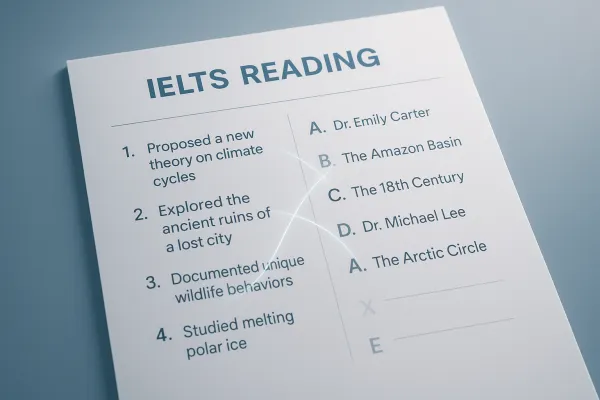
Matching Features is a question type that asks you to match a list of statements or specific pieces of information with a list of “features” (entities) that appear in the reading passage. These features can include:
- People: e.g., scientists, researchers, authors.
- Places: e.g., countries, cities, regions.
- Dates/Times: e.g., years, historical periods.
- Organizations or Projects: e.g., a company, a research project.
The goal of this task is to test your ability to:
- Locate specific information: You must identify the correct location of relevant details.
- Understand meaning: You must grasp the core message of each statement and paragraph.
- Recognize paraphrasing: The passage often uses synonyms or different phrasing compared to the questions.
Key points to remember about Matching Features:
- Non-sequential order: The statements (questions) do not follow the order of information in the passage. This means you cannot simply work through the text from start to finish as you might with other question types.
- Features can be reused: The instructions often state, “NB: You may use any letter more than once,” meaning one feature can be the answer to multiple statements.
- Extra statements: There are usually more statements than features, meaning some options will not be used.
2. Effective steps for solving Matching Features
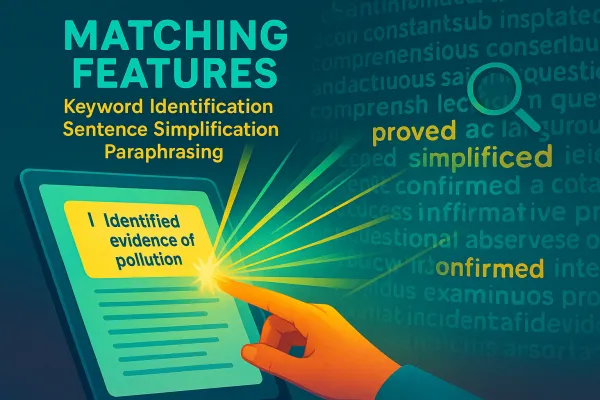
To excel at this task, follow these 5 steps:
Step 1: Read the statements carefully and underline keywords
Start with the list of statements provided in the question.
- Read each statement: Read thoroughly to fully understand the content.
- Underline key keywords:
- Easy-to-find keywords: These are words that rarely change, such as proper nouns (e.g., Dr. Alice Chen, Tokyo), figures (1950s, 75%), or technical terms (photosynthesis, quantum physics). These will help you locate information quickly.
- Keywords requiring comprehension: These are common verbs, nouns, or adjectives (proposed, discovered, impact, benefit, significant). These are likely to be paraphrased in the passage.
- Tip: Don’t underline too much. Focus only on the most important words that help you grasp the meaning and navigate the text.
Step 2: Locate the features in the passage
Now, turn to the reading passage to find the features you need to match.
- Skimming and Scanning:
- Skimming: Quickly read through the entire passage to get the gist of each paragraph. This gives you an overview of where specific features or related information might appear.
- Scanning: Use the easy-to-find keywords (names, numbers, etc.) to scan the text. When you find a feature (e.g., a scientist’s name), pause and focus on that section.
- Managing recurring features: Some features (e.g., a researcher) may be mentioned multiple times in different paragraphs. Note all these locations, as each mention may correspond to a different statement.
Step 3: Analyze information and identify paraphrasing
This is the most critical step for finding the correct answer.
- Read the relevant information closely: Once you have identified the paragraph containing the feature and potential information, read the sentences surrounding it carefully.
- Simplify the sentence: If a sentence is too long or complex, try removing unnecessary modifiers (subordinate clauses, long adverbial phrases) to grasp the core meaning.
Example:
Original sentence: “Dr. Anya Sharma, the lead researcher for the project, meticulously analyzed the comprehensive data, which unequivocally indicated a strong correlation between early childhood nutrition and cognitive development in later years.”
Simplified: “Dr. Sharma analyzed data, which showed a correlation between early nutrition and cognitive development.”
Core meaning: Dr. Sharma found a link between early nutrition and cognitive development.
- Recognize paraphrasing: The statements in the questions will not be identical to the text. Look for:
- Synonyms: advantages = benefits; challenges = obstacles; new approach = innovative method.
- Changes in sentence structure: e.g., active to passive voice, or reordering clauses.
- Explanations: The passage might use a phrase to explain the meaning of a word used in the question.
Example:
Statement: “The company prioritized environmental sustainability in its manufacturing process.”
Text: “The firm placed significant emphasis on reducing its carbon footprint and minimizing waste generation during production.”
Analysis: “environmental sustainability” is paraphrased as “reducing its carbon footprint and minimizing waste generation.”
- Distinguish between similar statements: This is a common trap. When multiple statements sound similar, read every word carefully. The difference often lies in a single adjective, adverb, or preposition.
Step 4: Cross-reference, eliminate, and select answers
- Once you find information in the text that matches a statement, link them (e.g., 1-A).
- Use the “features can be reused” rule flexibly: If the instructions allow, don’t hesitate to use the same feature (letter) for multiple statements if there is sufficient evidence in the text.
- Cross out used statements: (Unless they can be reused) This helps reduce the number of options for the remaining questions.
Step 5: Review
After matching the statements, take a moment to double-check:
- Review the matches: Ensure the linked pairs make logical sense, are grammatically sound (if applicable), and align perfectly with the text.
- Check remaining statements: If there are extra statements, ensure you have checked thoroughly and that no information in the text matches them.
3. Common pitfalls to avoid
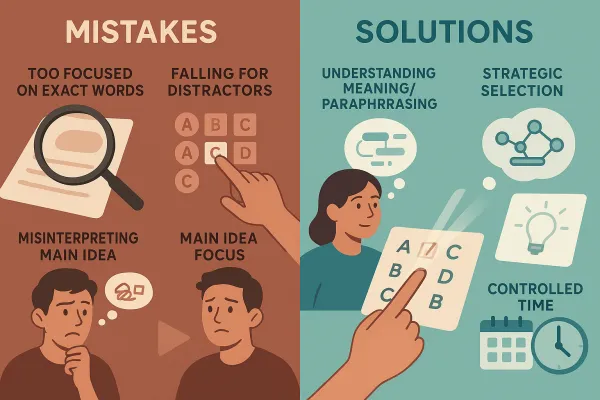
Matching Features can be deceptive if you aren’t careful:
- Looking only for identical keywords: This is the most common mistake. IELTS always uses paraphrasing. Focus on understanding the meaning rather than finding exact word matches.
- Confusing main ideas with details: A paragraph may contain many details, but a statement usually only matches one specific core idea related to that feature.
- Being misled by distractors: The test often includes extra statements or statements that contain keywords from the text but in a different context.
- Trying to work in question order: Since the statements are not in order, this is a waste of time. Be flexible in your search.
- Over-focusing on one feature: If a feature is mentioned multiple times, don’t read everything about it at once. Read each statement, find the information related to that statement, and then determine who said or did it.
- Reading the entire passage from start to finish: With limited time, this is inefficient. Use Skimming and Scanning to find specific information.
4. Advanced tips for optimizing your score
To master the Matching Features task, apply these tips:
- Practice paraphrasing: This is the foundation. Actively look for different ways to express an idea using various words and structures whenever you read English materials.
- Take quick notes: When you find a feature and its related information, jot it down quickly (e.g., “Dr. Lee: new theory on sleep patterns”). This helps organize your thoughts and prevents you from missing details.
- Manage your time effectively: This task can be time-consuming. Aim for 10–12 minutes for 4–6 questions. If you get stuck on one, skip it and come back later.
- Analyze your mistakes: Don’t just look at the correct/incorrect answers. Examine *why* you got it wrong—was it failure to recognize paraphrasing, misunderstanding the main idea, or falling for a distractor? Learn from it for next time.
- Read diverse topics: IELTS passages cover a wide range of scientific, social, and historical fields. Broad reading helps you become familiar with various vocabulary and contexts.
In summary, Matching Features is a comprehensive test of your detailed reading comprehension in IELTS Reading. ECE Language Center believes that with persistent practice using this 5-step strategy, combined with honing your paraphrasing, sentence simplification, and time management skills, you will not only overcome your anxiety but turn this task into an advantage to reach your target band score. Start your improvement journey today!





 Khai giảng Khóa học Hè cực HOT.
Chưa có bình luận nào!