


Tóm Tắt Nội Dung Bài Viết
The “Work / Employment” topic is one of the most familiar faces in the IELTS Writing Task 2 exam. Given its multifaceted nature and high level of practical relevance, this topic requires candidates to possess a rich system of ideas and the ability to construct rigorous, logical arguments.
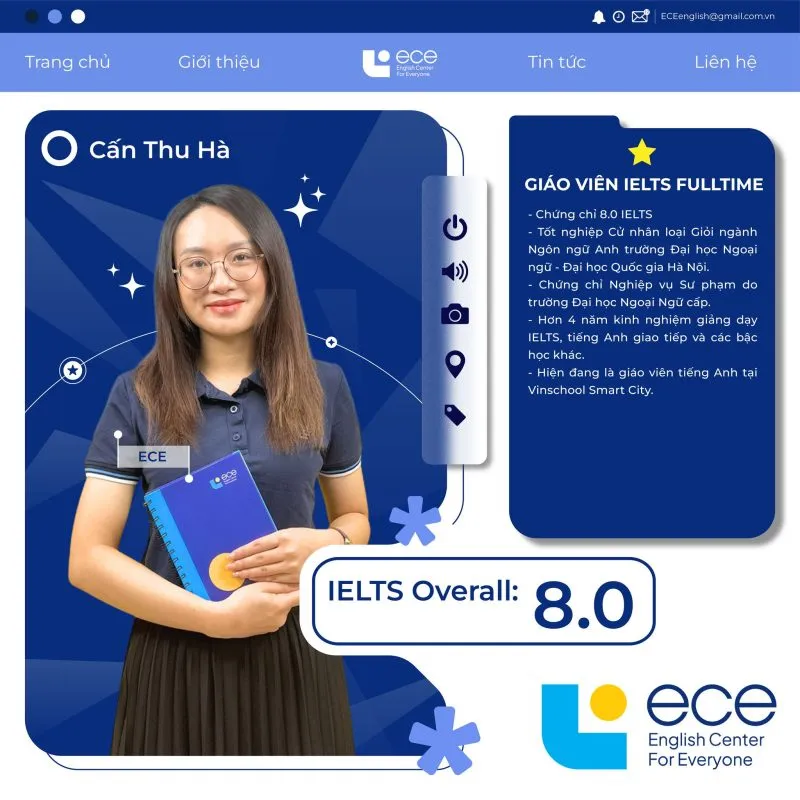
To help you confidently handle any work-related prompt, let’s explore this comprehensive guide compiled by Ms. Can Thu Ha (an 8.0 IELTS instructor at ECE), covering everything from general overviews and brainstorming ideas to a detailed band 8.0+ sample essay.
Why is the “Work” topic so common in IELTS?
According to Ms. Thu Ha, this topic appears frequently for the following reasons:
- Relatability: Aspects such as remote work, automation, work-life balance, and freelancing are all hot topics in modern society.
- Practicality: Candidates can easily develop arguments and provide examples based on personal experience, social observations, or global trends.
Brainstorming Ideas for Work/Employment in IELTS Writing Task 2
Below is a system of ideas and arguments compiled by Ms. Thu Ha to help you build depth in your writing.
➤ Remote work / Work from home
- Arguments:
- Pros: Time flexibility, savings on commuting costs, and potential for increased productivity if the home environment is conducive.
- Cons: Feelings of isolation, lack of social interaction, management difficulties, and the blurring of boundaries between work and personal life.
- Example: The remote work trend exploded after the COVID-19 pandemic and has been maintained by many companies as a long-term policy.
➤ Automation & AI
- Arguments:
- Many repetitive, manual tasks will be replaced by machines.
- However, jobs requiring creativity, emotional intelligence, and complex human skills remain irreplaceable.
- Example: Factory robots and AI software processing data replace data entry clerks. Meanwhile, fields like design, art, and senior management still require human input.
➤ Work–life balance
- Arguments:
- Modern employees increasingly prioritize time for family, hobbies, and rest.
- Excessive work pressure often leads to stress and burnout.
- Example: Long working hours in many Asian countries are sparking debate, leading to trials of a 4-day workweek.
➤ Freelance / Self-employment
- Arguments:
- Pros: Freedom, flexibility, and high income potential for those with specialized expertise.
- Risks: Unstable income and a lack of benefits like health insurance or pensions.
- Example: Popular freelance roles today include digital marketing and content creation.
➤ Work migration
- Arguments:
- Many people leave their hometowns for major cities or other countries to seek better job opportunities.
- Accompanying challenges: cultural and language barriers, legal issues (work permits), and high costs of living.
- Example: The wave of IT engineers moving from Vietnam or India to work in the US, Australia, or Europe.
➤ Job satisfaction
- Arguments:
- High salary is no longer the only factor. Work environment, relationships with colleagues, and the sense of purpose in one’s work are becoming increasingly important.
- Example: Tech giants like Google and Apple are famous for their welfare policies and creative work environments designed to retain talent.
Prompt Analysis and Sample Essay (Self-Employment)
Prompt:
“Nowadays many people choose to be self-employed rather than to work for a company or organisation. Why might this be the case? What could be the disadvantages of being self-employed?”
Sample Essay:
In recent years, there has been a noticeable trend: an increasing number of individuals prefer self-employment over traditional employment within an organization. This essay will explore the driving factors behind this shift and examine its potential drawbacks.
One major reason is the desire for autonomy and flexibility. Working for oneself allows people to set their own schedule, choose clients, and decide how intensely to work, which is especially appealing in fast-paced societies. Another driving factor is the advancement of technology and digital platforms, which have lowered barriers to entry for freelancers and small business owners. Thanks to remote tools, online marketplaces, and social media for marketing, many fields such as graphic design, content creation, and consulting have become accessible to solo entrepreneurs.
In addition, the rising importance of entrepreneurial culture and the value people place on meaningful work encourage them to take control of their careers. Young professionals, in particular, prefer projects where they feel their efforts directly tie to outcomes, rather than being one small cog in a large machine. Also, economic instability or dissatisfaction with hierarchical corporate systems drives some to break free and rely on their own abilities.
On the flip side, self-employment brings financial instability. Earnings can fluctuate drastically from month to month, and there is no guaranteed income or benefits such as health insurance or a pension. Many self-employed individuals must also manage administrative burdens – from tax filings to client acquisition and handling paperwork – tasks that a company would normally absorb. Finally, the lack of social interaction and support can be isolating; working solo often means fewer colleagues, less mentorship, and a heavier burden for decision-making.
In conclusion, while the appeal of self-employment lies in independence, flexibility, and creative control, it also carries significant risks such as unstable income, administrative overhead, and isolation. Whether someone should choose that path depends largely on their personality, risk tolerance, and ability to adapt in a competitive environment.
Here are the strategies Ms. Thu Ha used to turn these ideas into a coherent and persuasive essay.
1. Clear overall structure, strictly adhering to the prompt
This is basic but crucial. The prompt asks two clear questions:
- Why might this be the case?
- What could be the disadvantages?
Ms. Thu Ha’s approach addresses this structure precisely:
- Introduction: Introduces the trend and confirms the essay will clarify two issues: “driving factors” and “drawbacks.”
- Body Paragraphs 1 & 2: Focus on answering “Why?”. She dedicates two full paragraphs to analyzing these reasons in depth.
- Body Paragraph 3: Focuses on answering the “disadvantages” question.
- Conclusion: Summarizes both aspects mentioned.
➡️ Strategy: The essay structure mirrors the prompt. This ensures the writing never goes off-topic (Task Response), a key IELTS scoring criterion.
2. Highly logical grouping of ideas
This is the “winning” point of her approach. Instead of listing a long string of reasons, she groups them into major themes and dedicates a paragraph to each.
- Body Paragraph 1: Focuses on “Personal & Technological” factors
- Point 1: Personal desire – the desire for autonomy and flexibility. This is an internal motivation, a “pull factor.”
- Point 2: Technological support – the advancement of technology and digital platforms. This is an external factor that helps realize the aforementioned desire.
- Body Paragraph 2: Focuses on “Cultural & Economic” factors
- Point 1: Cultural shift – the rising importance of entrepreneurial culture. This is a social factor creating an environment that encourages self-employment.
- Point 2: Dissatisfaction with the old system – dissatisfaction with hierarchical corporate systems. This is a “push factor” that drives people to break away.
➡️ Strategy: This grouping demonstrates deep analytical thinking. It doesn’t just answer “Why?” but categorizes the “Whys” into different layers (personal, technological, social, economic), showcasing high-level critical thinking.
3. Developing each argument using the “General to Specific” formula
In every paragraph, Ms. Thu Ha follows a golden rule: Topic Sentence ➡️ Explanation/Clarification ➡️ Specific Example.
Consider the example in Body Paragraph 3:
- Topic Sentence (Stating the disadvantage): “…self-employment brings financial instability.”
- Explanation/Clarification: “…Earnings can fluctuate drastically from month to month, and there’s no guaranteed income or benefits…”
- Specific Example: “…such as health insurance or pension.”
➡️ Strategy: This approach makes every argument extremely clear and easy to follow. Examiners can easily track the writer’s train of thought, which boosts the Coherence and Cohesion score.
4. Expressing a balanced and insightful perspective in the conclusion
The conclusion does more than just repeat ideas; Ms. Thu Ha provides a profound summary.
- Summarizing both sides: “…while the appeal of self-employment lies in [pros], it also carries significant risks such as [cons].”
- Final thought: She does not label self-employment as strictly “good” or “bad.” Instead, she concludes that the choice depends on individual factors: “…depends largely on their personality, risk tolerance, and ability to adapt…”
➡️ Strategy: This conclusion demonstrates a multi-dimensional view. It shows the writer has thought thoroughly about the issue and acknowledges its complexity, a hallmark of high-band essays.
Key Vocabulary & Collocations
The essay uses natural, academic phrasing to help boost your band score.
- A noticeable trend: a trend worth noting
- Prefer X over Y: like X more than Y
- The driving factors behind this shift: the reasons pushing this change
- Desire for autonomy and flexibility: the wish for independence and adaptability
- Set their own schedule: manage one’s own time
- Lowered barriers to entry: made it easier to start
- Solo entrepreneurs: individuals running their own businesses
- Entrepreneurial culture: a culture of starting businesses
- Place value on meaningful work: prioritize work that feels significant
- Take control of their careers: manage one’s own professional path
- One small cog in a large machine: an idiom for a small, replaceable part of a large organization
- Hierarchical corporate systems: traditional top-down company structures
- Potential drawbacks: possible disadvantages
- Financial instability: lack of steady income
- Earnings can fluctuate drastically: income can change significantly
- Guaranteed income: steady, assured pay
- Administrative burdens / administrative overhead: paperwork, taxes, and management tasks
- Client acquisition: the process of finding customers
- Lack of social interaction: missing out on office socialization
- Can be isolating: can make one feel lonely
- A heavier burden for decision-making: more pressure when making choices
- Carry significant risks: involve major dangers
- Risk tolerance: the ability to handle uncertainty
We hope that with this comprehensive guide from Ms. Can Thu Ha, you have gained a solid overview and a robust system of ideas to conquer the Work/Employment topic in your upcoming IELTS exam. Good luck with your studies!
Check out more IELTS Writing Task 2 topics compiled by ECE:
Topic Gender Roles IELTS Writing Task 2
IELTS Writing Task 2 topic Newspapers





 Khai giảng Khóa học Hè cực HOT.
No comments yet!