
Tóm Tắt Nội Dung Bài Viết
Do you struggle with the Matching Information task in IELTS Reading? This question type requires you to locate specific information and match it to the correct paragraph.
This article from ECE English provides an overview, a detailed strategy, common pitfalls to avoid, and useful tips to help you tackle this challenge with confidence.
1. Overview of the Matching Information Task in IELTS Reading
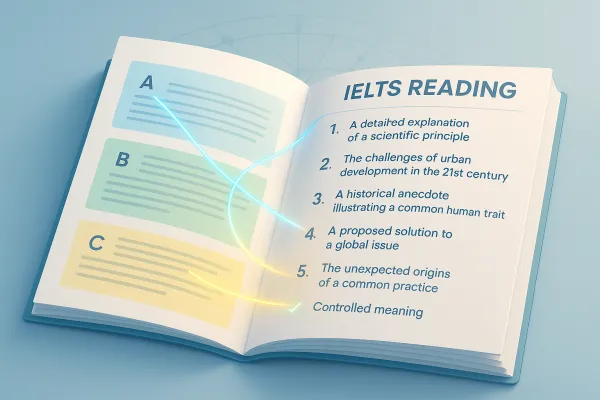
In a Matching Information task, you are given a list of statements or specific details. Your task is to identify which paragraph (A, B, C, etc.) contains the information for each statement.
The primary goal of this task is to test your ability to:
- Locate information accurately: You need to pinpoint the location of information quickly.
- Understand deep meaning: You must grasp the core message of the statements and compare it with the content of the passage.
- Recognize paraphrasing: Do not expect to find the exact same words; the passage will use synonyms or different sentence structures.
Key characteristics you should know:
- Non-sequential: The statements in the question are not arranged in the order they appear in the passage. You must be flexible and avoid following a linear search.
- Paragraph reuse: The instructions often state, “NB: You may use any letter more than once.” This means a single paragraph can be the answer to multiple statements.
- Extra statements: There are usually more statements than there are paragraphs, meaning some options will not be used.
2. A 5-Step Strategy for Effective Matching Information
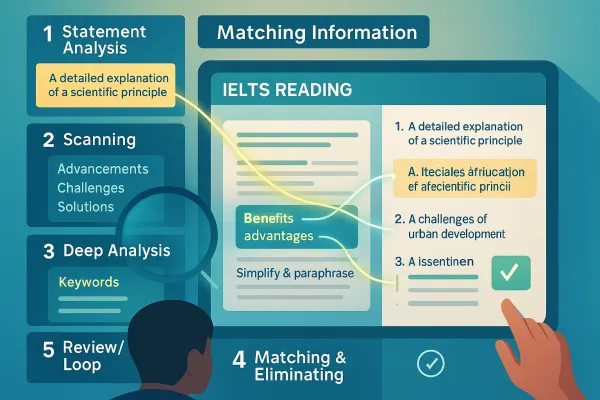
To optimize your time and increase accuracy, you can apply these 5 steps:
Pro-tip before you start: Many IELTS experts recommend tackling the Matching Information task last within a reading passage. By the time you have completed other question types (such as Multiple Choice or True/False/Not Given), you will have a better overview of the passage content, making it much faster to locate information for this task.
Step 1: Read the statements carefully & underline keywords
Start by fully understanding each statement.
- Read each statement one by one: Ensure you grasp the core content of every statement.
- Underline key keywords:
- Static keywords: These are “signposts” that are easy to find in the text, such as proper nouns (names, places), figures (years, percentages), or technical terms.
- Dynamic keywords: These are more common verbs, nouns, or adjectives. They are often paraphrased in the passage.
- Advice: If a statement contains static keywords, prioritize it, as it will help you locate the information faster.
- Anticipate paraphrasing: When underlining keywords, think about other words or phrases the passage might use to express the same idea.
Example: If a statement contains the word “consequences,” think of “effects,” “results,” or “outcomes.”
Step 2: Skim the passage & map out the paragraphs
Now, move to the passage to find relevant information.
- General skimming: Quickly glance at the title and the first sentence of each paragraph (A, B, C…) to grasp the main idea of each. This helps you know which paragraph covers which topic.
- Detailed scanning: Use the static keywords you underlined to scan each paragraph quickly. When you find a keyword, stop and read the surrounding sentences carefully.
- Paragraph-by-paragraph strategy: Since statements are not in order, an effective approach is to read one paragraph thoroughly (e.g., read paragraph A, then B, C…). After finishing a paragraph, check the list of statements to see if that paragraph contains the answer to any of them.
Step 3: Analyze deeply & decode the language
Once you have narrowed down a potential paragraph, this step requires detailed reading to confirm the match.
- Simplify the sentences: Sentences in the passage are often long and complex. Focus on the core meaning (key nouns, verbs, adjectives) and ignore redundant modifiers. This helps you grasp the main point faster.
Example:
Original: “The significant decline in insect populations, a phenomenon widely observed across various ecosystems, has been primarily attributed to intensive agricultural practices and widespread pesticide use.”
Simplified: “Insect populations declined due to agriculture and pesticides.”
Core meaning: Insect numbers dropped because of farming and pesticides.
- Recognize Paraphrasing (The key): Statements in the questions will often use different language than the passage. Look for:
- Synonyms: advantages = benefits; problems = issues; discovered = found.
- Structural changes: E.g., active voice vs. passive voice.
- Explanations: The passage might use a phrase to explain the meaning of a word in the question.
Example: “Urban sprawl” might be explained as “the uncontrolled expansion of cities into surrounding rural areas.”
-
- Generalization/Specification: The statement is general, while the passage provides a specific example, or vice versa.
- Distinguish similar statements: This is one of the hardest traps. When multiple statements sound similar, read every word and detail carefully. The difference often lies in a single adjective, adverb, preposition, or the context.
Step 4: Match & select your answer
- When you find information in a paragraph that matches a statement, write the letter of that paragraph in your answer box.
- Use the “paragraph reuse” rule flexibly: If the instructions allow, do not hesitate to use the same paragraph for multiple statements if there is clear evidence.
- Eliminate used statements: (If reuse is not allowed) Once you have selected an answer, cross that statement off your list to reduce the number of choices for the remaining questions.
Step 5: Review
After matching all statements, take a moment to double-check:
- Check for meaning: Re-read the chosen pair. Does it make logical sense and match the information in the passage perfectly?
- Check remaining statements: Ensure that the unselected statements do not match any of the paragraphs (if you have checked thoroughly).
3. Detailed Example
Here is an example for you to practice and better understand how to solve the Matching Information task:
Passage: The Impact of Ancient Trade Routes
A Long before the advent of modern transportation, a complex network of trade routes facilitated the exchange of goods, ideas, and cultures across vast distances. These ancient pathways, often developed over centuries, connected disparate regions and laid the groundwork for early global interactions. One notable route, stretching from the Mediterranean to East Asia, was instrumental in introducing new agricultural techniques to various communities, leading to increased food security in areas previously susceptible to famine.
B The logistical challenges of transporting goods across deserts and mountain ranges were immense. Caravans often faced harsh weather, banditry, and difficult terrain, making journeys perilous and slow. Merchants had to be adept navigators and skilled negotiators, not only dealing with physical obstacles but also managing diverse customs and languages. Despite these hurdles, the desire for exotic commodities like spices and silk fueled relentless exploration and expansion of these networks.
C Beyond mere commercial transactions, these ancient routes fostered significant cultural and technological diffusion. Innovations in metallurgy, irrigation systems, and even early forms of paper-making gradually spread along these pathways, transforming societies far from their points of origin. Moreover, the exchange of religious beliefs and philosophical ideas created a more interconnected world, influencing art, architecture, and governance in distant lands.
D Archaeological evidence from numerous sites along these historical routes reveals much about the nature of ancient trade. Excavations have unearthed a diverse array of artifacts, including pottery from distant lands, unique coinage, and rare gemstones, all indicating active commerce. Recent carbon dating of grain samples found in ancient merchant outposts suggests that certain staple crops were introduced to new continents much earlier than previously thought, highlighting the profound and often underestimated impact of these early exchanges.
Questions 1-4 Reading Passage has four paragraphs, A-D. Which paragraph contains the following information? Write the correct letter, A-D, in boxes 1-4 on your answer sheet. NB You may use any letter more than once.
- a reference to the difficulties faced during long-distance travel.
- examples of how cultural practices were shared.
- evidence from recent studies that challenged previous assumptions.
- the agricultural benefits brought by ancient exchange networks.
Analysis & Answers:
Step 1: Analyze Statements & Identify Key Signposts
- 1. a reference to the difficulties faced during long-distance travel.
- Keywords: difficulties, long-distance travel.
- Prediction: Find the paragraph discussing the hardships of traveling long distances.
- 2. examples of how cultural practices were shared.
- Keywords: examples, cultural practices, shared.
- Prediction: Find the paragraph providing examples of cultural diffusion.
- 3. evidence from recent studies that challenged previous assumptions.
- Keywords: evidence, recent studies, challenged, previous assumptions.
- Prediction: Find the paragraph mentioning new evidence that disproved old beliefs.
- 4. the agricultural benefits brought by ancient exchange networks.
- Keywords: agricultural benefits, ancient exchange networks.
- Prediction: Find the paragraph discussing agricultural advantages from ancient trade.
Steps 2 & 3: Scan, Analyze & Decode (Paragraph by Paragraph)
- Paragraph A:
- Keywords: “complex network of trade routes”, “agricultural techniques”, “increased food security”, “famine”.
- Analysis: This paragraph discusses ancient trade routes and their agricultural benefits (new techniques, increased food security, reduced famine).
- Match: Matches Statement 4 (“the agricultural benefits brought by ancient exchange networks.”).
- Answer: 4 – A
- Paragraph B:
- Keywords: “logistical challenges”, “harsh weather”, “banditry”, “difficult terrain”, “perilous and slow”.
- Analysis: This paragraph describes the difficulties and dangers of transporting goods on ancient trade routes.
- Match: Matches Statement 1 (“a reference to the difficulties faced during long-distance travel.”).
- Answer: 1 – B
- Paragraph C:
- Keywords: “cultural and technological diffusion”, “Innovations in metallurgy, irrigation systems, … paper-making”, “exchange of religious beliefs and philosophical ideas”, “influenced art, architecture, and governance”.
- Analysis: This paragraph focuses on how trade routes helped spread culture and technology, including ideas, beliefs, and influences on art and architecture.
- Match: Matches Statement 2 (“examples of how cultural practices were shared.”).
- Answer: 2 – C
- Paragraph D:
- Keywords: “Archaeological evidence”, “Recent carbon dating of grain samples”, “challenged previous assumption”, “earlier than previously thought”.
- Analysis: This paragraph discusses archaeological evidence, specifically recent carbon dating showing crops were introduced earlier than previously thought, challenging old assumptions.
- Match: Matches Statement 3 (“evidence from recent studies that challenged previous assumptions.”).
- Answer: 3 – D
Results:
- B
- C
- D
- A
4. Common Pitfalls
Matching Information can trick candidates if they aren’t careful:
- “Keyword matching” instead of “meaning matching”: This is the most common mistake. IELTS always uses paraphrasing. You will likely choose the wrong answer if you only look for identical words. Focus on the overall meaning.
- Distractors: The test often includes extra statements or statements with keywords present in the text but in a different context.
- Getting lost due to non-sequential order: Because statements are not in order, trying to search linearly from the first to the last question will waste time and cause you to miss information.
- Reading too fast and missing details: This task requires finding specific information; skimming too quickly can cause you to miss crucial details, leading to the wrong paragraph.
5. Advanced Tips & Score Optimization
To master the Matching Information task, apply these tips:
- Practice intensive paraphrasing: This is the foundation. Actively look for ways to rephrase ideas using different words and structures when reading any English material. Create your own tables of synonyms, antonyms, or notes on different ways to explain concepts.
- Use “quick notes”: When reading and spotting potential information, quickly jot down the paragraph (e.g., “Para A: reasons for interest”) next to the question. Or, note the main idea of each paragraph to make matching easier.
- Manage time effectively: This task can be time-consuming. Aim for 1 – 1.5 minutes per statement. If you struggle with a question for more than 2 minutes, skip it and come back later. Don’t let one difficult question ruin your pace.
- Analyze mistakes in detail: Don’t just look at the correct/incorrect answers. Analyze why you got it wrong—was it failing to recognize paraphrasing, misunderstanding the meaning, or falling for distractors? Learn from it so you don’t repeat the same mistake.
- Read diverse topics: IELTS reading passages cover various fields like science, society, and history. Reading widely helps you get familiar with different vocabulary and contexts, increasing your comprehension.
In summary, Matching Information is a comprehensive test of your detailed reading comprehension in IELTS Reading. ECE English believes that with persistent practice using this 5-step strategy, combined with honing your paraphrasing skills, sentence simplification, and effective time management, you will not only overcome your fear but turn this task into an advantage to reach your target band score. Start your improvement journey today!





 Khai giảng Khóa học Hè cực HOT.
Chưa có bình luận nào!