
Tóm Tắt Nội Dung Bài Viết
When learning English, you’re likely familiar with the rule that adjectives come before nouns. But what happens when you want to use more than one adjective to describe the same thing? Can you just place them in any order, or must you follow a specific order of adjectives?
This is where you need “The Royal Order of Adjectives,” also known as the OSASCOMP rule—a unique guideline that helps you arrange adjectives in the most natural and accurate way in English. Mastering the order of adjectives not only ensures your sentences are grammatically correct but also makes them sound “right” to a native speaker’s ear.
1. Basic Position of Adjectives in English
Before diving into the order of adjectives when using multiple words, let’s review the two basic positions of adjectives in a sentence:
1.1. Predicate Adjectives
In this case, the adjective acts as a predicate or a complement to the subject, typically appearing after the verb “to be” or other linking verbs.
Example:
- She is beautiful.
- The food smells delicious.
- He seemed tired after a long day.
- Common linking verbs: seem, look, feel, smell, taste, remain, become, sound, stay, appear, prove, get, turn.
1.2. Attributive Adjectives
This is the most common position for adjectives, where they stand directly before the noun they modify. While many languages place adjectives after the noun, English places them before the noun (e.g., a red shirt).
Example:
- It’s a lovely dress.
- She bought a new car.
And when you have more than one adjective modifying a single noun, you will need to follow the specific order of adjectives.
2. The Order of Adjectives in English: The OSASCOMP Rule
When multiple adjectives appear together to describe a noun, they must follow a fixed sequence. This sequence is summarized by the OSASCOMP rule, an incredibly useful mnemonic for the order of adjectives in English.
2.1. What is the OSASCOMP rule?

OSASCOMP is an acronym for 8 categories of adjectives, arranged from the most general/subjective to the most specific/objective, placed before the noun they modify:
Opinion → Size → Age → Shape → Color → Origin → Material → Purpose.
2.2. Detailed explanation and examples for each category
Understanding the nature of each adjective category will help you apply the order of adjectives naturally and accurately, rather than just memorizing it by rote. This order moves from subjective judgments (which vary from person to person) to objective physical characteristics (which are fixed).
1. Opinion
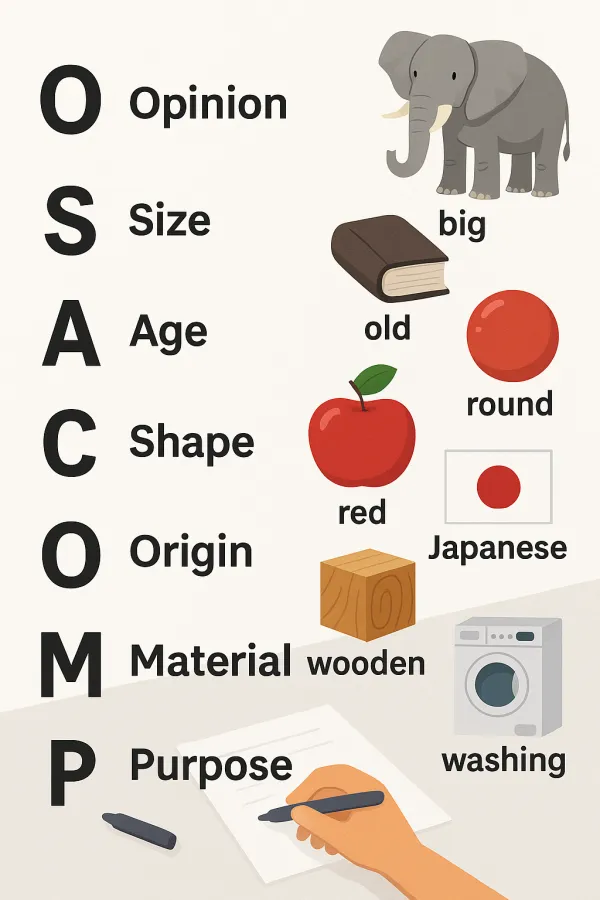
Explanation & Characteristics: These adjectives express personal feelings, evaluations, or opinions about something. Because they are subjective, they always come first in the sequence.
Examples: beautiful, ugly, lovely, wonderful, terrible, excellent, valuable, smart, kind, interesting, annoying…
2. Size
Explanation & Characteristics: Describes how big, small, long, short, tall, or short something is. This is a more objective characteristic than opinion.
Examples: big, small, huge, tiny, long, short, tall, little, enormous, miniature…
3. Age
Explanation & Characteristics: Describes the age or how new/old something is. This is an objective, verifiable characteristic.
Examples: old, new, young, ancient, modern, brand-new, antique, adolescent, youthful…
4. Shape
Explanation & Characteristics: Describes the specific physical form of the object.
Examples: round, square, circular, oval, triangular, rectangular, fat, thin, curvy, spherical…
5. Color
Explanation & Characteristics: Describes the color of the object. This is a very easily identifiable physical characteristic.
Examples: red, blue, green, black, white, yellow, purple, crimson, turquoise, golden…
6. Origin
Explanation & Characteristics: Describes nationality, location, or where the object comes from. These adjectives are usually capitalized.
Examples: Vietnamese, American, Japanese, Italian, French, Chinese, Asian, European, indigenous…
7. Material
Explanation & Characteristics: Describes what the object is made of. This is a fixed, objective characteristic.
Examples: wooden, plastic, metal, leather, cotton, silk, stone, glass, paper, gold, silver…
8. Purpose
Explanation & Characteristics: Describes the function or intended use of the noun. This is often a gerund (V-ing) or a noun acting as an adjective. It always stands closest to the main noun because it is intrinsically linked to the object’s function.
Examples: washing (machine), sleeping (bag), hunting (dog), school (bus), tea (cup), gardening (gloves), cooking (utensils)…
Comprehensive examples and analysis:
-
A beautiful (Opinion) big (Size) old (Age) round (Shape) brown (Color) Japanese (Origin) wooden (Material) tea (Purpose) table.
- Analysis: Starts with personal opinion (“beautiful”), followed by size (“big”), age (“old”), shape (“round”), color (“brown”), origin (“Japanese”), material (“wooden”), and finally the specific purpose of the table (“tea”).
-
My lovely (Opinion) small (Size) new (Age) white (Color) British (Origin) leather (Material) travelling (Purpose) bag.
- Analysis: “Lovely” is an opinion, “small” is size, “new” is age, “white” is color, “British” is origin, “leather” is material, and “travelling” is the purpose.
-
Those tiny (Size) red (Color) running (Purpose) shoes.
- Analysis: Even with only three adjectives, they still follow the correct order: Size, Color, and Purpose.
2.3. Mnemonic for OSASCOMP
To remember this order of adjectives easily and quickly, you can use the acronym OSASCOMP.
Opinion → Size → Age → Shape → Color → Origin → Material → Purpose
Tips for effective memorization:
- Practice and repetition: Repeat the acronym whenever you need to recall the order. Try writing your own examples with multiple adjectives and check them against the OSASCOMP rule to reinforce your knowledge. Regular practice will turn this rule into a natural reflex.
- Understand the logic: Combined with the detailed explanations in section 2.2, you won’t just memorize the acronym—you’ll understand *why* adjectives are arranged in that order, making it much more logical and less prone to errors.
The OSASCOMP rule has helped millions of English learners worldwide confidently use adjectives and create sentences that sound as natural as a native speaker’s.
3. Position of Determiners & Quantifiers
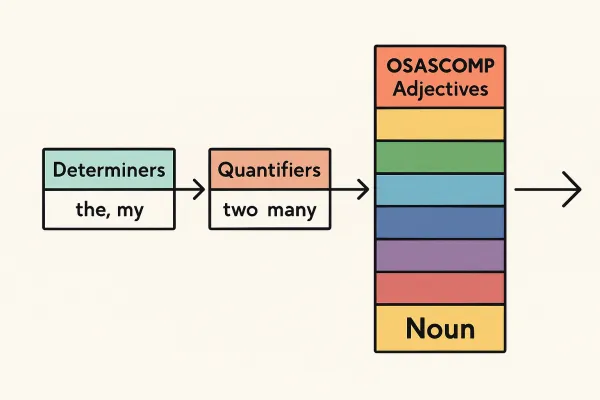
Before the sequence of adjectives following the OSASCOMP rule, there are usually determiners or quantifiers.
General Formula:
[Determiners] + [Quantifiers] + [O S A S C O M P] + Noun
- Determiners: Limit or define the noun. These include articles (a, an, the), possessive adjectives (my, your, his, her, its, our, their), and demonstratives (this, that, these, those).
- Important note: You cannot use two referring determiners consecutively (e.g., ~~the this car~~).
- Quantifiers: Words indicating quantity. Examples: one, two, three, many, few, several, a lot of, some, any.
Example:
- This (Determiner) beautiful (O) old (A) wooden (M) house.
- These (Determiner) two (Quantifier) naughty (O) young (A) kids.
4. Comma Rules for Multiple Adjectives
When writing, using commas between adjectives is an important grammatical point that helps clarify your sentences.
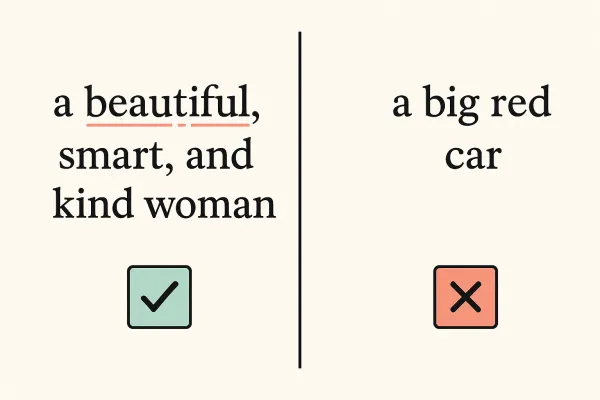
4.1. When to use commas (Coordinate Adjectives)
When adjectives are of the same category (e.g., multiple opinions or colors) and modify the same noun, we use commas to separate them. Usually, the last adjective in a coordinate sequence is preceded by “and”.
Example:
- He is a handsome, confident, thoughtful, and gentle man. (All are Opinion adjectives)
- She wore a long, flowing, and elegant dress.
4.2. When not to use commas (Cumulative Adjectives)
When adjectives belong to different categories in the OSASCOMP rule, we do not use commas to separate them. They naturally follow the established order.
Example:
- I’ve just got this new brown Italian leather bag. (new – Age, brown – Color, Italian – Origin, leather – Material)
- We need a big red plastic box. (big – Size, red – Color, plastic – Material)
4.3. Important notes on commas
- Do not put a comma between the last adjective and the noun:
Correct: a long black hair
Incorrect: a long black*,** hair*
- Do not put a comma between a determiner/quantifier and the first adjective:
Correct: This old house
Incorrect: This*,** old house*
- Use “and” when listing coordinate adjectives: When a phrase ends with a sequence of adjectives of the same type, the last two are usually joined by “and”.
Example: The concert was crowded and loud.
Example: She was such a pretty, delicate, and thoughtful woman.
5. Special Cases & Extensions
While OSASCOMP is the foundation, there are a few points to keep in mind for more natural usage:
5.1. Actual number of adjectives
In daily conversation or natural writing, it is very rare to use all 8 categories at once. Typically, a noun phrase with 2-3 adjectives is most common. Overloading a sentence with too many adjectives can make it sound clunky and confusing.
5.2. Compound Adjectives
Compound adjectives (e.g., well-known, brand-new, half-price) are usually hyphenated and function as a single adjective. Their position depends on the meaning they convey.
Example:
- A well-known (Opinion) young (Age) artist.
- A brand-new (Age) red (Color) car.
5.3. Flexibility of Material and Purpose
In some cases, Material and Purpose adjectives can form a compound noun phrase or swap positions slightly depending on context, but generally, Purpose tends to stay closer to the main noun.
Example:
- A leather school bag
- A plastic water bottle – “water” here acts as a purpose adjective.
5.4. When the adjective is part of the noun
Some adjectives have become inseparable parts of the noun, forming compound nouns or fixed phrases that do not strictly follow the OSASCOMP rule.
Example:
blackboardis not justblack board(a board that happens to be black).hot dogis not a “hot” dog.
6. Practice Exercises (with Answer Key)
To reinforce your knowledge of the order of adjectives in English, try the following exercises:
Exercise 1: Arrange the adjectives in parentheses in the correct order:
- Andrea had a ________ in her hair yesterday. (yellow / nice / bow)
- She lost a ________. (white / small / cat)
- I bought ________ oranges. (great / some / big)
- We met ________ people at the conference. (smart / two / very)
- The clown was wearing a ________ hat. (green and yellow / big)
- My grandfather has collected a ________ clock. (old / German / wonderful)
- Yesterday, the post officer gave me a ________ box. (square / big / blue)
- These ________ ornaments should not be used to decorate the Christmas tree. (yellow / disgusting / plastic)
Answers:
- nice yellow bow
- small white cat
- some great big
- two very smart
- big green and yellow
- wonderful old German
- big square blue
- disgusting yellow plastic
7. Practical Tips for Mastering Adjective Order
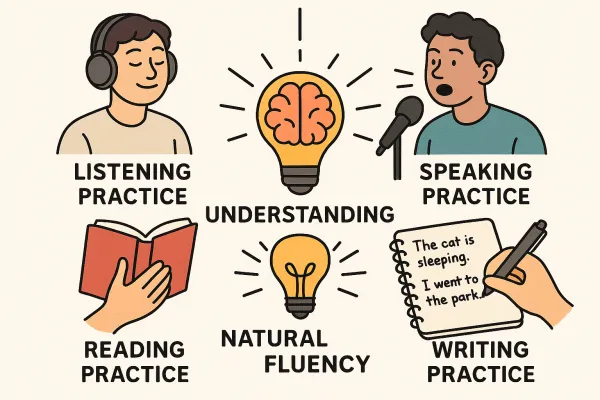
Memorizing the OSASCOMP rule is a great start. However, to use adjective order naturally and fluently like a native speaker, you should:
- Immerse yourself in English: Read books, newspapers, listen to podcasts, and watch movies. Constant exposure to standard English will help you develop a “feel” for the correct order without needing to consciously think about the rule.
- Practice listening and speaking: When listening, pay attention to how native speakers arrange their adjectives. When speaking, try to apply the rule consciously.
- Practice writing: Write sentences with multiple adjectives and have them reviewed by someone experienced.
- Don’t be afraid to make mistakes: You might still get it wrong in the beginning. The key is consistent practice and learning from those mistakes.
Conclusion
Mastering the order of adjectives in English is a crucial step toward improving the accuracy and natural flow of your writing. The OSASCOMP rule (Opinion, Size, Age, Shape, Color, Origin, Material, Purpose) is the key to arranging adjectives logically, from subjective to objective.
Keep practicing, and these rules will eventually become second nature. With that, you’ll feel much more confident when communicating and writing in English!





 Khai giảng Khóa học Hè cực HOT.
Chưa có bình luận nào!